Table of Contents (click to expand)
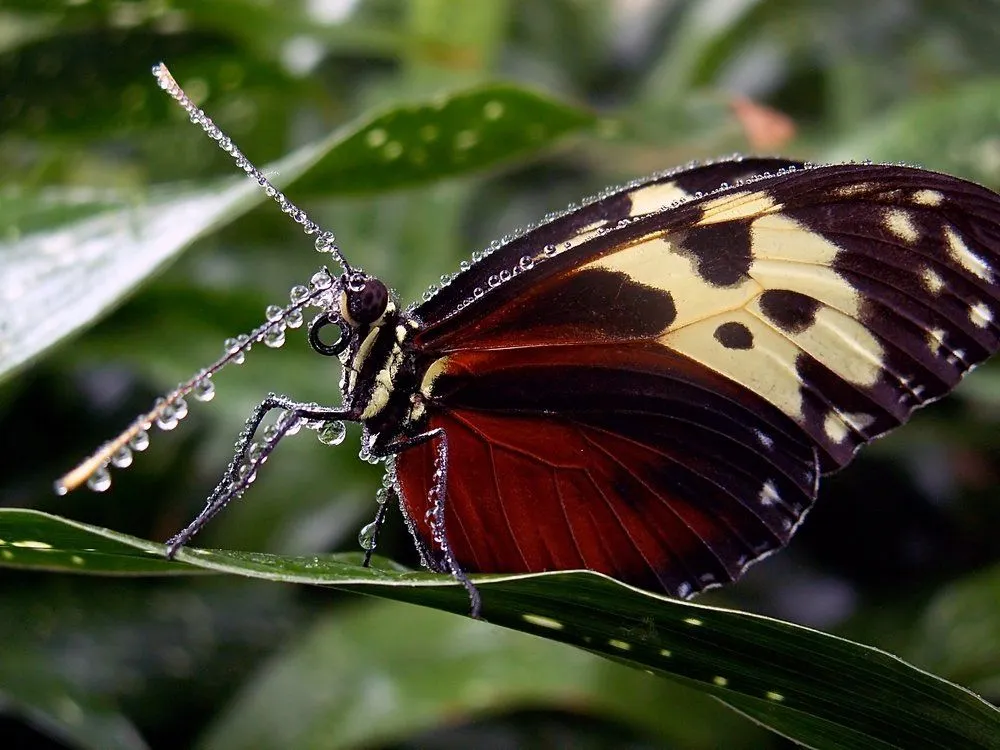
Butterflies taste their food through their legs, which have chemoreceptors attached to neurons that can detect the molecules that are edible and those that are not.
When you eat your food, depending on how it tastes, you can quickly decide whether you like it or not. You can thank the taste buds on your tongue for that important aspect of enjoying life (and discerning displeasure)!
Butterflies, however, don’t have taste buds like us mammals. Their mouthparts mainly serve as a straw through which they suck up their food, with no chewing necessary. Without so-called “taste buds”, how do butterflies know what is nectar and what isn’t?
Butterflies do taste their food, but not through their mouthparts. Instead, they do it through their feet! Having an animal’s feet serve as taste organs sounds preposterous, which is probably why researchers never even considered the possibility.
Most early research in the field looked at the antenna or the palpi, part of the butterfly mouthparts, as the primary taste organs. The thinking was that if humans and most other mammals had a tongue for taste, a similar organ must serve the same function in insects.
Nature rarely works in such a straight and predictable manner. While 19th-century naturalists first observed that butterflies appeared to "taste" plants with their feet, it was American researcher Dwight Minnich who, in 1922, provided the first experimental proof. He showed that butterflies extended their proboscis when their legs were touched with sugar solution, confirming that the tarsi possess contact chemoreceptors.
Taste Buds On Their Legs
Insects are a varied bunch of organisms, making it difficult to generalize a feature across them all. Butterflies have mouthparts designed like straws, so they don’t really have a tongue. Such insects whose mouthparts are only designed to suck liquids are called haustellate insects.
Lepidoptera, the order to which butterflies and moths belong, and Diptera, the order to which flies belong, are both “leg tasters”. The taste buds are called contact chemoreceptors, taste receptors, or basiconic sensilla in some literature.
These chemoreceptors are attached to nerve endings. When chemicals present in the insect’s surrounding come in contact with the chemoreceptors, they activate the nerves, which relay the information to the insect’s brain.
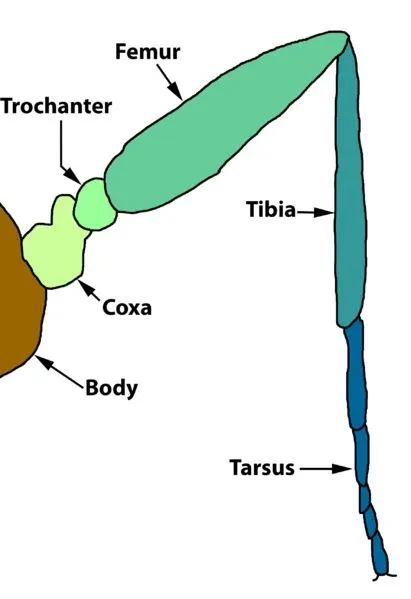
In butterflies, these chemoreceptors lie on the tarsus. Insect legs are subdivided into different segments, as the picture below shows. The tarsus is located distally, meaning “away from the body”.
Just as humans can taste the sweet in sugar and the bitterness of medicine, insects can sense different tastes too! They can sense sweet, bitter, sour and salty through their chemoreceptors.
This strategy is crucial for butterfly survival. In a review published in Insect Molecular Biology, the authors noted that multiple behavioral studies have shown that butterflies use taste to make many important choices. This informs not only what in their surroundings is food, but also guides them in choosing a mate, and deciding where to lay their eggs. Female butterflies perform a behavior called "tarsal drumming," rapidly tapping their forelegs against a leaf surface to maximize contact between their chemoreceptors and the plant's chemical profile before depositing eggs.
How Do Butterflies Choose The Right Plant For Their Eggs?
A butterfly’s sense of taste does more than locate a meal. For a female, it is also how she decides where her future caterpillars will live. Caterpillars are fussy eaters that can digest only a narrow range of host plants, and the egg-laying mother has to get that choice right, because her newly hatched young cannot travel far in search of a better leaf.

This is where the taste organs on her feet really earn their keep. When a female lands on a leaf, she drums it with her forelegs, scratching the surface to release its chemical signature. Her tarsal chemoreceptors then read that chemical profile to confirm she has found the correct plant.
Cabbage white butterflies (Pieris rapae) are a well-studied example. Their caterpillars feed on cabbages, mustard and other members of the Brassicales, plants defended by pungent chemicals called glucosinolates. Rather than being repelled, the cabbage white treats glucosinolates as a welcome sign. Researchers writing in PLOS Genetics described how a gustatory receptor called PrapGR28, found in the tarsal sensilla of adult Pieris rapae, detects the glucosinolate sinigrin and helps the butterfly recognize a suitable host. Some of her foot sensilla respond to a broad range of these compounds while others are narrowly tuned, letting her tell a good egg-laying site from a risky one before she commits a single egg.
Which Other Animals Taste With Their Feet?
Butterflies may be the most charming leg-tasters, but they are far from the only animals that sample the world through their feet. Contact chemoreception, the sense of taste triggered by touching a surface rather than smelling it from afar, is widespread among insects that need to judge a surface before feeding or breeding.

The common housefly is a familiar example. Like butterflies, flies are liquid feeders, and they carry taste receptors on their tarsi. A housefly walking across your kitchen counter is quite literally tasting it, and if its feet detect sugar, it will lower its mouthparts and feed on the spot.
Honeybees do something similar. In a study published in Frontiers in Behavioral Neuroscience, researchers showed that bees taste with their legs: the claws at the tips of their tarsi carry receptor cells that respond to sugar, so a foraging bee can size up a flower the moment it lands. Moths, the night-flying cousins of butterflies, share the same leg-tasting toolkit.
In each case the logic is the same one that serves the butterfly so well. An animal that can taste with its feet gets an instant verdict on whatever it is standing on, without having to risk a mouthful first.
How Do They Eat?
Now that we know how butterflies taste their food, the natural question is… how do they eat it? As mentioned before, butterflies have haustellate mouthparts. They can’t actually chew or bite their food, so they just drink liquids in the form of nectar, sap, juices from fruits, and certain minerals.
Haustellate mouthparts are an adaptation from the mouthparts used for chewing, called Mandibulate mouthparts. All “primitive” insects had mandibulate mouthparts, because they had large mandibles to crush their food. As insects evolved, they developed different mouthparts to adapt to their environment and dietary needs.
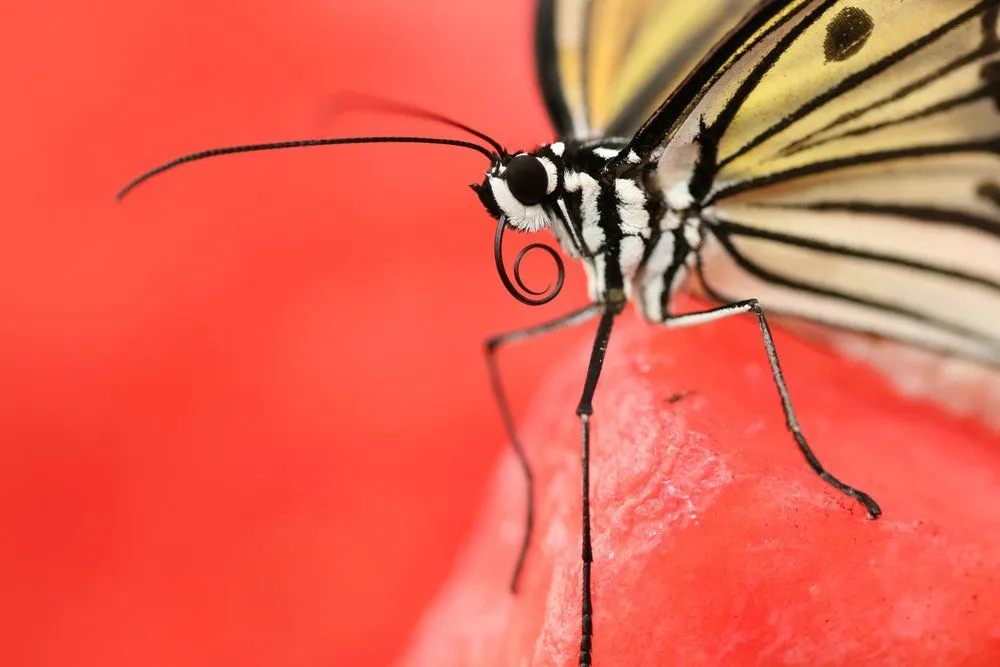
Butterflies have a long straw-like structure called a proboscis that performs these important tasks. Initially, when butterflies come out of their pupal case or chrysalis, the proboscis is separated into two parts.
The first thing the newly emerged adult must do is assemble these two halves, called galeae, into one long, tubular structure. The butterfly does this by curling and uncurling the halves repeatedly while secreting saliva. Capillary forces from the saliva pull and hold the galeae together, while tiny interlocking hooks called legulae zip them into place. If the butterfly doesn’t achieve this within about an hour of emerging, it can’t drink and won’t survive for very long.
New butterflies often curl and uncurl their proboscis to test it. When the proboscis is not being used, it remains curled up, like a garden hose.
Butterflies primarily feed on flower nectar. They perch on the flower, unfurl their proboscis and suck up the sugary liquid, but that’s not the only thing they consume.
Butterflies show a peculiar affinity for mud. This behavior, called puddling or mud-puddling is mostly seen in male butterflies, mainly in tropical regions, though it also occurs in more temperate climes. Male butterflies congregate at puddles because they are a great source of sodium and amino acids. These nutrients are transferred to females during mating as a nuptial gift via the spermatophore, helping to improve the viability of her eggs and increasing reproductive success.
One particularly valuable mineral is sodium. Since plant nectar is deficient in sodium, many insects on a plant diet are frequently sodium starved. This is why many butterflies are attracted to sweat, dung or even carrion. Additionally, any water bodies near puddles might allow butterflies to cool off during hot and dry weather.
If you’re sitting in a park or garden on a sunny day, and a butterfly happens to land on you, many will take it as a compliment and a sweet little blessing, but in truth, the butterfly is probably just attracted to the salt and sweat on your skin!
References (click to expand)
- Agnihotri, A. R., Roy, A. A., & Joshi, R. S. (2016, May 26). Gustatory receptors in Lepidoptera: chemosensation and beyond. Insect Molecular Biology. Wiley.
- Frings, H., & Frings, M. (1949, May). The Loci of Contact Chemoreceptors in Insects. A Review with New Evidence. American Midland Naturalist. JSTOR.
- Mouthparts | ENT 425 – General Entomology. North Carolina State University
- Beck, J., Mühlenberg, E., & Fiedler, K. (1999, April 14). Mud-puddling behavior in tropical butterflies: in search of proteins or minerals?. Oecologia. Springer Science and Business Media LLC.
- Whiteman, N. K., & Peláez, J. N. (2021). Taste-testing tarsi: Gustatory receptors for glucosinolates in cabbage butterflies. PLOS Genetics.
- de Brito Sanchez, M. G., Lorenzo, E., Su, S., Liu, F., Zhan, Y., & Giurfa, M. (2014). The tarsal taste of honey bees: behavioral and electrophysiological analyses. Frontiers in Behavioral Neuroscience.