Table of Contents (click to expand)
No, rainbows are not all the same. A 2015 study sorted them into twelve different kinds, set mainly by how high the sun sits above the horizon, along with the number of bows, the dark band between them, and any extra fringes. Their apparent size and colors vary too.
Out of the many natural wonders that we can witness in our beautiful world, few are as majestic and awe-inspiring as a rainbow. You’ve likely seen dozens or even hundreds over the course of your life, and they never fail to inspire a smile or a moment of quiet reflection.
Our fascination with rainbows has not only led to pot-of-gold legends, but also many questions. What is a rainbow? How big can a rainbow be? And perhaps most importantly, are all rainbows the same?
The Science Of Rainbows: ROY G BIV
When light from the sun shines through water droplets suspended in the air, each ray is refracted (bent) as it enters the droplet, reflected once off the back inner surface, and refracted again as it exits. That bending splits the light into its constituent wavelengths (colors). Visible light is made up of many wavelengths running from red (around 620-750 nm) to violet (around 380-450 nm). Each wavelength bends by a slightly different amount, which is why they fan out into the array of colors our eyes perceive in the sky.
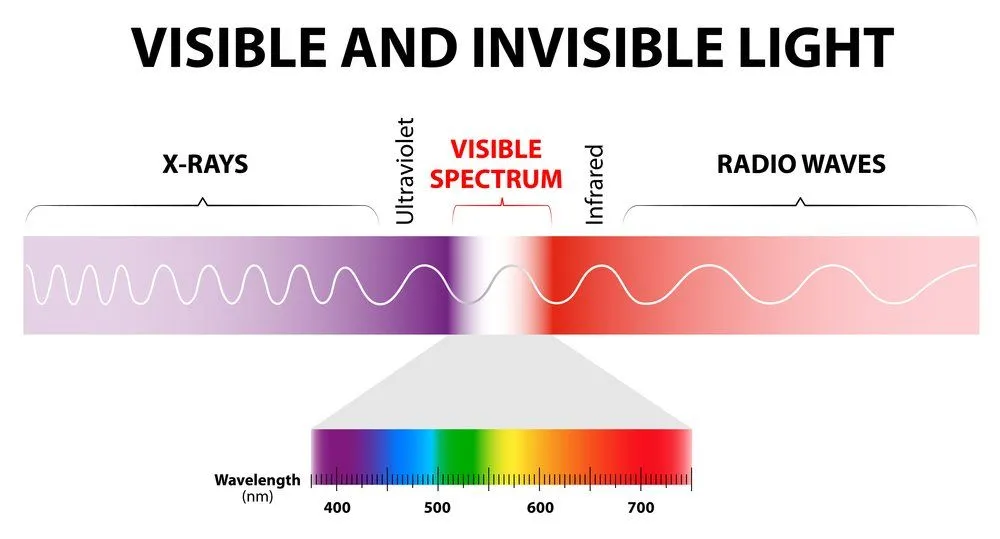
ROY G BIV, for those of you who don’t know, stands for Red, Orange, Yellow, Green, Blue, Indigo, Violet, more commonly known as the colors of the rainbow, in that particular order. These beautiful bands of colors will appear to human beings when we are at a certain angle in relation with the light being bent through the water particles in the air. That’s why a rainbow is curved, because the only light reaching our eyes to form the rainbow will be the rays that have refracted at a particular angle (roughly 42 degrees), which forms a semi-circle in our field of vision.
With that in mind, it seems like all rainbows would have to be the same, right? “The Science” of rainbows seems relatively simple…
Why Is The Color Order Always The Same?
Have you ever noticed that red always rides along the outer edge of a rainbow and violet always hugs the inside, no matter where or when you catch one? That sequence never shuffles, and the reason comes down to a fixed property of light itself. When a ray of sunlight bends as it enters and leaves a raindrop, each color is bent by a slightly different amount. Red light, with its longer wavelength, bends the least, so it emerges at the widest angle (roughly 42 degrees) and lands on the outside of the bow. Violet light, with the shortest wavelength, bends the most and exits at a slightly tighter angle (around 40 degrees), which places it on the inside. Every one of the colors of the rainbow falls into its own lane in between, and because those bending angles never change, the run from red on the outside to violet on the inside is locked in for every primary rainbow on Earth.

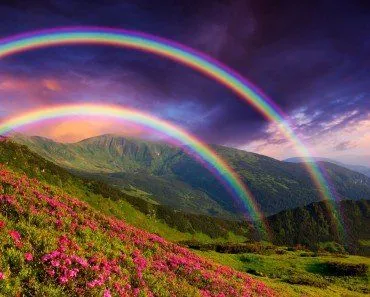
This is also why a second, fainter bow shows its colors in reverse. A secondary rainbow forms when sunlight reflects twice inside each droplet instead of once. That extra bounce flips the geometry, so red ends up on the inner edge of the higher bow and violet on the outer edge. The two arcs are effectively mirror images of one another, and the dark strip between them, known as Alexander's band, marks the zone where almost no light is sent back toward your eyes. So while the palette is always the same familiar band of colors, the direction they run simply depends on how many times the light bounced before heading your way.
Are All Rainbows The Same Size?
Here is where rainbows play a clever trick on us. In one sense, every primary rainbow is exactly the same size: its bright arc always sits about 42 degrees out from the point directly opposite the Sun, called the antisolar point (you can find it at the shadow of your own head). That angle is set purely by the physics of light bending inside a water droplet, so it does not matter whether the rain is falling 100 meters away or several kilometers off, and it does not matter how big the raindrops are. The primary bow always traces the same 42-degree circle, and the secondary bow, when it appears, always sits a little farther out at roughly 51 degrees.

So why do some rainbows look enormous while others seem small and shy? The difference is how much of that circle you can actually see. A rainbow is really a full ring of light, but the ground usually hides the lower half, leaving you the familiar arc. When the Sun sits low near sunrise or sunset, more of the ring climbs above the horizon and the bow looks tall and sweeping. As the Sun rises higher, the arc sinks lower, until the Sun passes about 42 degrees above the horizon and the whole bow slips out of sight below it. This is also why you can never walk up to a rainbow or reach its end: there is no fixed spot in the sky where it lives. The bow is built from countless droplets sitting at just the right angle between you and the Sun, so as you move, it moves with you, always staying that same 42 degrees away.
Not All Rainbows Are Created Equal
As it turns out, researchers have been discussing the types and number of rainbows for centuries. A 2015 study led by atmospheric scientist Jean Ricard of France’s National Centre for Meteorological Research sorted hundreds of photographs into twelve different kinds of rainbows.
As mentioned, rainbows are composed of light refracted back into our eyes at a particular angle through water particles in the air (typically rain). This can also cause secondary bows (a double rainbow), or even triple and quadruple varieties, depending on the weather conditions, the size of the raindrops, and the strength of the light rays. However, if you ever spot a “double rainbow”, you will see that there is a dark band between the two bows, and the colors on the second, fainter rainbow will be reversed from the original.
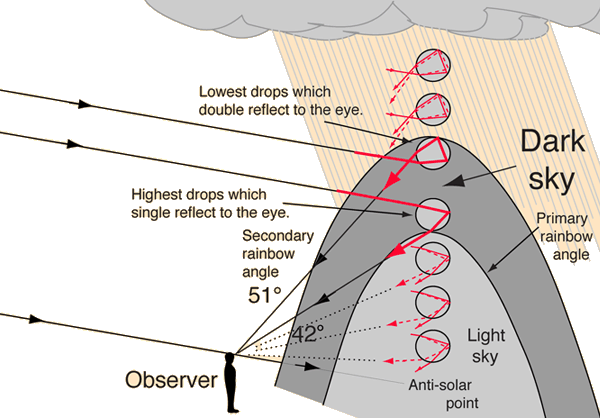
The dark space between the two bows is called Alexander’s band, and is the area where light isn’t refracting at the right angle for our eyes to detect a ‘bow. Furthermore, the height of the Sun in the sky has a lot to do with the appearance of a rainbow. In fact, Ricard’s team found this to be the single biggest factor, with raindrop size mattering far less than people once assumed. A rainbow only shows up when the Sun sits lower than about 42 degrees above the horizon. If the Sun climbs higher than that, the bow drops below the horizon and disappears from view. When the Sun is fairly high (but still under that limit), the bow tends toward blue and green; closer to sunrise and sunset, when the Sun is very low, the warmer reds and oranges dominate, and at those moments the arc can stretch into a full semicircle. Many people overlook these partial or non-traditional rainbows, only pointing to the sky with glee when the colors are at their boldest.
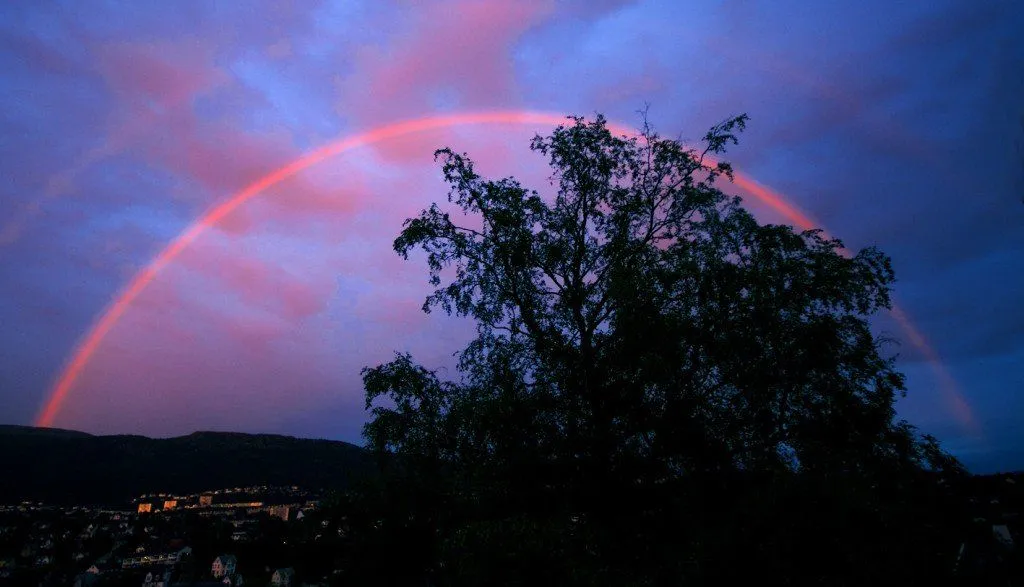
After researchers observed and categorized all these weird and wonderful varieties of rainbows, based on which colors are visible, the number of bows, and the strength of any dark band or extra fringes between them, a dozen final rainbow types were settled on. You might not be able to spot all of them in the sky by name (particularly with names like RB_1), but each one is different! You can also have different visual effects of these rainbow varieties, such as reflection rainbows, twinned rainbows, and rainbow wheels (when clouds sporadically interrupt the full arc, making the bow appear to “spin”).
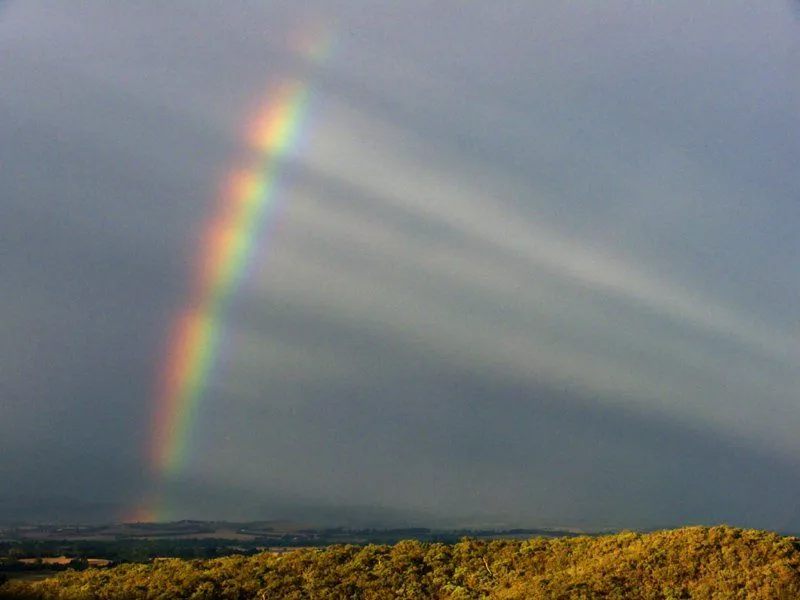
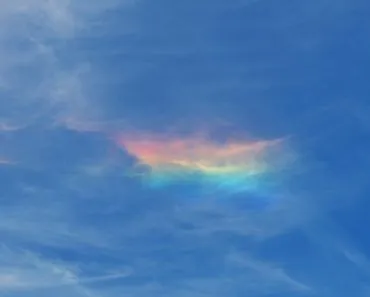
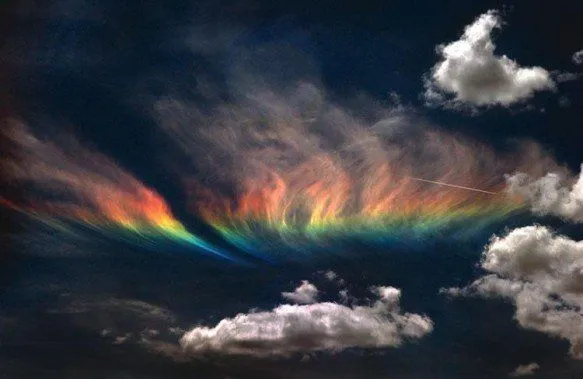
There are also different “bows” in nature, including fogbows (glowing white semi-circles in clouds or fogbanks), moonbows (the faint, rare bows you get when moonlight is refracted through water droplets), and so-called firebows (sunlight refracting through ice crystals high in cirrus clouds). The first two operate on the same principles as a rainbow, with light bending through droplets of water into an arc we can see. The firebow is really an ice-crystal halo rather than a true rainbow, so they’re not all technically rainbows, but they are certainly beautiful!
Perhaps the most fascinating thing about rainbows is that they are constantly changing. As every water droplet falls to Earth, it is only part of a rainbow for a few seconds at most. In other words, every time you look up at the sky and see those bright bows arcing overhead, you’re seeing a one-of-a-kind!