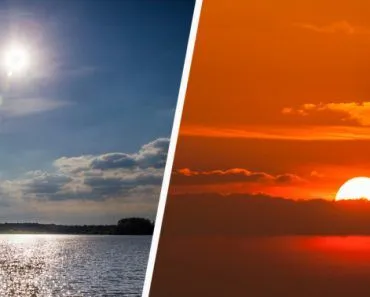
The sky looks lighter near the horizon because your line of sight is travelling through much more atmosphere than when you look straight up, roughly twelve times more air, plus water vapor, dust and pollutants concentrated near the ground. Repeated Rayleigh scattering washes the blue light out across all directions, while Mie scattering from larger particles adds whitish, evenly scattered light. The result is a pale, washed-out band where the sky meets the Earth.
Imagine the last time you were walking outside on a sunny day with clear skies. Looking directly above you, the sky would have likely been a bright and vibrant blue. This should come as no surprise, since we have been taught since childhood that grass is green and the sky is blue. Of course, even those with a rudimentary understanding of optics know that color is merely a construct based on the reflection and refraction of light.
Now, think back to that same sunny stroll; if you continued up a hill, and then to the top of the mountain, and looked towards the horizon, you may be surprised by the colors you see. The rich and vibrant blue present directly above your head does not remain uniform as your gaze stretches miles in the distance. In fact, near the horizon, the sky may appear nearly white. What causes this disparity of color in our stereotypically blue sky? Why is the sky so light near the horizon?
Blue-Sky Science
When people think about the sunlight that bathes our planet in life-giving warmth, it is common to imagine it as warm yellow light, as that is the color we closely associate with the sun. However, visible light is a combination of all the colors in varying wavelengths. When rays from the sun enter Earth’s atmosphere, they begin to interact with all the molecules present there, including nitrogen, oxygen, hydrogen, carbon dioxide and others, along with particulate matter and pollutants in the air.

Scattering
As sunlight strikes atmospheric particles, it makes their electrons oscillate rapidly up and down. The accelerating electrons re-emit radiation at the same frequency as the incoming light, but spread out in all directions. (The much heavier protons in the nucleus barely budge, so they make a negligible contribution.) This process of redirecting sunlight is known as scattering. When you look at the visible light portion of the electromagnetic spectrum, you’ll see that the blue side has a higher frequency and shorter wavelength than the red side.
Rayleigh Scattering
When sunlight strikes nitrogen and oxygen molecules in the atmosphere (the two most abundant components of air), short-wavelength blue light is scattered much more than long-wavelength red light. The Rayleigh formula goes as 1/λ⁴, which means blue light (~450 nm) is scattered roughly four to five times more strongly than red light (~650 nm). This type of unequal scattering of light through a medium of particles much smaller than the wavelength of the light is called Rayleigh scattering. This blue light is scattered in all directions at a high concentration, making the sky appear blue.
The less amount of atmosphere the light must pass through, the more blue it will appear, so when you look straight up on a clear day, you will see a “pure” blue color. However, the atmosphere does not evenly scatter light, so the effect of Rayleigh scattering is variable depending on what point in the sky you’re viewing. Further away from the mountaintop, for example, the sky will look like a paler blue, as the light must pass through far more of the atmosphere before reaching your eyes. This allows for a greater mixture of colors being scattered, so the “blue” is not as pure.
Mie Scattering
The example above was good for a clear sunny day, but we don’t always enjoy blue skies. Sometimes the sky appears grey or white, particularly on cloudy days. When light interacts with small air molecules like nitrogen and oxygen, Rayleigh scattering dominates, but in the case of larger particulate matter, such as pollutants, aerosols, water vapor, dust or smoke, light scatters more uniformly across wavelengths (though it tends to be peaked in the forward direction, not equal in every direction). The particles need to be roughly the same size as (or larger than) the wavelength of the incoming visible light for this effect to dominate. Because all colors scatter together, the result looks white, a combination of all the colors on the visible spectrum. This is why clouds are generally white, yet the sky is blue! This scattering of light in all directions by large particles is called Mie Scattering.

As mentioned above, as you look further away from you, the blue of the sky will begin to look somewhat paler, because the Rayleigh scattering effect is being “watered down” by the excess atmosphere you are looking through. Above your head is roughly 8 miles of atmosphere, but when looking at the horizon, the light must travel through 100 miles or more of the atmosphere before reaching your eye.
Therefore, viewing the horizon is like looking at the “bottom” of the atmosphere, where there is a higher concentration of aerosols, pollutants, smoke and dust (i.e., closer to the ground and human activity). These larger particles are heavier than air molecules like nitrogen and oxygen, which means that they will sit lower in the atmosphere. Therefore, looking out towards the horizon, the light will interact with more of these particles, causing a greater amount of Mie Scattering than if you were looking straight up!
Where Is The Horizon, And How Far Away Is It?
We have leaned heavily on the word horizon without really pinning down where it is. The horizon is simply the line where the sky appears to meet the ground or the sea. It is not a fixed object floating out in space; it is the edge of how far you can see before the curve of the Earth drops the surface away below your line of sight. That is why a "blue horizon" is really just the pale, washed-out band of sky we have been describing, hovering right at the far limit of your view.

So how far away is that line? It depends almost entirely on how high your eyes are. The geometry is a neat right triangle drawn between your eye, the center of the Earth, and the point where your line of sight just grazes the planet's surface. Working it through gives a tidy approximation: the distance to the horizon in kilometers is roughly 3.57 times the square root of your eye height in meters (or about 1.23 miles times the square root of your eye height in feet).
For an adult standing on a beach with their eyes about 1.7 m (5 ft 7 in) above the water, that comes out to roughly 4.7 km (about 2.9 miles). Climb a 100 m hill and the horizon races out to about 36 km (22 miles); from a clifftop or the deck of a tall ship it is farther still. That is exactly why the band of pale sky always sits low and far away. When you gaze at the horizon, you are looking along the longest possible path through the atmosphere, right down to where the air meets the land or sea.
Is The Sky Lighter Or Darker At The Horizon?
If you just want the short answer that people so often type into a search bar: the sky is lighter near the horizon and a deeper, richer blue when you look straight up. Put another way, the sky is darkest at the top of the dome, the point directly overhead known as the zenith, and palest at the bottom, where it meets the horizon.
Everything above explains why. Looking up at the zenith, your sightline cuts through the thinnest possible slice of atmosphere, so Rayleigh scattering paints a clean, saturated blue. Looking out at the horizon, that same sightline runs through many times more air and through the dustier, more humid layers near the ground, so Mie scattering and repeated Rayleigh scattering wash the blue out toward white. The change is gradual: scan slowly from overhead down to the horizon and you will watch the blue fade smoothly from deep to pale, with no sharp line anywhere in between.
This is also why a clear sky looks so striking from a high mountain or an aircraft. With far less air overhead, even the zenith deepens to an almost navy blue, and the contrast against the bright, pale horizon is more dramatic than it ever is at sea level. Carry that idea to its extreme and you reach space, where there is no air to scatter sunlight at all, so the sky overhead simply turns black.
Why Does The Sky Look Closer Overhead Than At The Horizon?
Here is a curious follow-on that many sky-gazers ask: why does the sky overhead seem to hang lower, or feel closer, than the sky far out at the horizon? Part of the answer is physical, since the column of air is genuinely thinnest straight up and deepest toward the horizon. But our perception leans the same way for a subtler reason that has nothing to do with scattering.

When people are asked to look up and point to the spot exactly halfway between straight overhead and the horizon, they almost never choose the true 45° midpoint. Instead they pick something much lower, with measured estimates clustering somewhere between about 20° and 45° above the horizon. That tells us the brain treats the overhead sky as nearer and the horizon sky as farther away, so we perceive the sky not as a true hemisphere but as a flattened dome, rather like an upside-down soup bowl.
This same flattening is a leading explanation for the famous Moon illusion, in which a full Moon low on the horizon looks startlingly bigger than the very same Moon high overhead, even though a camera shows the two to be identical in size. Because the brain places the horizon sky farther away, it effectively inflates the low Moon to fit that extra apparent distance. The idea has deep roots: Ptolemy floated a version of it around 150 CE, and the 18th-century mathematician Robert Smith folded it into one of the first formal explanations of the illusion.
A Final Word
Staring up into the endless blue has been a pastime since time immemorial, but don’t let anyone try to tell you that the whole sky is always blue! The color that we see in the world is merely a product of light interacting with different surfaces and substances, bouncing around the atmosphere and morphing depending on distance, intensity and any particulate obstacles in its way. And next time you’re gazing out from a mountain vista at the band of whiteness above the horizon, you can casually explain to your companions what causes this blue-sky anomaly: Mie scattering!
References (click to expand)
- What Determines Sky's Colors At Sunrise And Sunset?. Science Daily
- DW Hahn. Light Scattering Theory Introduction - plaza. The University of Florida
- Lilienfeld, P. (2004, June 3). A Blue Sky History. Optics and Photonics News. The Optical Society.
- Caruthers, J. W. (2011). On Rayleigh and Mie scattering. Proceedings of Meetings on Acoustics. Acoustical Society of America.
- Andrew T. Young. Distance to the Horizon. San Diego State University.
- Hipius, K. & Kornreich, D. A. The Celestial Vault is Not a Dome: Implications for the Moon Illusion. SUNY Cortland.
- Moon illusion. Wikipedia.