Table of Contents (click to expand)
Yes, apples can be red all the way through. Heirloom and crab-apple varieties like Hidden Rose, plus newer cultivars such as Redlove, Lucy, Baya® Marisa and Kissabel, owe their pink-to-crimson flesh to the anthocyanin pigment cyanidin 3-galactoside, switched on by the MdMYB10 and MdMYB110a genes. They are perfectly safe to eat.
Apples are the third most produced fruit in the world after bananas and watermelons. In 2023, almost 98 million metric tons of apples were produced globally. That is a lot of apples.
Cultivated apples (Malus domestica Borkh.) belong to the family Rosaceae. The genus Malus includes 30-35 species of smaller fruited varieties called crab apples, which are mostly used as ornamental plants. Apple breeders often use crab apples to introduce important traits, such as disease resistance or shorter juvenility, into cultivated types.
Apples are a rich source of polyphenols (typically 110 mg/100 g) and studies have shown that apples have anti-inflammatory, anticancer, and antioxidant effects, along with helping those who suffer from cardiovascular issues. Among the polyphenols are anthocyanins, which give the apple peel its red color.
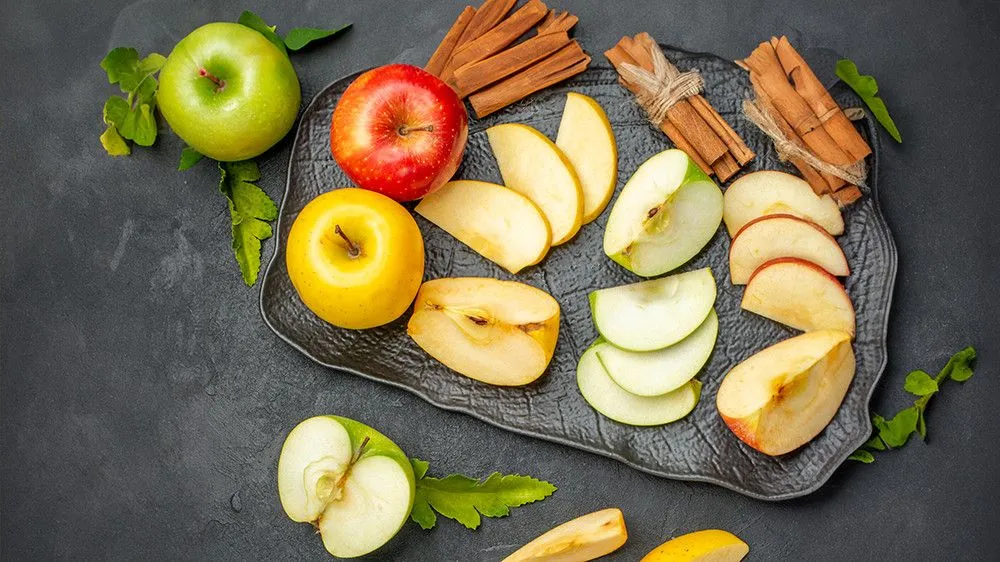
The Red Color Makes Apples Healthy
Apples are usually red, green, or yellow on the surface with white flesh beneath. The apple peel gets its red color from anthocyanin.
Anthocyanins are water-soluble plant pigments that give color to many red fruits, including cherries and grapes. Anthocyanins are polyphenolic antioxidants and an important type of flavonoids found in plants.
In white-fleshed apples, most of the anthocyanins are concentrated in the red peel. However, we eat very little of the peel. Red fleshed apples, on the other hand, would be a much richer source of phenolics and flavonoids, which might help boost an apple’s health benefits.
However, developing a red-fleshed apple isn’t as easy as “adding a molecule into the flesh”.
Fruit color depends on the genetics of the variety, plant hormones, and the environment (temperature and light). Anthocyanins, in particular, depend on the pH of plant cells. This is why we see different colors in roots, leaves, stems, flowers, and fruits.
Researchers and breeders spend a considerable amount of time studying fruit color development.
Can Apples Have Red Flesh?
You can find red-fleshed apples among crab apples and some older apple varieties. Anthocyanins are a large family of chemicals, but in apples one pigment does most of the heavy lifting: cyanidin 3-galactoside (also called idaein), which accounts for the bulk of the anthocyanin in both the peel and, when present, the flesh. Pelargonidin, the pigment that turns strawberries red, is essentially absent in apples.
Looking at the plant’s DNA, segments of the DNA called MYB transcription factors play a critical role in regulating anthocyanin production in the red skins. Transcription factors are proteins that turn genes on or off, and thus control the activity of the gene.
Two genes, MdMYB10 and MdNAC1 have been identified in red-flesh apples. Both of these genes are positive regulators of anthocyanin biosynthesis. This means that these genes ‘turn on’ the production of anthocyanins, thus resulting in the red color of the flesh.
Studies show that a duplication in an apple MYB transcription factor gene resulted in the red flesh color. Based on this, red-fleshed apples are categorized into two types: Type 1 is associated with a mutation in the MdMYB10 gene, which makes the fruit skin, flesh, leaves and all other vegetative tissues red; Type 2 is associated with the gene MdMYB110a. In Type 2, only the flesh is red, while the vegetative tissues do not have the red color.
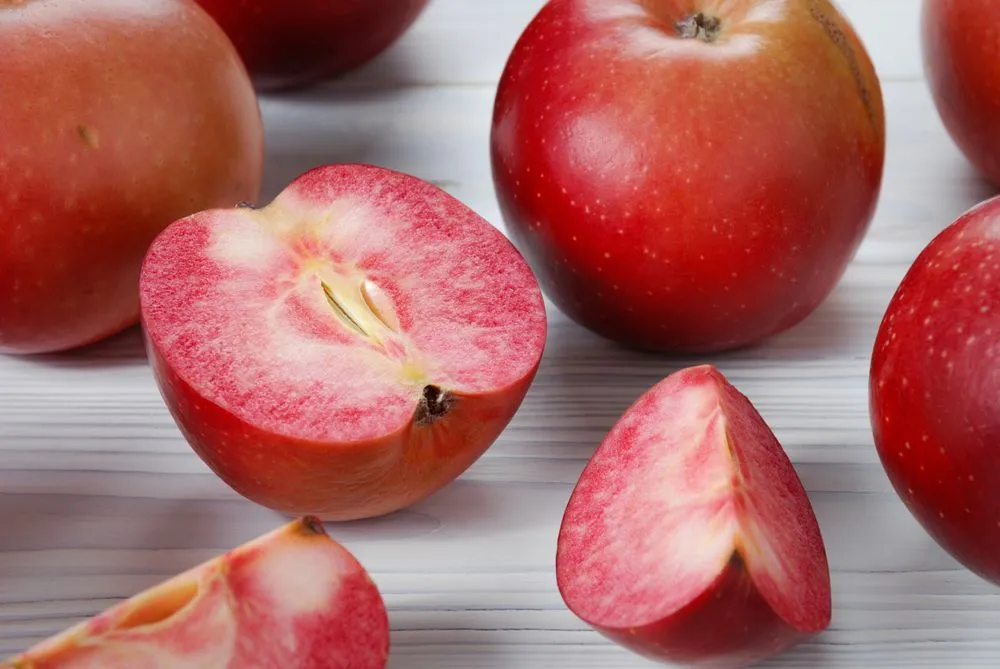
Will You Find A Red-fleshed Apple In A Supermarket Near You?
If you go to your neighborhood supermarket, you will most likely not find a red-fleshed apple. This is because red-fleshed apple varieties have been commercialized only recently and only in a few parts of the world. Developing a new apple variety is a long-term project. It can take 20-30 years from the time the breeders start working on the variety to the time it is fully commercialized. However, there are a few commercialized red-flesh varieties, and a few more in the pipeline.
Malus sieversii f. niedzwetzkyana, the red-fleshed version of Malus sieversii (an ancestor of cultivated apples) is a rich source of polyphenols and flavonoids. Breeders in China are working on developing red-fleshed varieties by crossing M. sieversii f. niedzwetzkyana with popular varieties like Fuji and Gala.
Some older red-fleshed varieties are grown locally in certain parts of the world. The most famous is an Oregon apple that goes by three different names: it was originally called Airlie Red Flesh, after a town near where Lucky Newell first found the seedling in 1959, and was relaunched in 2001 under the trademark Hidden Rose® by Thomas Paine Farms. Pacific Northwest growers who could not use that trademark started selling the same apple as Mountain Rose. Older Central Asian varieties such as Niedzwetzkyana, Almata and Rubaiyat are still grown across Kazakhstan, Kyrgyzstan and the wider region, and several are now used by craft cider makers.
Newer Varieties
The Bavarian Fruit Center in Germany developed the variety Baya® Marisa, which is a cross between a red-fleshed tart variety and a sweet dessert apple. They also developed the variety Baya® Franconia, which has ‘two-tone flesh’ with a ring of red color surrounding the white core.
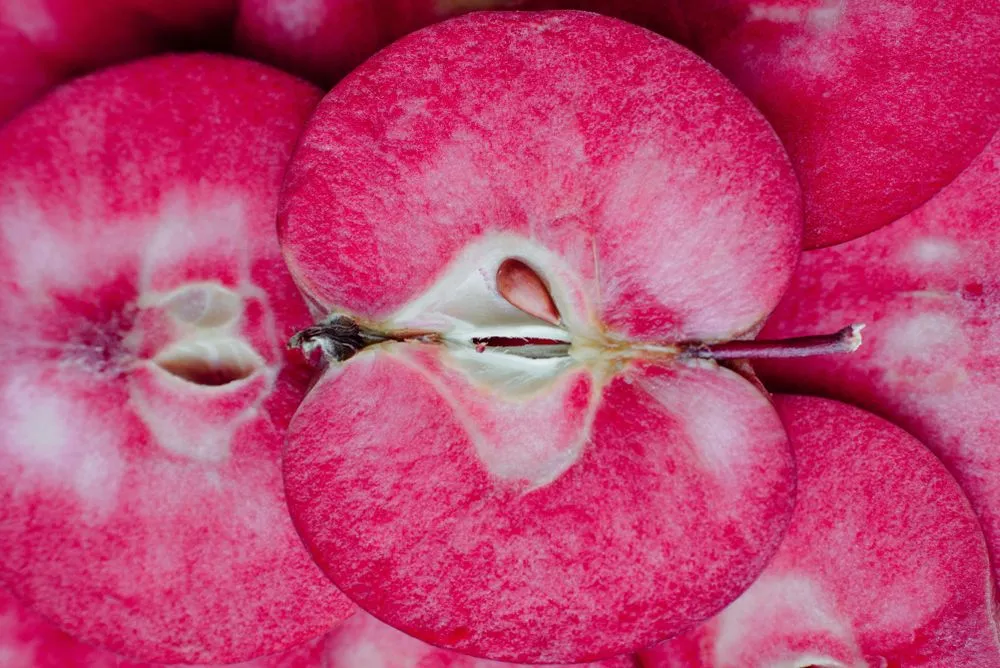
The Plant and Food research organization in New Zealand has developed a hybrid variety from red-fleshed and white-fleshed apples. However, this variety has yet to be commercialized.
Markus Kobelt in Switzerland developed a range of red-fleshed varieties named Redlove. These varieties were developed by crossing Royal Gala and Braeburn varieties with an undisclosed red-fleshed variety. They were released in 2010 and include the varieties Era, Calypso, Circe, Odysso, and Lollipop. Red Love is marketed by a British nursery and is grown in Europe, the USA, and Australia.
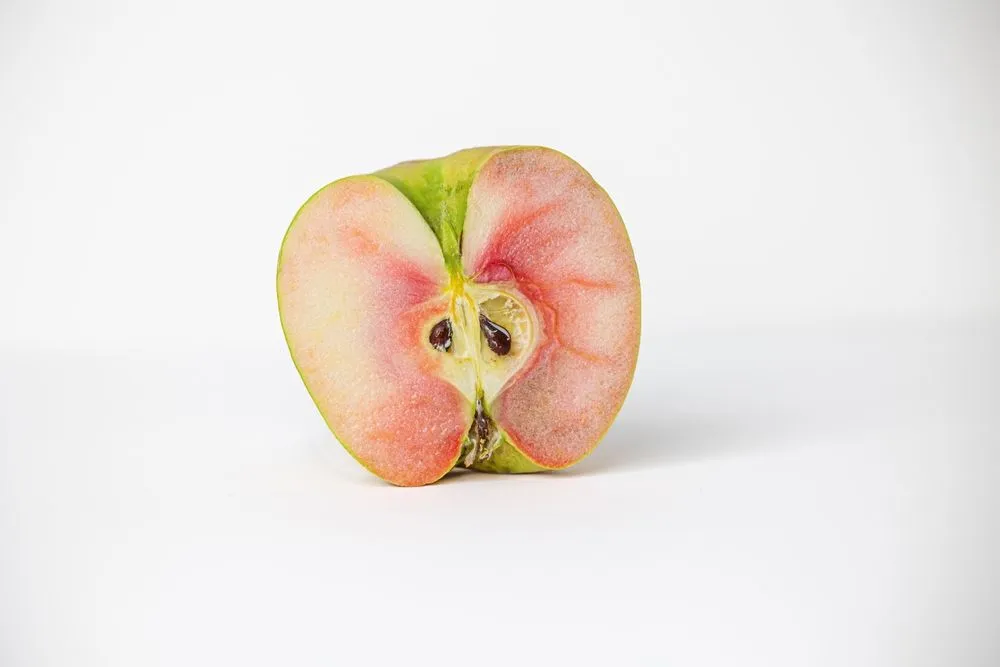
Probably the most familiar red-fleshed apple in the US is Lucy, developed by Washington plant pathologist Bill Howell from a cross of Honeycrisp and Airlie Red Flesh. Howell planted his first Lucy seedlings in 1996, selected the best two in 2009, and partnered with Chelan Fresh to trademark them as Lucy Rose and Lucy Glo in 2018. Lucy Rose is red on the skin and pink-to-red inside; Lucy Glo has blush-gold skin through which the pigmented flesh shows in streaks. Commercial volumes reached supermarkets around 2020, and the apples are still grown almost entirely in Washington.
More recently, the French-bred Kissabel® range arrived in Australia through grower Montague. Kissabel is managed by the international breeding consortium IFORED and is the product of more than two decades of conventional crosses between standard apples and red-fleshed crab apples; commercial sales began in 2017, and the apples are now grown in Europe, North and South America, South Africa, Australia and New Zealand.
Conclusion
Red-fleshed crab apples and a few lesser-known varieties have existed for decades, but they have only really stepped into the mainstream in the last few years. Apple breeders around the world are working on red-fleshed varieties that will pair that ruby flesh with the crispness, juiciness and shelf life of major commercial cultivars. Because apples are a tree fruit, it usually takes 20 to 30 years for a new variety to go from the first cross to a supermarket shelf, so progress is slow. The varieties on the market today, from Hidden Rose and Mountain Rose to Lucy, Redlove, Baya® Marisa and Kissabel, are all naturally bred (not GMOs) and are perfectly safe to eat. (Worth noting: if a normally white-fleshed apple like a McIntosh or Honeycrisp shows pink or red streaks inside, that is usually bruising, freezing damage or storage-related "internal browning", not a hidden red-fleshed variety.) It remains to be seen whether any of these reds will earn the same shelf space as the white-fleshed apples we have all come to love.
References (click to expand)
- Liu, W., Mei, Z., Yu, L., Gu, T., Li, Z., Zou, Q., … Wang, N. (2023, March 15). The ABA-induced NAC transcription factor MdNAC1 interacts with a bZIP-type transcription factor to promote anthocyanin synthesis in red-fleshed apples. Horticulture Research. Oxford University Press (OUP).
- Chen, Z., Yu, L., Liu, W., Zhang, J., Wang, N., & Chen, X. (2021, May). Research progress of fruit color development in apple (Malus domestica Borkh.). Plant Physiology and Biochemistry. Elsevier BV.
- Koutsos, A., Riccadonna, S., Ulaszewska, M. M., Franceschi, P., Trošt, K., Galvin, A., … Lovegrove, J. A. (2020, February). Two apples a day lower serum cholesterol and improve cardiometabolic biomarkers in mildly hypercholesterolemic adults: a randomized, controlled, crossover trial. The American Journal of Clinical Nutrition. Elsevier BV.
- Li, C. X., Zhao, X. H., Zuo, W. F., Zhang, T. L., Zhang, Z. Y., & Chen, X. S. (2020, February 16). Phytochemical profiles, antioxidant, and antiproliferative activities of four red‐fleshed apple varieties in China. Journal of Food Science. Wiley.
- Jezek, M., Zörb, C., Merkt, N., & Geilfus, C.-M. (2018, January 19). Anthocyanin Management in Fruits by Fertilization. Journal of Agricultural and Food Chemistry. American Chemical Society (ACS).
- Würdig, J., Flachowsky, H., Höfer, M., Peil, A., Eldin Ali, M. A. M. S., & Hanke, M.-V. (2014, July). Phenotypic and genetic analysis of the German Malus Germplasm Collection in terms of type 1 and type 2 red-fleshed apples. Gene. Elsevier BV.
- Red-fleshed: The science behind an uncommon apple breed.
- Cyanidin 3-O-galactoside: A Natural Compound with Multiple Health Benefits. International Journal of Molecular Sciences (PMC).
- An Oregon apple with a hidden surprise. Oregon Public Broadcasting (2024).
- The Curious Case of the Hidden Rose. Portland Monthly.