True blue roses do not exist in nature, because roses cannot produce the blue pigment delphinidin. The closest thing is the genetically engineered ‘Applause’ rose, developed in Japan by Suntory and the Australian firm Florigene and sold commercially since 2009. It is actually mauve, not blue. A 2018 experiment at Tianjin University, which used bacterial enzymes to make the blue pigment indigoidine inside cut white rose petals, has produced the bluest hue yet seen in a rose.
“Roses red and roses white
Plucked I for my love’s delight.
She would none of all my posies,
Bade me gather her blue roses.
Half the world I wandered through,
Seeking where such flowers grew.
Half the world unto my quest
Answered me with laugh and jest.”
Rudyard Kipling wrote those lines about blue roses in 1887, and they later appeared as the epigraph to Chapter VII of his novel The Light That Failed (1891). Back then, blue roses were truly impossible to find. Almost 140 years later, the quest for blue roses is far more promising.
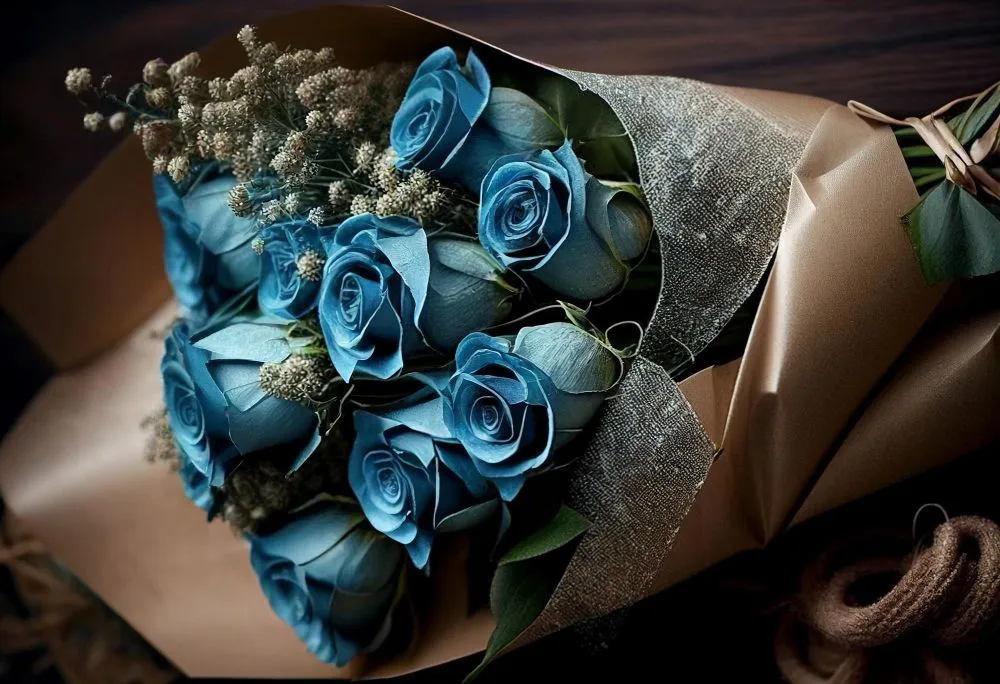
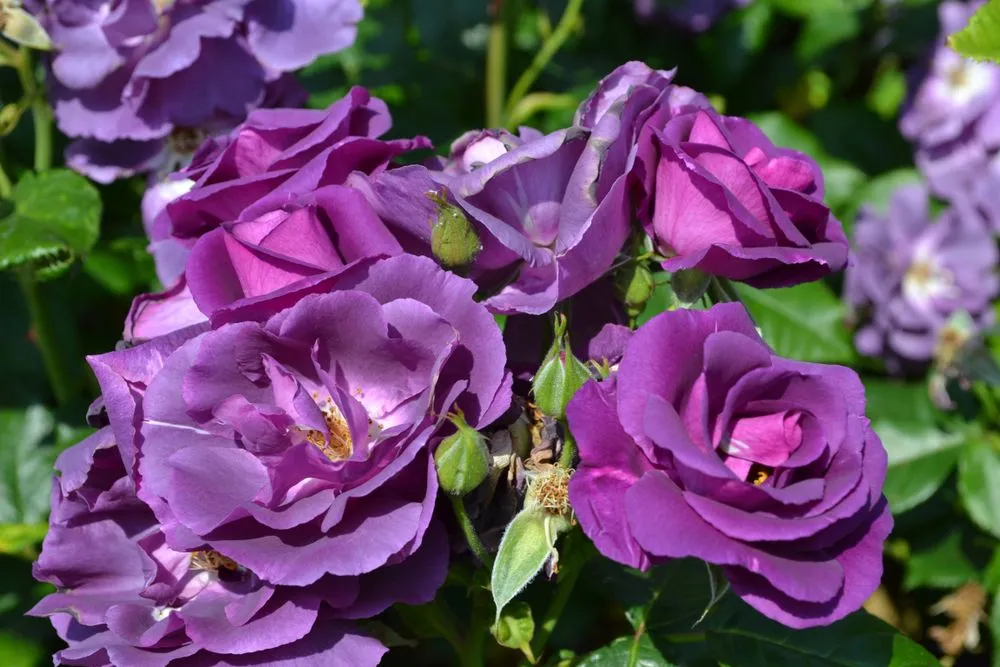
Most blue roses found at florists’ shops are actually white roses dyed with a blue coloring. Then there are the purplish shades of roses, such as Bleu Magenta and Rosa Rhapsody. However, naturally bred true blue roses continue to be elusive. True blue roses do not exist in nature.
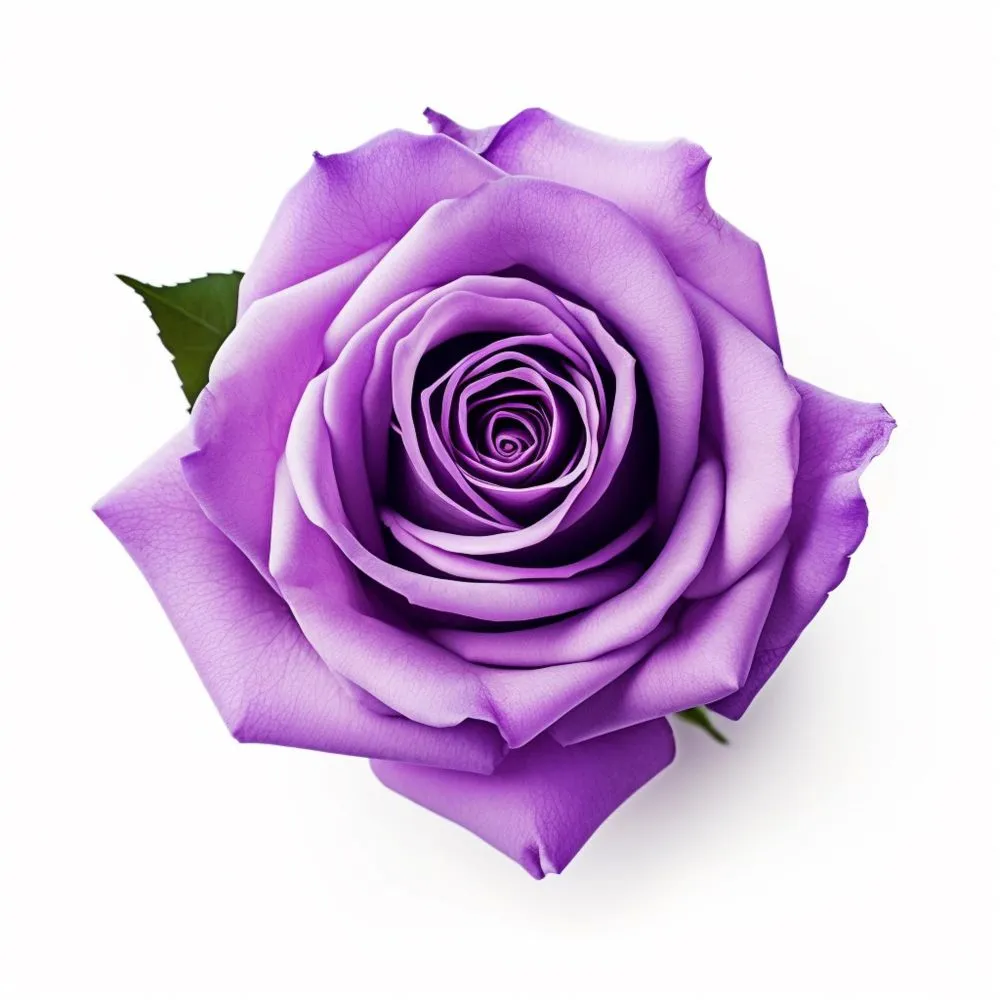
However, we might finally have access to blue roses thanks to biotechnology. So far, researchers in Japan and Australia have developed a genetically modified ‘blue’ rose called ‘Applause’, which actually looks more like a mauve rose. It is the closest we have to a real blue rose, but researchers are still working on developing a blue-er version of this rose.
Breeders Have Been Trying For Centuries
Blue roses have been a highly sought after target for rose breeders. According to popular accounts, the horticultural societies of Britain and Belgium are said to have offered a prize of 500,000 francs back in the 1840s for anyone who could develop a true blue rose. The prize, the story goes, was never claimed.
Even so, years of efforts by rose breeders could not produce a blue rose, because the flower lacked a key enzyme needed to produce the blue pigment delphinidin.
How Do Roses Get Their Color?
Roses, like other flowers, get their color from pigment molecules called anthocyanins. There are three main anthocyanin pigments in plants: cyanidin, pelargonidin and delphinidin. Cyanidin leads to deep red, pink and lilac or mauve. Pelargonidin is responsible for orange and red colors. Delphinidin is what leads to blue and purple colors. The rose flower lacks delphinidin, so there are no blue roses in nature.
A few rose varieties, such as the ‘Rhapsody in Blue’ have been reported to contain small amounts of the blue pigment rosacyanin, but that still does not give the flowers a true blue color.
In addition, the pH of the plant cell vacuole is important for pigment expression. Vacuoles are storage spaces in the cells within which pigment molecules are present. The colors are redder when the pH is acidic, and bluer when the pH is neutral or weakly acidic. Rose vacuoles have a pH between 3.69 to 5.78.
Pigments can also combine with other pigments or with metal ions to generate a blue color.
Common floricultural crops, such as roses, chrysanthemums and carnations, do not naturally contain delphinidin-based anthocyanins. You may be thinking, “But I saw those blue chrysanthemums at the florists.” Well, those are usually white chrysanthemums dyed with a blue coloring. Similarly, blue carnations are either dyed or genetically modified. Interestingly, in 2017, Japanese scientist Naonobu Noda and colleagues did succeed in engineering a genuinely true blue chrysanthemum, by inserting genes from the butterfly pea and a Canterbury bell into the plant. The chrysanthemum, in other words, beat the rose to the finish line.
Birth Of A Blue Rose
Back in 2004, researchers at Florigene (Australia) and Suntory (Japan) announced a prototype of a blue rose, built using genetic engineering technology developed by CSIRO (Australia). It took 20 years of research and an investment of about 3 billion Yen (roughly $26 million USD at the time) to get there. They introduced a blue pigment gene (delphinidin) from pansy, a gene for the enzyme dihydroflavonol reductase (DFR) from iris, and an RNAi sequence developed by CSIRO to turn off the DFR enzyme that existed within the rose.
When researchers introduced the delphinidin gene into a red rose containing cyanidin, it resulted in a dark burgundy rose.
Next, they used the RNAi gene silencing technology to turn off the enzyme DFR in the red rose. The enzyme DFR is what converts the precursor pigments to their respective color. By turning off the gene, there would be no interference from the cyanidin pigment. With the cyanidin pathway turned off, they introduced a delphinidin gene from pansy (for the blue color) and a modified DFR gene from iris to turn the delphinidin precursor to the blue color pigment. The resulting rose had high levels of delphinidin. However, the gene silencing did not fully work, so some cyanidin was produced, resulting in a mauve color. This mauve-colored rose was commercialized as the ‘Applause’ variety and has been available commercially in Japan since 2009, as well as in the US and Canada since 2011.
The researchers hypothesized that if they could make the rose petals less acidic (roses have pH 3.69 to 5.78) and/or use a more perfect gene-silencing method, they would be able to create a true blue rose.
A Bacterial Shortcut To True Blue
Rather than continue tweaking the plant’s own pigment pathway, a team at Tianjin University tried something quite different in 2018. They borrowed two bacterial enzymes (one from Erwinia, the other from a Pseudomonas strain) and injected them into the petals of a white rose. Together, these enzymes convert L-glutamine, an amino acid already abundant in the petals, into indigoidine, a naturally blue pigment.
The result was the bluest hue ever produced inside a living rose petal, a vivid patch radiating out from each injection site. It is not yet a uniformly blue rose growing on a bush, and the pigment is produced only after the petals are picked, but it is the closest anyone has come to a truly blue rose. The technique also hints at a faster route forward, by skipping the plant’s pigment pathway altogether and outsourcing the chemistry to bacterial enzymes.
So, In Which Country Can You Find A Blue Rose?
If you are hoping to stumble upon a blue rose growing wild in some far-off country, the honest answer is that no such place exists. A rose that is blue all the way through is not found in nature anywhere on Earth, for the pigment reasons we have already covered. The blue roses that turn up in florists’ bouquets around the world are almost always ordinary white roses that have been dyed, so the “country” they come from is really just wherever a florist happened to add the coloring.
The one genuinely engineered blue rose you can actually buy has a clear home address: Japan. Suntory’s ‘Applause’ rose first went on sale there on 3 November 2009, at flower shops in major cities across Japan. Each stem cost between 2,000 and 3,000 yen (about $22 to $33 at the time), close to ten times the price of a regular rose. The novelty sold well, and Suntory reported around 10,000 stems sold in Japan during 2010.
Applause later crossed the Pacific. Suntory announced North American sales beginning in the autumn of 2011, bringing the rose to select florists in the United States and Canada. So if you want to hold the closest thing science has yet produced to a true blue rose, Japan is where it began, and North America is where you are most likely to find one today.

Conclusion
The quest for true blue roses continues, although scientists have made significant progress in this pursuit. The genetically engineered mauve ‘Applause’ rose, the true-blue chrysanthemum and the indigoidine-producing rose petals each chip away at the puzzle from a different angle. Until a truly blue rose blooms in a garden somewhere, however, humanity will keep waiting for its first proper glimpse.
References (click to expand)
- Katsumoto, Y., Fukuchi-Mizutani, M., Fukui, Y., Brugliera, F., Holton, T. A., Karan, M., … Tanaka, Y. (2007, September 28). Engineering of the Rose Flavonoid Biosynthetic Pathway Successfully Generated Blue-Hued Flowers Accumulating Delphinidin. Plant and Cell Physiology. Oxford University Press (OUP).
- Plant gene replacement results in the world's only blue rose.
- Florigene Flowers.
- World's First 'Blue' Rose Soon Available in U.S.. Wired.
- Noda, N. et al. (2017). Generation of blue chrysanthemums by anthocyanin B-ring hydroxylation and glucosylation. Science Advances.
- Zhang, Y. et al. (2018). Cloning and Expression of a Nonribosomal Peptide Synthetase to Generate Blue Rose. ACS Synthetic Biology.
- Blue roses to debut in Japan. Phys.org.
- Blue rose. Wikipedia.