Table of Contents (click to expand)
Yes, one family of fish really can “fly.” Flying fish (family Exocoetidae, about 40 species) launch out of the water and glide on stiff, wing-like pectoral fins to escape predators like tuna and marlin. Typical flights cover around 50 m (160 ft), but record glides have stretched to 400 m (1,300 ft) over 43 seconds.
Have you ever seen an animal besides birds and bugs fly?
You’re probably thinking about bats, or maybe a flying squirrel, but the list of animals that can sail through the air doesn’t stop there. There are flying lizards, snakes, and even fish. Yes, fish. There’s a group of marine fish that can fly… just not in the way you think.
What Is A Flying Fish?
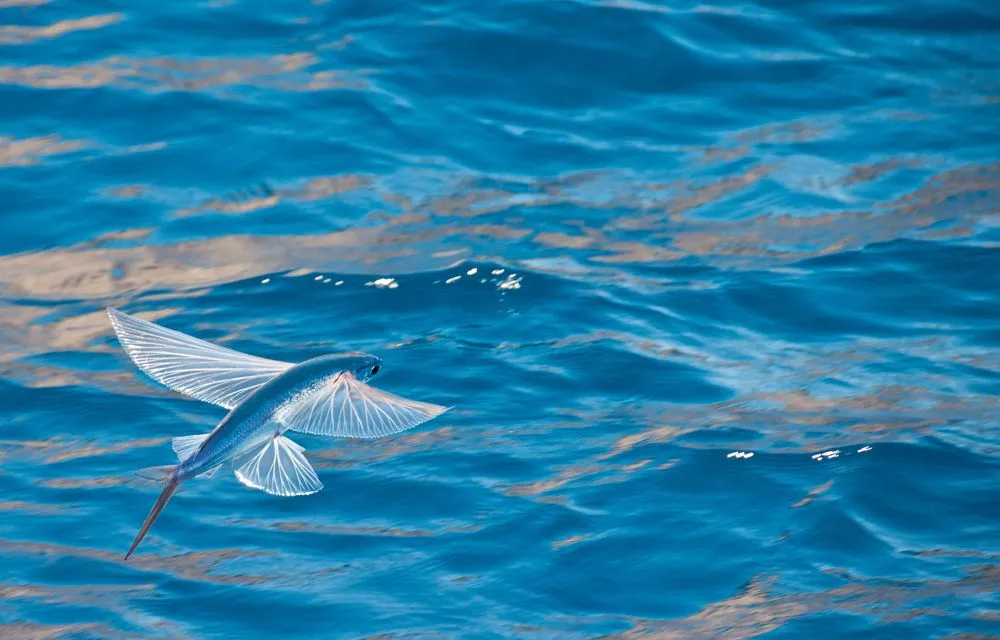
Flying fish are a group of marine fish that appear to fly just above the surface of the water. Unfortunately, these fish are more akin to Buzz Lightyear from Toy Story in the way they fly, as it’s actually just “falling with style”.
You might even mistake these fish for birds flying over the ocean. Only they don’t flap their ‘wings’ to take off the way birds usually do.
John Davenport, in the year 1994, published an article in which he described their graceful gliding. He writes, “[…] fish [flying fish] swim toward the surface at very high speed with the lateral fins furled, leap through the water surface at a shallow angle, accelerate to take-off speed by taxiing with the lateral fins expanded and the tail beating in the water at up to 50 beats s-1, and enter a free flight that may be prolonged by further taxiing.”
They have two groups of specialized muscles that enable them to extend their wings and fly. This allows them to propel themselves far out of the water and glide for up to 200 meters. The strongest fliers can do even better: Britannica notes single glides of up to 180 m (600 ft), and compound glides (when the fish dips its tail back into the water to refuel its speed) timed at 43 seconds and covering close to 400 m (1,300 ft). Their small size (less than 50 cm) helps them break the surface and stay airborne.
How Many Flying Fish Are There?
Flying fish as a family are called the Exocoetidae, boasting more than 40 different species. The major differences among the genera consist of how many wing-like fins they have.
Some of them only have two wing-like fins for pectoral fins, which are located just behind the head. Other members within the family Exocoetidae have four wing-like fins (two pectoral fins and two pelvic fins). The pelvic fins are found in the last third of the body next to the anal opening.
Given the variety of species, there are significant variations in size and how far they can fly. However, irrespective of their sizes, most if not all have been able to out-fly mankind’s initial attempt.

The Wright brothers are often called the first people to fly, however, their “flight” was only 36 meters. Not only can most flying fish glide further than the Wright brothers, but they were doing it millions of years before the idea of human flight was ever born.
Why Do They Need To ‘Fly’?
These fish live in the water and have gills that need to stay wet, so why would they evolve the ability to jump out of the water? To answer that question, we need to know a bit more about their size and diet.
Flying fish typically eat plankton and other small marine crustaceans. While they are carnivorous, they are far from the top of the food chain. At a length usually less than 50 cm (about 20 inches), they also aren’t very large by the standards of the ocean. This means that a variety of other animals would find them to be a lovely breakfast.
It is thought that the primary reason that flying fish fly is to avoid being consumed by predatory fish, such as tuna or marlin. Much larger and faster fish like tuna would easily be able to catch a flying fish in the water, but once they take to the air, the battle for survival is a different story.
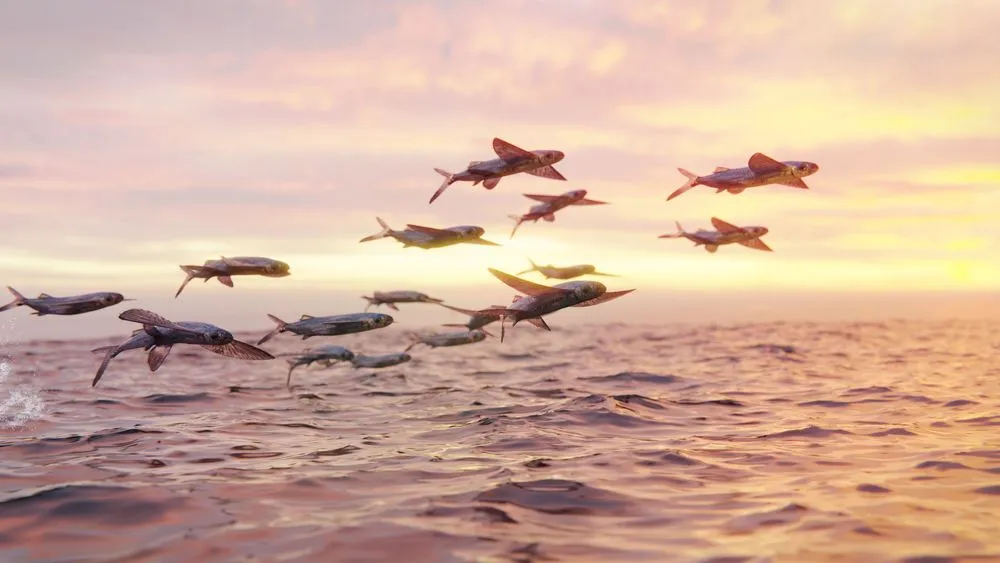
Once a flying fish is gliding through the air, it’s out of the tuna’s reach. Additionally, once airborne, it may be more difficult for predatory fish to track the movements of the fish, due to the ever-changing surface of the water.
However, tuna and marlin aren’t the only predators seeking out a high-flying meal.
A plethora of sea birds often try to eat them as well. The smaller varieties are especially easy for birds to grab. As the fish jumps out of the water and starts to glide, it’s safe from the fish below, but its gliding is no match for the dextrous wings of a hungry gull that can snatch them out of the air.
Importance Of Flying Fish
In addition to their place in the food web of the ocean, flying fish are economically and culturally important for a variety of people around the world.
Paired with cou-cou (a cornmeal-and-okra porridge), the flying fish forms the national dish of Barbados, and due to its commercial value, it has even caused tensions to flare between various countries over fishing rights and the importance of conservation. These fish are rather easy to catch compared to normal net fishing, as flying fish are attracted to light and will even jump into boats by accident when startled.

A Final Word
A wide variety of animals in this world can fly. Even though flying fish can only glide, it’s still an amazing feat. Their strange adaptation allows them to escape hungry predators of the ocean, only to take their chances with birds in the air. While not all flying fish will survive their flight, they’re amazing to watch. Additionally, many people around the world say they’re also wonderful to eat!
References (click to expand)
- Davenport, J. (1994, June). How and why do flying fish fly?. Reviews in Fish Biology and Fisheries. Springer Science and Business Media LLC.
- Flying Fish - National Wildlife Federation. The National Wildlife Federation
- Flying fish. Encyclopaedia Britannica.
- 1903 Wright Flyer | National Air and Space Museum. The National Air and Space Museum of the Smithsonian Institution
- Claims of Caribbean piracy as national symbol takes flight. The Sydney Morning Herald