Yes, it can really rain animals — small frogs, fish and other light creatures occasionally fall from the sky after being lifted into a storm. Tornadic waterspouts (tornadoes that form over water, or move from land out over a lake or coast) are the leading culprit. Their vortex can suck up surface water and the animals living in it, carry them in the updraft, and release them miles away when the storm weakens.
It’s a nice day and you are walking down the road around your neighborhood wondering which TV series you are going to binge-watch later in the evening. Sure, Breaking Bad is good but Downton Abbey also looks appealing too… But then you realize that you need to see the latest sci-fi show Black Mirror which has just come out! Suddenly your train of thoughts is broken by a barrage of frogs falling from the sky! Kerplunk!! Certainly what you did not expect, is it?
This might seem like something out of fantasy novels or even mythological texts but it can actually happen!
Has It Already Happened?
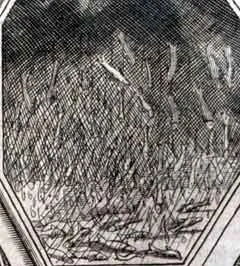
Accounts of animals mysteriously falling from the sky are found throughout the history of many cultures. It’s a rare occurrence, to be sure, but there are engravings of raining animals dating back hundreds, if not thousands of years. The most common types of animal rain appear to be those involving fish and amphibians. Recent reports include raining fish in Australia (Lajamanu, Northern Territory, recorded fish falls in 1974, 2004, 2010 and again in 2023), the Philippines, two different regions of India, Texarkana, Texas in late 2021, and small frogs falling in Japan and Hungary. The American writer Charles Fort spent his career cataloguing such "falls" in his 1919 book The Book of the Damned, which remains the standard historical reference for the phenomenon.
Why Did It Happen?
“It is certainly within the realm of possibility that fish and frogs could rain from the sky,” says Greg Carbin, formerly Warning Coordination Meteorologist at NOAA’s Storm Prediction Center and now Chief of the Forecast Operations Branch at the Weather Prediction Center. We should probably begin by saying that most of the stories concerning ‘animal rains’ are pure eyewitness accounts and some are even totally inaccurate. For example, a dead group of animals spread out over a large area might be misconstrued as being rainfall related when in reality it’s just because of some other ecological catastrophe. Also, people who live in suburban or urban environments tend to underestimate the number of organisms living around their homes. Therefore, they may suspect that animals came from the sky rather than their natural habitat.
Tornadic Waterspout
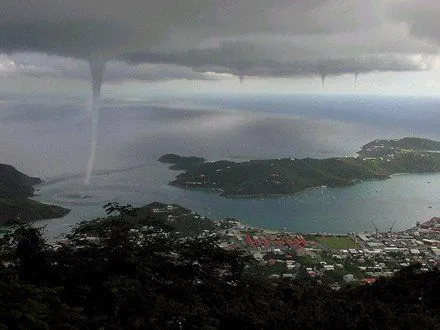
Though when it actually happens, scientists have reasonable explanations. Many scientists believe tornadic waterspouts may be responsible for frog and fish rainfalls. According to NOAA, a tornadic waterspout is a tornado that either forms directly over water or moves from land out over water. (NOAA also recognises gentler fair-weather waterspouts, which build upward from the water surface rather than down from a thunderstorm.) When cold air moves over warm water, the warm air rises rapidly. Intense thunderstorms have powerful updrafts that have been known to pull insects and even birds into the atmosphere.
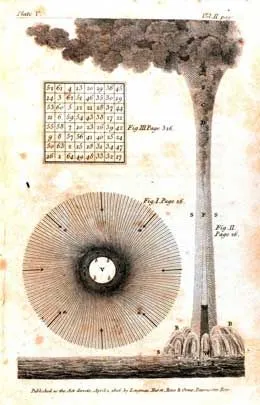
Land-based tornadoes can reach wind speeds of about 300 mph (the 1999 Bridge Creek–Moore F5 tornado in Oklahoma was clocked at 301 mph ± 20 mph, the highest near-surface wind ever directly measured on Earth). Waterspouts are usually much milder, averaging around 30 to 60 mph at the outer wall, but the strongest tornadic waterspouts can exceed 100 mph and become very destructive. Like a tornado, a mature waterspout consists of a low-pressure central vortex surrounded by a rotating funnel of updrafts. The vortex at the center of these storms is strong enough to “suck up” surrounding air, water, and small objects like a vacuum and transporting animals high up in the air.
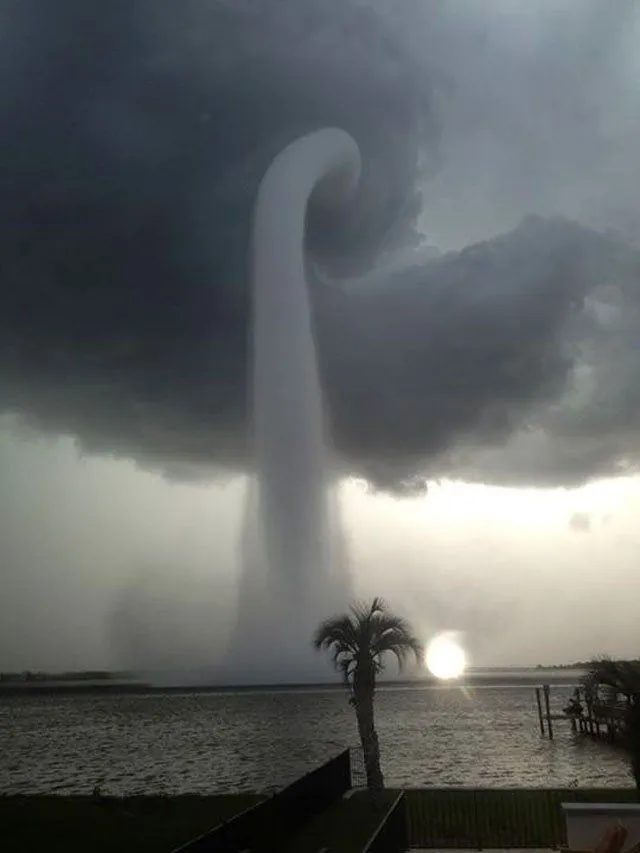
Because these waterspouts and other types of tornadoes are on the move, when they do eventually break open and release their unwilling passengers, the animals will be far away from their original habitat, hence the appearance of animals raining from nowhere.
Is This Hypothesis Correct?
Basically, even after this explanation is based on science and seems to be quite reasonable, many scientists are still sceptical. Their critique usually concerns two problems with the ‘waterspout hypothesis’. Firstly, it is weird that accounts of raining animals always seem to involve just one species. It’s always either raining fish or raining frogs, but it never seems to rain fish and frogs. We certainly hope that weather is not biased against one of the species. It’s possible that only dense groups of a particular specie allow ‘liftoff’ at a particular instance.
Secondly, nobody has ever seen it happen! Lots of people have seen the supposed result of raining animals which is, a lot of animals dead on the ground where they’re not supposed to be and a decent subset of those have actually seen the creatures fall from the sky. But nobody has ever managed to see a waterspout pick up a pond’s worth of life and carry them thousands of feet into the air.
Has It Ever Rained Snakes Or Other Animals?
Fish and frogs get all the headlines, but they are not the only creatures on the list. Small worms and even tiny jellyfish have turned up in reports of such "falls," and the most notorious case of all involves snakes. On 15 January 1877, after a short but violent rainstorm, a two-block stretch of South Memphis, Tennessee, was reportedly left crawling with small dark snakes. It sounds like a textbook animal rain, until you read the fine print: nobody actually saw them fall. The creatures were only 30 to 46 cm (12 to 18 inches) long, no thicker than a knitting needle, and moved by looping their bodies like inchworms rather than slithering. Investigators later suspected they were horsehair worms or leeches flushed out of hiding by the downpour, not passengers dropped from a cloud.
The modern version of this confusion is digital. Viral clips of snakes tumbling from the sky, shared widely in 2025 and 2026, have been traced back to artificial intelligence rather than the weather. One heavily circulated "snake rain" video was flagged as AI-generated with roughly 96.5% confidence by detection tools, and analysts pointed out snakes appearing to pass straight through power lines and floating in place instead of falling under gravity.

Spiders are a category all their own. The "spider rain" that occasionally blankets towns in Brazil looks exactly like animals falling from the sky, but it is really ballooning: young spiders spin out silk threads and drift away on air currents to spread to new territory, and their abandoned sheets of gossamer then drape trees, fences and power lines. No storm lifts them and nothing truly rains down. It just looks that way from the ground.
Why Does It Rain Frogs In The Movie Magnolia?
The most famous frog storm of all never happened outside a cinema. In the climax of Paul Thomas Anderson's 1999 film Magnolia, thousands of frogs suddenly pelt the San Fernando Valley while the tangled lives of the characters reach breaking point. So why frogs, and why then? The scene has two roots. Anderson has said he first borrowed the idea from Charles Fort, the same writer whose 1919 Book of the Damned catalogued the real-world falls of fish and frogs that we met earlier in this article.

The second root is biblical. The film is quietly stitched together with references to Exodus 8:2, the verse in which Moses warns Pharaoh, "if thou refuse to let them go, behold, I will smite all thy borders with frogs." That is the second plague of Egypt. A sign glimpsed in the background reads "Exodus 8:2," and the paired numbers 8 and 2 keep resurfacing throughout the story. The twist is that Anderson has said he did not realise the frog rain was also a scriptural image when he first wrote it; he was chasing Fort's fringe science, and only later did the Exodus parallel reveal itself. So the movie's frogs end up being equal parts strange weather report and ancient prophecy. As for whether a single real frog was involved in the downpour, that is a question for the next section.
Will You Ever Be Able To See Falling Animals?
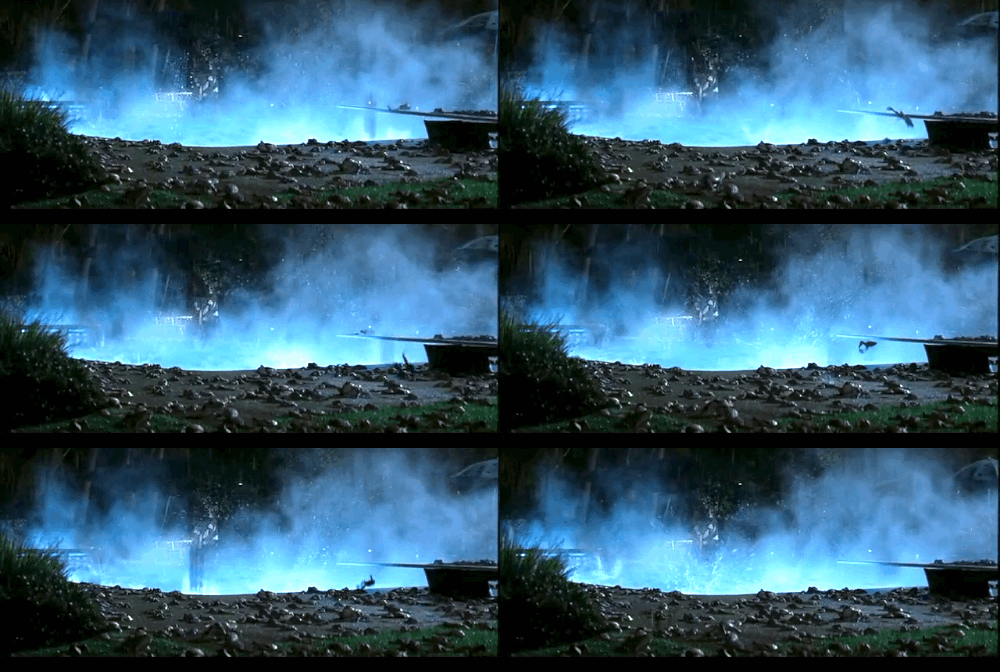
Apart from creepy scenes in a movie, the probability of actually catching one such event on tape is pretty slim. In the movie “Magnolia,” explaining the rain of frogs is easy, as no real frogs were used. Visual effects artist Derek Gillingham and about a dozen other artists, animators and technicians spent weeks studying frog coloration and physiology before generating the digital amphibians that fall through the air.
In a warmer world the atmosphere can hold more moisture, which means more thunderstorm-driven heavy rainfall events. The probability of a storm being able to lift small animals from ponds and other places might also increase. So, with the global temperature on a rise let’s hope that we never have to experience ‘cownados’.
References (click to expand)
- Can it rain frogs, fish, and other objects? Library of Congress, Everyday Mysteries.
- What is a waterspout? NOAA National Ocean Service.
- Waterspouts. National Weather Service, Key West.
- Benjamin Franklin to John Perkins, 4 February 1753 (waterspouts and whirlwinds). Founders Online.
- 1999 Bridge Creek–Moore tornado (301 mph wind measurement). Wikipedia.
- Fort C. The Book of the Damned (1919). Project Gutenberg.
- Why Are Birds Falling From the Sky? National Geographic.
- Magnolia (film). Wikipedia.
- Why Magnolia Has So Many References To The Book Of Exodus. SlashFilm.
- When Snakes Rained on Memphis. Memphis Magazine.
- Truth Behind the Viral Snake Rain Video: AI-Generated, Not Real. CyberPeace.
- It's Raining Spiders in Brazil. Smithsonian Magazine.