Table of Contents (click to expand)
Scooping out all the plastic in the oceans sounds simple, but it is not realistic. With 75 to 199 million tons already in the water, cleanup is slow and costly, and the ships involved burn fuel and risk by-catch of marine life. Stopping plastic at its source matters far more than scooping it out.
We have found plastic in every corner of the world we’ve looked at, from the Arctic to the Antarctic, from the highest points on land to the deepest oceans.
Since the invention of Bakelite in 1907, plastic has been silently tightening its grasp over our planet and all its ecosystem inhabitants. A landmark 2017 study published in Science Advances tallied up every kind of plastic ever made: roughly 8.3 billion metric tons by 2015. Of all the plastic waste generated up to that point, only about 9% had been recycled and 12% incinerated. The remaining 79% piled up in landfills or leaked into the natural environment, where most of it still sits today.
All plastic ends up harming the environment where it is released or disposed of; animals get caught in it or end up consuming it. Since plastic doesn’t decompose, it will persist in the environment for decades, if not centuries. One solution is to remove the bigger pieces of plastic, such as water bottles and plastic bags, from natural spaces. This is easy to do on land, as we can simply walk over and pick up the piece of plastic.
But what about the 75 to 199 million tons of plastic matter that’s already in the oceans?
To address this issue, The Ocean Cleanup, a Dutch non-profit, has taken the matter into its own hands, committing to cleaning up the plastic present in marine water bodies by literally “scooping out” the floating plastic trash from the oceans.
How efficient is this process, and how will it impact marine life?
The bigger picture demands us to rephrase the question from, “Can we scoop out the plastic from the oceans?” to “Should we be scooping out the plastic at all?”
The Amount Of Plastic In Our Oceans
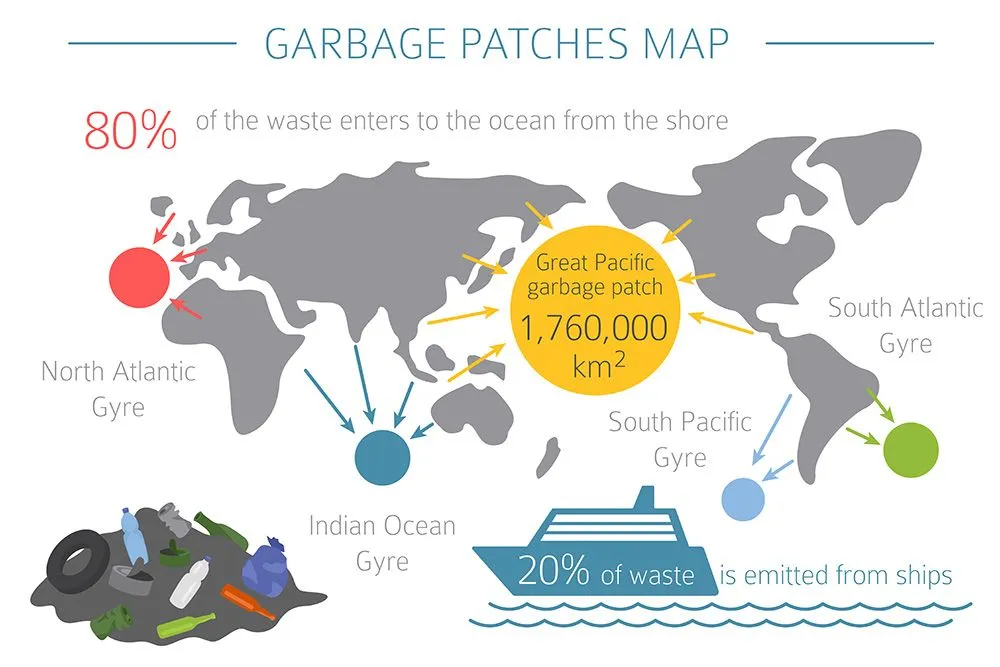
Plastic in our ocean is everywhere, but the majority is concentrated in patches due to rotating oceanic currents (gyres). There are five such gyres and garbage patches, the most famous of which is the Great Pacific Garbage Patch, covering 1.6 million square kilometers (about 620,000 square miles, or twice the size of Texas). The Ocean Cleanup estimates it holds roughly 100,000 metric tons of plastic spread across an astonishing 1.8 trillion pieces.
The others include a patch in the Indian Ocean, two in the Atlantic, and another in the Pacific Ocean.
Each gyre has garbage patches of various sizes.
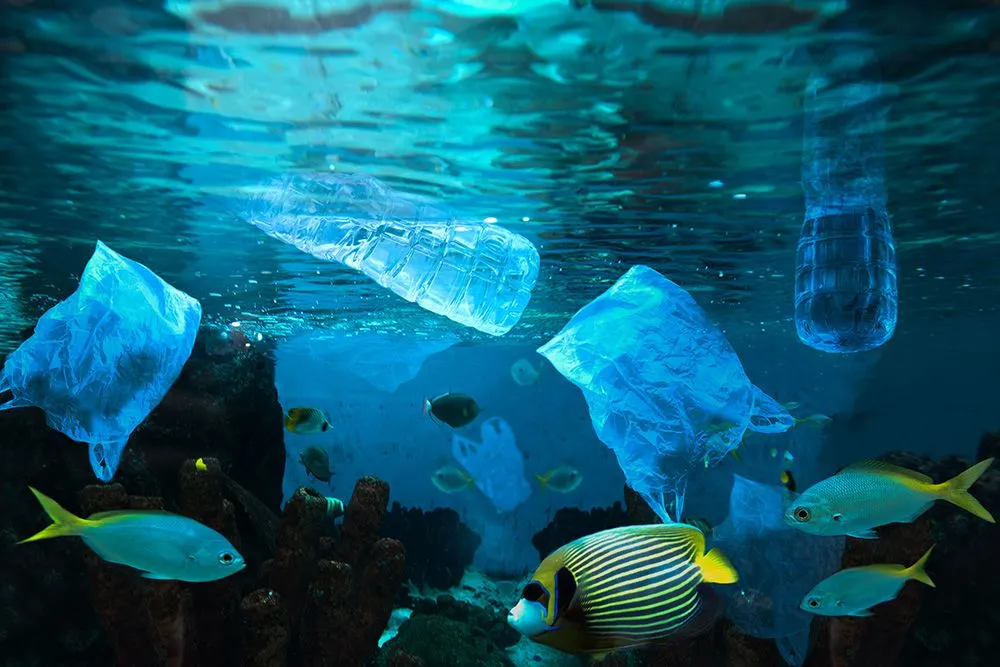
Floating plastics caught in these patches will continue to circulate until they disintegrate into smaller fragments, making it increasingly challenging to clean up. Plastic bags are frequently mistaken for jelly fish, a favorite food of loggerhead sea turtles. Albatrosses feed plastic resin pellets to chicks because they perceive the pellets to be fish eggs. The chicks eventually starve to death or suffer organ rupture.
Research shows that most of the plastic litter spiraling into the gyres and the Great Pacific Garbage Patch is decades old, but it turns out that more recently produced plastic remains closer to coastlines. This suggests that one of the best ways to deal with ocean plastics may be through beach cleanups.
The Ocean Cleanup
The goal of The Ocean Cleanup is to remove 90% of the floating plastic waste in the ocean and to make the Great Pacific Garbage Patch “garbage free.”
Its latest and most functional cleanup technology, System 03 (deployed in 2023), consists of a three-meter-deep, floating net-like barrier roughly 2,250 meters (about 1.4 miles) long that is towed in a large U shape between two ships. By August 2025, this floating system had pulled close to 500,000 kilograms (about 1.1 million pounds) of plastic out of the Great Pacific Garbage Patch. In 2025 The Ocean Cleanup actually paused extraction for a year to run a “hotspot hunting” survey, mapping where the plastic concentrates most densely so future sweeps are more efficient.
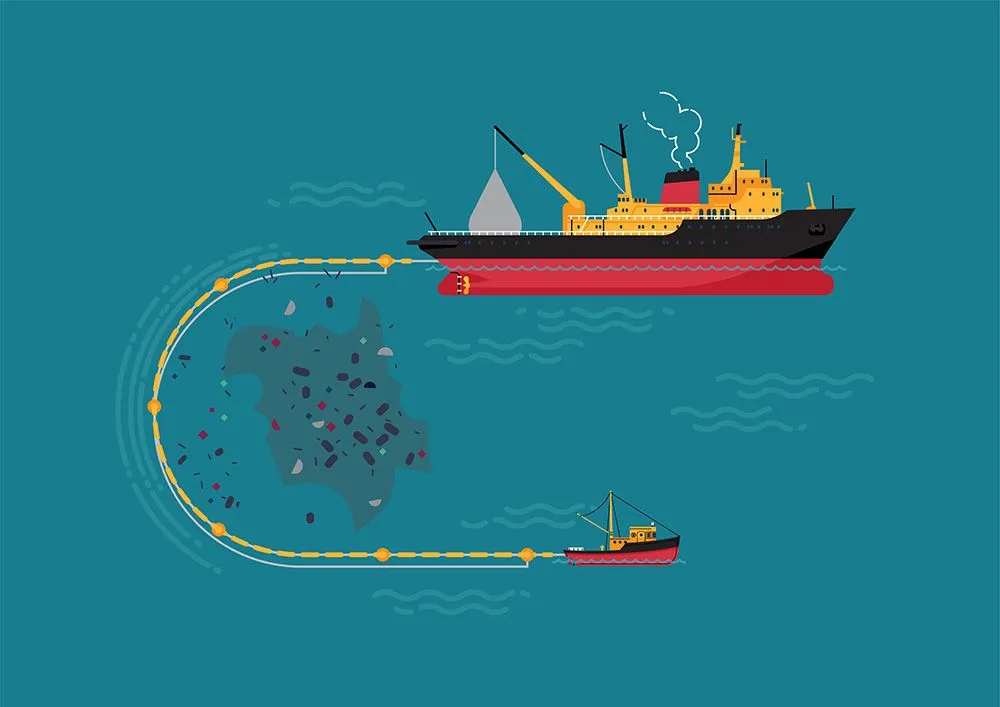
However, what gets overlooked is that the large ships used to drag the collection net have a sizable carbon footprint. Dragging nets through ocean water with massive ships powered by fossil fuels adds to air and climate pollution. In their own Environmental Impact Assessment report, it can be seen under Section 5.0 that the two vessels operated by The Ocean Cleanup release 600 metric tons of carbon dioxide per month of cleanup, which is comparable to over a hundred cars on the road for an entire year.
There is also a bycatch issue (trapping marine animals whilst collecting plastic). Free-floating plastics are tricky to scoop out from the water without entangling fish, turtles, and other marine wildlife. Even when they are thrown back into the water, these creatures usually die. Organisms that get entangled in fishnets suffer a hampered ability to find food and evade predators. Even if the organism doesn’t actually die, injuries, limitations on movement, and a reduction in their foraging capacity will seriously harm the animal.
Scientists have expressed concern about the effects that this passive collection technology may have on the neuston, a type of biota that dwells on the Pacific Ocean surface (this research was funded by The Ocean Cleanup).
Snails, crabs, sea dragons, and jellyfish are all a part of this ecosystem. These creatures are frequently found living on the surface of plastic waste. As an integral part of the food web, neuston establishes significant ecological links between various oceanic communities. For instance, the neuston serves as a nursery habitat for young fish species, such as Atlantic cod and salmon, and is the primary food source for endangered species like loggerhead turtles.
Riverine Plastic Pollution
According to a 2017 study, the global riverine system discharges somewhere between 1.15 and 2.41 million metric tons of plastic into the oceans every year, and it pointed to a handful of large Asian rivers as the worst offenders. A more recent and finer-grained 2021 analysis in Science Advances revised that picture: more than 1,000 rivers (about 1% of the world’s rivers) are responsible for roughly 80% of the plastic flowing in from waterways, and many of the biggest culprits turned out to be small urban rivers winding through densely populated coastal cities rather than a few giant ones.
From the rivers to our drinking glasses, plastic has made its way into our guts. Drinking water, including bottled and tap water, is the most significant contributor of plastic in the human diet, with the average person ingesting about 1,769 tiny microplastic particles every week, based on a 2019 report backed by the WWF.
To curb this source of marine plastic pollution, The Ocean Cleanup has additionally deployed solar-powered vessels called Interceptors at the mouths of plastic-polluted rivers. Trash is gathered by a barrier as the water flows, is transferred to a conveyor belt, and then dumped into a shuttle, which carries it to a waste management facility. These river systems now operate across countries including Indonesia, Malaysia, Vietnam, Thailand, the Dominican Republic, Jamaica, and the United States. The organization has since folded this work into a “30 Cities Program,” aiming to cut the plastic reaching the ocean from rivers by up to a third by 2030. Across rivers and the open ocean combined, The Ocean Cleanup reports having removed more than 45 million kilograms (roughly 100 million pounds) of trash by early 2026.
Whether this approach does more good than harm over the long run is still an open question, and one that scientists continue to study closely.
Conclusion
The Ocean Cleanup strategy is new, but the ironic damage it does to the environment is not something we should ignore. The best approach to scooping out the plastic from the oceans is to “not focus on the scooping part,” but to focus on the original source of the plastic.
Today’s throwaway culture runs on single-use plastic. Global production has now climbed past 400 million metric tons of plastic a year, and roughly half of it is for single-use items. Cans, water bottles, food containers, and anything else you use once and toss are a huge part of the problem. Tackling it at the source is the most efficient fix, before it escalates beyond our control to the point where cleanup efforts are futile.
References (click to expand)
- Cressey, D. (2016, August). Bottles, bags, ropes and toothbrushes: the struggle to track ocean plastics. Nature. Springer Science and Business Media LLC.
- Lebreton, L. C. M., van der Zwet, J., Damsteeg, J.-W., Slat, B., Andrady, A., & Reisser, J. (2017, June 7). River plastic emissions to the world’s oceans. Nature Communications. Springer Science and Business Media LLC.
- Geyer, R., Jambeck, J. R., & Law, K. L. (2017, July 19). Production, use, and fate of all plastics ever made. Science Advances. AAAS.
- Meijer, L. J. J., van Emmerik, T., van der Ent, R., Schmidt, C., & Lebreton, L. (2021, June 18). More than 1000 rivers account for 80% of global riverine plastic emissions into the ocean. Science Advances. AAAS.
- No pLAStIc IN NAture:.
- Vered, G., & Shenkar, N. (2021, September). Monitoring plastic pollution in the oceans. Current Opinion in Toxicology. Elsevier BV.