Table of Contents (click to expand)
A blowhole is a sea-cave landform that forms when a coastal sea cave erodes upward into a vertical shaft that breaks through to the cliff top. When waves rush in at high tide or in storms, the trapped water and air shoot up through the shaft as a jet that can reach 30 meters (about 100 feet) above the rock. They are not normally dangerous from a distance, but the eruptions are sudden and have killed people who got too close - which is why signposted blowholes (Kiama in Australia, Halona in Hawaii, La Bufadora in Mexico) come with safety barriers.
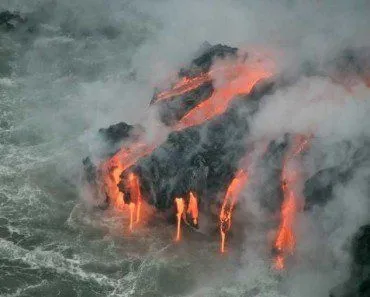
Try thinking of Mother Nature not as some gigantic being that controls all existence on the planet, but rather as a mere human being who experiences emotions, like happiness, sadness, regret and so on. Also, imagine if nature also experienced anger… if this was how nature really worked, then there would definitely be two natural events that depict it; volcanoes and blowholes.
Blowholes
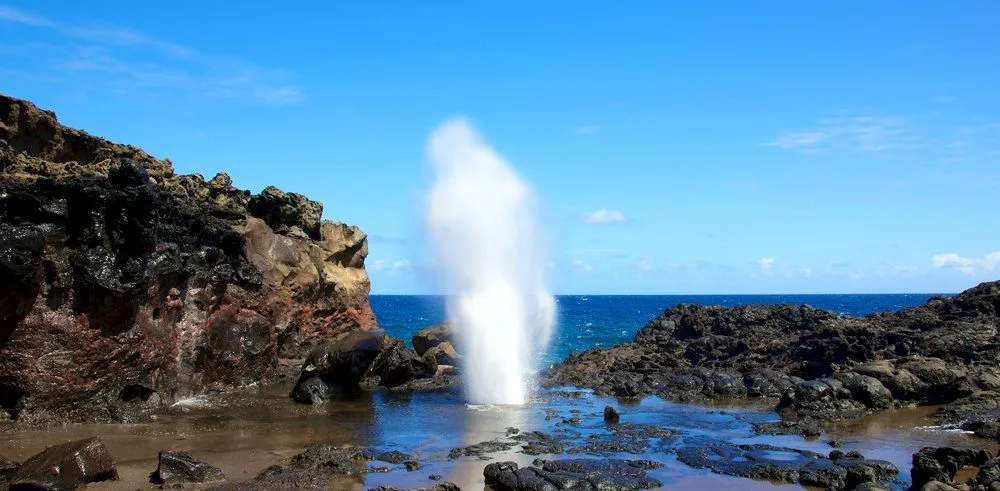
Rocks are undeniably the strongest naturally occurring objects above the surface of Earth, but like many other natural things, rocks also undergo numerous changes over long periods of time. A blowhole, for example, is formed when sea caves grow landwards into vertical shafts, which can cause abrupt blasts of water from its gaping hole.
How Are Blowholes Formed?
Bottom Of The Rock
A blowhole is actually the end product of a long geological process that can take thousands of years, if not longer! At first, the hydraulic action of the waves of the ocean crashing against land causes small fractures in the surface. The constant movement of waves at the bottom of cliffs (or any solid structure at the shore) eats away at the area around the crack and renders it weak enough to create sea caves at the bottom.
As if this wasn’t bad enough for the health of the rock, the movement of waves forces air into these small fissures, which are formed on the surface. As a result, the rock is placed under ever-increasing stress. Things become even worse during high tide, as more faults in the rock are created, more of the surface is eaten away and more air is forced into these fissures.

Above The Land
The rock not only becomes weaker as time passes, but the land above the rock also undergoes geological changes. There is constant and gradual erosion of the upper surface due to various natural processes, such as weathering and chemical dissolution. Therefore, the upper surface is also considerably weakened over a long period of time.
Breakthrough
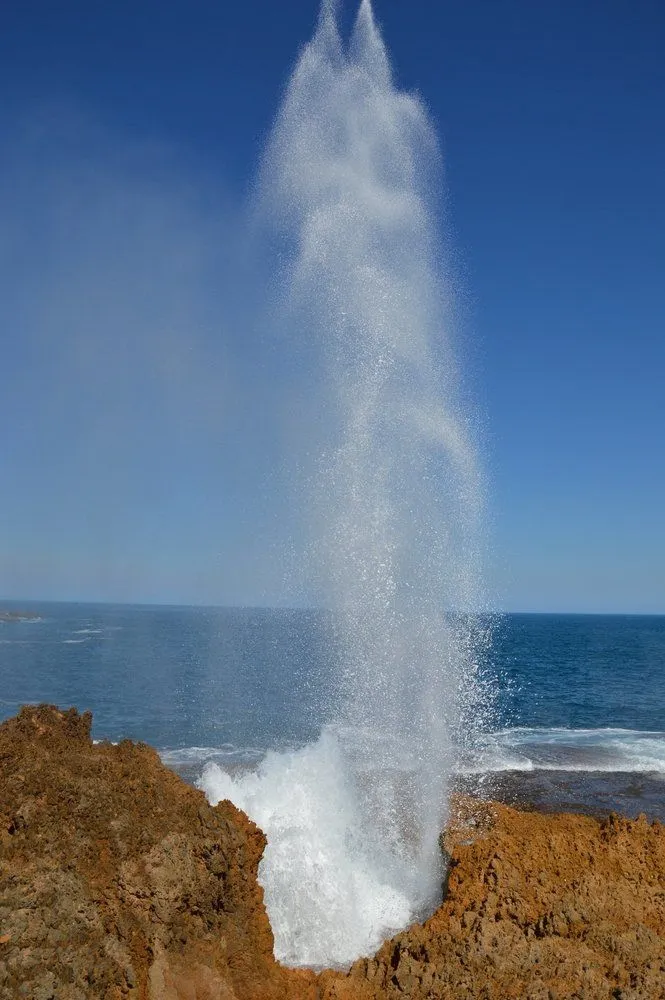
The strength of a rock diminishes at two vital points; its top and its bottom. When both the parts are unable to endure the pressure of the trapped air below and the constant attack of the sea, part of the rock crumbles. When the conditions are ripe, i.e., when there is a high tide or a rough storm at sea, jets of water abruptly erupt out of the newly formed hole at enormous pressures. Some of the outbursts of these water jets can shoot up as high as 30 meters (~98 feet).
Some Known Sites Of Blowholes
There are a few identified sites around the world that are notorious for their famous blowholes. Notable examples include Tiarei in Tahiti, the Hālona Blowhole on Oʻahu, Hawaii, the Trevone blowhole in Cornwall (UK), La Bufadora on the Punta Banda Peninsula in Baja California (Mexico), and Kiama in New South Wales (Australia). The "blowhole" at Wupatki National Monument in Arizona is a different inland phenomenon - a small surface vent connected to an underground earth-crack that breathes air in and out with changing atmospheric pressure rather than being driven by the sea.
How Many Blowholes Are There In The World?
This is one of the most common questions people ask, and the honest answer is that nobody has a tidy number. Unlike the world’s volcanoes or its tallest mountains, coastal blowholes have never been counted in a single global census. There is no official register, and part of the reason is that a blowhole is really just a fleeting stage in a much longer process: the same relentless erosion that opens one can later widen it into an ordinary gully or collapse it entirely, so the “population” is always quietly changing.

What we can say is that blowholes are relatively uncommon. They need a fairly specific recipe: a rocky, wave-battered coast, a sea cave eroding inland, and a line of weakness running up to the surface for the water to escape through. Only a few dozen are well enough known to be named, mapped and (in many cases) fenced off as tourist attractions. The famous ones are scattered widely. La Bufadora near Ensenada, Mexico, fires a jet up to 30 meters (about 100 feet) on a remarkably regular rhythm of one eruption every 13 to 17 seconds, because each blast is timed to the incoming ocean swell. The Hummanaya blowhole in southern Sri Lanka can reach a similar height, and others draw crowds in Hawaii (Hālona), Samoa (Alofaaga), Australia (Kiama) and along the north coast of Barbados. So while you can’t quote a single figure for how many blowholes exist, it is safe to say there are far fewer than people assume, and the truly spectacular, reliable ones number only in the dozens.
Are Blowholes Dangerous?
Blowholes are not known as natural dangers, perhaps less than any other naturally occurring phenomena of such force and energy. What can make blowholes lethal, however, is that they erupt all of a sudden, giving absolutely no time to those people nearby to take any evasive action. The real hazard is rarely the spout itself, but the surging waves that feed it. The most infamous example is the Kiama Blowhole in Australia. On 11 July 1992, a sudden surge of water washed two families off the rocks beside the blowhole; six people drowned and a seventh was lost and presumed dead, in one of the country’s worst tourist tragedies. Hawaii’s Hālona Blowhole has its own grim record: people have been swept into it over the decades, including a Californian teenager who fell in and drowned in 2002. Once someone is dragged into the shaft, rescuers can do little without risking their own lives.
However, the regions where blowholes have been identified usually have warning signs installed near the rocks along the sea line to highlight the presence of blowholes that may erupt suddenly. So your best defense strategy against blowholes is to read those warning signs and keep a safe distance from any dangerous areas on the rocks.
Peeking inside a blowhole obviously isn’t the wisest choice, but if you wait long enough, you’ll be able to catch a glimpse of Mother Nature at her angriest from a safe distance!
References (click to expand)
- Coastal Landforms: What Is A Blowhole? WorldAtlas.
- Lindsay N. W Alker, John E. M Ylroie, Adam D. Walker, And Joan R. M Ylroie - The Caves Of Abaco Island, Bahamas: Keys To Geologic Timelines - CiteSeerX
- Blowhole (geology). Wikipedia.
- 6 Die In Australia After Surge At Blowhole (Kiama, 11 July 1992). Deseret News.
- Blowhole Dangers Caught On Tape (Hālona Blowhole, Oahu). Hawaii News Now.