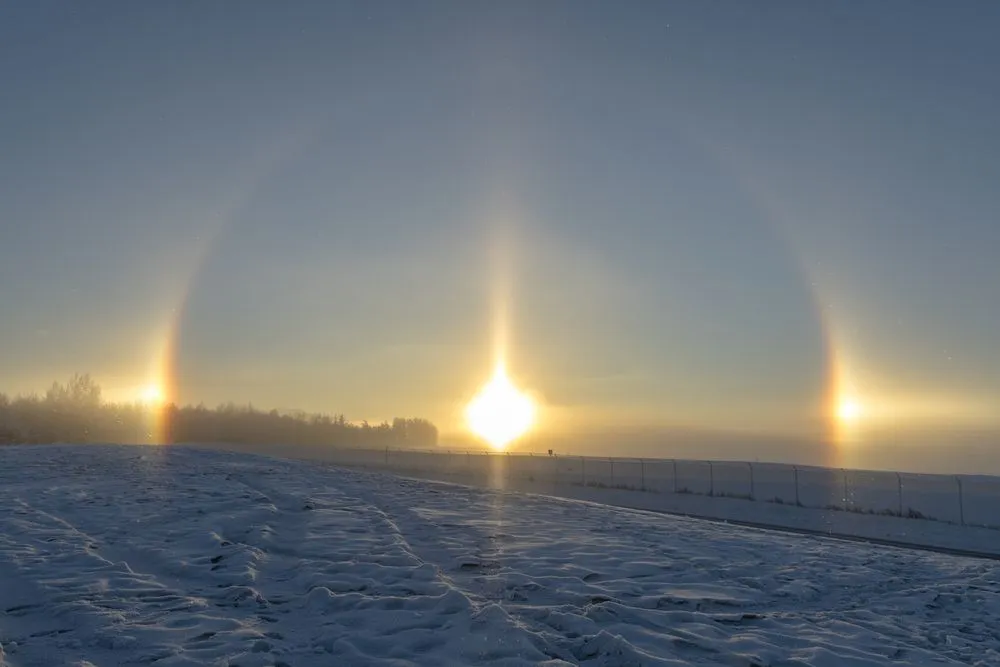
A sun dog is an optical atmospheric phenomenon that causes bright spots at an angle of 22 degrees on one or both sides of the sun. It is also called a mock sun or parhelion in meteorology. Sun dogs occur as a result of the refraction or scattering of light from flat hexagonal-shaped ice crystals that are suspended in clouds.
Sun dogs? Is that a hybrid dog breed? The name certainly sounds peculiar! Do they bite or wag their tails? Not even close. Sun dogs are natural phenomena in the sky that occur under specific conditions. Like so many good things, the beautiful natural combination of colors doesn’t last long, like fleeting rainbows or sky dances in the west, which come and go in a hurry. Nature showcases its mysteries proudly, but only for a short time.
Have you ever seen a triple sun in the sky? Or a bright circle appearing to gleam around the sun? If yes, then you’ve actually spotted sun dogs before! These brilliant arrays of color form around the sun, often appearing on winter afternoons or an hour before sunset during the hot summer. Whenever you see such a phenomenon, you can be sure of one thing—there is ice up in the sky! This ice can reflect, refract or scatter light in many different ways, which leads to the formation of sun dogs. Sometimes, this phenomenon even makes it look like there are three suns in the sky. Most of the time, sun dogs occur when the sun is low on the horizon — typically near sunrise or sunset — during winter under high pressure systems. Despite their reputation as a rare sight, parhelia are actually fairly common; they are simply easy to overlook because they often appear faintly and only when you happen to be looking toward the sun at the right angle.
How Do Sun Dogs Occur?
Sun dogs are formed by hexagonal ice crystals suspended in clouds that drift in the air at lower levels. These ice crystals act as a prism, bending the light rays that pass through them. As the crystals sink vertically through the air, they refract the sun rays horizontally, leading to the formation of sun dogs. Sun rays enter one side of the crystal and pass through another, inclined at 60 degrees to the first. Rays are deviated by 22° or more. Red is the less deviated color, giving the sun dogs a red inner edge. Farther out, the colors fade from shades of orange to blue. Mostly, the colors overlap and eventually result in varying shades of white. These rays deviate through other angles and form halos around the sun.
Formation Of Sun Dogs
- Ice crystals become suspended in cirrus clouds.
- They move vertically down through the air.
- Some of those crystals are flat hexagonal plates, and tend to orient with their flat sides horizontal.
- These crystals begin to act as prisms that refract light.
- Sun rays are refracted by all these crystals, thereby forming a sun dog or halo.
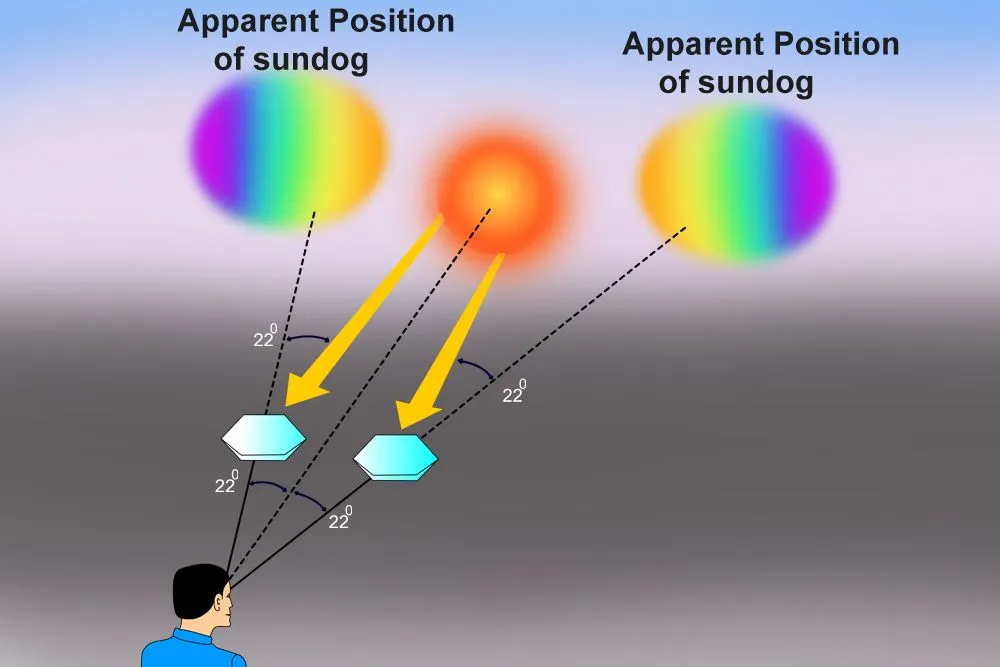
All crystals refract the sun’s rays, but we only see those rays that direct the lights towards our eyes. These are the crystals that are at 22° from the sun. Their collective glints form sun dogs. At times, these appear as broken fragments of a rainbow and in other cases, they appear like an entirely other sun. They can last from 15-30 minutes, depending on conditions. The shape of the crystals determine the form of sun dogs, which could be either a complete circle around the sun, called a halo, or two bright spots on either side of the sun. The distance between the sun dog and the sun affects the color of the sun dog. More clear and visible sun dogs occur when the horizon is very near to the sun. As the sun rises, the sun dogs begin to fade, since the rays passing through the ice crystals are skewed and the angle of deviation increases.
Why Are They Called “Sun Dogs”?
If the name still puzzles you, you are in good company. The honest answer is that nobody is entirely certain, and the Oxford English Dictionary simply lists the word as being “of obscure origin”. What we do have are a few charming theories. One idea leans on an old meaning of the verb to dog, which is to track, hunt or follow. Just as a faithful dog trots alongside its owner, these bright spots seem to follow the sun across the sky, always keeping pace at its side.

A second theory points north, to Norse and Scandinavian folklore. The Danish solhunde and Norwegian solhund both translate literally as “sun dog”, while the Swedish solvarg means “sun wolf”. In these older sky-tales, wolves chase the sun and moon across the heavens, one running ahead and one behind, which is a rather neat description of the twin spots that flank the sun. The formal scientific name avoids the menagerie entirely: a single sun dog is a parhelion (plural parhelia), from the Greek for “beside the sun”. You may also hear them called mock suns, since a bright sun dog can genuinely look like a second, smaller sun hanging in the sky.
How Rare Are Sun Dogs, And When Should You Look?
Here is the surprise: sun dogs are not nearly as rare as their dramatic appearance suggests. According to reviews of atmospheric optics observations, parhelia turn up roughly once or twice a week on average, and the larger 22° halo is visible on the order of 100 days a year. The reason most of us rarely notice them is simple. We are warned from childhood never to stare at the sun, so we almost never look in the right direction at the right angle to catch one.
You can see sun dogs anywhere in the world and in any season, provided there are high, thin cirrus clouds carrying the right ice crystals. They are most obvious when the sun sits low, near sunrise or sunset, which is also the safest and most comfortable time to look toward it. Winter afternoons under a high-pressure system are classic conditions, but the same display can appear on a hot summer evening when ice crystals form high in the cold upper atmosphere. A single show typically lasts somewhere between 15 and 30 minutes, fading as the geometry of the sun and crystals shifts. So the trick is less about luck and more about habit: glance about a hand-span to the left and right of a low sun on a hazy day, and you will start spotting them far more often than you would expect.
Sun Dogs Vs. Halos And Sun Pillars: How To Tell Them Apart
Sun dogs belong to a whole family of ice-crystal optics, and it helps to know the cousins. The closest relative is the 22° halo, a complete ring of light circling the sun at a radius of about 22 degrees. The halo and the sun dogs share the same basic ray path through hexagonal crystals, but they differ in how those crystals are arranged. A 22° halo forms when the crystals tumble in all orientations, so light is bent into a full ring. Sun dogs need the flat, plate-like crystals to drift roughly horizontal, which concentrates the light into two bright spots level with the sun, sitting right on the halo where it crosses that line.

There is a neat way to tell them apart in the sky. When the sun is near the horizon, the sun dogs sit almost exactly on the 22° halo. As the sun climbs higher, sunlight has to take a more skewed path through the plate crystals, so its angle of deviation grows and the sun dogs drift outward, away from the halo, before fading from view. A sun pillar works on a completely different principle. Instead of light being refracted (bent) through the crystals, a pillar is light reflected off the flat faces of falling crystals, producing a vertical shaft of glow directly above or below a low sun rather than spots to the side. So the quick field guide is: a ring means a halo, two colored spots beside the sun mean sun dogs, and a vertical streak of light means a sun pillar.

Sun Dogs And Beliefs
There are many beliefs and sayings about sun dogs. Ancient Greeks believed that sun dogs signified an upcoming storm. Some people also believed that sun dogs meant it would be a fair weather day. Also, if a sun dog appeared in early December or late January, people used to say, “Tonight will be clear as a bell and cold as hell.” Sun dogs are often seen as a sign of upcoming rain or snow, and generally imply good fortune.
This phenomenon also occurs in relation to the moon, which is (unsurprisingly) called a moon dog. This is less significant and far more rare, since moonlight is not as bright as sunlight. It is also observed that this phenomenon can occur on other planets. On Mars, sun dogs may form from both water-ice and carbon dioxide (CO2) ice crystals in the thin Martian atmosphere. On the gas giants — Jupiter, Saturn, Uranus and Neptune — sun dogs would be produced by ammonia, methane and other exotic ice crystals, and astronomers expect that four separate sun dogs (rather than two) could appear because of the different crystal geometries involved. Clearly, sun dogs are one of the most astonishing, entrancing and widespread mysteries of nature!