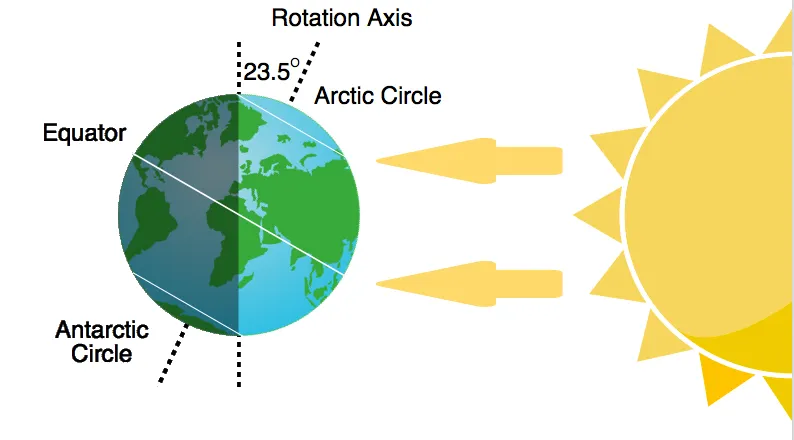
The Midnight Sun and Polar Night happen because Earth's axis is tilted about 23.5° relative to its orbit around the Sun. During each hemisphere's summer, that tilt leaves the polar region permanently angled toward the Sun, so the Sun never sets — giving Norway, Iceland, Alaska and Antarctica weeks of continuous daylight. Six months later, the same region tips away from the Sun and gets the opposite: weeks of Polar Night, with the Sun never rising. At the poles themselves, each phase lasts roughly six months.
Are you a morning person? Do you simply love the morning and feel that there is never enough daytime to do all the outdoor activities you want? Do you just hate the silence and darkness of night? Or are you a night owl who loves the dark hours? Do all your creative thoughts come to life in the solace of night?
Well, the Earth moves such that you have to face both night and day in your regular life. For some people, night can be very depressing and lonely, whereas there are other people who love the nighttime and they hate nothing more than the morning sunlight.
Well, what if I told you that in this world, there are places where the Sun does not set for days at a time? For all you night owls, don’t worry… these places also have a period of time when the Sun does not rise for days!
Let’s find out where and how this amazing phenomenon occurs!
What Is The Midnight Sun?
Midnight sun is a natural phenomenon where you can see the Sun even at midnight. This phenomenon occurs near the Arctic and Antarctic Circles.
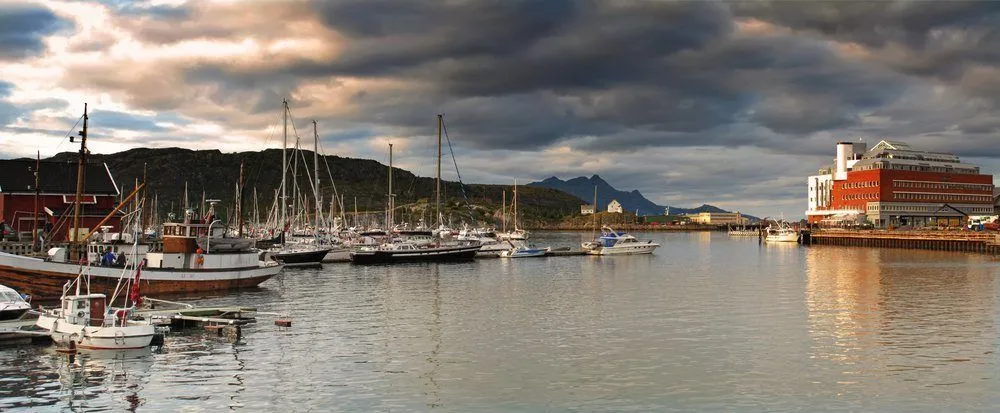
Midnight Sun occurs north of the Arctic Circle around the June solstice (~June 21), when the Northern Hemisphere is tilted toward the Sun. At the same time south of the Antarctic Circle, the opposite phenomenon — Polar Night — is taking place. Six months later, at the December solstice (~December 21), the Antarctic Circle gets the Midnight Sun while the Arctic Circle goes through its Polar Night.
In the Arctic circle, midnight sun can be seen in countries like Norway, Finland, Iceland, Sweden and Canada. In the Antarctic circle, the phenomenon can only be seen in Antarctica, which is not inhabited by humans (aside from a small number of researchers) In fact, in places close to the poles, the Sun does not set for half a year during their respective summer seasons and does not rise for half a year during their winters.
What Is The Polar Night?
The opposite of this phenomenon is called ‘polar night’ — a 24-hour stretch with no direct sunlight. It only happens inside the polar circles (north of 66.5° latitude or south of −66.5°), where Earth’s tilt drops the Sun fully below the horizon. Areas just outside the polar circles never quite go fully dark because the atmosphere scatters light from the still-below-horizon Sun, producing twilight rather than night. Even within the polar circles, that scattered twilight cuts into the polar-night count: at the North Pole the Sun is geometrically below the horizon for around 179 days, but only a portion of those days are truly dark — many feel like a long, dim dusk.
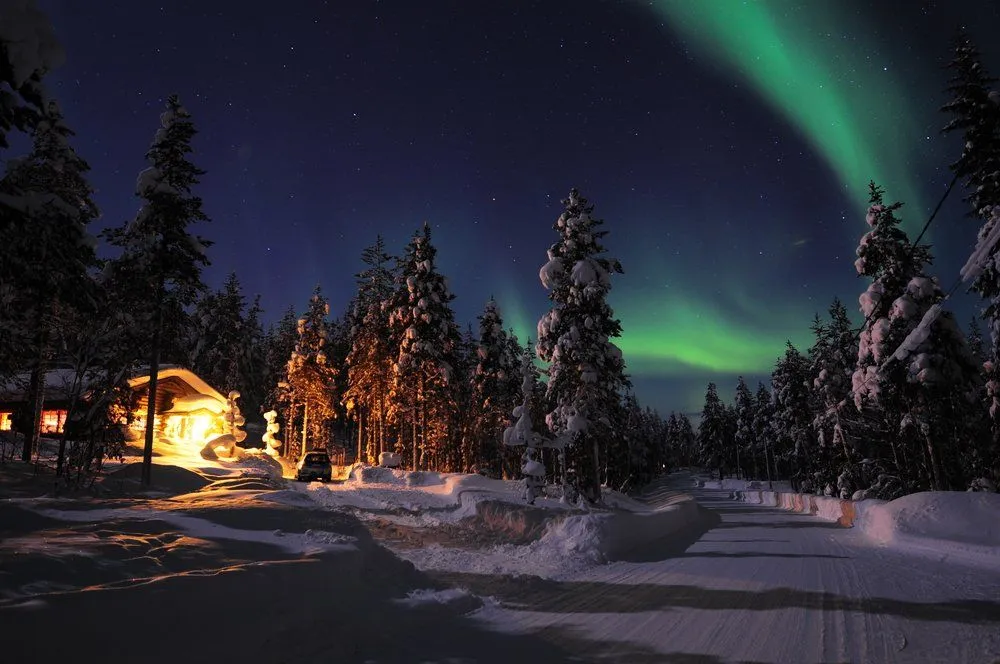
Polar Night (Credits: Richard Cavalleri/Shutterstock)
Why Do Midnight Sun And Polar Night Occur?
Earth completes one rotation on its axis every 24 hours, which causes the daily change between day and night. But the planet is also tilted — its rotational axis sits at about 23.5° relative to the plane of its orbit around the Sun. If Earth’s axis were instead perpendicular to that orbital plane, every place on Earth would get 12 hours of daylight and 12 hours of night, all year round.
As a result of that axial tilt, the Sun never sets above the Arctic Circle around the June solstice — and right at the North Pole, the Sun stays up continuously for about six months from the March equinox to the September equinox. The Antarctic Circle gets the mirror image: continuous daylight around the December solstice, and continuous Sun at the South Pole for the roughly six months from September to March.
Wow! No matter how much you love night or day, can you imagine yourself living in an area where the Sun does not set for six months, but for the next six months, the world is entirely dark?
Which Places Actually Get 6 Months Of Day And 6 Months Of Night?
This is the part that trips most people up. You may have heard that somewhere on Earth the Sun stays up for six months and then vanishes for the next six. That is genuinely true in only one kind of place: right at the geographic North Pole and South Pole. No country or town sits exactly on a pole, so no inhabited place gets a clean half-year of daylight followed by a half-year of darkness. The popular “6 months day, 6 months night” line is really shorthand for what happens at the poles, not at any city you could move to.

Even at the poles, the split is not a perfect 50/50. At the North Pole the Sun stays continuously above the horizon for about 186 days and below it for about 179 days; at the South Pole those numbers are flipped. Two effects tip the balance toward more daylight. First, the atmosphere bends (refracts) sunlight by roughly 34 arcminutes near the horizon, and because the Sun is a disc rather than a point, its upper edge stays visible even when its center has already dropped below the horizon. By the standard the US Naval Observatory uses, sunset only counts once the Sun’s center sinks about 50 arcminutes (34′ of refraction plus 16′ for the Sun’s radius) below the horizon. Second, Earth’s orbit is an ellipse, and the planet is closest to the Sun (perihelion) in early January, which stretches out the Northern Hemisphere’s polar day. Put together, the polar day always runs a little longer than the polar night.
So the honest answer to “which country has 6 months of day and 6 months of night?” is: none of them, not exactly. The closest experience belongs to the people living farthest north, and even they get weeks or a couple of months of each, never a tidy half-year.
Where Does The Midnight Sun Occur, And Who Lives With It?
The midnight sun is visible anywhere inside the Arctic Circle (about 66.5°N) or the Antarctic Circle (about 66.5°S). Thanks to the same atmospheric refraction described above, you can actually catch it slightly south of those lines too, from roughly 65.7° all the way to the poles. The closer you are to a pole, the longer the run of all-night sunshine: at the circle itself it lasts essentially a single day around the solstice, while near a pole it stretches on for months.

Because Antarctica has no permanent residents beyond research crews, almost everyone who actually lives with the midnight sun is in the far north. Longyearbyen on Norway’s Svalbard archipelago, at 78°13′N, is the world’s northernmost true town (around 2,500 people) and sees the Sun stay up from roughly late April to late August. Murmansk in Russia, the largest city north of the Arctic Circle, gets the midnight sun for about 62 days (22 May to 22 July). Parts of northern Norway, Sweden, Finland, Iceland, Alaska, Canada and Greenland all share the experience to differing degrees, courtesy of the same axial tilt that gives the planet its seasons.
References (click to expand)
- http://curious.astro.cornell.edu/about-us/46-our-solar-system/the-moon/observing-the-moon/127-is-the-moon-always-visible-during-winter-on-the-north-pole-intermediate
- Polar Regions - Dive & Discover.
- Rise, Set, and Twilight Definitions. US Naval Observatory, Astronomical Applications Department.
- Midnight sun. Wikipedia.