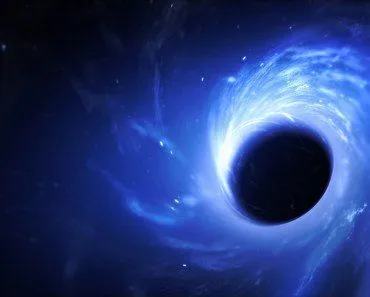
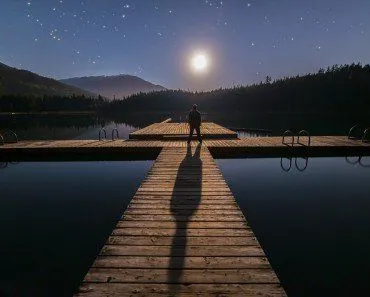
Darkness can’t possibly be faster or slower than light, since darkness possesses no physical properties of its own.
What do you see when you look up at the sky?
Emptiness.
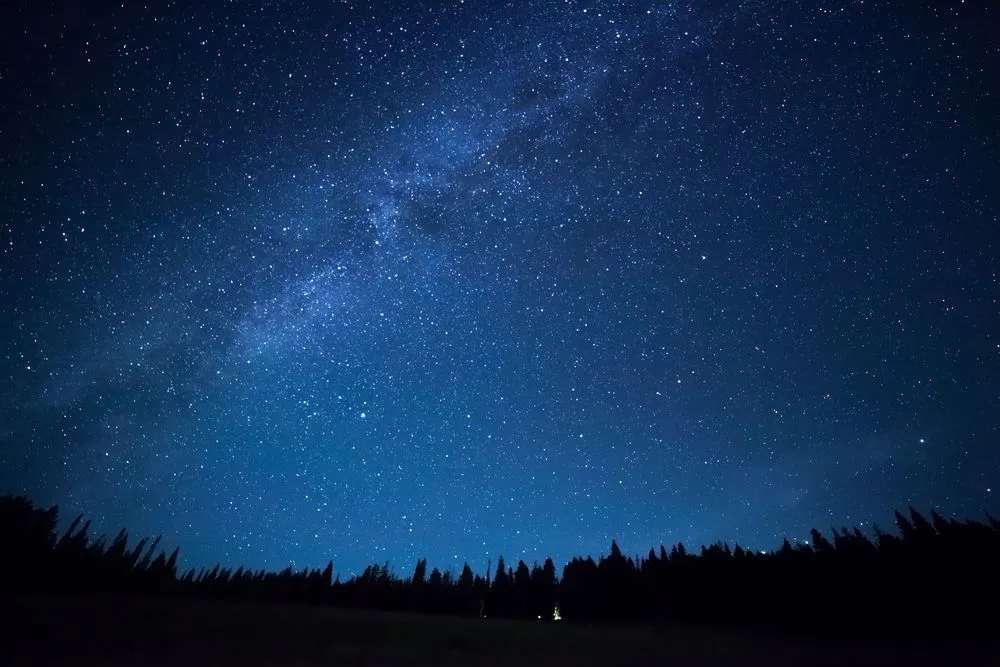
Well, not exactly emptiness, but an expanse so vast that anything it contains seems like a mere speck of dust in the open sky. During the day, this vast expanse seems light blue to anyone on the surface of the Earth. This is due to the scattering of the Sun’s light rays in Earth’s atmosphere. However, when the Sun sets, and there is no external source of light, we see the true colors of the Universe, the true color of the Universe being no color at all. That’s why we refer to it as space. Being an empty, open space leaves it in darkness.
To the human eye, darkness and light are two opposing entities, so from a scientific standpoint, which one of them is faster? Which one would traverse the distance from point A to point B quicker? The short answer to this question is that there is no comparison to be made, as darkness does not possess a speed of its own. However, this short answer isn’t exactly a satisfying answer. For that, we need to understand the relationship between light and darkness.
Are Darkness And Light Two Opposing Entities?
When we look up at the night sky, the shining lights of the stars stand out against the darkness of the Universe. So, if they look like polar opposites to the human eye, and we consider them as opposites in all aspects, be it media, art, good and bad, Yin and Yang, they must actually be opposing entities, right?
Wrong.
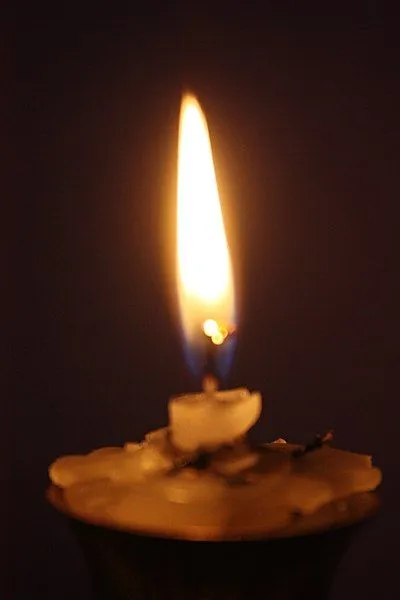
Now, light travels at exactly 299,792 kilometers per second (about 300,000 km/s) in a vacuum (in the absence of a medium). That is, light possesses speed of its own and, therefore, physical properties of its own. Furthermore, we can produce light because light has a source from which it originates. This makes light an independent physical entity.
However, the same principle doesn’t apply to darkness.
Darkness does not possess a speed of its own. We cannot create darkness, as darkness has no source. In fact, the only reason why humans can identify darkness is that light exists. Scientifically, darkness is not an independent physical entity. Darkness is defined as merely the absence of light. It is mere emptiness.
Almost everything we point a telescope at looks dark. The black gaps between the stars are not a substance; they are simply directions in which no bright source happens to be sending light to our eyes, either because nothing is there or because any objects are so far away that their light hasn’t reached us yet. (This visual darkness is a separate idea from the finding that the cosmos is roughly 95% dark matter and dark energy, where "dark" means invisible to our instruments rather than literally unlit.)
Look at it this way: Why do we experience day and night on Earth? Day and night happen because Earth rotates on its axis, so the half facing the Sun is lit while the opposite half is in shadow. Other rotating bodies, even airless ones like Mercury and the Moon, experience their own day-night cycles for exactly the same reason.
What the atmosphere does change is the transition. On Earth, sunlight gets scattered by the air, giving us a soft twilight before sunrise and after sunset. On a body without an atmosphere, the change from full sunlight to darkness is almost instantaneous, with no slow, glowing dawn. So the speed at which night replaces day is set by how quickly the Sun, our light source, drops below the horizon.
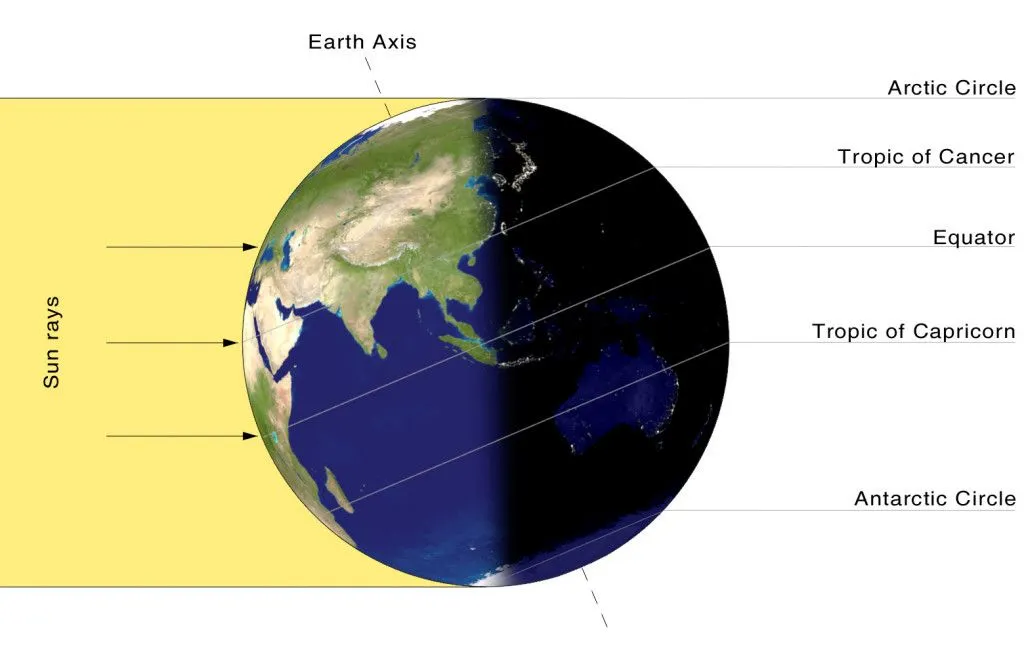
Darkness, once again, has no source, so the rate at which night replaces day is set entirely by how fast the light source disappears. Since darkness is defined as the absence of light, the boundary between lit and unlit regions can only keep pace with the light that defines it. When that boundary is set by a receding light source, it advances at the speed of light, 299,792 kilometers per second in a vacuum, and no faster. (There is one striking exception, where the edge of a shadow can appear to race across a distant surface faster than light without anything physical breaking the cosmic speed limit. We unpack that below.)
Light Or Darkness: Which Is Faster?
To present this from a purely scientific point of view: To find out whether darkness is faster or slower than light, we would need to compare their speeds. Speed here is not relative. For either of these to be deemed quicker or slower, both must possess their own speed. Now, light in a vacuum possesses a speed of 300,000 kilometers per second. This speed changes from medium to medium, being 225,000 kilometers per second in water, 200,000 in glass[2], etc.
Darkness, on the other hand, possesses no speed of its own.
So, scientifically, no comparison can be made, since darkness cannot be produced, and no speed can be ascertained. The speed of darkness in an environment where light is present can only be calculated at a point where light is receding, so the speed of darkness would be the same speed at which the light is moving.
Therefore, the speed of darkness would also be 300,000 kilometers per second in a vacuum, 225,000 kilometers per second in water, and so on. From a scientific standpoint, darkness is neither faster nor slower than light, since it travels at the speed of light itself.
Does Darkness Exist, Or Is It Just The Absence Of Light?
This is the question most people are really asking, and the honest answer is that "darkness" is a description, not a thing. Think of it the way you think about a dry towel. "Dry" is not a substance you can bottle and pour onto a surface; it is just the word we use when water is absent. You can only take water away. In exactly the same way, you cannot manufacture darkness and ship it somewhere. You can only remove the light, and whatever is left over, we call dark.

In physics, the same idea holds. An object looks dark when it absorbs the light that lands on it rather than reflecting it back, which is why matte black paint and fresh tarmac look so much darker than a white wall. The "darkness" is not a coating on the object; it is the shortage of reflected photons reaching your eye. A region of space looks dark for the same reason, because few or no photons are travelling from it to you.
Here is the twist that makes "true" darkness almost impossible to find. Even the blackest gap between the galaxies is not genuinely empty of light. The whole observable Universe is bathed in the faint afterglow of the Big Bang, the cosmic microwave background, a sea of microwave-wavelength photons that fills every direction we look. Our eyes simply cannot see those wavelengths. So darkness, scientifically, is best described not as a substance and not even always as a perfect absence of photons, but as a place where there is no visible light reaching us. It is real as an experience, but it is not a "thing" with properties of its own, which is exactly why it cannot have a speed.
Can Darkness (Or A Shadow) Travel Faster Than Light?
You may have heard the claim that a shadow can move faster than light, which sounds like it should shatter Einstein's rules. It does not, and the reason is worth slowing down for, because it is a favourite trick question in physics.

Picture a small lamp, your finger held close to it, and a wall far away. Your finger casts a shadow on the wall. Now wiggle your finger just a centimetre. The shadow on the distant wall lurches a long way, because the shadow is a magnified projection of your finger's movement. The University of California, Riverside physics FAQ on faster-than-light travel puts numbers on it: the shadow's speed gets multiplied by the factor D/d, where d is the lamp-to-finger distance and D is the lamp-to-wall distance. Make the wall distant enough, and the edge of that shadow sweeps across it faster than 299,792 kilometers per second.
The same goes for a spotlight or a laser. Sweep a laser pointer's wrist and the bright dot on a faraway surface can, in principle, cross it faster than light. So why is relativity safe? Because nothing physical actually travels along the wall. The photons only ever go in a straight line from the lamp to the wall, each at the ordinary speed of light. Different photons light up different spots in sequence, and our brain stitches that sequence into the illusion of a single moving edge. As the UC Riverside FAQ stresses, that moving spot "doesn't constitute a signal," so it carries no matter, no energy, and crucially no information from one end of the wall to the other. Relativity only forbids matter, energy, and information from beating light, and a sweeping shadow does none of those things. So the absence of light, just like light itself, never lets you send a faster-than-light message.
Why Do Our Eyes See Darkness At All?
If darkness is just missing light, why does a pitch-black room feel like such a vivid, almost solid thing? The answer is partly in your eyes, not in the room.

Your retina carries two kinds of light detector. Cone cells handle bright light and colour, while rod cells take over in the dark. Rods are astonishingly sensitive, so much so that a rod can register a single photon of light. When you walk into a dark room, your pupils widen and your rods slowly ramp up their sensitivity, a process called dark adaptation that improves noticeably over the first five to ten minutes and keeps sharpening for half an hour or more. That is why a cinema looks impossibly black when you first walk in, then gradually reveals the seats.
Because rods cannot tell colours apart, deep darkness drains the world of colour, leaving the grey-on-grey "night vision" known as scotopic vision. And when essentially no photons reach the retina at all, you do not see a true mathematical "nothing"; the brain fills the void with a faint, formless dark-grey field. Curiously, this means the darkness you "see" is partly built by your own visual system. The room is simply short of light, and your eyes, straining at the very limit of their sensitivity, paint the rest. (If you want to go deeper, we have a whole piece on whether the human eye can detect a single photon.)
References (click to expand)
- The Dark Universe - Chandra X-ray Observatory. The Chandra X-ray Observatory
- Speed of Light in Transparent Materials - Molecular Expressions. Florida State University
- Jo, B., Kim, H., Kim, H. D., & Shin, C. S. (2021, April 27). Exploring the Universe with dark light scalars. Physical Review D. American Physical Society (APS).
- Is Faster-Than-Light Travel or Communication Possible? - The Physics and Relativity FAQ. University of California, Riverside.
- The Building Blocks of the Universe (dark energy, dark matter and normal matter). NASA Science.
- Light and Dark Adaptation. Webvision: The Organization of the Retina and Visual System. NCBI Bookshelf, NIH.
- The discovery of the ability of rod photoreceptors to signal single photons. The Journal of General Physiology (2018). PMC, NIH.