Table of Contents (click to expand)
Light is affected by black holes because of the theory of general relativity, which states that any massive object warps the spacetime around it. This means that the spacetime around a black hole is warped, and light takes the shortest path, which is a little curved. At the event horizon, the spacetime is curved into itself, and light cannot escape the black hole.
For those of us who have done a bit of homework on space, and have a basic understanding of the properties of light and gravity, we may feel like have a lot of the answers. These two things have a huge impact on the known universe, as well as our conception of it.
However, the interaction of these two fundamental aspects of space gets a bit confusing.
We have heard adages like nothing can escape the gravitational pull of a black hole, and we often think of black holes as cosmic vacuum cleaners that can suck up entire galaxies and anything else that has mass. We also think of light as being composed of massless photons, and as the fastest-moving thing in the universe – moving at roughly 300,000 km/second.
So, if light has no mass, then what effect do black holes have on it?

The Movement Of Light: Einstein’s Theory Of Relativity
One of the most important discoveries of the 20th century, and one of Einstein’s key foundations of his theory of relativity, is that light moves at “the speed of light” – roughly 300,000 km/s. The interesting thing is that this is a universal constant, meaning that light cannot move faster or slower than that speed, and that every observer, regardless of the velocity at which they’re moving, or the velocity at which the source of light is moving, will also measure a beam of light moving at the exact same speed.
Having a constant like the speed of light, which didn’t change based on point of view, like other observable phenomena and geometry in the universe, made it very valuable. Einstein used it in his theory of special relativity as an accepted postulate, and it helped establish his ideas about the geometry of space-time, and how time flows based on gravitational and velocity-related factors.

Perhaps most important to this discussion, Einstein posited an opposing view to Newton’s traditional definition of gravity. Instead of Newton’s definition of gravity as the attractive force between two objects that both possess mass, Einstein proposed that large objects in the universe have the ability to distort space-time. In other words, when considering the constant velocity trajectory of a thrown baseball, followed by its gently arcing down to the ground, Einstein didn’t believe that represented the “pull” of gravity.
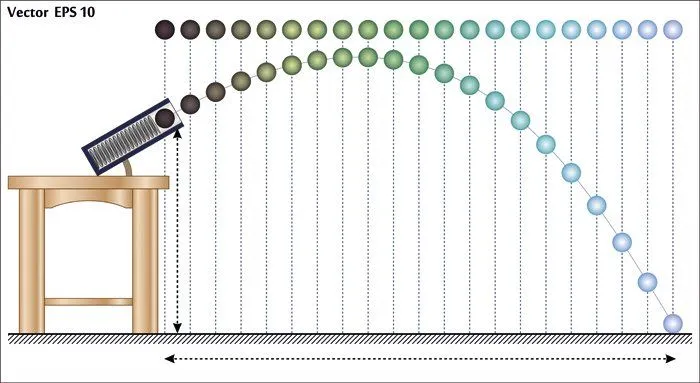
He said that by distorting the geometry of space-time between two objects, that new trajectory was actually a constantly dynamic “straight line”.
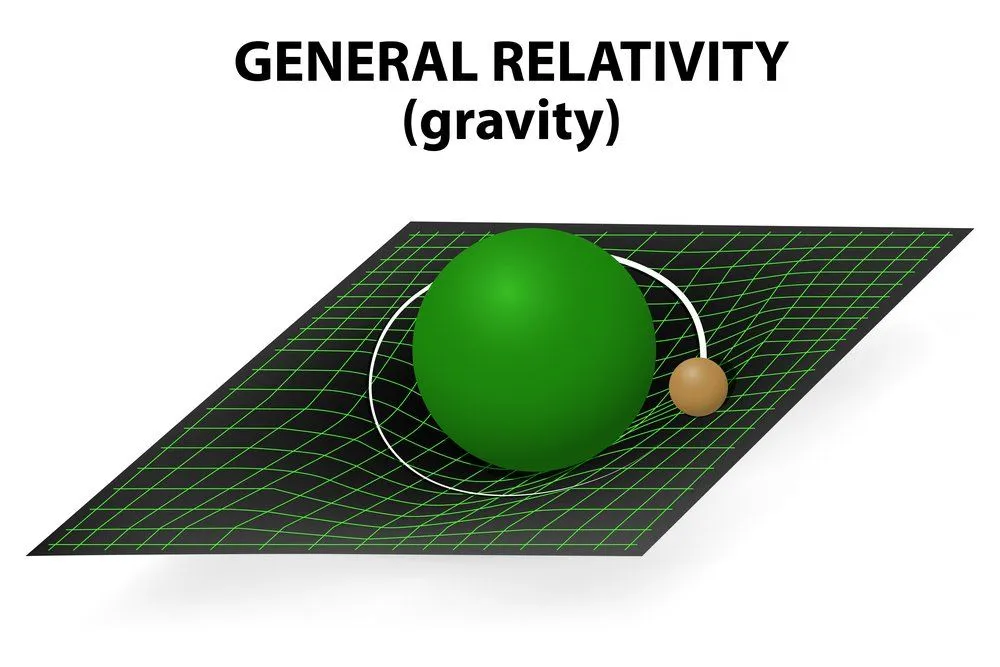
Surprisingly enough, we see the same thing happen to light, which has no mass. When light passes by black holes, as it shifts in that straight line of space-time, it doesn’t speed up or slow down (unlike massive objects, which would accelerate in a gravitational field), because the speed of light is a universal constant. However, the frequency of the light is changed by this space-time geometry distortion, which affects the color of light that we can observe. This phenomenon is known as the gravitational red-shift or blue-shift effect. The color that is emitted versus the color that is observed will be affected by a shift of the light within the visible spectrum, either closer to blue (shorter wavelength) or red (longer wavelength).
Black Holes Vs. Light
Now, we have been talking about light and its colors being affected by gravity wells and passing near black holes, but what about the main event? People say that black holes have such powerful gravitation that not even light can escape it, but that seems contrary to everything we’ve just learned. Light can’t change its velocity, so how could it ever be “contained” or “captured” by a black hole?
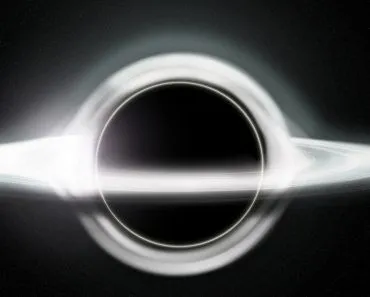
Well, black holes are unique phenomena in the universe because they have what’s called an event horizon. Beyond that point, matter is unable to escape from the black hole’s “pull”. Given what we know about blue and red light shifts, coupled with the distortion of space-time near large material bodies, we begin to understand what happens to light. The closer that light is to the event horizon, the more the distortion of space-time causes light to bend.

Why Does Light (Photons) Feel The Effects Of Gravity When It Has No Mass?
As mentioned earlier, the theory of general relativity states that any massive object warps the spacetime around it. Since a photon travels by the shortest distance between two points, light appears to bend when it passes through the warped spacetime around a massive object.
What this means is that gravity doesn’t directly bend light (by influencing the motion of photons); it’s just that the spacetime around a massive object (a black hole) is warped and light takes the shortest path (which is a little curved), making it look like the black hole is affecting the motion of light. (Source) At the event horizon, the spacetime is curved into itself. The upshot of this phenomenon is that light cannot escape the black hole.
Can Light Ever Escape A Black Hole? The Photon Sphere And The Point Of No Return
We keep saying that light can’t escape, but it helps to be precise about where that becomes true. The boundary is the event horizon, and there’s a clean way to picture it. The escape velocity of any object is the speed you’d need to break free of its gravity. The event horizon is simply the radius at which that escape velocity climbs all the way up to the speed of light. As Penn State’s astronomy course puts it, the event horizon is “a spherical region at which the escape velocity is exactly equal to the speed of light.” Cross it, and the velocity you’d need to get back out is faster than light itself, and since nothing can travel faster than light, nothing gets out, photons included.

That radius has a name, the Schwarzschild radius, given by Rs = 2GM/c2. It scales straight up with mass, so a black hole weighing 30 times the Sun has a horizon with a radius of only about 90 km (56 mi). Outside the horizon, though, light isn’t simply free or trapped. There’s a special shell sitting at 1.5 Schwarzschild radii (R = 3GM/c2) from the center, called the photon sphere. Here gravity bends spacetime so sharply that a beam of light can be forced into a circular orbit, briefly looping around the black hole. Those orbits are unstable, like a marble balanced on a knife’s edge, so the slightest nudge sends the photon either spiraling inward past the horizon or flinging back out into space. So light that passes close can be deflected, captured into a fleeting orbit, or swallowed entirely, depending on exactly how near the photon sphere it strays. It never “slows down” below its constant value of roughly 300,000 km/s (186,000 mi/s); the curved geometry simply decides whether its straight-line path leads out or in.
If Light Can’t Escape, How Do We Know Black Holes Are There?
Here’s the natural follow-up: if a black hole gives off no light, how have astronomers found them, let alone photographed one? The trick is that we don’t look at the black hole itself, we watch how it bullies its surroundings. As NASA’s Imagine the Universe explains, “astronomers cannot observe black holes directly, but see behaviors in other objects that can only be explained by the presence of a very large and dense object nearby.” It’s a bit like knowing someone has been in your kitchen from the mess they left behind.

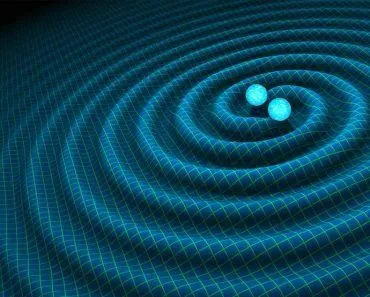
There are several giveaways. Gas and dust spiraling toward a black hole pile up in a hot, fast-spinning accretion disk; friction and infalling energy heat that gas to a few million degrees, and once it gets that hot it blazes in X-rays that satellites detect long before the matter ever reaches the horizon. Astronomers also track stars orbiting an unseen object, looping tightly around something massive and invisible. And in 2019 the Event Horizon Telescope, a planet-wide network of radio dishes, released the first image of a black hole, the giant at the heart of galaxy M87. What you see there isn’t the black hole but a bright ring of glowing gas wrapped around a dark central shadow, the silhouette where light is swallowed; the team repeated the feat for Sagittarius A* at the center of our own Milky Way in 2022. A fourth route is gravity itself: when two black holes spiral together and merge, they shake spacetime into ripples called gravitational waves, first caught by the LIGO detectors on 14 September 2015. So even though a black hole hides its interior perfectly, it leaves fingerprints all over its neighborhood.
References (click to expand)
- Black Holes. NASA Science
- Black Holes – Imagine the Universe! NASA Goddard
- Hubble Space Telescope Overview. NASA
- Black Hole Anatomy. NASA Science
- Black Holes. ASTRO 801, Penn State Department of Astronomy & Astrophysics
- How Scientists Captured the First Image of a Black Hole. NASA JPL Education
- Astronomers Reveal First Image of the Black Hole at the Heart of Our Galaxy. U.S. National Science Foundation
- Gravitational Waves Detected 100 Years After Einstein’s Prediction. LIGO/Caltech