Table of Contents (click to expand)
- Space Has Microgravity
- Free Falling In Space
- Why Astronauts On The ISS Float Around Weightless
- How Strong Is Gravity At 400 km? (Spoiler: Almost As Strong As Here)
- Newton's Cannon: The Thought Experiment That Explains Orbits
- Does The ISS Spin To Cancel Gravity? (Myth-Bust)
- Do Two Astronauts In Space Pull On Each Other?
- What Would Happen If There Really Was No Gravity In Space?
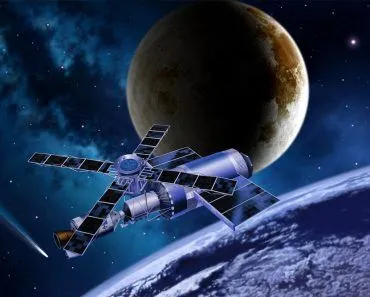
In space, there is a thing called microgravity, which is a very weak gravitational force. Every object that has mass generates gravity, and gravity causes every object to pull every other object towards it. However, as you travel further away from an object in space, the force decreases. This is why things in space don’t bump into each other.
If you take any two objects, let’s say a shoe and a ball, and release them from a certain height, what will happen? No, this is not a trick question. They will both fall to the ground. Now, you might think that was a dumb question, but be patient. Instead of being on Earth, imagine doing the same thing in space… what will be the outcome? The two objects will float, right? Can you think of a reason for that?
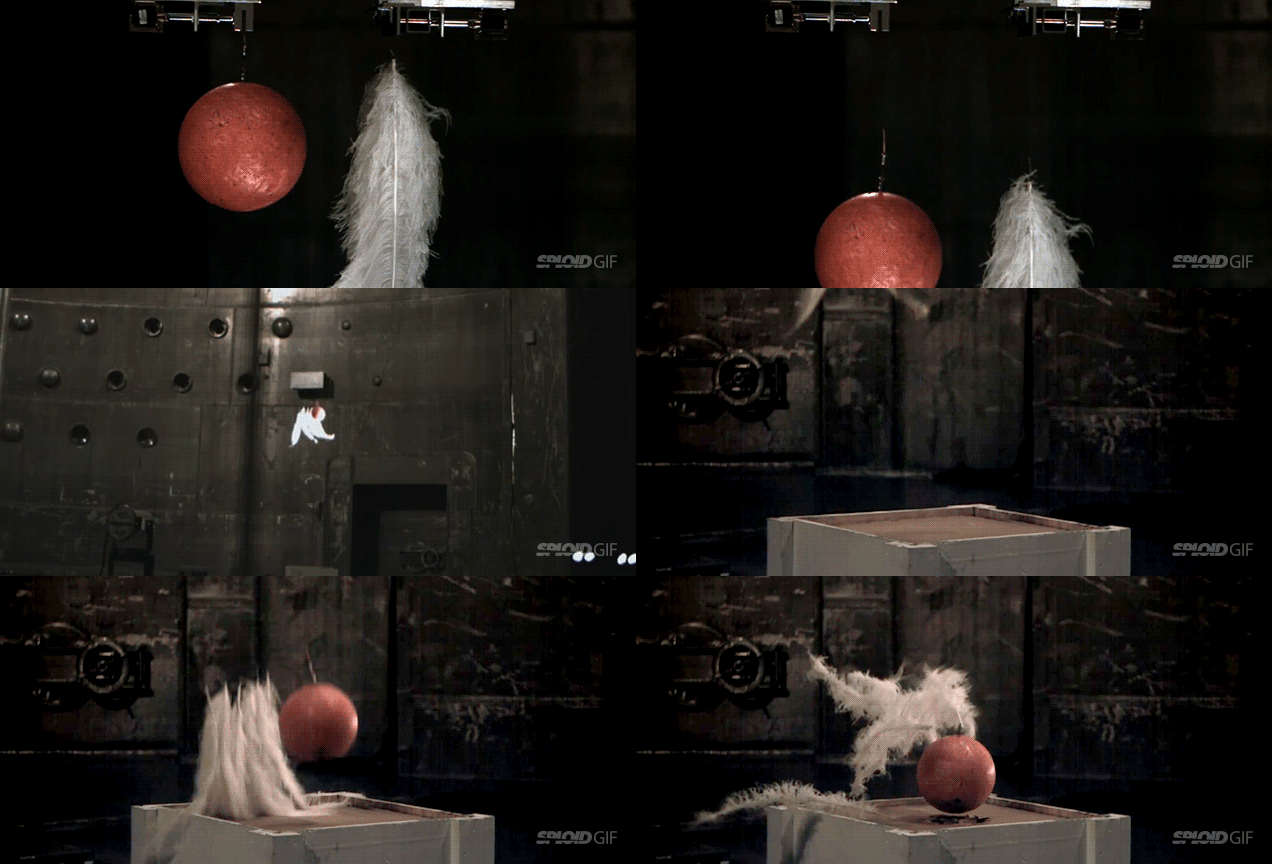
If you answered that on Earth the objects fall due to gravity, but in space they don’t because there is no gravity, then I’m afraid your answer is far from the truth. Every nook and cranny of the universe is filled with myths and mysteries, and the absence of gravity in space is no exception. It is true that space is a partial vacuum devoid of what we commonly call “atmosphere”, but the belief that it is also devoid of forces is a fallacy. In the absence of gravity, how can celestial bodies have defined orbits?
Space Has Microgravity
In space, gravitational forces do exist. Space has microgravity which is very weak gravitational force. Any object that has mass generates gravity, and gravity causes every object to pull every other object towards it. Space contains massive objects that exert a gravitational force on everything around them. For example, the gravitational pull exerted by the Sun on the planets is what keeps them in orbit, just as Earth’s gravity keeps the moon in orbit. However, as you travel further away from an object in space, the force decreases. This can be explained by Newton’s Universal Law of Gravitation, which states that the gravitational force between two objects is directly proportional to the product of their masses and inversely proportional to the square of the distance between them.
Hence, as we move away from the Earth and further into space, the distance increases so the force decreases.
However, if objects in space attract each other, such as the earth and the moon, then how do they not crash into each other? Also, microgravity does not explain astronauts floating in space.
Free Falling In Space
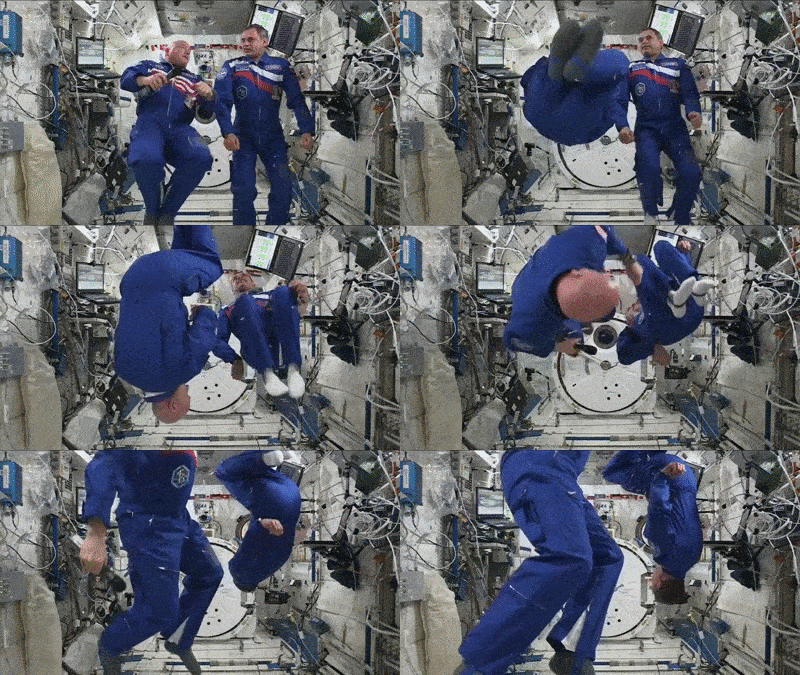
Well, the reason that celestial bodies and our international space station do not suddenly fall out of the sky is because all objects are actually falling. In the case of planets and moons, they have momentum that drives them horizontally, but the gravitational pull is what gives them their curved orbits. Similarly, in the case of an individual astronaut in space or an international space station, they are falling AROUND Earth. What that means is that the space station, all its equipment and astronauts are constantly falling towards Earth.

However, don’t worry, because the space station is also traveling at a speed of 28 thousand km/hr, which roughly matches the way the Earth’s surface curves. When you throw a ball, it does not fall immediately to the ground, right? It follows a trajectory that gradually slopes towards the ground.
Similarly, the space station keeps falling towards the ground, but as it reaches close, the Earth curves beneath it. The ISS falls in a curved path, and the Earth’s surface is curved too, so the former never actually reaches the latter. Also, in space, heavy objects and light objects will fall at equal speeds, irrespective of their mass. Therefore, an astronaut and a spacecraft would both fall at the same speed. This falling without huge amounts of gravity make the astronauts feel weightless and appear to us as though they are floating around.
Isn’t our universe full of surprises? And all this time you thought that science wasn’t magic!
Why Astronauts On The ISS Float Around Weightless
If you’ve ever watched footage of astronauts on the International Space Station, you’ve probably wondered the same thing most people do: have they somehow climbed high enough to escape Earth’s gravity? It’s probably the single most widespread misconception about life on the ISS, the idea that the crew floats because they’ve flown beyond gravity’s reach. It’s an intuitive guess, and it’s also wrong.
Here’s the surprising truth: the astronauts on the ISS are not weightless because gravity isn’t there. Gravity is very much there, and it’s very nearly as strong up there as it is in your living room. They float because they — along with the entire 420-tonne space station around them — are continuously falling toward Earth. They simply never hit the ground, because the station is also moving sideways fast enough to keep missing it.
That single idea — that the ISS and its crew are in a state of perpetual free fall rather than a state of no gravity — is the key. Everything strange about weightlessness in orbit follows from it.
How Strong Is Gravity At 400 km? (Spoiler: Almost As Strong As Here)
The ISS orbits at an average altitude of about 400 km (250 miles) above Earth’s surface. That sounds like a long way up — and it is, by airliner standards — but it’s peanuts compared to the size of the Earth itself, which has a radius of roughly 6,371 km.
Newton’s universal law of gravitation tells us that the strength of gravity drops off with the square of distance from the center of a massive body. Plug the numbers in: at 400 km up, you are at a distance of 6,771 km from Earth’s center instead of 6,371. The ratio of gravitational pull there to the pull at Earth’s surface works out to (6371 / 6771)² ≈ 0.886 — about 89 percent.
In plain English: according to NASA, a 100-pound person on Earth would weigh about 90 pounds at the altitude of the ISS — if you could stand them on a scale up there. So the astronauts aren’t somewhere gravity-free. They’re only about ten percent lighter than they’d be on the ground. The reason they appear weightless on a scale is that the scale is falling at exactly the same rate they are, so it never has anything to push against.
This is why scientists call the environment on the ISS microgravity, not zero gravity. The “micro” doesn’t refer to the gravitational pull from Earth (which is huge), but to the tiny apparent forces between objects that happen to be falling together inside a falling spacecraft.
Newton's Cannon: The Thought Experiment That Explains Orbits
If gravity is still pulling the ISS down hard, why doesn’t it crash? The cleanest answer was sketched out by Isaac Newton more than three centuries ago, and it remains the easiest way to wrap your head around what an orbit really is.
In a book published posthumously in 1728, A Treatise of the System of the World, Newton imagined standing on top of a very tall mountain and firing a cannonball horizontally. Forget air resistance for the moment. What happens?
- Fire the cannonball gently and it curves downward and lands a few hundred meters away.
- Fire it harder and it lands much farther — its curving trajectory matches more of Earth’s curvature before hitting the ground.
- Fire it hard enough, and as it falls, the Earth’s surface curves away beneath it at exactly the same rate. The cannonball never reaches the ground. It’s in orbit.
This is precisely the situation the ISS is in. The station is going about 28,000 km/h (17,500 mph) sideways relative to Earth’s surface — roughly five miles every second. At that speed, the distance the ISS falls in any given second is matched by how much the curved Earth drops away beneath it. It is literally falling around the planet, completing one full orbit every 90 minutes and racking up sixteen sunrises and sunsets every day.
The same idea explains the moon, communications satellites, GPS satellites, and — taken to a larger scale — even the Earth’s orbit around the Sun. Everything in orbit is just something that has been thrown sideways fast enough to keep missing what it’s falling toward. A peer-reviewed analysis of the cannonball thought experiment, published in the American Journal of Physics, walks through the math in considerably more depth, but the geometric intuition is exactly the one Newton gave us in 1728.
Does The ISS Spin To Cancel Gravity? (Myth-Bust)
There is one final misconception worth dismantling: the idea that the ISS spins fast enough to “cancel” gravity. It’s another guess that turns up regularly in classrooms and comment threads. It’s a reasonable guess if you’ve seen sci-fi space habitats from 2001: A Space Odyssey, Interstellar, or The Expanse, where giant ring-shaped stations rotate to give their crews a feeling of weight. The ISS doesn’t do this. Spinning isn’t how it manages microgravity — orbital free fall is.
The mix-up is understandable, because rotation can create artificial gravity, just in the opposite way. If you spin a space station fast enough, the floor of the ring pushes outward against your feet (centripetal force), and that push feels indistinguishable from real gravity. This is the principle behind every proposed rotating space habitat. The ISS, however, is far too small and structurally unsuited to spin for this purpose; the centripetal force on a station that small would be negligible even at high spin rates, and the whole structure would tear itself apart long before reaching a useful spin rate.
What the ISS does do is maintain a fixed orientation relative to Earth — its “floor” always faces the planet — which means that over the course of one 90-minute orbit, the station completes one slow rotation as seen from the stars. That rotation has nothing to do with weightlessness, though. It’s for keeping antennas pointed at ground stations, solar panels angled at the Sun, and the radiator panels working efficiently. The astronauts inside would still float around weightlessly whether the station rotated or not, because the deciding factor is the free fall, not the spin.
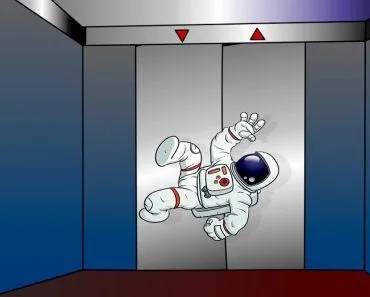
If you’d like to feel a tiny taste of this on Earth, you can — momentarily. The same effect is reproduced by NASA’s parabolic flights (the famous “Vomit Comet”) and even by a free-falling elevator, as Einstein realized in his happiest thought. For the few seconds the aircraft is on the falling arc of its parabola, everyone inside is in free fall — and gravity, while undiminished, becomes invisible.
Do Two Astronauts In Space Pull On Each Other?
Here is a question that trips up a lot of physics students: if every object with mass creates gravity, then two astronauts floating side by side inside the ISS must be pulling on one another, right? The answer is yes, they absolutely are. Newton's law of universal gravitation applies to every pair of masses in the universe, not just to planets and stars. Two people, two coffee mugs, two grains of sand: each pair tugs on the other.

The catch is how astonishingly weak that tug is. The force is given by F = G·m1·m2/r2, where G, the gravitational constant, is just 6.674 × 10⁻¹¹ N·m2/kg2 (one of the tiniest numbers in all of physics). Take two 75 kg astronauts floating 1 metre apart and crunch the numbers: the gravitational force between them works out to roughly 3.8 × 10⁻⁷ N, well under a millionth of a newton. That is about two billion times weaker than the weight each of them carries back on Earth.
To put it another way, the OpenStax university physics text points out that two 1 kg masses sitting 1 metre apart pull on each other with about 6.7 × 10⁻¹¹ N, a force it likens to the weight of a single grain of pollen. The mutual attraction between bodies as small as ours, it notes, is simply imperceptible. So the gravity between two astronauts is genuinely there, but in practice a gentle nudge off a handrail will send one drifting weightlessly across the cabin far faster than their mutual gravity could ever draw them together. Gravity only becomes a force you can feel when one of the masses involved is something planet-sized.
What Would Happen If There Really Was No Gravity In Space?
By now the theme is clear: space is full of gravity. Even so, it is worth playing out the opposite scenario, because it reveals just how much gravity is quietly doing in the background. What would happen if gravity genuinely switched off everywhere at once?
The key is Newton's first law of motion. As NASA states it, a body stays at rest or keeps moving in a straight line at constant speed unless an external force compels it to change. Right now gravity is the force endlessly bending things off that straight path. The Moon would sail away in a straight line if Earth's gravity were not continuously curving its trajectory into an orbit, and the same goes for the ISS and every satellite overhead.
Switch gravity off, and all that bending stops. The Moon, the planets, the ISS and every satellite would stop curving and simply coast off in straight lines, tangent to wherever they happened to be at that instant. Earth would no longer loop around the Sun. And it does not end with orbits: gravity is also the glue that gathers and holds together planets, stars and entire galaxies. As NASA's Space Place puts it plainly, a galaxy "is held together by gravity". Remove it and none of those structures could stay bound, and the cosmos would gradually unravel into drifting debris.

Which is exactly why the popular phrase "there is no gravity in space" cannot be true. If it were, there would be no orbits, no Moon circling Earth, no planets looping the Sun, and no galaxies holding their shape at all. The fact that the night sky is organized into all of those things is itself the proof that space is saturated with gravity.
References (click to expand)
- What Is Microgravity? NASA. (Confirms ~90% gravity at ISS altitude and the free-fall explanation.)
- Ask Us — Space Physics: Physics in Everyday Objects. NASA Goddard Cosmicopia.
- International Space Station Facts and Figures - NASA.
- Newton's cannonball - Wikipedia.
- The flight of Newton's cannonball - American Journal of Physics.
- Newton's Law of Universal Gravitation - University Physics Volume 1, OpenStax.
- Newtonian Constant of Gravitation - NIST CODATA.
- Newton's First Law of Motion - NASA Glenn Research Center.
- What Is a Galaxy? - NASA Space Place.