All objects fall at the same rate because the mass of the falling object cancels out: gravity pulls on it with a force F = m × g, but Newton’s second law (F = m × a) divides that force by the same mass to give the acceleration. The result is a = g ≈ 9.81 m/s² for everything in free fall, regardless of weight. Air resistance is what makes a feather fall slower than a brick in everyday life; in a vacuum, they hit the ground together, as Apollo 15 demonstrated on the Moon in 1971.
Universal Law Of Gravitation
Isaac Newton saw objects falling downwards after being suspended in the air all his life, but one fine day, in the year 1665 or 1666, he realized that there had to be a force causing the objects to fall downwards, instead of sideways or even upwards. He applied the same logic to an apple falling from a tree and used the example to devise his Universal Law of Gravitation[1].
The law says that every pair of objects with mass pulls on each other with a force F = G · m1m2 / r2, where m1 and m2 are the two masses, r is the distance between their centres, and G is the gravitational constant (about 6.674 × 10⁻¹¹ N·m2/kg2). The Earth tugs an apple downward, but by Newton’s third law the apple also tugs the Earth upward. The apple just has so little mass that the Earth’s motion in response is impossibly tiny.
Earth’s Gravitation
For an object near the Earth’s surface, the distance r in Newton’s formula is essentially Earth’s radius (the few extra metres of altitude make no measurable difference). Plug in Earth’s mass and radius, and the formula simplifies to F = m · g, where g = G · MEarth / REarth2 ≈ 9.81 m/s2. That single number, the acceleration due to gravity, is the same whether you drop a coin, a brick, or a piano.
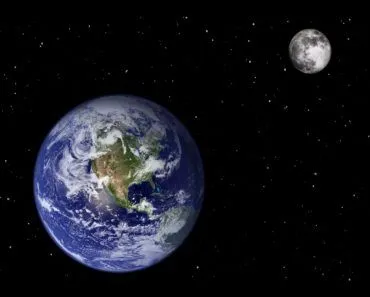
g is different for different planets, depending on their mass and radius. The Moon’s gravitational pull is about 1/6th that of the Earth[5], so any object’s weight on the Moon would be 1/6th of what it weighs on Earth. Any object that falls towards the surface of the Moon will fall at about 1/6th the rate that it would fall towards the surface of the Earth.
Weight And Mass
Here is the punchline. The gravitational force pulling an object down is F = mg, but Newton’s second law says that whatever force you apply to an object produces an acceleration a = F / m. So for a freely falling object near Earth, a = F / m = (m · g) / m = g. The mass cancels out. A bowling ball and a marble plunge with exactly the same acceleration of about 9.81 m/s2, because the stronger pull on the bowling ball is exactly offset by its larger inertia.
Galileo Galilei was the first to argue that all bodies fall alike (more on how he actually did it below). The most spectacular re-run was performed live on the Moon: on August 2, 1971, Apollo 15 commander David Scott released a 1.32 kg (2.91 lb) geological hammer and a 0.03 kg (1.1 oz) falcon feather from the same height in front of a TV camera. In the Moon’s near-vacuum they hit the lunar dust at exactly the same instant, a textbook proof that, without air, every object falls at the same rate.
So why do a feather and a rubber ball fall to the ground at different times in everyday life? Well, a feather’s shape and extremely low mass make it especially susceptible to air resistance, the drag force the surrounding air exerts on anything pushing through it. Most everyday objects are dense enough that air resistance is negligible compared to gravity, so they all reach the ground at roughly the same time. Inside a vacuum chamber, even a feather and a bowling ball land together, exactly as Newton and Galileo would have predicted.
Since the force on a falling body from anything other than gravity (air drag aside) is negligible, the only acceleration affecting its motion is g = 9.8 m/s2.
Therefore, their rate of falling towards the Earth’s surface is independent of their mass.
Did Galileo Really Drop Weights From The Leaning Tower Of Pisa?
For nearly 2,000 years, Western science took Aristotle at his word: heavier objects fall faster than lighter ones, in proportion to their weight. It is an easy thing to believe. Drop a hammer and a sheet of paper side by side and the hammer clearly wins, so a heavier body seeming to fall faster matches everyday experience. Aristotle reasoned that heavy objects hurry to their "natural place" more eagerly than light ones, and few people thought to question it.

Galileo Galilei demolished the idea in the early 1600s, but probably not by climbing the Leaning Tower of Pisa and dropping cannonballs off the top. That story comes from The Life of Galileo, a biography written by his devoted pupil Vincenzo Viviani years after Galileo died, and most historians treat it as a charming legend rather than documented fact. Galileo never described such a public stunt in his own writings.
He had something better: a pen-and-paper argument that needs no tower at all. Imagine tying a heavy ball to a light one. If Aristotle were right, the light ball should drag on the heavy one and slow it down, so the pair falls slower than the heavy ball alone. Yet the two tied together also weigh more than the heavy ball, so by the same rule they should fall faster. The same setup cannot fall both slower and faster, so Aristotle's rule contradicts itself[6]. The only way out is that all bodies fall at the same rate.
To prove it experimentally, Galileo did not need free fall at all. He rolled bronze balls down a gently sloping wooden ramp, an "inclined plane," which dilutes gravity and slows the motion enough to time with a water clock. He found that a ball covers distances in the ratio 1 : 4 : 9 : 16 over equal time intervals, the squares of the times. That is the signature of constant acceleration[7], and the same constant acceleration shows up no matter what the ball weighs. Gravity, he argued, hands every object the same acceleration.
Why Does Gravity Treat Every Object Identically? The Equivalence Principle
Look again at why the mass cancels in the falling-object equation, because there is a quiet miracle hiding inside it. The mass on top, in F = mg, is gravitational mass, a measure of how strongly gravity grips the object. The mass on the bottom, in a = F / m, is inertial mass, a measure of how stubbornly the object resists being accelerated by any force, gravity or a shove or a rocket. There is no obvious reason these two numbers should be equal. One describes a pull, the other describes resistance to pushes. Yet every experiment ever done finds them identical, which is the only reason the mass cancels and everything falls at the same rate[8].

For Newton this equality was just a curious coincidence. Albert Einstein refused to accept it as a coincidence, and that refusal changed physics. In 1907, while sitting at his desk in the Bern patent office, he had what he later called "the happiest thought of my life": a person falling freely from a rooftop does not feel their own weight[8]. During the fall, every object around them, their keys, their phone, the air, falls at exactly the same rate, so relative to the falling person, gravity has simply vanished.
Einstein turned that into the equivalence principle. Picture yourself in a sealed box with no windows. If you feel pressed to the floor, you cannot tell from inside whether the box is parked on Earth's surface, or being towed through deep space by a rocket accelerating at 9.81 m/s2. Drop a ball and it falls to the floor identically in both cases. Gravity and acceleration are locally indistinguishable[8]. The reason objects fall at the same rate, Einstein realized, is that gravity is not really a force pulling on mass at all. It is the shape of spacetime, and a falling object is simply coasting along the straightest available path through it. This single idea, born from a puzzle about why a feather and a hammer land together, became the seed of his 1915 theory of general relativity.
How Precisely Do We Know All Objects Fall Alike?
If the whole edifice of general relativity rests on inertial mass equaling gravitational mass, physicists had better be sure the two really are equal. So they have hunted for the tiniest difference for over a century, and the more carefully they look, the more perfectly the two match.
The classic test came from Hungarian physicist Loránd Eötvös. Starting in the 1880s and continuing through the famous Eötvös-Pekár-Fekete experiments of about 1906 to 1908, he hung pairs of different materials from a delicate torsion balance and watched for the faint twist that would appear if Earth pulled on them even slightly differently per unit of inertia. He found none, confirming that gravitational and inertial mass match to roughly one part in 100 million (about 10-8)[9]. Modern torsion-balance experiments have since pushed that to better than one part in a trillion.
The most precise verdict so far came from space. The French space agency CNES launched the MICROSCOPE satellite on April 25, 2016, carrying two test masses, one made of a titanium alloy and one of a platinum alloy, and let them orbit Earth in continuous free fall. If the two materials fell even microscopically differently, sensitive accelerometers would catch it. After the mission's final analysis, published in 2022, the answer was a resounding no: the two masses fall identically to about one part in 1015 (a quadrillion), with the measured difference statistically consistent with zero[10]. One part in 1015 is the difference a single second makes against roughly 30 million years. Four centuries after Galileo's ramp, his deceptively simple conclusion still holds, to a precision he could never have dreamed of.
References (click to expand)
- 6.5 Newton's Universal Law of Gravitation. College Physics, University of Iowa.
- Hirakawa, H., Tsubono, K., & Oide, K. (1980, January). Dynamical test of the law of gravitation. Nature. Springer Science and Business Media LLC.
- Buček, S. (2016, July). Falling Objects And Projectile Motion With Regard The Air Resistance. EDULEARN proceedings. IATED.
- Moon Fact Sheet. NASA NSSDC.
- The Apollo 15 Hammer-Feather Drop. NASA Science.
- Galileo Galilei. Stanford Encyclopedia of Philosophy.
- Galileo's Acceleration Experiment. University of Virginia, Department of Physics.
- Einstein's Spacetime: The Equivalence Principle. Gravity Probe B, Stanford University.
- Equivalence Principle. The Eöt-Wash Group, University of Washington.
- Touboul, P. et al. (2022). MICROSCOPE Mission: Final Results of the Test of the Equivalence Principle. Physical Review Letters, 129, 121102.