Table of Contents (click to expand)
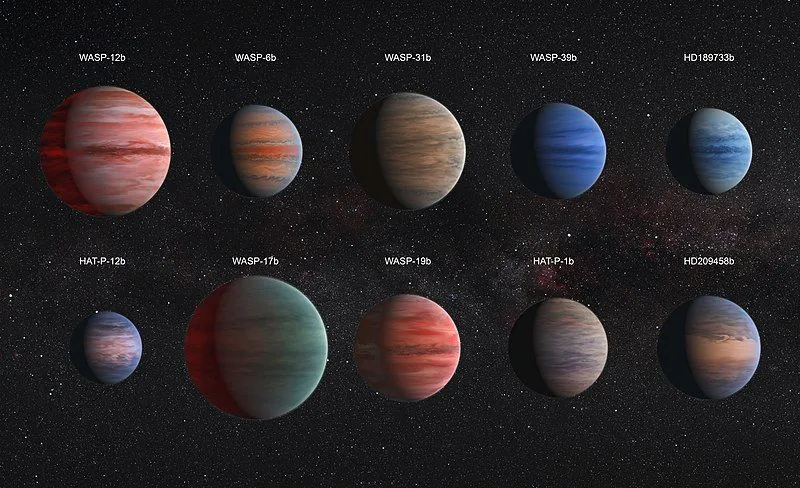
Hot Jupiters are gas giant exoplanets, similar in size to Jupiter, that orbit extremely close to their parent stars, often within about 0.1 astronomical units and with orbital periods of just a few days. This proximity heats their atmospheres to between 700 and over 2,000 degrees Celsius, and many follow unusual circular, eccentric, or even retrograde orbits.
Jupiter is one of the most recognizable planets in our solar system. As the largest planet in our solar system and the third-brightest object in the night sky (after the Moon and Venus), it is one we have learned a great deal about.
However, this Jupiter is in our solar system… are there Jupiter-like planets in other star systems too?
In our exoplanetary quest, there is a classification titled ‘gas giants.’ These are exoplanets possessing the size of Jupiter or Saturn, but it turns out that inside this category, there is a class of exoplanets called ‘Hot Jupiter.’
So, what exactly is a Hot Jupiter?
Introduction To Hot Jupiters
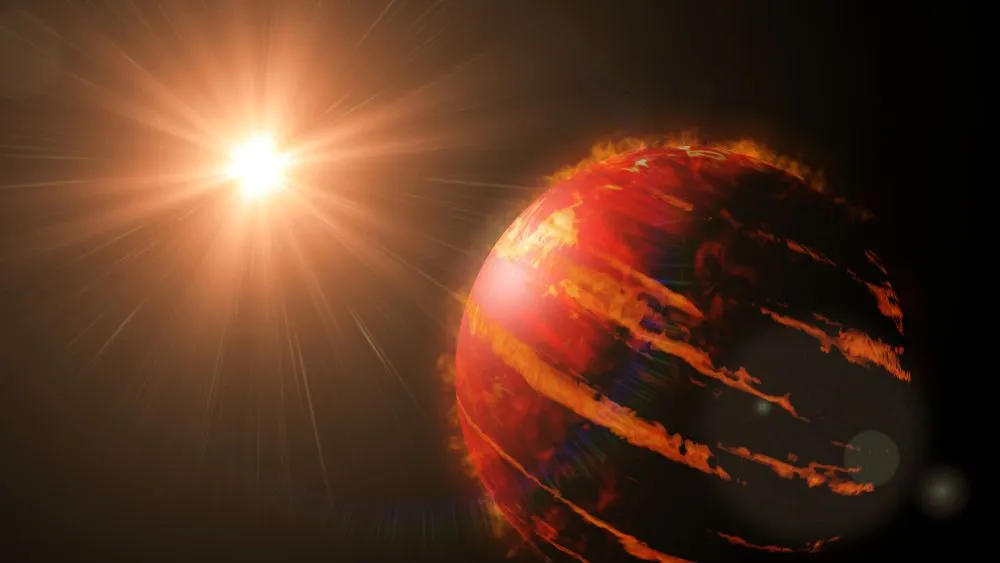
As its name suggests, Hot Jupiters are Jupiter-like gas giants that orbit very close to their parent stars. They are so close to their parent star that their orbital radii usually have values of about 0.1 astronomical units (AU). Comparatively, the average distance between Mercury and the Sun is 0.4 AU.
Hot Jupiters are the first type of exoplanets that astronomers have discovered. In 1995, Swiss astronomers Michel Mayor and Didier Queloz found a gas giant orbiting around a Sun-like star, 51 Pegasi. For this discovery, they won the 2019 Nobel Prize in Physics.
Their observation of this Hot Jupiter revealed that the exoplanet has a short orbital period of around 4.2 days. As of 2020, the majority of the exoplanets discovered using ground-based surveys (like WASP, HATNet, etc.) have been Hot Jupiters.
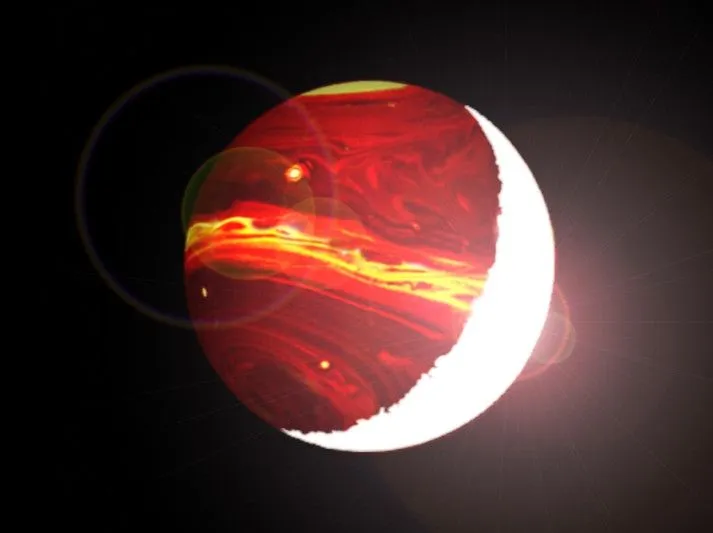
Of the Hot Jupiters detected thus far, around six have orbital periods of less than one day. These objects are classified as Ultrashort period (USP) Hot Jupiters. In 2020, researchers published an article on the discovery of a USP Hot Jupiter with the shortest orbital period. The object is called NGTS-10 b and has an orbital period of 0.77 days (around 18 hours)!
Surface Temperatures
The proximity of a Hot Jupiter to its host star is the reason for its rather extreme temperatures. One feature of Hot Jupiters is that they are tidally locked, with one side always facing its host star and the other permanently turned away.
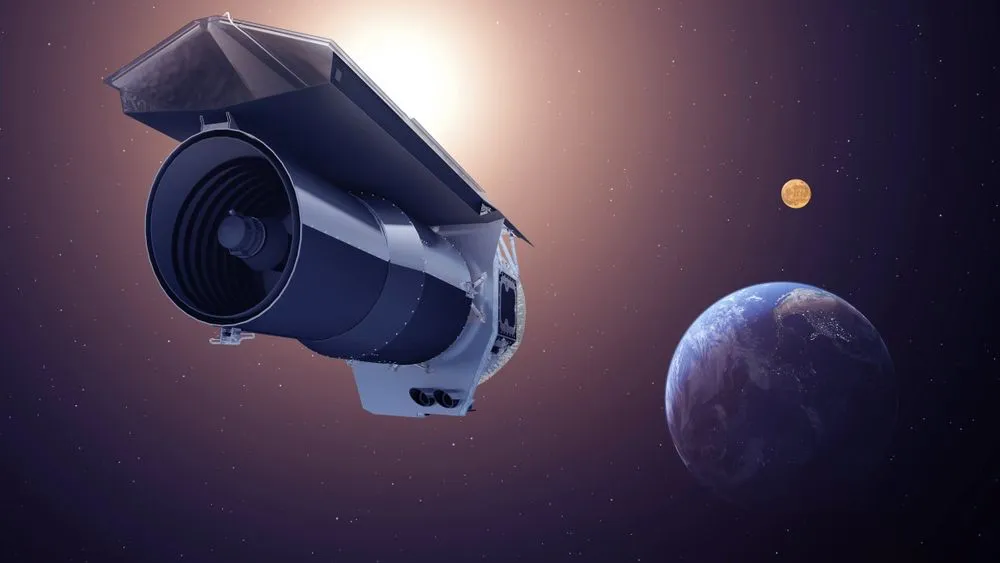
Observations from the Spitzer Space Telescope sorted these worlds into families: relatively cooler Hot Jupiters with atmospheric temperatures up to about 700 degrees Celsius (1,300 degrees Fahrenheit), and hotter versions ranging from roughly 700 to 1,700 degrees Celsius (1,300 to 3,100 degrees Fahrenheit).
However, there is a subclass of Hot Jupiters, known as ultra-Hot Jupiters (UHJs), with higher temperatures. These exoplanets closely orbit their host stars, resulting in daytime temperatures exceeding 2,200 Kelvin, around 1,930 degrees Celsius (3,500 degrees Fahrenheit), which is also the defining line of what constitutes a UHJ.
This extreme environment causes the dissociation of some molecules, like water (H2O), in the atmosphere. In 2021, astronomers detected the hydroxyl radical (OH), a telltale product of water breaking apart, in the UHJ WASP-76b, which confirmed that this dissociation is taking place in the exoplanet’s atmosphere. In the future, these spectral signatures can be used to study the atmospheres of other UHJs, especially their molecular dissociations, and obtain more information about their properties.
One strange discovery of Hot Jupiters regarding their temperature is that they all had the same nightside temperatures. This is surprising, since differences in atmosphere, planetary mass, radii, rotation periods and more should have resulted in different nightside temperatures. However, all Hot Jupiters showed themselves to have roughly the same nightside temperature, about 1,100 Kelvin.
There is, however, a possible explanation for this. The models used for this study assumed an environment free of clouds. Unfortunately, modeling clouds is a difficult task, requiring heavy computation. Hot Jupiters, having more extreme atmospheres, will also have more complicated cloud formations. However, with the James Webb Space Telescope (operating since 2022) and the European Space Agency’s upcoming ARIEL mission, cloud characterization on Hot Jupiters, especially on their nightsides, is becoming far more feasible.
Retrograde Orbits And Orbital Eccentricities
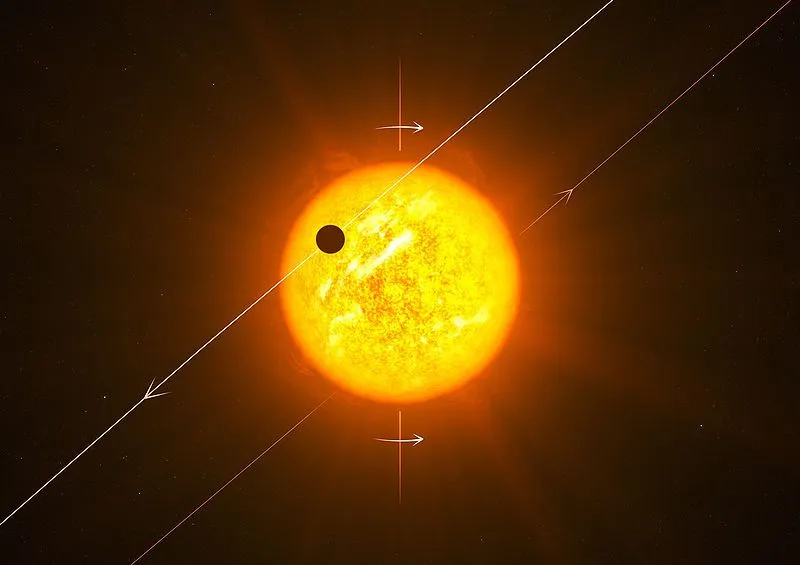
Another unique aspect of Hot Jupiters’ orbits is that a few of them (around 25 percent of those discovered) seem to have retrograde orbits around their host star. This means that the direction of the planet’s orbit around its parent star and the rotation of the star itself are moving in opposite directions. No planet in our solar system has retrograde orbits, and the same is true of other exoplanets.
Finally, we come to the eccentricity of their orbits, which determines how circular or elliptical the orbit appears. An eccentricity value of 0 implies that it is a circular orbit and a value between 0 and 1 (excluding both numbers) indicates an elliptical one. The eccentricities of a planet’s orbit give us information about their origins.
Those Hot Jupiters with orbital periods that last up to 3 days generally show a circular profile in their orbits. Their short periods might be the reason for their non-elliptical orbits due to an effect called fast tidal circularization.
Tidal circularization refers to the effect of the tidal forces acting between a primary object (like a star) and another secondary object orbiting it (like a planet). In this effect, these tidal forces cause the eccentricity of the secondary’s orbit to decrease with time, making it more circular. This effect is notably strong for those Hot Jupiters with orbital periods of three days or less.
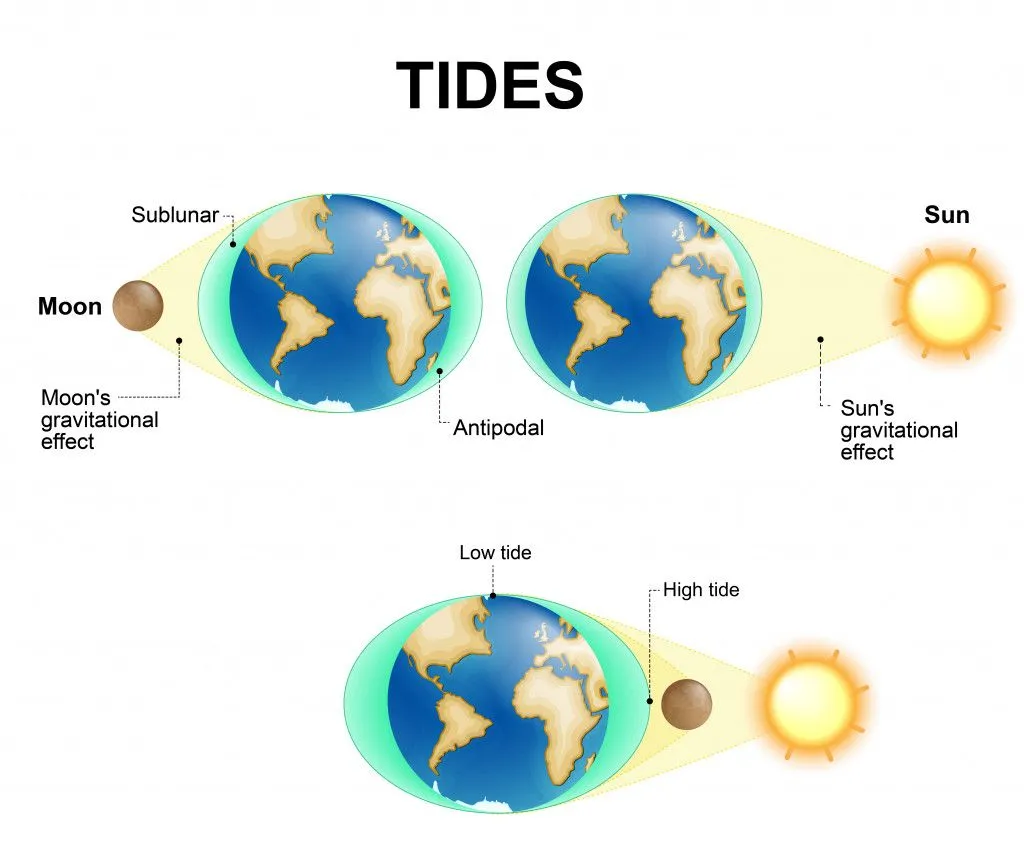
However, with orbital periods between three and ten days, some Hot Jupiters have shown fairly elliptical orbits. One reason for this is a process called high eccentricity tidal migration.
After the formation of exoplanets in a star system, another giant planet might have disturbed the Hot Jupiter into a highly eccentric (or elliptical) orbit. Over time, the orbital eccentricity of that Hot Jupiter would have lowered due to tidal effects (like tidal circularization), eventually resulting in a medium elliptical orbit around the central star. However, not all Hot Jupiters with a 3-10 day orbital period have elliptical orbits; some have circular orbits too.
Summary
Hot Jupiters are one of the strangest varieties of exoplanets out there. They are also one of the most easily observed using the Doppler technique. It is necessary to try and understand their physical and orbital properties and their interactions with their host stars, as this will help us better understand our theories on planet and star formation.
Looking into their orbits gives us valuable insight into planetary motion, helping us look into the extreme nature of planetary orbits. In our quest to fully understand the planets and their movements around stars, Hot Jupiters provide an essential piece to this puzzle. With better observations, we will be able to learn more about them and help us construct a more realistic picture of planets and their movements.
References (click to expand)
- Gas Giants and Hot Jupiters. NASA Science. The National Aeronautics and Space Administration
- Overview | Planet Types – Exoplanet Exploration - NASA. The National Aeronautics and Space Administration
- Wang, J., Fischer, D. A., Horch, E. P., & Huang, X. (2015, January 30). On The Occurrence Rate Of Hot Jupiters In Different Stellar Environments. The Astrophysical Journal. American Astronomical Society.
- Dawson, R. I., & Johnson, J. A. (2018, September 14). Origins of Hot Jupiters. Annual Review of Astronomy and Astrophysics. Annual Reviews.
- (2020) NGTS-10b: the shortest period hot Jupiter yet discovered. Oxford University Press
- Retired Space Telescope Reveals 'Hot Jupiter' Secrets. NASA Science. The National Aeronautics and Space Administration
- Landman, R., Sánchez-López, A., Mollière, P., Kesseli, A. Y., Louca, A. J., & Snellen, I. A. G. (2021, December). Detection of OH in the ultra-hot Jupiter WASP-76b. Astronomy & Astrophysics. EDP Sciences.
- Keating, D., Cowan, N. B., & Dang, L. (2019, August 26). Uniformly hot nightside temperatures on short-period gas giants. Nature Astronomy. Springer Science and Business Media LLC.
- The Origin and Maintenance of a Retrograde Exoplanet. subarutelescope.org
- Beaugé, C., & Nesvorný, D. (2012, May 14). Multiple-Planet Scattering And The Origin Of Hot Jupiters. The Astrophysical Journal. American Astronomical Society.