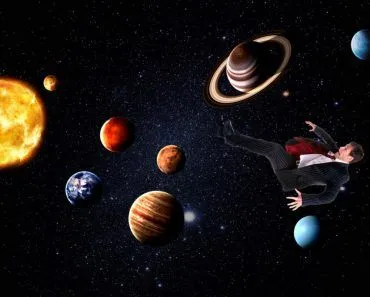
Jupiter is a planet that does not have a hard, rocky surface like Earth does. If an astronaut were to be dropped towards the planet from above, they would die of radiation poisoning before reaching the surface. However, if they were wearing an indestructible spacesuit, they would start accelerating through the upper layers of the atmosphere and burn up like meteors do before impacting Earth’s surface.
First off, you should know that Jupiter does not have a hard, rocky surface like the one we have here on Earth. Thus, the phrase “stepping on the surface of Jupiter” would not be literally possible, as Jupiter is a gas giant, meaning that it has no hard, solid surface to set one’s feet on.
So, what would happen if an astronaut was dropped towards the planet from above, assuming that they are wearing a spacesuit that is magically indestructible (this is purely hypothetical, of course!)
In order to know what happens then, it’s only fair that we first get a sense of what the phrase ‘surface of Jupiter’ actually means.
Jupiter – The Planet
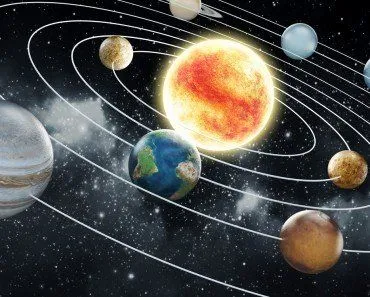
As you might already know, Jupiter is the largest planet in our solar system. It’s so large, in fact, that it could fit 1300 Earths inside itself. In addition to being the largest member of our solar system (after the sun), it’s also a gas giant, meaning that it is overwhelmingly hydrogen and helium (about 76% hydrogen and 24% helium by mass, with traces of methane, ammonia, water vapour and other gases), much like the sun.
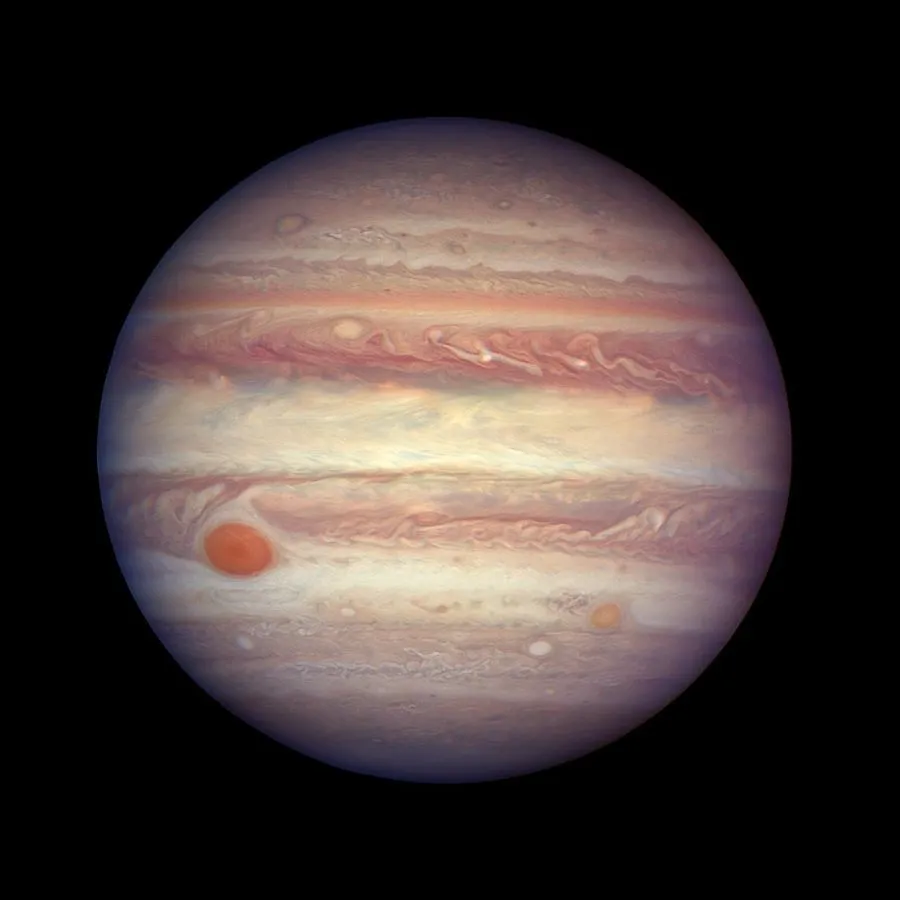
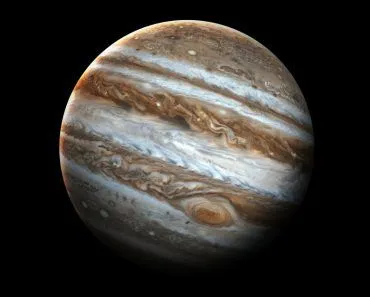
The stripes that you see on the planet are actually red, yellow, brown and white clouds, all of which are part of Jupiter’s atmosphere.
I have referred to Jupiter’s ‘surface’ a few times in the article so far, but interestingly enough, it doesn’t really have a surface, at least not in the same way our planet does. When someone refers to a planet’s surface, we tend to conjure up the image of rocky, solid ground. Quite amazingly, that’s not true in Jupiter’s case.
Jupiter’s Surface
Unlike Earth, Jupiter does not have a hard, solid surface. It just a big chunk of gases (and some other stuff) that is pulled together in the shape of a planet. And, similar to Earth’s atmosphere, the gases present in Jupiter’s atmosphere have a ‘ceiling’ or a ‘top’; the layers just keep getting thinner and thinner as you go further away from the planet until, at some point, the atmosphere becomes one with interplanetary space.
So, let’s assume you get dropped from some height way outside of Jupiter’s visible atmosphere. Once you get within around 300,000 km of a particular level (we shall call this level ‘the surface’, because it’s the level where the gas pressure is 1 bar, nearly equal to Earth’s surface pressure), you would die of radiation poisoning… normally.
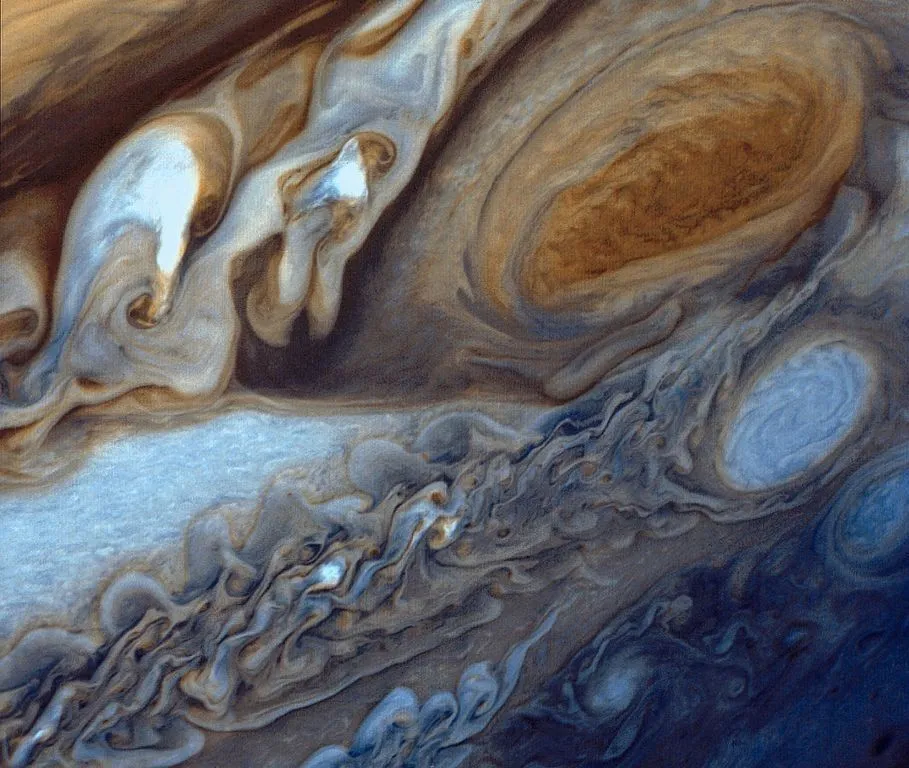
However, since you have an indestructible spacesuit, you actually wouldn’t die. Instead, you would start accelerating (due to Jupiter’s immense mass) through the upper layers of the atmosphere and burn up like meteors do before impacting Earth’s surface.
How Big Is Jupiter’s “Surface”?
Even though there is nothing solid to stand on, scientists still need a reference level to call Jupiter’s “surface,” so they settle on the altitude where the atmospheric pressure equals 1 bar (roughly the air pressure you feel at sea level here on Earth). Measured at that 1-bar level, Jupiter has a radius of about 69,911 km (43,441 mi), which makes the planet roughly 11 times wider than Earth.

Wrap that radius into a sphere and the numbers get dizzying. The area of that 1-bar shell comes out to about 6.1 × 10¹⁰ km2, or roughly 61 billion km2. Because surface area grows with the square of the radius, being about 11 times wider makes Jupiter’s “surface” close to 120 times larger than the entire surface of Earth. That is the same reason the giant could swallow more than 1,000 Earths if it were a hollow shell.
It is worth repeating that this enormous figure is not a sheet of ground you could ever survey on foot. It is simply the area of an imaginary boundary drawn through the clouds. Below it, the gas just keeps getting denser, hotter and darker, which is exactly the journey we are about to take.
A Particularly Long Plummet Through Jupiter’s Gaseous Layers
Going a bit further, if you were somehow dropped in the middle of the planet’s upper atmosphere, even then, you’d fall constantly through ammonia clouds. Fortunately, the fall wouldn’t burn you up at that point, since you are already past the thickest part of the atmosphere. Hence, frictional heating and supersonic compression wouldn’t turn you to ashes.
After a few minutes, you’d still be falling, but through an area where the pressure is 2 bars (twice the average surface pressure on Earth). Here, you would pass through various kinds of clouds made of ammonia ice, ammonium sulfide and ammonium hydrosulfide.
These clouds are not much different than regular clouds, but they are brown and only get browner as you go deeper.
As you keep falling, the atmospheric pressure would continue to climb. Around the 5–7 bar level you would pass through clouds of water ice, where the temperature has warmed up to roughly the freezing point of water back home (about 0 °C / 32 °F). Beyond those clouds everything around you starts getting dark. After a few more minutes, you would be in complete darkness and the temperature would have climbed well past 100 °C (212 °F).
The further you fall, the more the temperature would continue to rise. Once you reach the interior regions of the planet (which space researchers don’t know much about), the pressure and density would be so high that their combined effect would bring your speed of descent to an absolute minimum.
This is the level where you would find a huge ocean of liquid metallic hydrogen. Around two million bars and 8,000–10,000 °C, the pressure squeezes hydrogen so tightly that its electrons break free and the liquid starts conducting electricity like a metal. Jupiter has the fastest-spinning speed in our solar system, and as it spins, the swirling, liquid metal ocean creates the strongest magnetic field in the solar system.
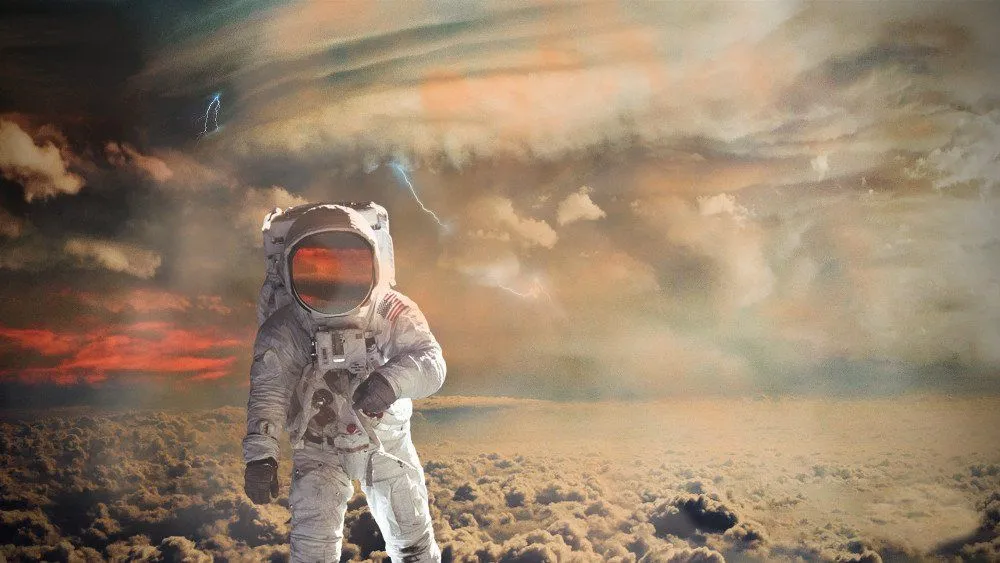
Finally, as you reach Jupiter’s deep interior, where Juno-era models put the pressure around 45 million bars and the temperature around 20,000 °C (about three and a half times hotter than the surface of the Sun), your descent would come to an end. And so would you.
Space scientists believe that Jupiter has a dense core of heavy elements, formed during the early stages of the solar system. Data from NASA’s Juno orbiter (in orbit around Jupiter since 2016) has since complicated that picture: instead of a sharp rocky core, Juno’s gravity measurements suggest a "dilute" or fuzzy core where heavy elements are mixed gradually into the metallic-hydrogen layer above. Either way, "setting foot" on any of it is out of the question.
Therefore, it’s essentially impossible for any person to set foot on any ‘surface’ of Jupiter.
Has Any Spacecraft Ever Landed on Jupiter?
Short answer: no, and a spacecraft never will in the way we “land” on the Moon or Mars, simply because there is no ground to touch down on. No human has been anywhere near the planet either. But we have done the next best thing, and the story is wild.
On 7 December 1995, NASA’s Galileo mission released a small atmospheric probe that became the first probe ever to descend through the clouds of a gas giant and radio back measurements from inside one. The probe hit the cloud tops at roughly 170,000 km/h (about 106,000 mph) and decelerated so violently that it briefly endured around 228 times Earth’s gravity, while its heat shield glowed at temperatures near 16,000 °C (about 28,800 °F), nearly three times hotter than the surface of the Sun.

Once it had slowed down, the probe popped a parachute and began radioing back the first direct measurements of what Jupiter is really made of. It kept transmitting for only about 58 minutes. In that time it sank roughly 150 km (about 95 mi) below the cloud tops, until the surrounding pressure climbed to about 23 bars and the temperature passed 150 °C (300 °F), which finally silenced it for good. So even a purpose-built, heat-shielded spacecraft survived less than an hour, which tells you everything you need to know about how long a falling astronaut would last.
Today, NASA’s Juno orbiter studies Jupiter from a safe distance overhead, and it has circled the planet since 2016, but nothing has gone back down into the clouds since. “Landing,” in any ordinary sense of the word, simply is not on the table.
References (click to expand)
- What Is Jupiter? - NASA. The National Aeronautics and Space Administration
- What's It Like Inside Jupiter? | NASA Space Place. The National Aeronautics and Space Administration
- The Outer Planets: Giant Planets: Interiors - lasp.colorado.edu:80
- Volume % Oxygen by Bimetric Pressure - hq.nasa.gov
- What Is Jupiter's Atmosphere Made Of? - Mission Juno. missionjuno.swri.edu
- The Atmosphere of Jupiter. The University of Rochester
- Jupiter & Saturn | Cool Cosmos - Caltech. The California Institute of Technology
- Galileo Jupiter Atmospheric Probe - NASA Science. The National Aeronautics and Space Administration
- Jupiter Facts - NASA Science. The National Aeronautics and Space Administration