The third law of thermodynamics states that as the temperature of a system approaches absolute zero (0 K, or -273.15 °C), its entropy approaches a constant minimum value. For a perfect crystalline substance, that minimum is exactly zero. The principle was formulated by the German chemist Walther Nernst in 1906.
The entropy of a bounded or isolated system approaches a constant minimum value as its temperature approaches absolute zero.
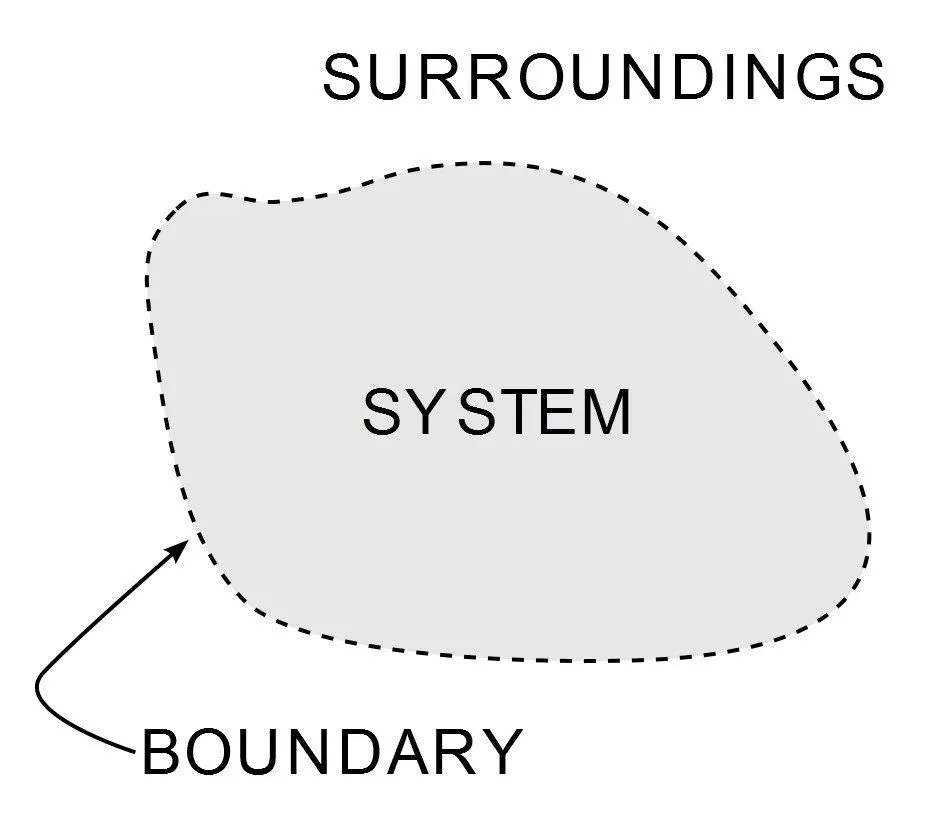
Thermodynamics is one of the most important and widely studied branches of physical science. Other than tormenting mechanical engineering students for most of their academic lives, its ubiquity is seen from the cold breeze of my air conditioner to one of the pinnacles of the industrial age – the steam engine. Its implementation is governed by three laws, which are known as the Laws of Thermodynamics. The laws define how work, heat and energy affect a system. A system is any region in the Universe that is finitely bounded across which energy is transferred. Everything outside this boundary is its surroundings.
What Is Entropy?
While the first law of thermodynamics implies that the Universe began with finite usable energy, where a system drawing energy will partly spend it in doing work and partly spend it through increasing its internal temperature, the second law explores its implications. This includes the conversion of this finite usable energy into unusable energy; for instance, the formation of matter occurring billions of years ago due to the condensation of energy that the Universe started out with. In this process, the finite usable energy is now converted to unusable energy.
This unusable energy is measured by something called “Entropy”, a barometer for measuring randomness or disorder in a system.
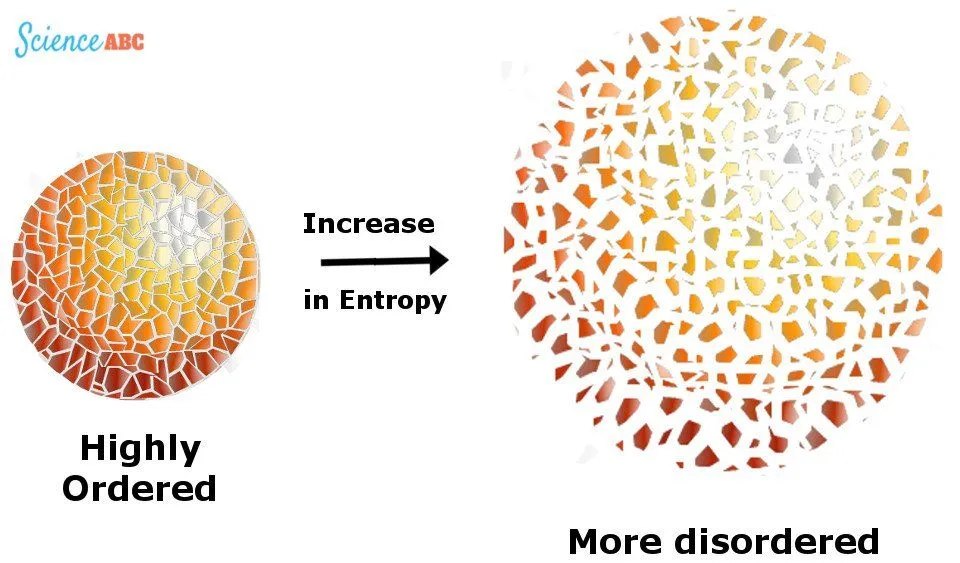
The Universe is like a room filled with clothes that are lying around in an unorganized way. The entropy of this system increases as more and more clothes are used and discarded, supplementing the mess, unless the inhabitant makes an effort to pick them up and organize them, which reduces this disorder.
Considering the Universe as one system, there is nothing in its surroundings to derive energy from, so with all its energy converted to unusable energy, all that is left behind is a cold, dark place. This is called the heat death and is one of the ways the Universe could end. A bounded system like our Universe possesses finite sources of energy, such as its bright stars, which will burn for aeons before surrendering to the cruel laws of nature.
What’s The Third Law Of Thermodynamics?
The third law of thermodynamics predicts the properties of a system and the behavior of entropy at temperatures approaching absolute zero. Absolute zero is the lowest temperature physically possible and sets a hard floor on the Universe's temperature range.
How cool is that! No, seriously, how cold is it? Absolute zero is 0 Kelvin on the absolute (Kelvin) temperature scale, which is the same as -273.15 °C (-459.67 °F). This scale will give you an idea.
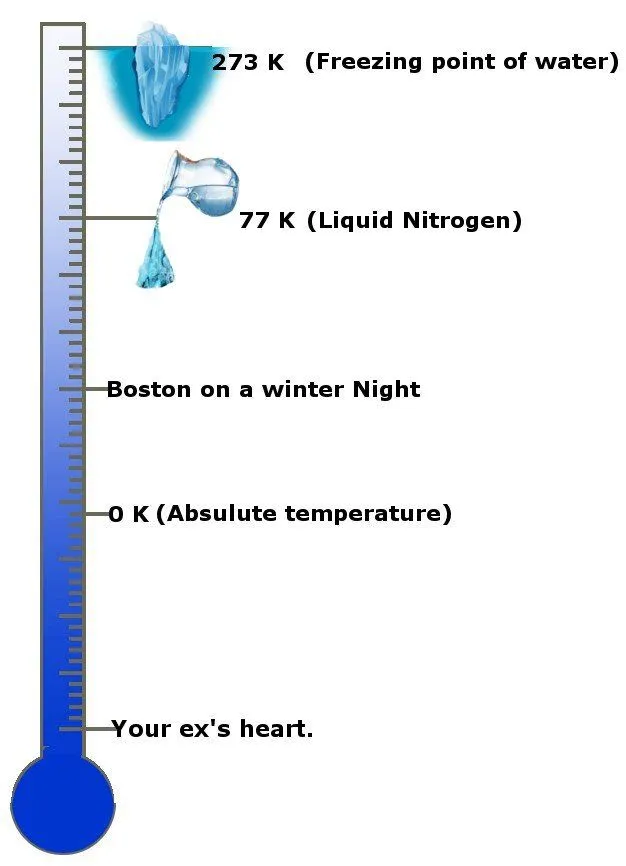
The third law states that as the temperature of a system approaches absolute zero, its entropy becomes constant, or the change in entropy is zero.
The relationship is captured by the limit equation lim ΔS → 0 as T → 0 K, where T is the absolute temperature in Kelvin and ΔS is the change in the system's entropy between two states. The arrow notation just means that as the temperature drops toward zero, the entropy change for any reversible process in the system also drops toward zero. A practical consequence is that absolute zero itself can never be reached in a finite number of steps; you can only get arbitrarily close to it (this is the Nernst unattainability theorem).
Importance Of The Third Law Of Thermodynamics
The third law is rarely applicable to our day-to-day lives and governs the dynamics of objects at the lowest known temperatures. It defines what is called a ‘perfect crystal’, whose atoms are glued in their positions. The perfect crystal thus possesses zero entropy, a state that is only achievable in the limit as the temperature approaches absolute zero.
The concept of entropy has also been popular in some theories defining the continuous flow of time objectively, such as the linear increase in the entropy of the Universe.
Ideally, at 0 Kelvin, the entropy changes for reactions regarding the formation of matter would be zero, although practically all matter manifests some amount of entropy, owing to the presence of the tiniest amount of heat. The coldest naturally occurring place we have measured is the Boomerang Nebula, at about 1 K, while the cosmic microwave background sits at about 2.73 K. In laboratories, physicists have driven gases of atoms down to a few hundred picokelvin (less than a billionth of a degree above absolute zero) using laser cooling and Bose-Einstein condensation techniques pioneered by Wolfgang Ketterle's group at MIT and others, but no one has ever reached absolute zero itself, and the third law says no one ever will.
In other words, enjoy the summer while it lasts!
What Are Some Real-World Examples Of The Third Law?
It is fair to ask what a law about absolute zero, a temperature nobody can actually reach, does for the rest of us. The answer is quietly enormous: the third law is what lets chemists put a real, absolute number on the entropy of any substance. Because a perfect crystal has exactly zero entropy at 0 K, that point becomes a fixed zero on the entropy scale. Starting from there and adding up the entropy a substance gains as you warm it (measured from its heat capacity at each step), you arrive at its absolute entropy rather than just a change in entropy.
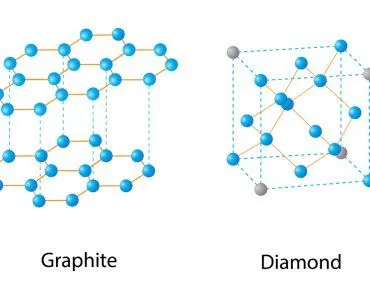
These tabulated values are called standard molar entropies, written S°, the entropy of one mole of a substance at 298 K (25 °C) and standard pressure, in joules per mole per kelvin (J/(mol·K)). They are not abstractions; they are the everyday currency of chemistry. The numbers track how ordered a material is: diamond, with its rigid, tightly bonded lattice, has an S° of only about 2.4 J/(mol·K), while the looser layers of graphite come in at about 5.7. Liquid water sits near 70.0, and the same molecule as water vapor jumps to roughly 188.8, because a gas has vastly more ways to arrange its molecules than a liquid or a solid. That ordering, S°(gas) > S°(liquid) > S°(solid), falls straight out of the third law's bookkeeping.

Engineers and chemists feed these absolute entropies into calculations of whether a reaction will happen on its own, how efficiently a chemical plant runs, and how materials behave when chilled toward absolute zero in cryogenics, the science of the very cold, where liquid nitrogen at about -196 °C (-321 °F) is a workhorse. So while you will never sit at absolute zero, the third law is doing real work every time someone looks up an entropy value in a table.
Why Don't Real Crystals Have Exactly Zero Entropy?
The third law promises zero entropy only for a perfect crystal, one in which every atom and molecule sits in a single, uniquely ordered arrangement. Real materials cooled toward absolute zero often fall short of that ideal, and the leftover disorder they carry is called residual entropy. It is one of the most telling real-world fingerprints of the third law, precisely because it shows up when the law's "perfect crystal" condition is broken.

The classic example is solid carbon monoxide (CO). The molecule is nearly symmetric, so as the crystal freezes each molecule can point either way, as C–O or O–C, and the lattice gets stuck with a frozen-in jumble of both orientations. If the choice were perfectly random, the residual entropy would be R ln 2, about 5.76 J/(mol·K). The measured value is around 4.2 J/(mol·K), telling us the real crystal is a little more ordered than fully random, but still nowhere near a perfect, zero-entropy crystal.
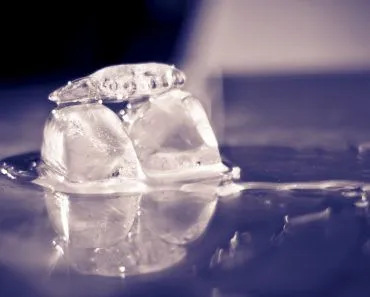
Ordinary water ice tells the same story. In the 1930s, Linus Pauling explained why ice keeps a residual entropy of roughly 3.4 J/(mol·K) near absolute zero: the oxygen atoms sit in a neat hexagonal lattice, but the hydrogen atoms can occupy many equivalent positions along the hydrogen bonds, leaving the protons disordered even at the lowest temperatures. The lattice looks orderly, yet a hidden layer of arrangement never settles. Residual entropy does not break the third law; it sharpens it, reminding us that the law's zero applies to a true ground-state crystal, not to the imperfect solids nature usually hands us.
Read More:
What is The First Law of Thermodynamics?
The Boltzmann Equation: Connecting Thermodynamics And Statistical Mechanics
References (click to expand)
- Third law of thermodynamics. Encyclopedia Britannica.
- Walther Nernst (1864-1941). Encyclopedia Britannica.
- Entropy and the Third Law of Thermodynamics. Chemistry LibreTexts.
- Statements of the Second and Third Laws of Thermodynamics. MIT.
- Absolute zero (and laboratory record lows). Wikipedia.
- Entropy Changes and the Third Law of Thermodynamics (standard molar entropies). Chemistry LibreTexts.
- Third Law of Thermodynamics (absolute entropy and Debye extrapolation). Chemistry LibreTexts.
- Residual entropy (carbon monoxide and water ice). Wikipedia.