Table of Contents (click to expand)
A subduction zone is a convergent plate boundary where a denser tectonic plate (usually an oceanic one) bends downwards and sinks beneath an overriding plate into the mantle. This process, called subduction, slowly carves out deep ocean trenches such as the Mariana Trench, feeds chains of arc volcanoes like those of the Pacific Ring of Fire, and produces the largest earthquakes ever recorded.
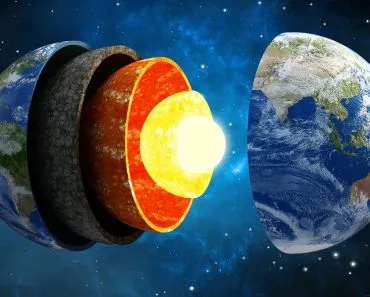
When you look at a cake from above, what do you see? Obviously, you see both the icing and the chocolate chips. Only when you cut a piece are you able to observe the different layers inside the delicious dessert.
The same is the case with our planet. It ranges from a variety of topographic variations on the top, but the inside is also full of surprises. Interestingly enough, it’s actually these hidden parts that cause the changes in the surface of the earth that we see!
According to the theory of Plate Tectonics, the rigid outer shell of Earth, called the lithosphere (the crust plus the brittle uppermost mantle), is broken into giant slabs known as tectonic plates. These plates come in two flavors: continental and oceanic. The oceanic ones are comparatively heavier, so when they collide with a less dense plate, they bend down and sink, forming a zone referred to as a subduction zone. This fascinating phenomenon contributes to the formation of the world’s deepest trenches, the occurrence of the most powerful earthquakes, and even massive volcanic eruptions!
What Are Tectonic Plates?
Before diving into the science of subduction zones, let’s first take a look at what the theory of Plate Tectonics is all about.
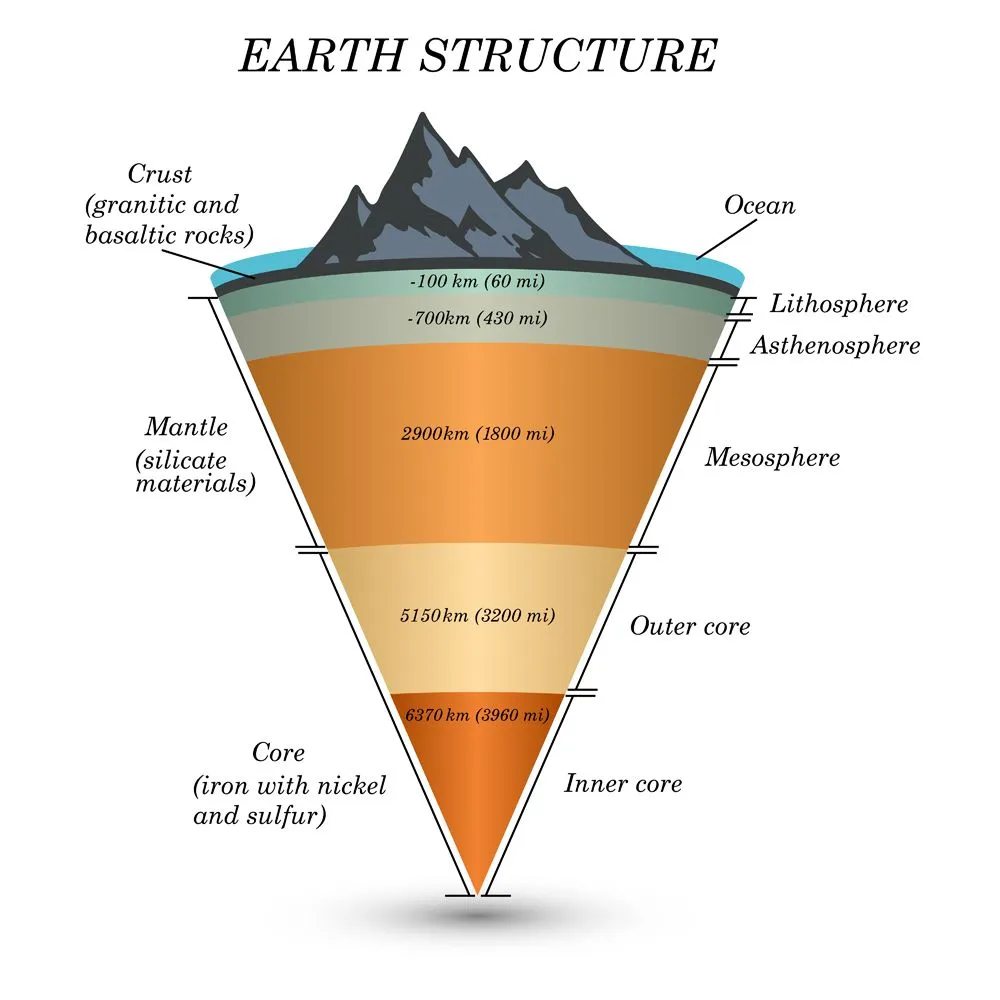
According to this theory, the outer shell of the earth, known as the lithosphere, is composed of broken slabs or plates of rock. These slabs of rocks are called tectonic plates. The plates exist somewhat like puzzle pieces. What is even more interesting, however, is that these plates are in continuous motion as they slide over the asthenosphere beneath them.
The asthenosphere is the layer of the earth that lies directly under the lithosphere. Despite often being described as “fluid,” it is actually solid rock, just mechanically weak enough to flow plastically (like extremely stiff putty) on geological timescales.
Plate boundaries are actually the peripheral areas of a tectonic plate. A tectonic plate can come in two types, based on its density. It can either be an oceanic plate or a continental plate. A characteristic feature of a continental plate is that it’s comparatively lightweight, as it is composed of granitic material. On the other hand, an oceanic plate is much denser and heavier, which can be attributed to its basaltic composition.
Now, if the plates are in motion, what happens? Primarily, every structure or disturbance, such as an earthquake or a volcanic eruption, is caused by this geologic activity. The plates either converge with each other or they diverge away from each other. However, if a plate is converging at one point, then it must undoubtedly be diverging from another!
What Are Subduction Zones?
Even though the plate boundaries are absolutely invisible from the surface of the earth, they are definitely still there. These boundaries can also be mapped through certain satellites.
It was found that when two plate boundaries floating on the asthenosphere converge towards each other, the denser one subducts beneath the lighter one. This can be understood by taking the example of two boats.
Consider a boat carrying many boxes of goods. If this boat collides with an empty one, which one do you think would submerge? Of course, the boat with the goods, because it is significantly heavier!
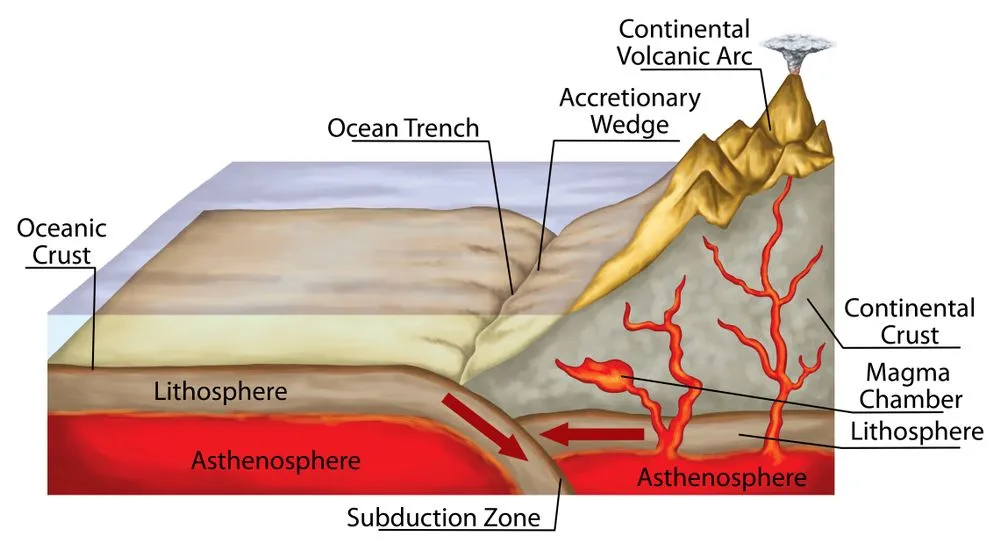
When an oceanic plate collides with a continental plate, the oceanic plate (being heavier) bends and slides beneath the continental plate. When this plate is forced to bend downwards, the process is called subduction. The process of subduction results in the formation of a zone called a subduction zone. The plate that bends usually curves down into the mantle. After curving, it forms a v-shaped zone in the ocean that is very narrow. This curving also gives rise to a series of stunning phenomena, such as the formation of trenches, the occurrence of earthquakes and even volcanic eruptions!
What Do Subduction Zones Create?
As mentioned above, subduction zones form oceanic trenches. At the region where the oceanic crust bends and curves into the mantle, a v-shaped region is formed. This region results in the formation of a deep trench. An oceanic trench is a depression in the seafloor that is very narrow in width. The famous Mariana Trench in the western Pacific Ocean, where the Pacific Plate slides beneath the small Mariana Plate, is a classic example of this phenomenon in action. At its deepest point, Challenger Deep, the floor drops to roughly 10,935 m (35,876 ft) below sea level, making it the deepest known spot on the planet.
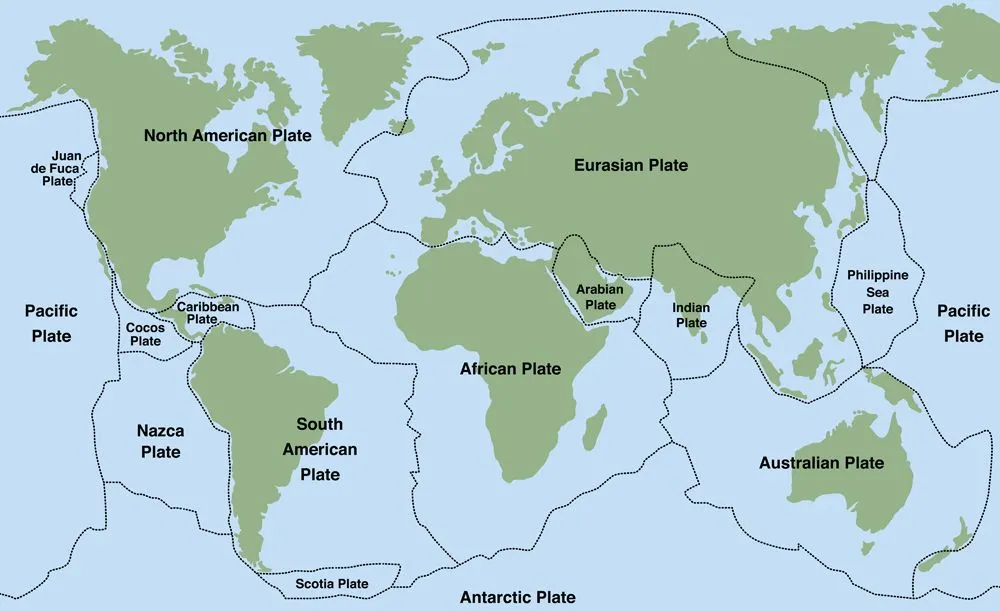
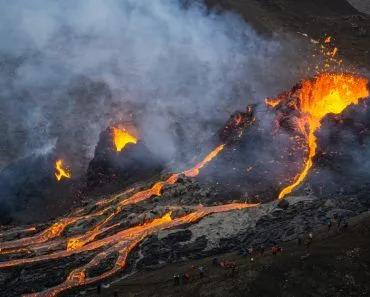
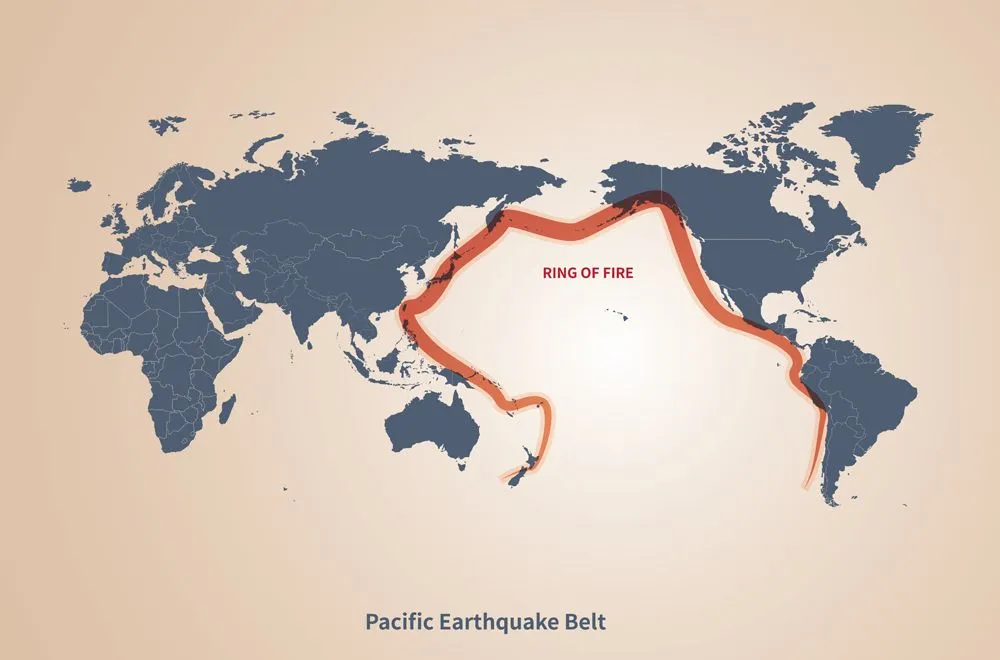
Subduction zones are also responsible for volcanic eruptions, though the mechanism is a little sneakier than just "melting from the heat." As the slab sinks to about 100 km depth, the hydrous minerals it carries down break apart and release water into the wedge of mantle rock sitting directly above it. That water lowers the melting point of the mantle rock (a process called flux melting), generating magma in the mantle wedge itself, which then rises through the overriding plate and erupts as a chain of volcanoes running parallel to the trench. The most famous example is the Pacific Ring of Fire, a horseshoe-shaped string of subduction zones around the rim of the Pacific Ocean that involves the Pacific, Nazca, Cocos, Juan de Fuca, Philippine Sea, North American, South American, Caribbean and Australian plates. According to the USGS, the Ring of Fire hosts about 75% of the world’s active volcanoes and roughly 90% of its earthquakes.
Aside from the trenches and volcanic eruptions, subduction zones also cause earthquakes, including the most violent ones we know of. When two massive plates lock together along the boundary and then suddenly slip, the stored elastic energy is released as a megathrust earthquake. Every magnitude 9+ earthquake ever recorded on a seismograph has come from a subduction zone: the 1960 Valdivia, Chile event (M9.5, the largest ever measured), the 1964 Great Alaska earthquake (M9.2), the 2004 Sumatra-Andaman quake (M9.1) that triggered the Indian Ocean tsunami, and the 2011 Tōhoku event (M9.1) that struck Japan. Sometimes the shaking is mild, but when a subduction zone fails along a long stretch of the fault, the consequences are catastrophic.
Conclusion
As we know, what is visible from the top might be caused by a number of underlying reasons. Subduction zones, being the case in hand, are responsible for many catastrophic events that we witness on a daily basis. Earth is truly a place of ever-expanding wonder, isn’t it?
References (click to expand)
- Understanding Plate Motions - U.S. Geological Survey (This Dynamic Earth)
- What is the Ring of Fire? - U.S. Geological Survey
- Asthenosphere - Encyclopaedia Britannica
- Subduction Zones - Columbia University, Lamont-Doherty
- The Mariana Trench - NOAA Ocean Exploration
- 20 Largest Earthquakes in the World - USGS Earthquake Hazards Program
- Plate Tectonic Theory: Plates and Interplate Relationships - James Madison University GeoLab