Table of Contents (click to expand)
- Why Is It Warmer In Summer And Colder In Winter In The First Place?
- What Is The Polar Vortex?
- Polar Vortex Affecting Weather Outside The Poles
- How Global Warming Affects The Polar Vortex
- Why Is The Arctic Warming Faster Than The Rest Of The Planet?
- Is The Polar Vortex–Global Warming Link Actually Settled Science?
- Conclusion
Yes, counter-intuitively, global warming can drive harsher, snowier winters in some regions. A warming Arctic can destabilize the stratospheric polar vortex, the high-altitude ring of fast winds that normally pens cold air over the pole. When the vortex weakens or splits in a Sudden Stratospheric Warming event, that trapped Arctic air spills southward and dumps brutal cold and snow on the eastern US, Europe and East Asia, even as the planet as a whole gets warmer. The exact strength of this link, though, is still an active area of climate research.
Whenever we experience the strong heat of summer, we think, surely it can’t get any hotter than this! However, the very next year, it is inevitably even hotter. The strangest thing to wrap our heads around is the apparent paradox of colder winters.
Technically, the temperature of the Earth is increasing, so shouldn’t the winters also be warmer than the previous ones we have experienced?
Surprisingly, we have also seen harsher winters with our hotter summers! In fact, places where it never snows have been regularly receiving snowfall…
What is this sorcery?! As always, science has an answer for everything, or at least the tools to find all the answers. In our case, the answers can be found in the Polar Vortex.
Why Is It Warmer In Summer And Colder In Winter In The First Place?
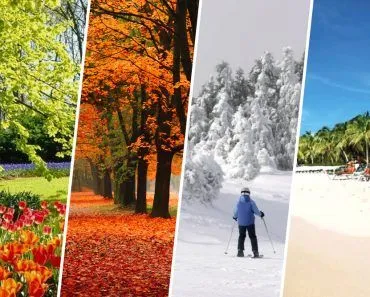
Before we tackle the paradox, it helps to remember why we have seasons at all. The popular guess, that summer is hot because Earth swings closer to the Sun, is simply wrong. In fact, the Earth is at its farthest from the Sun in early July and its closest in early January, the opposite of what that idea would predict.

The real culprit is the tilt of Earth's spin axis, which leans about 23.4° away from straight up. As our planet orbits the Sun, that tilt points the Northern Hemisphere toward the Sun for half the year and away from it for the other half. When your hemisphere leans toward the Sun, sunlight arrives more directly, striking the ground at a steep angle so that a beam of light is squeezed onto a smaller patch of surface. More energy per square meter means warmer days, and that is summer.
In winter, your hemisphere leans away. The Sun sits low in the sky, so each beam smears its energy across a wider area and heats the ground far less, the way a flashlight makes a bigger but dimmer pool of light when you tilt it. At a mid-latitude of 45°, the noon Sun climbs to roughly 68° in summer but only about 22° in winter, which works out to nearly 93% of full overhead sunlight in summer versus only about 37% in winter. Shorter winter days, with fewer hours of sunshine to bank, make the chill deeper still. (If you want the full picture, we have a separate article on what causes the seasons.) This ordinary, tilt-driven cold is the baseline. The puzzle this article tackles is why some of these winters have been turning harsher even as the planet warms.
What Is The Polar Vortex?
If you recall from recent years, whenever there is the threat of unusually cold temperatures in a region, social media erupts with ‘The Polar Vortex is coming!’
This makes it sound like the polar vortex is some monster or alien invasion, and it certainly isn’t something that comes to us!

So, what is the vortex exactly? Well, technically, there are two of these vortices, one at each of the poles. These vortices are very high-speed winds situated high in the atmosphere. To be more exact, their speeds can exceed 161 km/hr (100 miles/hr)! The reason they are called vortices is that they move in a counter-clockwise motion to form a vortex above the poles. Effectively, they form a barrier against the cold of the polar regions.
These polar vortices lie in the stratosphere, so they shouldn’t affect the weather, but they do affect the high-velocity winds just below them, which are responsible for the weather. Indirectly, they are affecting the weather. Usually, they stick to affecting the weather at the poles, but sometimes their influence can spread…
Polar Vortex Affecting Weather Outside The Poles
In our case, we are interested in the Northern Polar Vortex (the Arctic vortex), which has been responsible for our recent bout of severe winters. As stated, the vortex traps the cold of the Arctic within that region. It can be imagined as a prison for the cold. If it’s strong, the weather influencing the jet stream only brings about regular rain. However, if it weakens, the prison is broken and all the cold escapes outward.
This cold air freezes the moisture in the air, and the weather-influencing jet stream brings snow storms as a result. This is how the temperature drops so low in those polar vortex years. It’s also why regions that normally only experience mild cold with occasional rain suddenly find themselves buried under snow!
Now, the natural question is… what affects this polar vortex? If you guessed global warming, you’re correct. Let’s find out how!
How Global Warming Affects The Polar Vortex
See, global warming, as the name implies, means a global rise in temperature. This means that the atmosphere (at least the innermost layers) is warming up.
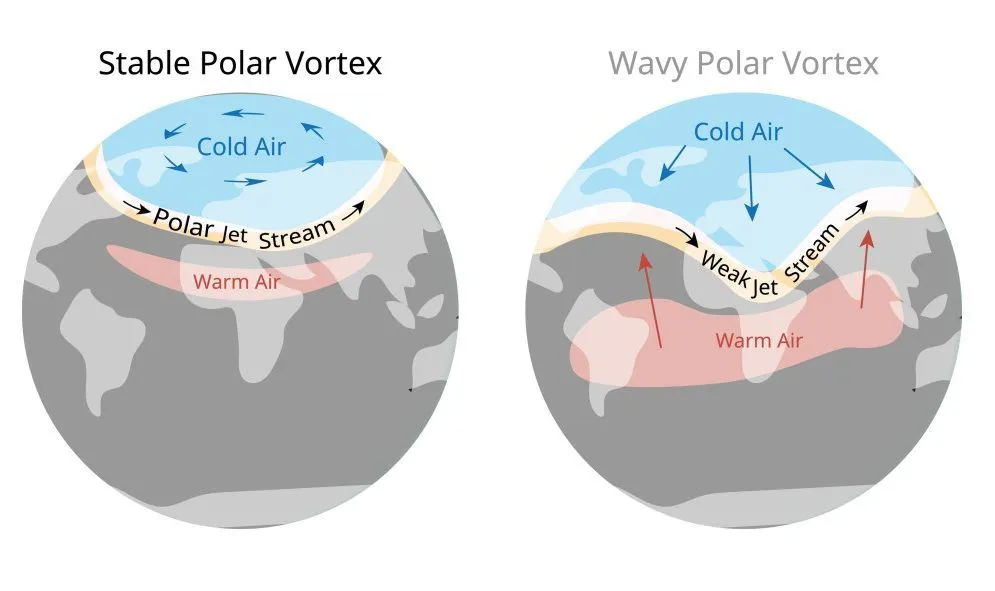
The problem is that warm air from the mid-latitudes travels up from warmer areas to the colder Arctic region. This warm air affects the polar vortex by throwing it off balance, and the consequences are serious! In what climatologists call a Sudden Stratospheric Warming (SSW), stratospheric temperatures can shoot up by 50–80 °C in just a few days. At that point the polar vortex becomes weak or even splits into two lobes, allowing the cold of the Arctic to seep out into mid-latitude regions.
In short, the cold is no longer contained to the arctic once the vortex is disrupted. It spreads out into the surrounding regions thanks to the jet stream and, in turn, the arctic becomes less cold.
Why Is The Arctic Warming Faster Than The Rest Of The Planet?
There is a piece missing from that story: why does warm air pile into the Arctic so persistently in the first place? The answer is that the far north is not warming at the same pace as everywhere else. According to NASA, the Arctic has been heating up about twice as fast as the mid-latitudes, and more recent assessments put the gap even higher over the last few decades. Scientists call this lopsided heating Arctic amplification, and it is the engine sitting behind a wobbly vortex.

The biggest driver is a feedback loop involving sea ice. Bright white ice is a superb mirror, bouncing most incoming sunlight straight back to space, which scientists describe as a high albedo. As the planet warms and that ice melts, it exposes the dark ocean beneath, and dark water soaks up far more solar energy than ice ever did. NASA notes that this lower albedo means the surface "absorbs more heat from sunlight rather than reflecting it back to space," which warms the water, melts even more ice, and the cycle feeds on itself.
This runaway warming does more than melt ice. It shrinks the temperature contrast between the icy pole and the warmer regions to its south, and that contrast is exactly what powers and steadies the polar vortex and the jet stream. With a smaller temperature difference to hold them in line, both can grow sluggish and prone to the wobbles described earlier. So the warmer the Arctic gets, the more readily its cold can come unstuck and slide our way.
Is The Polar Vortex–Global Warming Link Actually Settled Science?
Here is where honesty matters: the broad idea that a warming Arctic can occasionally feed harsher mid-latitude winters is taken seriously, but the precise chain of cause and effect is not settled science. It is one of the liveliest debates in climate research right now, and you should be wary of anyone, on either side, who claims the case is closed.
The split runs right down the middle of the field. Long-term observations are, in the words of NOAA, "strongly suggestive" of a link between Arctic warming and a wavier, more disruptive jet stream. Yet when researchers reproduce the same warming inside climate models, many find only a tiny effect, and some models even predict a stronger vortex rather than a weaker one. Several high-profile modelling studies in recent years have cast real doubt on the simplest version of the theory. As one NOAA scientist puts it, the influence of global warming on the vortex so far is "small compared to the noise of natural variability," meaning ordinary year-to-year randomness can easily swamp the signal.
None of this unwinds the physics in this article. Sudden stratospheric warmings are real, the vortex genuinely does weaken and split, and cold air genuinely does spill south when it does. What remains genuinely uncertain is how much human-driven warming is tilting the dice toward those events, versus how much is simply the atmosphere doing what it has always done. That is an open question, and it is a perfectly scientific answer to say so.
Conclusion
One surprising fact is that the effect of global warming on the Polar Vortex has been studied for a long time. There are many pieces of research that warned us these sorts of disruptive weather events were possible. This was when such bitterly cold winters were not even a recurring phenomenon.
But now, we experience a record-breaking summer of heat every year and a consequent record-breaking winter of cold as well. It has become a recurring phenomenon in recent years, and shows no sign of slacking off.
How strange that a phenomenon associated with increasing temperatures is also responsible for the coldest temps as well!
References (click to expand)
- Polar vortex brings freezing cold – DW – 02/07/2021. Deutsche Welle
- Polar Vortex - National Geographic Education. National Geographic
- Zhang, J., Tian, W., Chipperfield, M. P., Xie, F., & Huang, J. (2016, October 24). Persistent shift of the Arctic polar vortex towards the Eurasian continent in recent decades. Nature Climate Change. Springer Science and Business Media LLC.
- Why does Earth have Seasons? NOAA NESDIS.
- What Causes the Seasons? NASA Space Place.
- Arctic Amplification. NASA Earth Observatory.
- Understanding the Arctic polar vortex. NOAA Climate.gov.
- Q&A: How is Arctic warming linked to the ‘polar vortex’ and other extreme weather? Carbon Brief.