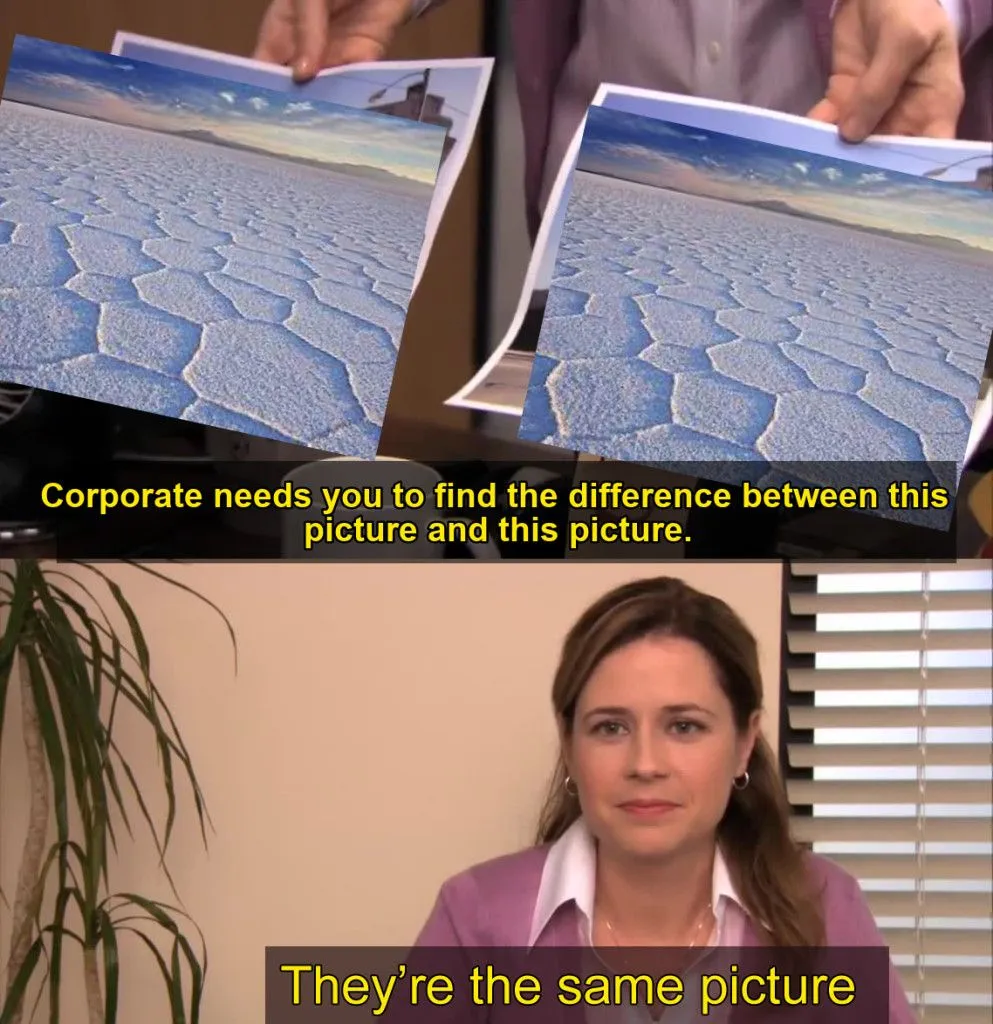
The honeycomb patterns in salt deserts form because salty water beneath the crust sinks while fresher water rises, circulating in convection “rolls” much like hot and cold water in a heated pan. Salt piles up into ridges where the heavy water sinks, carving the uniform 1-2 meter polygons seen on salt flats worldwide.
Have you ever seen this strange pattern that forms across salt deserts?
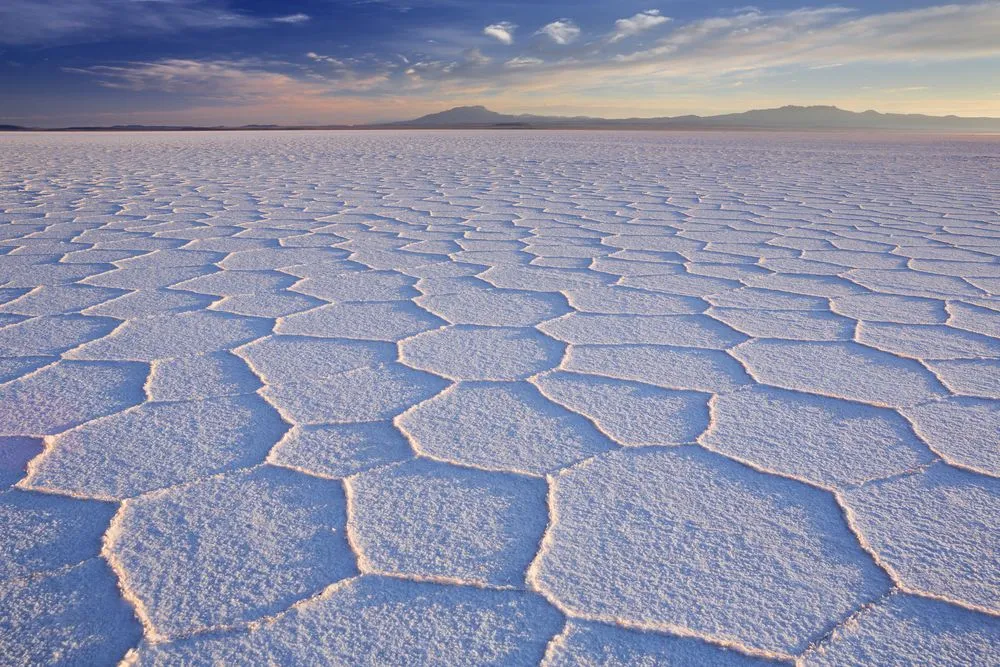
It may look like a mysterious, alien landscape from a sci-fi movie, but this is a real location: a giant salt flat (also known as a salt pan). The Salar de Uyuni in Bolivia was even used to shoot the Crait battle scene in Star Wars: The Last Jedi. The beauty of the salt deserts fascinates tourists, researchers and movie-makers alike.
But how does the “honeycomb” pattern form in salt deserts around the world?
To get to the bottom of this, first, we must understand what a salt flat is.
What Is A Salt Desert Flat And How Is It Formed?
Natural salt pans are flat areas of land, usually found in deserts, covered in large expanses of salts and other minerals. Salt flats were once water bodies (e.g., lakes or ponds). Due to a lack of rain for several years, the ground gets hotter. The water that cannot seep into the ground evaporates. Only particles of minerals and salts remain.
A salt pan usually shines like a dry white sea under the sun. The vastness of the terrain itself fills viewers with awe. The honeycomb pattern on top of it adds to the wonder… and has caused quite a bit of head-scratching.

A salt desert may seem to be bone-dry, but you’ll be surprised if you dig deep with your bare hands. You’d quickly reach a layer of water that lies in the soil right beneath the crust. However, that water is so salty that you can’t drink it!
Previous Attempts To Figure Out The Honeycomb Pattern
Many early studies suggested that when the salt crust becomes too dry, it begins to grow cracks, which cause these patterns to form. Another explanation was that when the salt crust swells too much, it bends under strain, without having enough space to grow, and crumbles into a network of honeycomb-like ridges.
However, none of these hypotheses could explain why the series of polygonal shapes look so alike all over the world, particularly in terms of how uniform they are in size and shape (always 1-2 meters/3-6 feet) and the pace at which they form.
The pattern remains the same, regardless of the differences in their environmental, geological or chemical features.
Breaking Fresh Ground
In 2023, a study published in Physical Review X by Jana Lasser, Lucas Goehring and their colleagues cracked the puzzle. Drawing on fieldwork at Badwater Basin in Death Valley and the Salar de Uyuni, plus lab experiments and computer models, they showed the honeycomb pattern is driven by how salty water moves below the sandy surface in the desert soil.
So, how does it work?
We should all be familiar with how heated water ‘rolls’ in a circular motion. When water is heated, the hot water particles that are less dense well up to the surface, while the cooler and more dense water particles sink to the bottom. This circulation of hot and cold water in a boiling pan is known as a convection current.
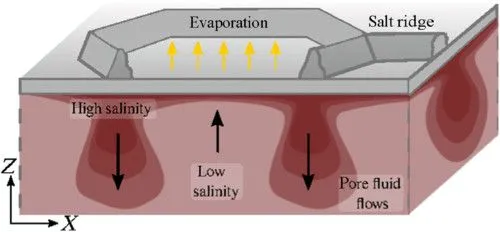
In a similar way, a convection ‘roll’ of salt and fresh water takes place directly below the salt pans. This is triggered by the contrast in salinity (the amount of salts dissolved in different layers).
Convection Flow Is The Driving Force: The Way Of Water
Saltwater, as we know, is more dense than freshwater. Saltier water becomes heavier than the layer of water that lies directly below the ground in these salt pans. At a certain point, the saltier water sinks to the bottom and the less dense freshwater rises up from below. Thus, many rolling plumes of water sweep across the whole area, creating a uniform texture in the salt flats.
But why a polygon? Why not a circle?
If only a single roll occurred, we’d find a circular shape, but many such convection rolls happen next to each other at the same time. As a result, they are “squeezed” together, pushing one another into developing these hexagonal salt patterns. The salty water then sinks down along the edges of these structures.
Each of these convection rolls reaches down through roughly the same depth of soil, on the order of a meter or two. Because the width of a roll is set by its depth, the cells (and the salt polygons stamped above them) end up roughly 1-2 meters (3-6 feet) across, no matter which salt flat you visit. That single mechanism is what finally explained why these patterns look so uniform worldwide.
In places where the salt content is very high, salt crystals crystallize more prominently on the surface, building up the raised ridges you see along the polygon edges.
A Final Word
From Badwater Basin in California’s Death Valley National Park, Bonneville Salt Flats in Utah, to the Makgadikgadi Pan in Botswana, these surreal patterns of hexagonal shapes are a common feature. For years, it seemed like one of Mother Nature’s mysteries that couldn’t be cracked.
Looking at them, we can’t but wonder how nature creates such regularity and uniformity, even in the most barren and inhospitable lands. Now, it seems, we are much closer to the answer!
References (click to expand)
- Lasser, J., Nield, J. M., Ernst, M., Karius, V., Wiggs, G. F. S., Threadgold, M. R., … Goehring, L. (2023, February 24). Salt Polygons and Porous Media Convection. Physical Review X. American Physical Society (APS).
- Physical Geography | How Salt Shapes Our Lives. Saltassociation.co.uk
- M Buchanan. Why Death Valley Is Full of Polygons. American Physical Society
- Bonneville Salt Flats | Utah.com. Utah
- Death Valley - National Park Service. National Park Service