When water droplets in clouds freeze, they form ice crystals. The shape of the ice crystal is determined by the temperature and humidity of the air around it. Snowflakes usually have six sides, because that is the shape of the ice crystals. The environment where a snowflake grows also impacts its shape.
The mere mention of snowflakes induces a fuzzy warm feeling of the holidays, blankets, and lovely stretches of pure white snow. What could possibly be better than experiencing the feeling of soft snowflakes falling on your skin on a pleasant, brisk day. You’ve surely played with snowflakes at many times in your life, but have you ever stopped to wonder why they have those stunning, intricate shapes?
Snowflakes
A snowflake is an ice crystal, or an accumulation of ice crystals, that fall to the Earth from the atmosphere. These flakes begin their journey as snow crystals, and then develop gradually as supercooled microscopic cloud droplets freeze. Despite being made of ice, snowflakes generally appear white (due to the reflection of the entire spectrum of light by the small facets of the crystals).
Shape
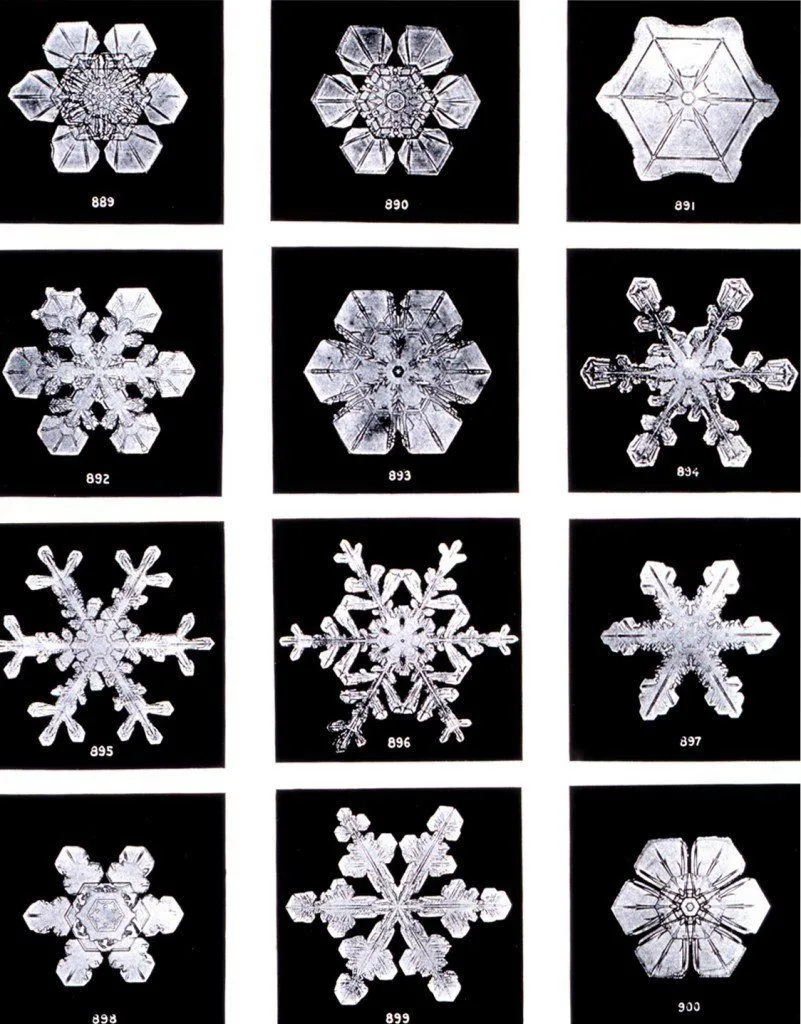
Snowflakes come in a seemingly endless variety of shapes and sizes. Some are simple and hexagonal-shaped, but others are much more complex in their shape. There are snowflakes that have intricate patterns and designs, which is why they appear so fantastic, particularly under a microscope. Due to their exposure to different atmospheric conditions, almost all snowflakes are unique.
Factors That Determine A Snowflake’s Shape
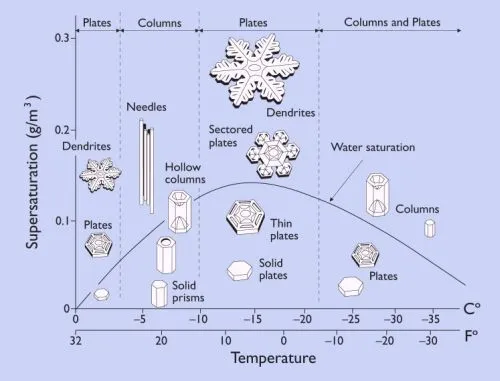
Two factors play key roles in determining the shape of a snowflake: temperature and humidity.
Kenneth Libbrecht, Professor of Physics at the California Institute of Technology, made some extensive observations regarding snowflakes’ shapes in different atmospheric conditions. He observed that snowflakes formed below -22 degrees Celsius (-7.6 degrees Fahrenheit) have comparatively simpler shapes than those formed in warmer temperatures.
The other crucial factor is humidity. It has been seen that the most intricate patterns in snowflakes are formed when there is ample humidity in the air. On the contrary, however, drier air results in snowflakes with simpler designs.
Why Are Snowflakes That Particular Shape?
Snowflakes commonly display a hexagonal shape; in other words, they form based on six-fold radial symmetry. The reason for this can be assumed to be from the fact that the crystalline structure of ice is also six-fold. The six arms of a snowflake grow independent of the growth of the other arms, which is the reason why a snowflake is never absolutely symmetrical. The environment where a snowflake grows also undergoes continuous changes in its temperature and humidity. Furthermore, the clouds through which a snowflake passes do not have a uniform temperature and water content. These changes impact the way that water molecules (present in the atmosphere) become attached to the snowflake.
Why Six Sides? The Hexagon Hidden In Ice

So why six, and not five or eight? The answer is hiding inside a single water molecule. Each water molecule is two hydrogen atoms bonded to one oxygen atom (H2O). When water freezes, those molecules don't pack together randomly. Instead, the oxygen atoms link up with neighboring molecules through hydrogen bonds, and the only way they can all settle into their lowest-energy arrangement is to line up in rings of six. As chemist Jason Benedict of the University at Buffalo puts it, the water molecules "arrange themselves in a lattice of hexagonal rings."
That repeating hexagonal lattice is the template for everything that follows. A growing snow crystal simply adds water molecules to the outside of this six-sided scaffold, so the crystal inherits the same six-fold symmetry at the scale you can see. It is the same reason a honeycomb is built from hexagons rather than squares: six-sided units are the shape that tiles space most efficiently for these particular building blocks.
This also settles a question many people ask: do snow crystals have octagonal (eight-sided) symmetry? They do not. Because the underlying ice lattice is hexagonal, natural snow crystals are six-sided. You can occasionally find twelve-pointed flakes, which form when two crystals fuse at a rotated angle, but never genuine eight-sided ones. That same hexagonal lattice, with its roomy, open structure, is also why water expands when it freezes instead of contracting like most liquids.
Are Snowflakes Actually Symmetrical?

Look at a classic star-shaped snowflake and the six arms seem like mirror images of one another. So how does a flake coordinate six branches that aren't even connected to each other? There is no central planner. The trick is that all six arms grow at the same time, in the same tiny pocket of air, as the flake tumbles through the clouds. Whenever the temperature or humidity shifts, every arm feels that change at the same instant and responds in the same way, so they grow in step. Physicist Kenneth Libbrecht of Caltech compares it to a crowd reaching for umbrellas the moment it starts to rain: nobody is communicating, yet everyone moves in sync because they all share the same surroundings.
That shared history is exactly why the six branches end up looking so alike. It is also why a snowflake is never perfectly symmetrical. If you photograph one at high magnification, you will always find small mismatches between the arms, because no two parts of the crystal experience conditions that are truly identical. So when a textbook says "snowflakes are always symmetrical," the honest version is that they are approximately, beautifully six-fold symmetric, not flawlessly so. The symmetry is a powerful tendency, not an iron rule.
What Shapes Can A Snowflake Be?

"Snowflake" is really a catch-all for several distinct crystal types, and which one you get depends largely on the temperature where it grows. In the 1930s, Japanese physicist Ukichiro Nakaya grew snow crystals in the laboratory under controlled conditions and mapped this out in what is now called the snow crystal morphology diagram (or Nakaya diagram). Nakaya liked to say that snowflakes are "hieroglyphs from the clouds," because the shape of a flake tells you the conditions it passed through.
Working from Libbrecht's summary of that diagram, the pattern goes roughly like this: near -2 °C (28 °F) you get thin, flat hexagonal plates; near -6 °C (21 °F) the crystals grow as slender columns and needles; and near -15 °C (5 °F) you get the large, elaborate six-armed stellar dendrites that most people picture when they hear the word snowflake. Curiously, the crystal type flips back and forth between plates and columns as the temperature falls, a quirk scientists still do not fully explain.
Humidity is the second dial. When the air holds only a little extra water vapor, crystals grow slowly into simple plates and prisms. When humidity is high and growth is rapid, the crystals sprout the intricate, feathery branches that make a dendrite look so ornate. Because a falling flake is constantly drifting between warmer and colder, wetter and drier pockets of cloud, it picks up a one-of-a-kind sequence of these features on the way down, which is the deeper reason falling snow arrives in such endless variety.
Popularity Of The Symbol

Due to their exquisite design, snowflakes are immensely popular in various fields. For example, the symbol of a snowflake is often the seasonal image used around the time of Christmas. Making snowflakes out of folded paper is also quite a beloved activity among children. This symbol is generally used to represent winter, which is why it was widely used in Frozen, an animated movie that was released in 2013, which depicted a princess that possesses the power to create and mold ice.
Nature not only provides us with plentiful resources, but also some extremely beautiful objects, like snowflakes, which become a great source of inspiration for people with a predilection towards the creative arts. Aside from those people, however, snowflakes inspire awe and wonder in countless millions around the world!
References (click to expand)
- Snowflake - Wikipedia. Wikipedia
- Guide to Snowflakes. The California Institute of Technology
- Snowflakes - No Two Alike?. The California Institute of Technology
- How snowflakes get their shapes - Iowa State University. Iowa State University's College of Liberal Arts and Sciences
- The chemistry of snowflakes, explained. University at Buffalo
- The Physics of Snowflakes: Why Flakes Have Six Sides and None Are Alike. American University
- Snow Crystal Morphology. SnowCrystals.com (Kenneth Libbrecht, Caltech)
- The Science of Snow Crystals. SnowCrystals.com (Kenneth Libbrecht, Caltech)