The dark-green, striped, and pale rinds you see at the market are different cultivars of watermelon, not different ripeness stages. Solid dark-green melons (with no stripes) are usually Sugar Baby types; bold wide-stripe-on-light-green melons are All Sweet; medium even stripes are Crimson Sweet; thin dark stripes on a pale background are Jubilee; and uniformly light-green melons with no stripes are Charleston Gray. Rind color is genetically controlled, and breeders pick crosses based on what their target market wants, but the pattern alone tells you nothing about sweetness.
The renowned author Paolo Coelho said, “Outer beauty is inner beauty made visible.” This is certainly true for watermelons as well. We enjoy the delicious pink flesh of the watermelon only after we select our watermelon based on its external appearance.
Sellers want their watermelon bins or piles to look a certain way to attract buyers. Consumers have specific preferences for what a watermelon should look like, and they prize watermelons that fit these preferences.
Some parts of the world have a strong preference for striped watermelon fruits, while others have a preference for dark green fruits, and still others prefer light green varieties. The type of stripe varies with the watermelon variety. They can be wide, medium, narrow, or thin.
Watermelon growers will only cultivate varieties that the consumers in their region (or target export market) prefer.
In this article, we will discuss different types of watermelon fruits based on their rind patterns.
Rind patterns are genetically controlled and watermelon breeders design their crosses based on what watermelon variety they are developing.
Types Of Watermelons
Watermelons are categorized into different types based on the type of rind they have, as well as their shape.
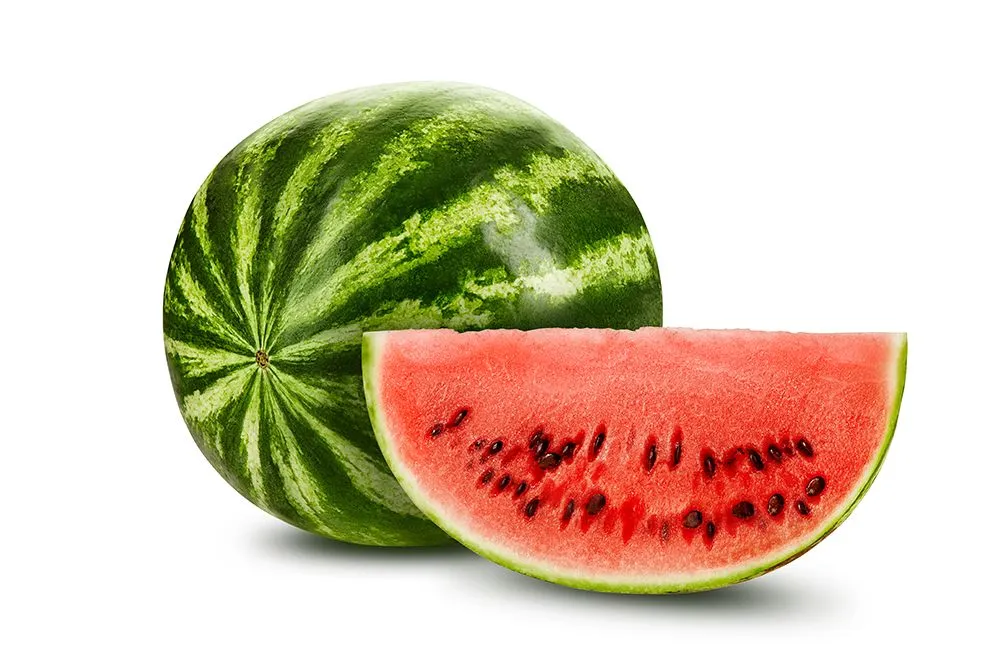
Crimson Sweet watermelons have dark green medium-width stripes on a light green background. The width of the stripe and the background are more or less equal. Commercially available Crimson Sweet melons are usually oblong in shape and can be seeded or seedless. However, that doesn’t mean that they cannot be round or elongated. Most regions around the world prefer Crimson Sweet watermelons to be oblong in shape. The flesh inside can be red, pink, or yellow.
The first Crimson Sweet variety was developed by Charlie Hall in 1963 at Kansas State University, USA. It went on to become the most popular type of watermelon around the world and all varieties with similar stripes were called ‘Crimson Sweets’. Seeded Crimson Sweet melons are preferred in regions such as Italy, Brazil, Turkey and Chile, and they are starting to gain popularity in India. Seedless Crimson Sweet types are preferred in the US.
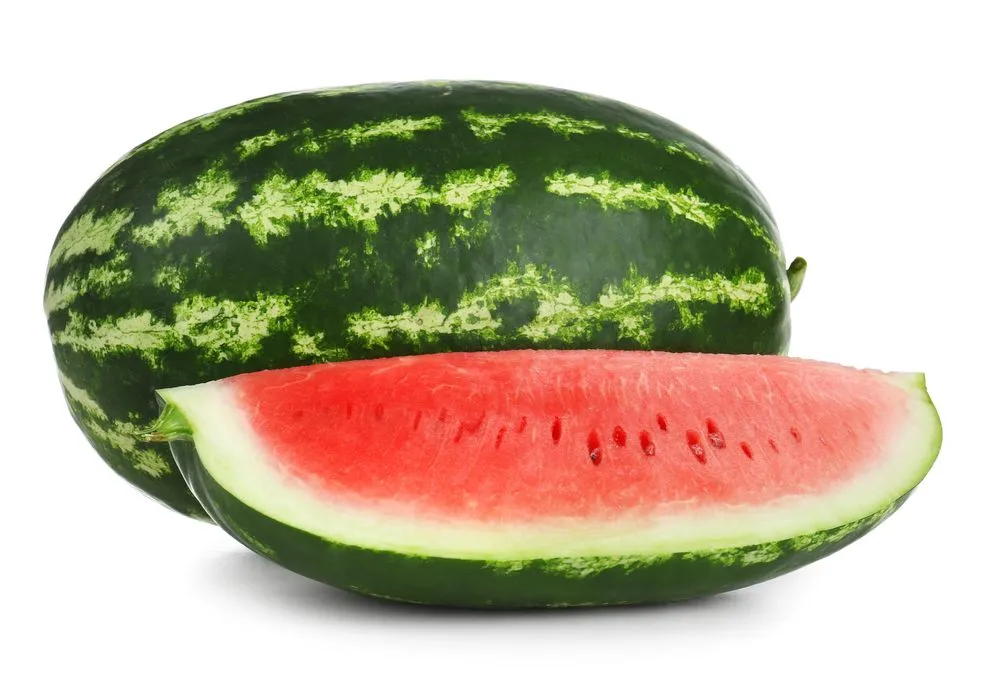
All sweet watermelons are usually large and elongated or oblong with wide dark green stripes on a lighter green background. Their difference from the Crimson Sweet type lies in the width of the stripes. In All sweet melons, the dark green stripe is wide and interspersed with a narrow region of lighter green background. The first all sweet variety was released in 1973 by Charlie Hall. Commercially available all sweet types are seeded and are popular in regions such as Mexico, South Italy, and some African countries.
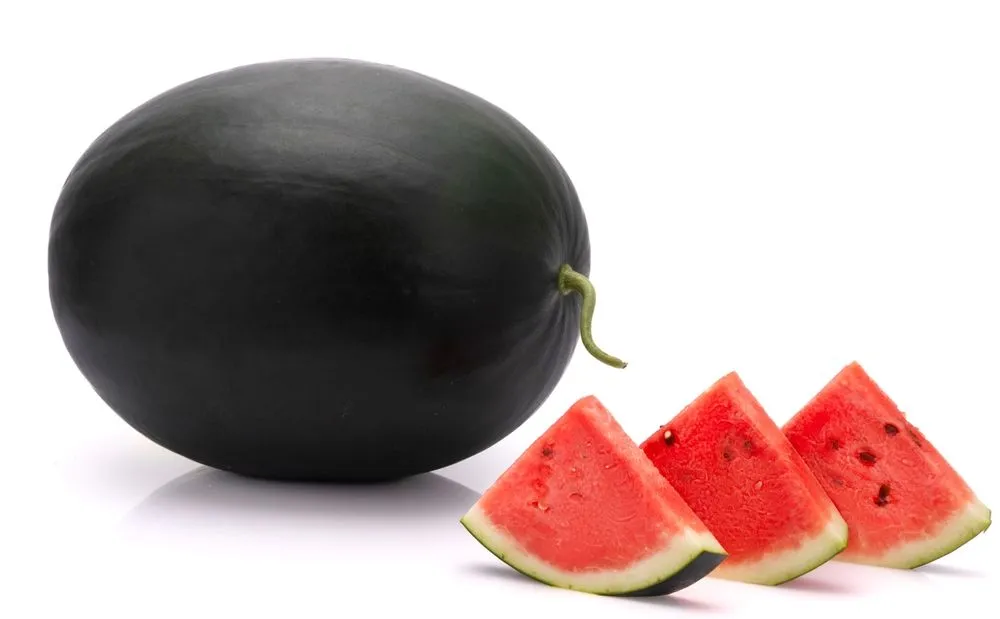
Sugar Baby watermelons have very dark green rind with no stripes. The shade of dark green can vary, with some varieties having almost a black rind, and others possessing a medium-dark rind. Although these types do not have the typical stripes, occasionally they have some very fine lines (called pencil stripes). The first Sugar Baby watermelon was introduced in 1955. Sugar Baby melons are usually round to oval and can be seeded or seedless. Seeded sugar baby types are preferred in India. Seedless sugar babies are preferred in Australia and Spain.
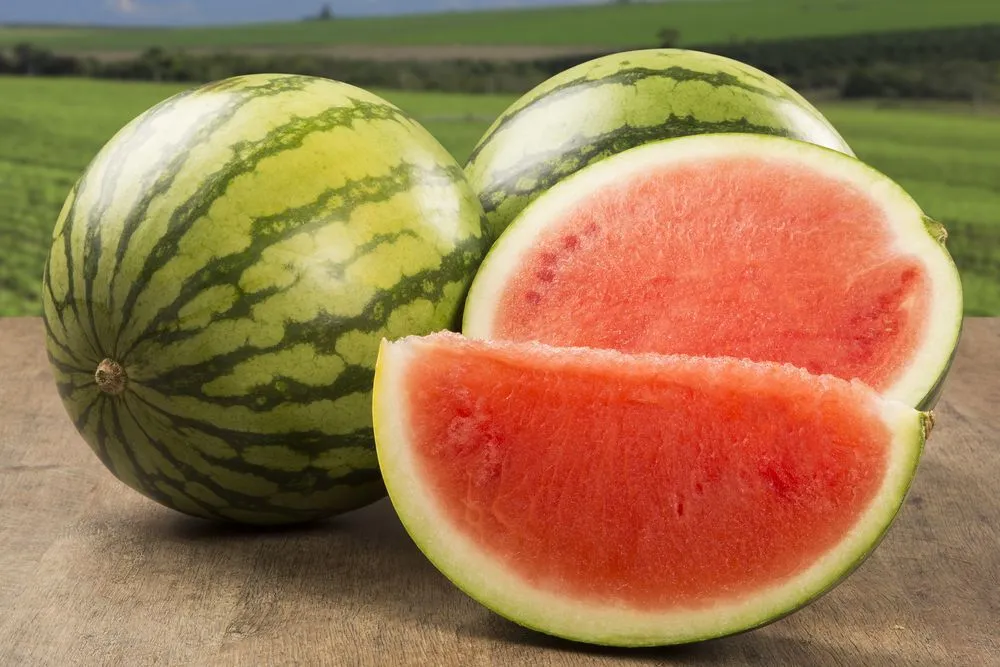
Jubilee or Tiger watermelons have stripes that are very dark green, angular, and thin on a light green or pale background. The first Jubilee watermelon, with the same variety name, was developed by JM Crall in 1963 at the Florida Agricultural Experiment Station, USA. Since then, all watermelon varieties with that type of stripe are called Jubilees. Most commercial jubilee types are round or oval and can be seeded or seedless. Seeded jubilee types are common in Southeast Asian markets, while seedless jubilee types are popular in the US.
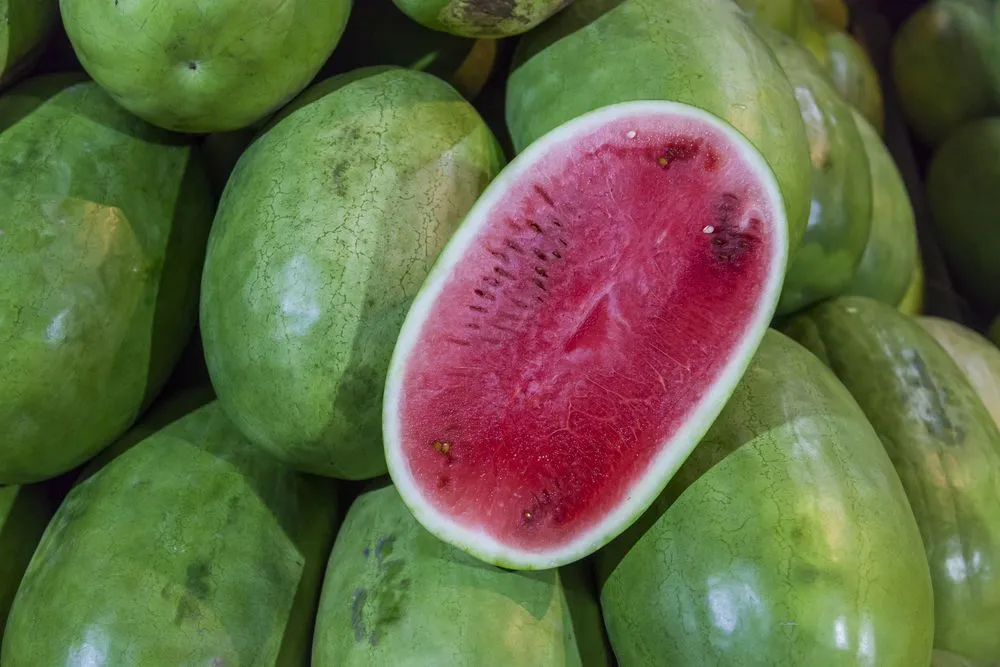
Charleston Gray watermelons are light green with no stripes. They can be round, oval, or elongated. The first Charleston Gray variety was developed by Charles Frederick Andrus in 1954 at the U.S. Vegetable Breeding Laboratory in Charleston, USA. Charleston Gray types are usually older seeded types and can be found in some Middle Eastern and African countries. Most watermelon breeders no longer breed for Charleston Gray types; however, they are used in breeding programs to introduce important traits into modern varieties.
Why Do Watermelons Have Stripes In The First Place?
The stripes are not painted on, and they are not a record of how the fruit grew. They are a pigment pattern built into the rind and written in the plant's genes. The darker bands simply hold more green pigment (chlorophyll) than the paler background between them, so the contrast you see is really a map of where the rind packs in the most chlorophyll.
This pattern is inherited, and breeders have understood its rough genetics for decades. A classic series of versions (alleles) of a single gene, known as the g locus, lines up neatly with what you find at the market: solid dark green, wide stripes, medium stripes, narrow stripes, and finally a solid pale or gray rind. They sit in a dominance ladder that runs from solid dark green at the top down to solid pale at the bottom, with the stripe widths ranked in between. That is why a single breeding program can turn out everything from a Sugar Baby to a Charleston Gray.
More recent work has put real coordinates on these traits. Geneticists have mapped the genes that switch striping on, and that control how sharp the stripe edges look, to chromosome 6 of the watermelon genome, and have begun to name the individual genes responsible. So when you spot a bold-striped melon sitting beside a solid dark one, you are looking at two different settings of the same small set of genes, not two different stages of ripeness.
Does The Rind Pattern Predict How Sweet The Watermelon Is?
The short answer is: No!
Watermelon varieties are bred based on the preferences of consumers in their target markets. For example, many Asian consumers prefer round-oval seeded watermelons with jubilee stripes and yellow flesh. Therefore, watermelon breeding companies combine these characteristics in their commercial varieties. On the other hand, consumers in the US prefer round-oval seedless jubilee types with red flesh.
There is a common misbelief that darker rind colors correlate with dark red sweeter flesh, but this is not true. This idea probably developed because some of the commonly available sweeter and redder varieties had dark red stripes (e.g., the variety Fascination). However, this does not mean that all varieties with dark stripes will be intensely sweet. Sweetness varies based on the genetics of the variety. A variety with medium green stripes can also have dark red and sweet flesh (e.g., the variety Excursion).
What Does A Dark Green Watermelon With No Stripes Mean?
If you have picked up a watermelon that is a solid, deep green all over with no stripes at all, there is nothing wrong with it. You are almost certainly holding a Sugar Baby or a closely related dark-rind variety. These melons are bred to be that uniform color, and some Sugar Baby types are so dark they look almost black, occasionally carrying only a few faint "pencil" lines rather than true stripes.
A solid dark rind tells you nothing about whether the melon is ripe, sweet, or deep red inside. As we saw above, rind color and pattern are locked in by the variety's genetics, while sweetness is governed by a separate set of genes and by how long the fruit stayed on the vine. A no-stripe melon is not an unripe striped one, and it is not a guaranteed "extra sweet" kind either.
To judge whether any watermelon, striped or solid, is ready to eat, ignore the rind pattern and check three things instead. Look for a creamy yellow ground spot, the patch where the melon rested on the soil; a white or pale-green spot usually means it was picked too early. The fruit should feel heavy for its size and give a dull, hollow sound rather than a high, tinny one when you tap it. A slightly dull rather than glossy surface is one more sign that it is ripe.
Striped vs Solid Dark-Green Watermelon: What's The Difference?
Shoppers often line up a boldly striped melon next to a solid dark-green one and assume they must be completely different fruits, or that one is riper than the other. In truth, the only guaranteed difference between them is the variety they were bred from. Here is how the two compare at a glance:
| Feature | Striped melon (Crimson Sweet, All Sweet, Jubilee) | Solid dark-green melon (Sugar Baby) |
|---|---|---|
| Rind look | Dark green stripes over a lighter green background | Uniform dark green, sometimes with faint pencil lines |
| Why it looks that way | A stripe allele of the rind-pattern genes | The solid dark-green allele of the same genes |
| Typical size & shape | Often larger, oblong to round | Usually smaller and round, an "icebox" melon |
| Flesh color & sweetness | Set by the variety, not by the stripes | Set by the variety, not by the dark rind |
| Shows it is ripe? | No, check the ground spot, weight, and sound | No, check the ground spot, weight, and sound |
In short, the difference is cultivar and appearance, not quality. Pick whichever pattern you like the look of, then use the ground spot, weight, and tap test to find the ripe one in the bin.
Conclusion
Watermelons can be classified into 5 types (Crimson Sweet, All sweet, Sugar Baby, Jubilee, and Charleston Gray) based on their rind color and pattern. Watermelon breeders develop varieties based on the preferences of consumers in their target markets. Rind color and pattern cannot predict flesh color and sweetness, which are determined by the genetics of the variety and market preference.
References (click to expand)
- Boyhan, G. E., O’Connell, S., McNeill, R., & Stone, S. (2019, June). Evaluation of Watermelon Varieties under Organic Production Practices in Georgia. HortTechnology. American Society for Horticultural Science.
- Watermelon | Center for Crop Diversification.
- Varieties | SC Watermelon Association.
- Guner, N., & Wehner, T. C. (2004). The Genes of Watermelon. HortScience, 39(6), 1175–1182.
- Yang, S., et al. (2024). Fine genetic mapping and transcriptomic analysis revealed major gene modulating the clear stripe margin pattern of watermelon peel. Frontiers in Plant Science, 15, 1462141.
- How to Pick a Ripe Watermelon. University of Georgia Cooperative Extension.