Table of Contents (click to expand)
Sloths are so slow because slowness saves energy, and energy is scarce on a diet of low-calorie leaves. Their metabolism runs about 40 to 45% below the rate expected for a mammal their size, so they conserve fuel by creeping along at roughly 0.25 km/h (0.15 mph). Moving slowly and silently also keeps camouflaged sloths off the radar of visual predators like harpy eagles and big cats.
Sloths are probably the ‘spirit animal’ of a sizable chunk of the world’s population… can you guess why?
Because sloths are so damn slow!
Sloths are so famously slow that the word “sloth” has actually become synonymous with laziness, lethargy, and a general lack of energy.
Have you ever wondered why sloths move so slowly? Why do they drag themselves through life at a snail’s pace? Can’t they just hurry up and get moving and perhaps improve their reputation?
What Are Sloths?
Sloths are arboreal mammals that spend most of their lives hanging upside down in the trees of Central and South American rainforests. There are seven living species split between two genera, Bradypus (the three-toed sloths) and Choloepus (the two-toed sloths), and despite the names, every sloth has three toes on its hind limbs (only the forelimbs differ).
A sloth’s entire job description is, basically, hang on. They don’t build nests. They pick a tree, settle into a fork high in the canopy, and stay there for hours at a stretch, well camouflaged against the foliage. EEG studies of wild three-toed sloths actually clock them at around 9.6 hours of sleep a day, roughly the same as a well-rested human, which means the “sloths sleep 20 hours” line you’ve probably heard is just a captive-zoo artefact.
Their leaves-only diet is famously low in calories, and their metabolism runs about 40 to 45% below the rate expected for a mammal their size. The upshot is simple: less energy in, less energy spent, fewer reasons to ever climb down and go looking for trouble.
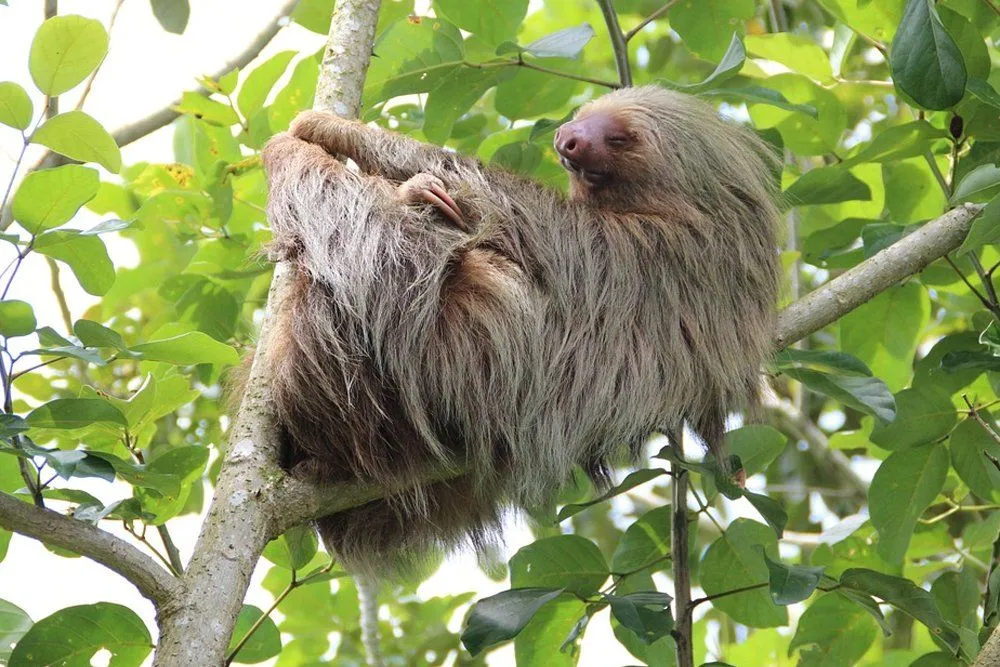
Camouflage seals the deal. A sloth’s coarse, grooved fur is colonised by a specialist green algae, Trichophilus welckeri, which tints its coat a mossy green and makes it almost invisible against the canopy. Because the sloth barely moves, the algae carpet is never disturbed and the disguise stays on full-time. Visual hunters like harpy eagles and jaguars rely on movement to spot prey, and a near-motionless lump of leafy fur high in a tree is a remarkably bad target.
Why are sloths so slow?
Sloths are notorious for being exceptionally slow in terms of movement. To help put this in perspective, consider this: on average, a sloth covers only about 40 metres (around 44 yards, or 130 feet) per day. That’s well under half the length of an American football field, and on the ground their top speed is roughly 0.25 km/h (0.15 mph), which is slower than most people walk to the fridge.

The primary reason why sloths are so slow is that it’s a more efficient way to live! It has a number of other advantages too!
The phrase ‘survival of the fittest’ basically means that the most suitable life forms will survive and reproduce, thus passing down those favorable genetic combinations. There are obvious ‘winner’ species – those that are fast and strong enough to protect themselves from their predators or catch their own prey and thrive. However, natural selection doesn’t just select the fastest and strongest species, but rather those that are most suited to thrive in their environment.
Sloths are one such species that base their ‘strategy’ around maximizing efficiency. First off, they have an incredibly slow metabolism. They move very slowly and maintain a lower body temperature than most other mammals. This means that their need to acquire resources (food) is less than many other animals. It works as a type of trade-off, which is a niche that sloths have mastered.

Sloths spend most of their time in trees. (Image Credit: Pixabay)
There is also a curious thermal twist to it. Three-toed sloths run an unusually low and variable body temperature, dipping to around 29 °C (84 °F) on cool nights and climbing into the high 30s °C (high 90s °F) at midday, and a 2018 study in PeerJ showed they can actively turn their metabolism down when it gets too hot, the first known case of a mammal doing this without hibernating. So instead of sweating or panting like most mammals, a sloth’s answer to a heatwave is, essentially, to do even less.
A leaf diet also takes a long time to process. The tough, fibrous leaves sit in a multi-chambered stomach where microbes ferment them for days, sometimes weeks, before the sloth absorbs the meagre nutrients. With food coming in slowly and energy budget so tight, sprinting around the canopy is simply not an option the body can pay for.
Sloths diets consist mostly of leaves which gives them minimal energy and nutrition.(Image Credit: Pixabay)
And here’s the punchline: sloths are not actually defenceless because they’re slow, they’re safer because they’re slow. Imagine you’re a harpy eagle scanning the canopy from above. You’re wired to lock onto twitches, rustles, the flick of a tail. A green-tinged lump that hasn’t moved in twenty minutes barely registers. Slowness, silence and that algae-painted coat together make a sloth almost invisible to the very predators that hunt by sight and motion.
All in all, moving slowly requires far less energy than moving fast, and on a leaf diet that’s the entire ball game. Sloths haven’t failed to evolve speed; they have evolved away from it, and built a quiet, low-budget life around the trade-off.
References (click to expand)
- Animals of the Rainforest-Sloth - www.srl.caltech.edu
- Three-toed Sloth - Bradypus variegatus - The Virtual Rainforest by Gerald Urquhart - msu.edu
- Putting the sloth in sloths: Arboreal lifestyle drives slow motion. The University of Wisconsin–Madison
- What’s with sloths’ dangerous bathroom breaks? Maybe hunger. The University of Wisconsin–Madison
- The metabolic response of the Bradypus sloth to temperature – Cliffe et al., PeerJ (2018)
- Sleeping outside the box: EEG measures of sleep in wild sloths – Rattenborg et al., Biology Letters (2008)