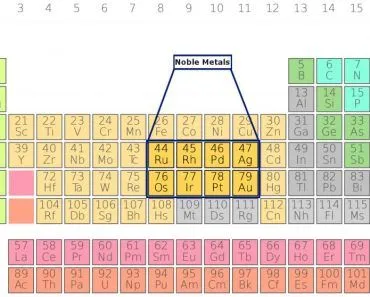
Yes, metals can be gases, depending on how high their boiling points are… but are gaseous metals really considered metals?
Close your eyes for a moment and let the word ‘metal’ float around in your head. So, what’s the first image that comes to your mind when you think of ‘metal’?
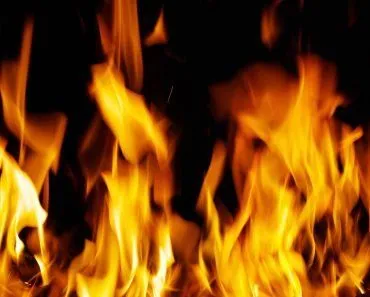
Some of you may see something like this:

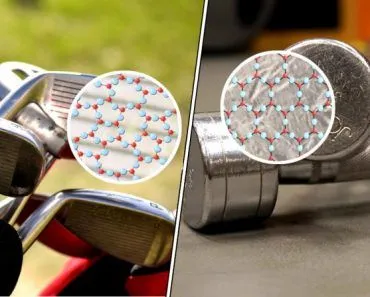
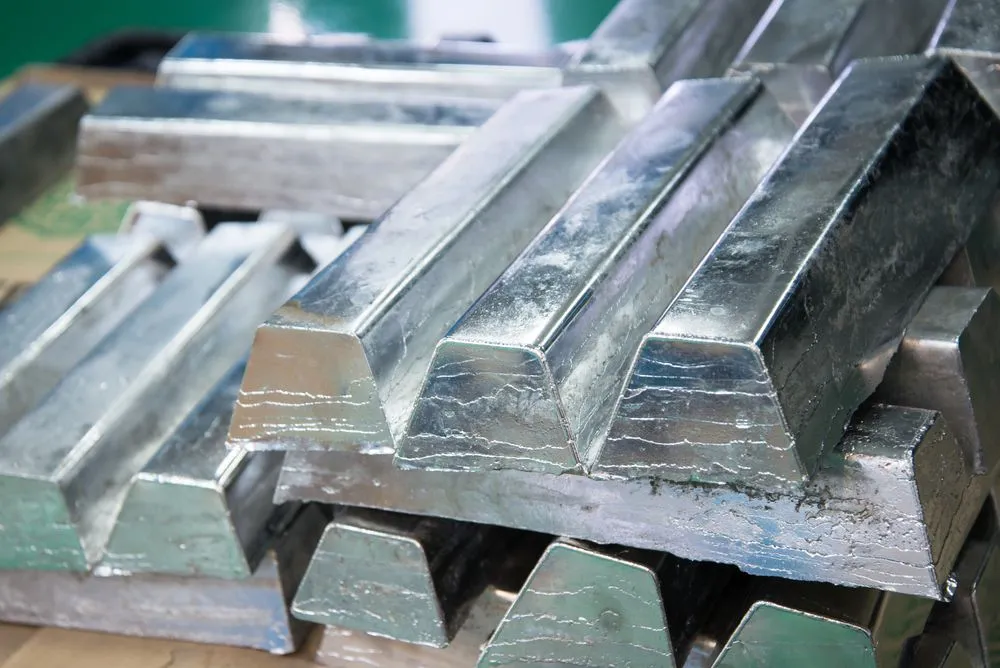
But I think most of you will envision a hard, shiny solid object, maybe a shiny sword, a slick car or clean cookware?
We associate the word ‘metal’ with solid objects, as most metals around us are solids. But are metals restricted to the solid state? Can they be a gas?
Can A Metal Be A Gas?
Yes, absolutely! Although metals usually occur in a solid state at room temperature (which is probably why we associate the word ‘metal’ with solid objects), metals can be in a gaseous state.
The thing about states of matter is that they are universal: a metal can be solid, liquid or gas, but that state is decided based on the right conditions of temperature and pressure.
For instance, a metal, say, lead, has a boiling point of 1749 degrees Celsius. Now, you know that lead, in its ‘natural state, is a solid, but when you start heating it, it will first turn into a liquid at 327 degrees Celsius, and if you continue to supply more heat, it will turn into gas at 1749 degrees Celsius.
The same principle applies to other metals. Iron, for instance, becomes a gas at 2,861 degrees Celsius, while gold boils at 2,836 degrees Celsius. These temperatures are extremely high, which is why we never encounter gaseous iron or gaseous gold in everyday life.
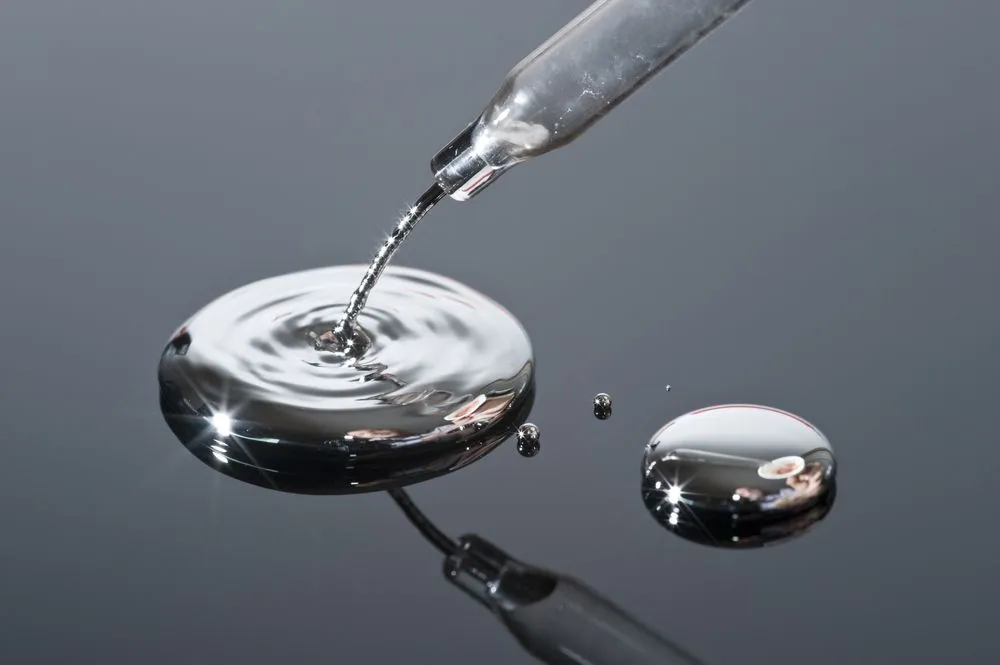
Another excellent example is mercury. In fact, it’s the metal with the lowest boiling point (356.7 °C) among all stable metals, meaning that of all metals, it turns into gas at a relatively lower temperature.
However, it is important to note that mercury vapors are very harmful. According to the World Health Organization, “the inhalation of mercury vapor can produce harmful effects on the nervous, digestive and immune systems, lungs and kidneys, and may be fatal. The inorganic salts of mercury are corrosive to the skin, eyes and gastrointestinal tract, and may induce kidney toxicity if ingested” (Source).
Now, let’s discuss another aspect of this metal-to-gas saga.
Does A Metal Remain A Metal When It Turns Into Gas?
We’ve established that metals can turn into gases if they’re heated to their boiling points, but once a metal is heated to its boiling point and becomes gas, is it still metal? In other words, can a metal be in a gaseous state and still be considered a metal?
The short answer? No.
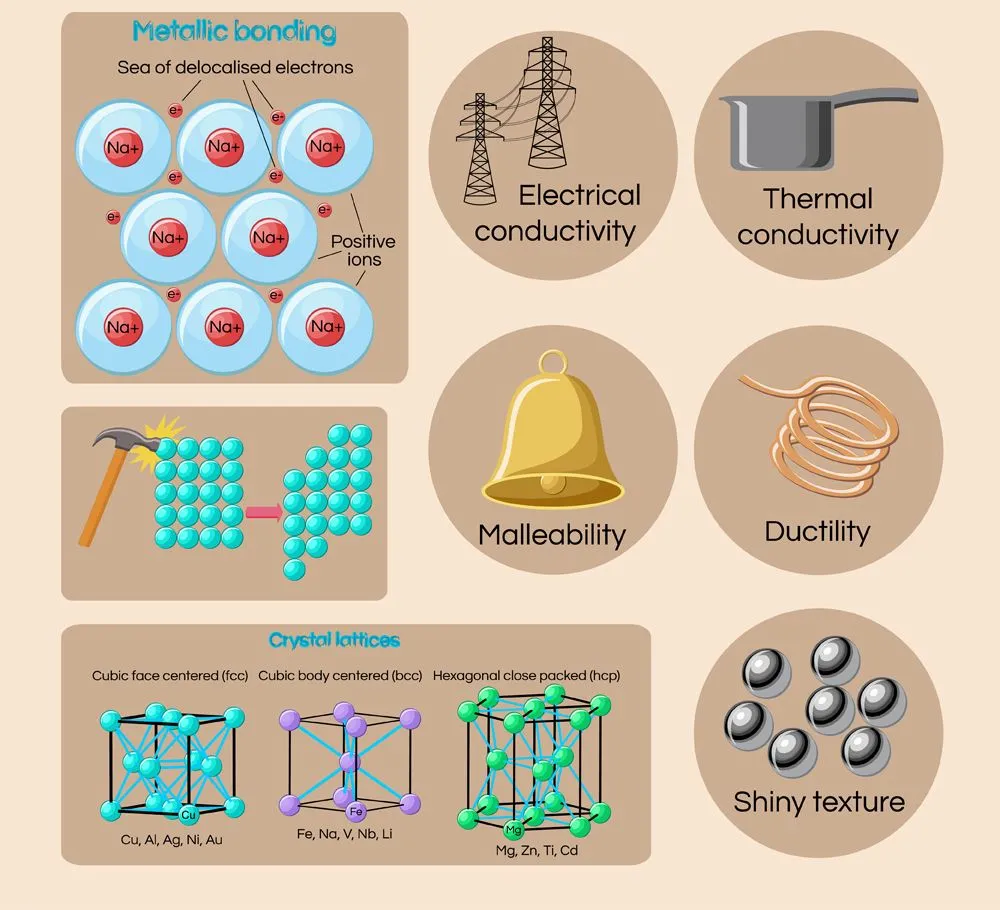
Gaseous metals don’t retain the properties of their solid counterparts, including the metallic bonds, metallic conductivity, ductility, luster or other metallic properties. This is why metals are no longer considered metals when they assume a gaseous state – they’re just gas with certain characteristic properties of the ‘parent’ element, i.e. “mercury gas”.
Why Are Metals Solid?
Metals are generally solid at room temperature (with the notable exception of mercury, which is liquid) because of how their constituent atoms are packed together.
You see, all matter is made of atoms. The state of a substance relies on how close or far apart these atoms are to each other.
If the constituent atoms of a substance are far apart, then that substance will exist as a gas at room temperature. Atoms in the liquid state are relatively closer together, but in solids, atoms are packed together in very tight crystals.
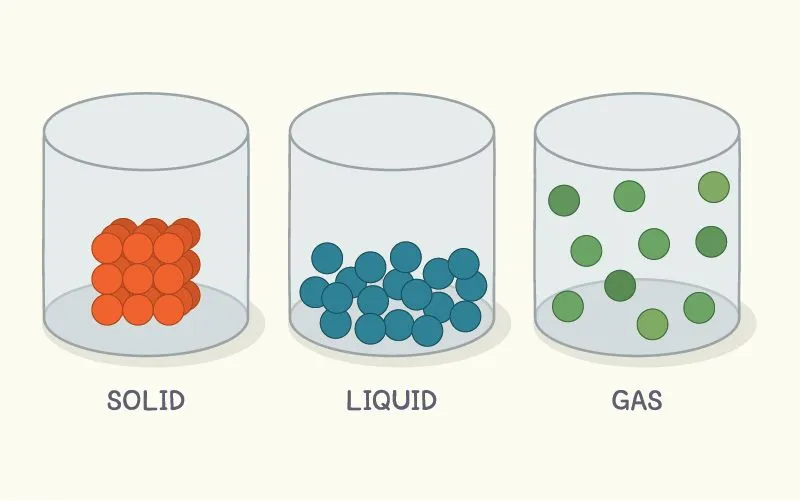
Due to the strong forces that hold these atoms close together, solids are rigid and have a definite shape and size (unlike liquid and gas).
Most metals are solid at room temperature, due to the constituent atoms of metals being packed so close together, imparting them a rigid or ‘set’ exterior. This is also why metals generally have high melting points (mercury being a notable exception, as it is liquid at room temperature).
What State Of Matter Are Metals At Room Temperature?
Here is the short, clean answer: at room temperature, every metal is a solid, with one famous exception. That exception is mercury, which is a liquid. No metal is a gas at room temperature (and remember, even mercury, the metal with the lowest boiling point, only turns to vapor at 356.6 °C / 673.9 °F). As the chemistry textbook Chemistry: The Central Science puts it, “metals are solids at room temperature with the exception of mercury, which is liquid at room temperature.”
So if you have ever seen a question like “are all metals solid at room temperature?”, the honest answer is almost. The periodic table holds dozens of metals, and at a comfy 20–25 °C (68–77 °F), all of them are solid except liquid mercury.

A couple of metals sit right on the edge. Gallium is a solid you can hold, but its melting point is only 29.8 °C (85.6 °F), so the warmth of your palm (about 37 °C / 98.6 °F) is enough to turn it into a shiny liquid. Caesium melts at 28.5 °C (83.3 °F), and rubidium at 39.3 °C (102.7 °F), so on a hot day they teeter on the line too. Push past those thresholds and they liquefy, but they still do not become a gas anywhere near room temperature. The same logic, by the way, explains why fire is not a solid, liquid or gas in the ordinary sense: state of matter is set by temperature and pressure, not by what a material “usually” looks like.
At What Temperature Do Metals Turn Into Gas?
A metal turns into a gas once you heat it past its boiling point. Below that, you only get a liquid; cross it, and the atoms break free as vapor. The catch is that most metals boil at staggeringly high temperatures, far hotter than a kitchen oven or even a typical wood fire, which is exactly why we never see gaseous iron or gaseous gold in everyday life. Here are the boiling points (and, for comparison, the melting points) of some common metals, as listed by the Royal Society of Chemistry:
| Metal | Melts at | Boils (turns to gas) at |
|---|---|---|
| Mercury | −38.8 °C (−37.8 °F) | 356.6 °C (673.9 °F) |
| Lead | 327.5 °C (621.4 °F) | 1,749 °C (3,180 °F) |
| Aluminium | 660.3 °C (1,220.6 °F) | 2,519 °C (4,566 °F) |
| Copper | 1,084.6 °C (1,984.3 °F) | 2,560 °C (4,640 °F) |
| Gold | 1,064.2 °C (1,947.5 °F) | 2,836 °C (5,137 °F) |
| Iron | 1,538 °C (2,800 °F) | 2,861 °C (5,182 °F) |
| Tungsten | 3,414 °C (6,177 °F) | 5,555 °C (10,031 °F) |
So when people ask “can iron be a gas?” or “at what temperature does iron become a gas?”, the answer is yes, at about 2,861 °C (5,182 °F). Gold boils at 2,836 °C (5,137 °F), and even noble metals are no exception. Tungsten sits at the extreme end, holding out as a solid until 3,414 °C and not boiling until 5,555 °C (10,031 °F), which is part of why it is used for the filaments inside incandescent bulbs and for rocket nozzles. The lesson is consistent: any metal will become a gas if you make it hot enough, but “hot enough” usually means thousands of degrees.
All in all, metals can be converted into gas, but once they turn into gas, they don’t retain their metallic properties.
References (click to expand)
- Mercury and health - World Health Organization (WHO). The World Health Organization
- Properties of Metals as Solids - Hyperphysics. Georgia State University
- Metals and Nonmetals - Hyperphysics. Georgia State University
- Metals, Nonmetals, and Metalloids - Chemistry LibreTexts
- Iron - Element information, properties and uses. Royal Society of Chemistry
- Tungsten - Element information, properties and uses. Royal Society of Chemistry
- Gallium - Element information, properties and uses. Royal Society of Chemistry