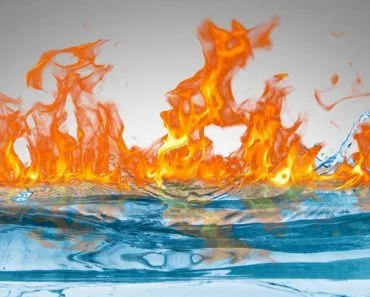
Fire is not really a solid, a liquid, a gas, or even a textbook plasma. It is a rapid chemical reaction (combustion) whose products happen to be hot, glowing gases. An everyday candle or wood flame is mostly a hot gas mixture (carbon dioxide, water vapor, soot particles) with only a tiny fraction of its atoms ionized. Hotter flames, like an oxyacetylene torch, are ionized enough to genuinely qualify as plasma, the “fourth state of matter”.
Every object that has ever existed on this planet can be classified into three basic states of matter: solid, liquid or gas. That’s what we were told to believe in our science classes, right? But… what about fire? Imagine holding fire in your hands like a brick, storing it in some kind of vessel or even better, trying to fill a balloon with a raging inferno! Doesn’t seem possible, right? To all those people who scratched their heads during those boring chemistry classes, here’s a piece of trivia: fire doesn’t really belong to any of the aforementioned groups. In fact, the closest state of matter that it can be compared to is plasma. Plasma?
What on God’s green earth is that?
How Is Fire Like A Gas?
Before jumping to the fun part, one must rule out the possibilities of fire being a gas or a solid (Surely, it’s not a liquid, right?) So… why can’t fire be a gas? In its true nature, fire does share some properties with other gases. Like gas, it does not have a definite shape or volume, unless it is enclosed in an appropriate container. The visible conflagration that one witnesses is simply gas that is still reacting and providing illumination. However, fire doesn’t expand evenly like other gases in a given closed container.
Furthermore, fire is incapable of forming structures like filaments, beams and double layers under the influence of a magnetic field. Thus, fire cannot serve as an electromagnet when exposed to a magnetic field, which is not the case with solids, liquids or gases. So basically, fire’s atomic structure is acting like Switzerland did during the World War! Not taking sides…. nice and complicated.
Also, the laws of physics dictate that one cannot extract more energy out of a given substance without investing more energy into it. This fact eliminates the slightest possibility of fire being a solid, liquid, or gas. All types of fire gradually die out and cannot continue to exist in their natural state forever, unlike the above. For example, a funeral pyre would eventually die out if it was not constantly furnished with oxygen and flammable material.
Fire And Plasma? Plasma!
Let’s rewind and take a look at some of the earlier theories developed by humans to give tangible meaning to their outlandish findings. Before Sir William Crookes identified what he called "radiant matter" in cathode-ray experiments in 1879 (the term plasma for this fourth state of matter was actually coined by the American physicist Irving Langmuir in 1928), mankind only believed in three states of matter. Long before that, the ancient Greeks classed fire as one of the four classical elements, alongside earth, water and air.
Plasma is a hot, electrically conducting gas in which some atoms have been stripped of one or more of their electrons. The resulting soup of positively charged ions and negatively charged free electrons (the nuclei, including their protons and neutrons, stay intact) lets plasma respond strongly to electric and magnetic fields and behave as a single collective system rather than as a bunch of independent atoms. It pretty much behaves like a high school punk who decides to abandon his set of friends, only to succumb to a life of solitude. Aside from the hypothetical existence of “Dark Matter”, plasma is the most abundantly and scientifically accepted form of ordinary matter found throughout the universe!
Plasma resembles a gas more than any other state of matter, but it behaves very differently from a gas. This is because the free electrons are not in constant physical contact with one another due to a lack of affinity towards each other. This means that plasma can flow like a liquid or a fluid, comprised of specific areas that are like groups of atoms sticking together. This property of plasma differentiates it from all other gases.
So what should you actually say if a teacher asks you which state of matter fire is? The most honest scientific answer is this: fire is a chemical reaction (combustion) whose visible product is a hot gas, with a very small fraction of its atoms ionized. Ordinary fires (a candle, a campfire, a gas stove) are weakly ionized, so they sit closer to a hot gas than to a true plasma. Only very hot flames such as an oxyacetylene torch, an arc-welding flame or the plasma inside a lightning bolt clearly cross into the plasma state. So when popular sources say "fire is plasma", take it with a pinch of physics: it’s a useful shorthand, but the more accurate description is that fire contains a small amount of plasma alongside lots of hot gas.
Is Fire Matter, Or Is It Even Alive?
Here is the question that trips everyone up: if fire isn’t neatly a solid, a liquid or a gas, then is it even “stuff” at all? The honest answer is that fire isn’t a thing so much as a thing happening. As MIT chemist Jiahao Chen puts it, fire is best described as a chemical reaction in a mixture of incandescent gases, typically luminous and intensely hot. The matter is real enough (the fuel, the oxygen, the hot soot and exhaust gases all have mass), but the flame itself is the glowing, energy-releasing process linking them together, not a substance you could ever bottle.
That process has a name: combustion, an exothermic chain reaction in which a fuel rapidly combines with oxygen and dumps out energy as heat and light. The Royal Society of Chemistry is blunt about the bookkeeping here: once the fuel or the oxygen runs out, fire simply ceases to exist. A brick, a glass of water or a balloon of helium will happily sit unchanged for a thousand years. A flame cannot. Strip away its fuel or its oxygen and it vanishes in an instant, which is exactly why we can put fires out by smothering, cooling or starving them.
So is fire alive? It is tempting to think so, because fire does some suspiciously life-like things: it “eats” fuel, “breathes” oxygen, grows, moves and even reproduces by spreading. But these are coincidences of chemistry, not biology. Fire has no cells, no DNA, no metabolism in the biological sense, and it can’t maintain or repair itself. It is a self-sustaining reaction, the same way a row of falling dominoes is self-sustaining, and just as un-alive. If you’ve ever wondered whether there’s anything fire simply cannot burn, the answer comes down to the same chemistry: no fuel and no oxygen means no reaction.
What Does A Flame's Color Tell You?
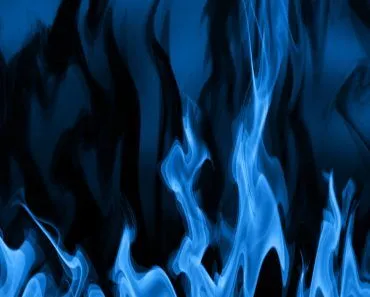
Strike a match and you’ll see a flame that fades from a faint blue base to a bright yellow tip. That isn’t just decoration. A flame’s color is a rough thermometer, and the rule of thumb is delightfully counterintuitive: blue is hotter than yellow, the opposite of how we usually rank “warm” and “cool” colors.
The yellow and orange glow most of us picture as “fire” comes from incandescence, the thermal radiation of trillions of tiny soot particles (unburned specks of carbon) heated until they glow, much like the filament in an old light bulb. NASA describes exactly this: gravity carries soot to a candle flame’s tip, and that glowing soot is what makes the flame yellow. The catch is that yellow soot light signals incomplete combustion, where the fuel isn’t getting enough oxygen, and that runs cooler. A clean blue flame, by contrast, means complete combustion, with little or no soot and most of the light coming straight from excited gas molecules rather than glowing particles.

The numbers back this up. The cool, ragged outer edge of a candle flame sits near 800 °C (about 1,470 °F), while its hotter region climbs to roughly 1,400 °C (around 2,550 °F). Crank the oxygen all the way up and the heat soars: an oxyacetylene welding torch burns a fierce blue at about 3,100 °C (roughly 5,600 °F), hot enough to slice through steel. It’s the same logic that lets a chemist read a Bunsen burner at a glance, opening the air valve turns a lazy, sooty yellow flame into a roaring blue cone. The strangest cousin of all is the cool flame, a faint, barely visible reaction that smolders at only about 400 °C without ever bursting into ordinary fire.
Why Do Flames Always Point Up (And What Happens In Space)?
Have you ever wondered why a candle flame always tapers to a point at the top, no matter how you tilt the candle? The flame isn’t reaching for the sky out of some preference. It’s being shaped by gravity. The hot gases inside a flame are far less dense than the cool air around them, so they rise, exactly like a hot-air balloon, while cooler, oxygen-rich air is pulled in from below to take their place. This constant upward churn is called buoyant convection, and it’s what stretches a flame into its familiar teardrop shape and feeds it a fresh supply of oxygen from underneath.
Take gravity away and the whole picture changes. On the International Space Station and earlier shuttle missions, astronauts have lit candles in microgravity and watched them burn in a way that looks almost alien. With no gravity, there’s no “up” for hot gas to rise toward, so the buoyant convection vanishes entirely. NASA’s observation is striking: “In microgravity, where convective flows are absent, the flame is spherical, soot-free and blue.” Instead of a pointed teardrop, the flame becomes a tiny, dim blue ball, only about 1.5 cm (roughly 0.6 inches) across, fed by the slow, gentle drift of molecular diffusion rather than a roaring updraft.

Far from being a party trick, this matters for real lives. Studying how fire spreads without buoyant convection is central to keeping astronauts safe, and NASA's Advanced Combustion via Microgravity Experiments (ACME) examined more than 1,500 flames aboard the Space Station over four years beginning in 2017 to learn how blazes start and creep in spacecraft.
References (click to expand)
- Is fire a solid, a liquid, or a gas? - MIT School of Engineering |. The MIT School of Engineering
- What state of matter is fire considered to be in? - UCSB Science Line. The University of California, Santa Barbara
- What state of matter is fire? - Royal Society of Chemistry (RSC Education)
- Candle Flame - 1g vs Microgravity - NASA
- Why NASA Is Studying Flames in Space - NASA Science