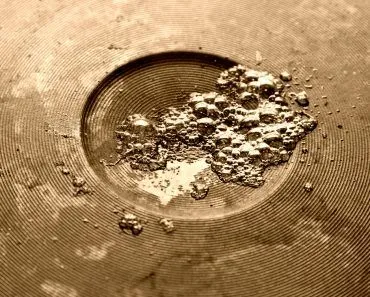
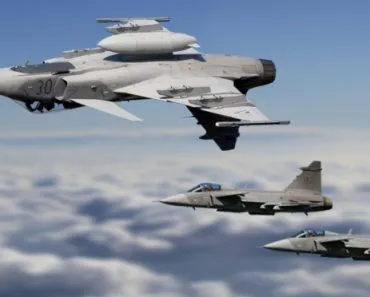
The Coanda effect is the tendency of a fluid jet (a liquid or a gas) to stay attached to a nearby flat or curved surface. A faster-moving jet has lower local pressure, so the surrounding higher-pressure air or liquid pushes the jet against the surface and lets it follow its curve. It is why coffee dribbles down the side of a mug, and it shows up in airplane lift, F1 exhausts and even echocardiograms.
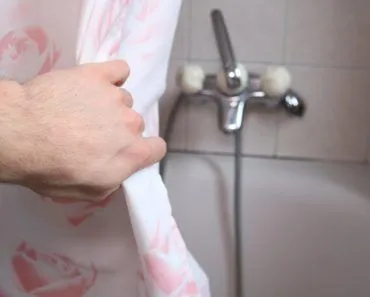
After revealing the mysteries behind why your shower curtain always tries to get you, today we will expose another of life’s mysteries that affects us all: why is it so hard to pour liquid from a mug without spilling it?
You will likely be shocked to know that one of the phenomena that causes your drink to spill is also thought to be responsible for why an airplane flies. We know the phenomenon as the Coanda Effect, and it explains the adherence of fluids to curved surfaces.
For airplanes, the surrounding air adheres to the wings and generates the lift necessary for flight; while in the case of mugs, the liquid inside clings to the curved mug lip and trickles along its surface, leaving a mess for us to clean up.

Coanda Effect
The effect is named after Henri Coandă (1886-1972), a Romanian aeronautical engineer. The popular legend traces the discovery to 1910, when Coandă was testing his Coandă-1910 aircraft and noticed that the engine’s exhaust flames clung to the fuselage rather than streaming straight back; the plane reportedly caught fire. Modern aviation historians are skeptical that the aircraft actually flew or that he immediately recognized the phenomenon, but Coandă did describe and patent the effect in the 1930s, and it has carried his name ever since.
He observed burning gases exiting from the engine flying in close proximity to the body of the aircraft (fuselage). Subsequent experiments and studies finally led him to affirm what we now know as the ‘Coanda Effect’.
Coanda himself described the effect as “the tendency of a jet of fluid emerging from an orifice to follow an adjacent flat or curved surface and to entrain fluid from the surroundings so that a region of lower pressure develops.”
In simpler terms, the Coanda Effect is the tendency of a fluid, such as air or any other liquid, to adhere and flow along flat and curved surfaces.

Bernoulli’s Principle Into The Play
A jet exiting from an orifice sweeps the surrounding air along with it. However, the exiting jet flows at a greater speed than the ambient air, and according to Bernoulli’s Principle, fluids flowing at higher speeds have lower pressure and vice versa. Thus, the low-pressure jet is enclosed by the comparatively high-pressure ambient air. The surrounding air pushes on the jet from both sides, balancing it in the middle.
When a solid surface is present or introduced on one side of the jet, the high-pressure ambient air pushing it up and thus balancing the jet is removed. As a result, the ambient air from the other side forces the jet downward, causing it to adhere to the surface. The jet continues to adhere to the surface even when it curves.
Coanda Effect While Pouring
Coming back to our question, pouring from mugs is difficult for two reasons. First, it is difficult due to the surface tension of the liquid, and second, due to the adhesion of liquid molecules onto the mug surface as a result of the Coanda Effect. While we’ve already discussed the surface tension aspect in detail (Why do liquids sometimes run down the side of the container while pouring?), this isn’t the only culprit at work.
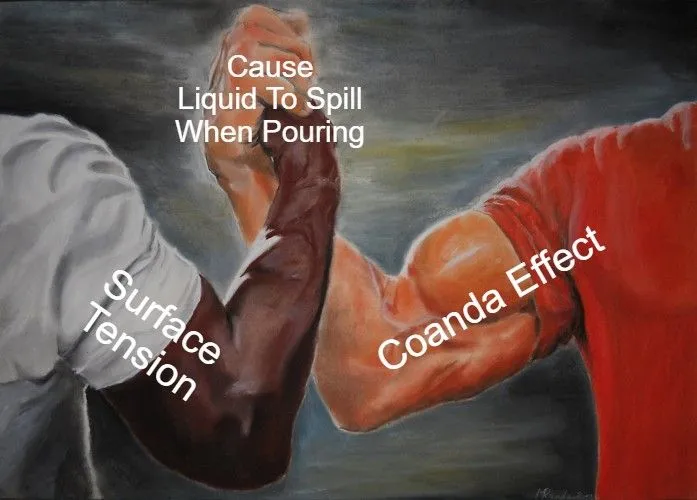
The fluid molecules inside the mug are subject to ambient pressure from the surrounding air. When one pours from a mug, the ambient pressure forces the fluid to adhere to the mug’s surface. The molecules remain stuck, even when the mug surface curves at the lip. To prevent the liquid from dribbling, gravity must overcome both the surface tension of the liquid and the adherence of liquid to the mug surface, due to the Coanda Effect. Nine out of ten times, the combined forces prove too great for gravity to overcome, so liquid dribbles down the mug surface.
Lift Generation In Aircraft
The Coanda Effect is also believed to be the reason why an airfoil shape generates lift, although this hasn’t been proved. For the longest time, people believed that airfoils generate lift due to Bernouilli’s Principle, but extensive studies carried out using simulation software argue otherwise.
The hypothesis (also known as the equal-transit theory or longer path theory) assumes that air particles of the upper stream and the lower stream must meet at the tail concurrently. Since the upper and bottom surface of airfoils aren’t uniform, the particles on the upper surface must travel at a greater speed than the lower surface particles to reach the tail at the same time. Aforementioned, according to Bernoulli’s Principle, the speed and pressure of fluid are inversely proportional.
Thus, there is more pressure at the bottom surface than the upper surface, and this difference in pressure generates lift. However, the assumption on which the theory is based, i.e., particles from the bottom and top surface must reach the trailing edge at the same time, has no logical explanation and is considered absurd.
In reality, the particles of the upper streamline reach the tail before the lower streamline particles. Furthermore, the application of Bernouilli’s Principle is limited to two points on the same streamline, not two different streamlines. For these reasons, the equal-transit theory has been disproved.
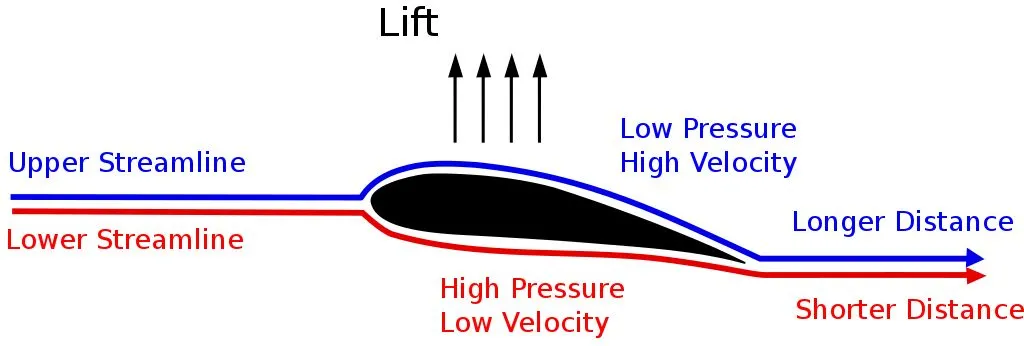
An airfoil is curved on both sides and, as suggested by the Coanda Effect, fluid particles adhere to curved surfaces. This adherence forces the airflow downwards. For the flow to adhere, there must be more pressure at the top of the particle than the bottom. This also creates a pressure difference on opposite sides of the airfoil, which produces lift. Also, according to Newton’s third law, the downward flow (action) produces an upward force (reaction) in the form of lift.
How To See The Coanda Effect For Yourself
You do not need a wind tunnel to watch the Coanda Effect at work. Switch a hair dryer to its coolest, gentlest setting, point the airstream straight up, and balance a ping-pong ball in it. Now tilt the dryer slowly to one side. Instead of tumbling away, the ball keeps hovering off to the side of the nozzle. The fast-moving jet bends around the curved surface of the ball and clings to it, and that redirected air pushes back just hard enough to hold the ball up against gravity. It is the same clinging behavior that dribbles coffee down your mug, except this time it is keeping a ball in the air.

A word of caution about the most famous "proof" of all. Hold the back of a spoon close to a thin stream of tap water and the water swerves sideways to run over the curved metal, and the spoon even seems to get tugged into the stream. It looks exactly like the Coanda Effect, and countless demonstrations label it that way. In reality, physicists point out that this particular trick is dominated by surface tension and molecular attraction rather than the Coanda Effect itself. So try both experiments, but keep in mind that only the floating ball is a clean example of the phenomenon.
Does The Coanda Effect Bend A Football?
Search for the Coanda Effect online and you will quickly run into slow-motion clips of curling free kicks, so it is worth clearing up a common mix-up. When a footballer wraps their foot around the ball and it swerves in mid-air, that curve is driven by the Magnus effect, not the Coanda Effect. A spinning ball drags a thin layer of air around with it, speeding the air up on one side and slowing it down on the other. The airflow then peels away from the ball later on the fast side and earlier on the slow side, and that lopsided wake flings air off to one side while the ball is pushed the opposite way. Roberto Carlos's astonishing 1997 free kick against France is the textbook example.

So where does the Coanda Effect come in? The two are close relatives. Both are stories about a moving fluid choosing to follow a surface and then peel away unevenly. Some physicists go so far as to describe the Magnus effect as the Coanda Effect applied to a spinning object, since the ball's turning surface drags the airflow around its curve before releasing it. Whether you count them as one effect or two, the takeaway is the same: a bending banana kick is really a spinning-ball phenomenon, whereas the pure Coanda Effect is about a jet hugging a stationary surface, like the lip of your mug.
Everyday Devices That Rely On The Coanda Effect
The Coanda Effect is not just a party trick or an aviation curiosity; it quietly runs machines you use all the time. The Dyson Airwrap hair styler is the clearest consumer example. A motor drives a high-speed jet of air out of slots along each cylindrical barrel, and because that fast jet clings to the curved barrel, it drags nearby hair along with it, wrapping the hair around the barrel and curling it with airflow instead of scorching heat. The whole tool is essentially the floating-ball demonstration turned into a styling gadget.
Look up and you will find the effect in the ceiling too. Many air-conditioning diffusers are shaped so the chilled air they blow out sticks to the flat ceiling instead of dropping straight onto the people below. Because the Coanda Effect keeps the stream hugging the ceiling, the air travels much farther across the room before it sinks, which spreads the cooling more evenly and lets the system run at a lower, quieter discharge speed. Formula 1 engineers once exploited the very same trick to bend hot exhaust gases toward the rear diffuser for extra downforce, until the sport tightened its rules in 2014 and closed the loophole.
Conclusion
Apart from lift generation in aircrafts, other applications of the Coanda Effect include hydropower screening, oscillatory flowmeters, in air conditioning, etc. The effect also finds applications in the fields of metrology, automobiles and medicine. In automobiles, the effect is primarily used by F1 car manufacturers to keep exhaust gases at bay, as well as in certain fluid dispensers, whereas in medicine, the effect appears in ventilators and helps us better understand mitral regurgitation of the human heart.
However, the Coanda Effect isn’t universal, and only applies when the curvature of a surface isn’t very sharp. Thus, to avoid spilling your drink, pour swiftly while keeping the mug at a greater angle to the horizontal plane!
References (click to expand)
- Ahmed, N. A. (2019). Coanda Effect: Flow Phenomenon and Applications. CRC Press
- Principles of Flight: Foam Wing (Grades K-12). The National Aeronautics and Space Administration
- Fluidics and the Coanda Effect - media.lanecc.edu
- Ginghină, C. (2007, June). The Coandă effect in cardiology. Journal of Cardiovascular Medicine. Ovid Technologies (Wolters Kluwer Health).
- Incorrect Lift Theory - NASA. The National Aeronautics and Space Administration
- Henri Coandă - Britannica
- Coandă effect - Wikipedia
- Magnus effect - Wikipedia
- Coanda and Bernoulli - Understanding Flight
- Love Is In The Air - Dyson