Capillary action is the movement of a liquid through a narrow tube or porous material, against gravity, driven by the interplay of two intermolecular forces: adhesion between the liquid and the surface, and cohesion between the liquid's own molecules. When adhesion outweighs cohesion (as with water in glass or soil), the liquid climbs; when cohesion dominates (as with mercury in glass), it doesn't.
Water in soil is absorbed by a plant’s roots and propelled upwards to the rest of its organs with absolutely no assistance. The plant, to push along the water the nutrients to replenish its resources, does not issue any force to negate or overcome the pull of gravity. With no force to drive it, how in the world does the water rise against gravity? What sorcery is at play here?

Capillary Action Definition
The startling rise of a liquid in a narrow tube is called capillary action or simply, capillarity. Capillary action has fascinated people so deeply, in fact, that Einstein’s first paper didn’t explore his esoteric theory of cause and effect or gravity, nor did it demonstrate the particle nature of light. Instead, it described his Conclusions Drawn from Capillary Action, a paper now obscured in the fame of his miracle year papers.
The Irish chemist Robert Boyle, intrigued by the observations of a “few inquisitive French men” as he put it, dipped a thin tube in red wine and witnessed how, unlike mercury, the wine rose to a certain height in the tube. Why do water and wine rise, as the French and Boyle observed, but mercury doesn’t? Eventually, chemists realized that whether a liquid would ascend or descend depends on two forces: the cohesion and adhesion forces between the molecules of the liquid and molecules of the tube.
The Cohesion And Adhesion Forces
The cohesion forces are the attractive forces that, as the name suggests, cause cohesion, or bind the molecules of the liquid together. It is the cohesion forces that power surface tension, the property of a liquid to resist penetration. They exist between like molecules, in water primarily through hydrogen bonds between neighboring H₂O molecules, which is what gives water its famously high cohesion.
Adhesion forces aren’t all that different. These are attractive forces as well, but the attraction they encourage doesn’t manifest between similar atoms, but dissimilar atoms. As their name suggests, they cause adhesion, or glue one family of molecules, in this case, the liquid, to another family of molecules, here, the capillary surface.
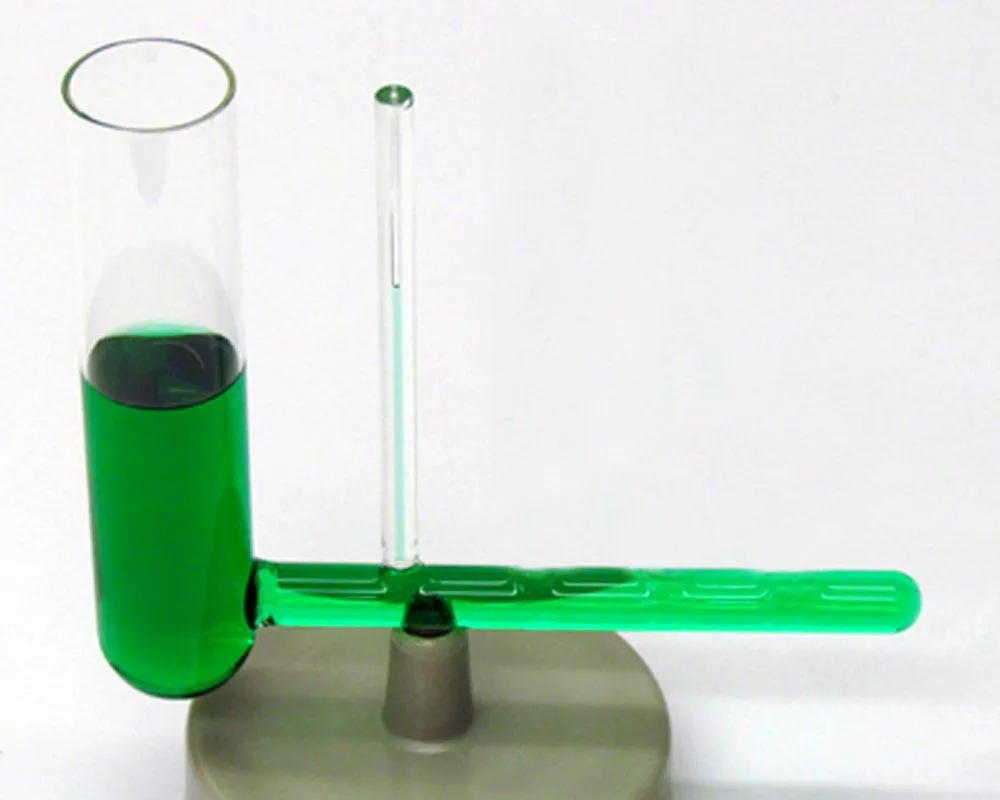
A liquid will rise only if the adhesion forces between its molecules and the tube’s molecules are greater than the cohesion forces among its own molecules. A tube, such as a plant’s thin stem carrying water and nutrients, attracts and “pulls” the liquid higher and higher along its adhesive surface.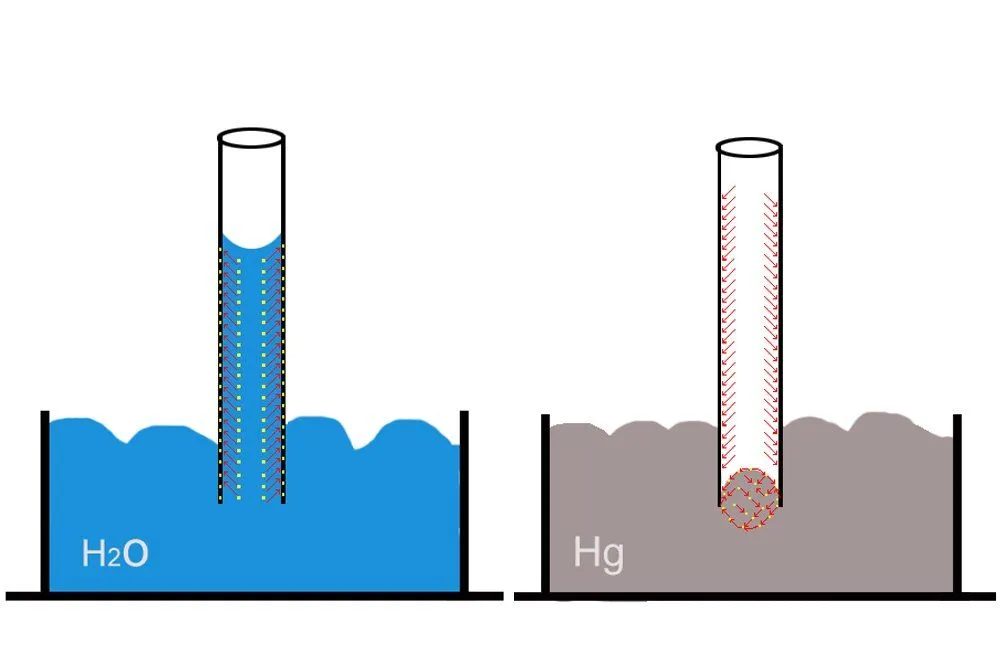
A liquid like mercury does not rise in a glass tube for the simple reason that its cohesion forces are greater than the adhesion forces between it and the glass. In fact, the cohesion forces of mercury are so strong that it exhibits what is called capillary repulsion: it does not rise but, to the contrary, descends lower in the tube! However, it is imperative to understand that capillarity is therefore not only a function of the properties of the liquid but also the chemical composition of the tube.
As the liquid rises, the top of its surface assumes a concave shape. This represents the tussle in which adhesion and cohesion forces are constantly engaged. Eventually, as more and more water enters the tube, the cohesion forces gain sufficient strength to negate the adhesion forces: equilibrium is achieved, which is evident from the flattening of the concave surface.
The Height
The height of capillary rise is determined by this equation:
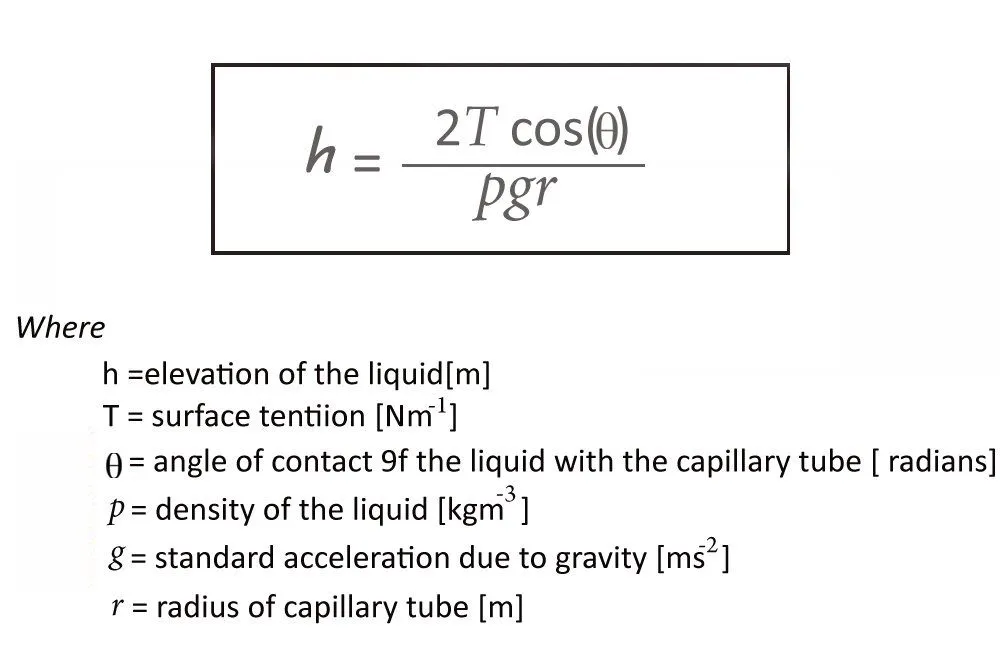
One can discern that the height to which a liquid will rise is inversely proportional to the radius of the tube. The wider the tube, the lesser the ascension. This is because a wider tube will mean a lesser quantity of the liquid is in contact with its surface, which logically causes the adhesion forces to dwindle.
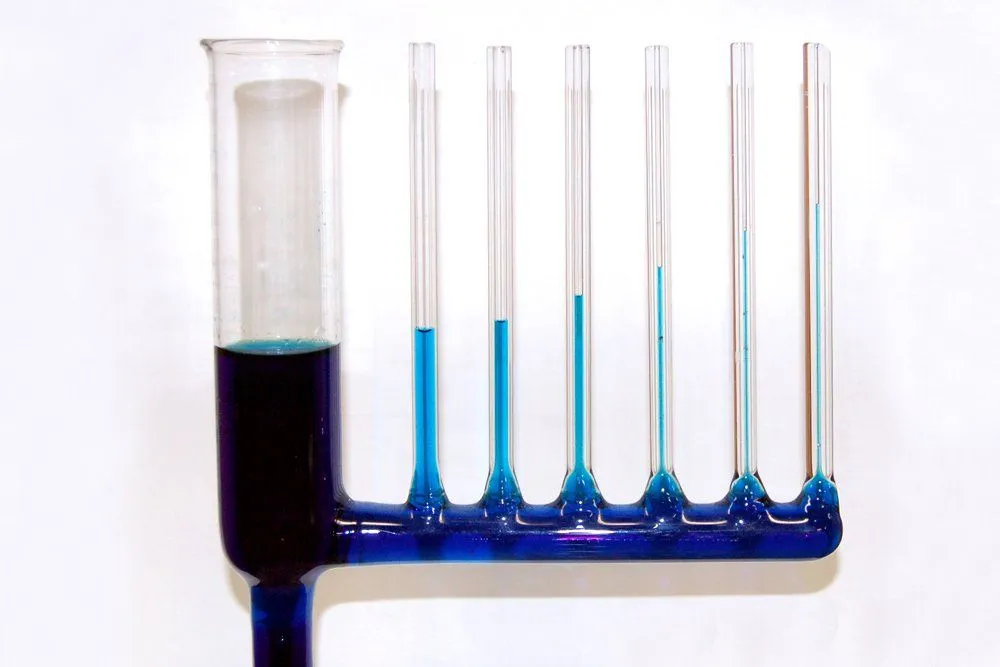
Lastly, while the adhesion forces are initially strong enough to overcome the pull of gravity, gravity will eventually emerge victorious. As the water builds up in the tube, at a certain height, the mass of the liquid becomes too large for the adhesion forces to lift. At this height, the intermolecular forces are utterly defeated by gravitational force.
What Is The Capillary Rise Formula?
That equation above has a name: it is Jurin's law, after the English physician James Jurin, who described the relationship in a 1719 paper for the Royal Society. Written out in full, the height a liquid climbs in a narrow tube is:
h = (2γ cosθ) / (ρ g r)
Every symbol earns its place, so it helps to take them one at a time:
- h – the height the liquid rises, in meters (m)
- γ (gamma) – the surface tension of the liquid, in newtons per meter (N/m). For water at 20 °C this is about 0.0728 N/m
- θ (theta) – the contact angle where the liquid meets the tube wall. Water on clean glass wets it almost completely, so θ is close to 0° and cosθ ≈ 1
- ρ (rho) – the density of the liquid, in kilograms per cubic meter (kg/m3); water is 1,000 kg/m3
- g – gravitational acceleration, 9.81 m/s2
- r – the inner radius of the tube, in meters (m)
The formula isn't pulled from thin air. It comes from a simple balance of forces. Surface tension tugs the liquid upward all the way around the rim of the tube, a circle of length 2πr, with the useful component scaled by cosθ. That upward pull, 2πrγ cosθ, has to support the weight of the raised column of liquid, which is its volume (πr2h) times density times gravity, or ρgπr2h. Set the lift equal to the weight, 2πrγ cosθ = ρgπr2h, cancel a factor of πr from both sides, and rearrange for h. Jurin's law falls straight out.
Put real numbers in and the result is surprisingly tidy. For water in a glass tube of radius 0.5 mm (a fine drinking straw is far wider), h = (2 × 0.0728 × 1) / (1,000 × 9.81 × 0.0005) ≈ 0.030 m, or about 30 mm. Halve the radius to 0.25 mm and the water climbs roughly twice as high, to about 60 mm. That inverse relationship between height and radius is the whole story of the graph below.

The same law explains why mercury behaves backwards. Mercury doesn't wet glass, so its contact angle is greater than 90° and cosθ turns negative. The formula then returns a negative h: the liquid is pushed down below the outside level rather than drawn up, which is exactly the capillary depression Boyle's contemporaries puzzled over.
How Does Capillary Action Work In Plants?
Return to the question we opened with: how does a plant haul water from the soil up to its highest leaves without spending any energy on a pump? Capillary action is part of the answer, but only part, and it is worth being precise about where its limits lie.

Water travels up a plant through the xylem, a network of narrow, hollow tubes running from the roots to the leaves. These tubes are exactly the kind of fine conduit in which capillary action thrives: water adheres to the lignin-reinforced walls of the xylem while its own molecules cohere to one another through hydrogen bonds, and the column inches upward just as it does in a glass capillary. The same two forces from earlier, adhesion and cohesion, are doing the work.
On its own, though, capillarity can only lift water reliably for about a meter. That is plenty for a blade of grass or a young seedling, but nowhere near enough for an oak, let alone a 100-meter redwood. The dominant mechanism in a tall plant is the cohesion-tension theory: as water evaporates from tiny pores called stomata in the leaves, a process called transpiration, it pulls on the water beneath it. Because cohesion holds the water molecules together in an unbroken thread, that pull is transmitted all the way down the xylem to the roots, creating a tension strong enough to draw the whole column upward. So when people ask what capillary action does for plants, the honest answer is that it primes the system and moves water through the smallest vessels, while transpiration-driven cohesion-tension does the heavy lifting in anything taller than a shrub.
References (click to expand)
- Capillary Action and Water | U.S. Geological Survey - USGS.gov. The United States Geological Survey
- Capillary Action - Chemistry LibreTexts. LibreTexts
- Jurin's Law - Fluid Mechanics lecture notes. The University of Texas at Austin
- Water Transport in Plants: Xylem | Organismal Biology. Georgia Institute of Technology
- Cohesion-Tension Theory - Biology LibreTexts. LibreTexts
- James Jurin. Wikipedia