Table of Contents (click to expand)
- Coefficient Of Restitution: A Simple Explanation
- Values Of The Coefficient Of Restitution
- Coefficient Of Restitution Formula
- How Do You Measure The Coefficient Of Restitution? (The Drop-Height Method)
- Can The Coefficient Of Restitution Be Greater Than 1?
- The Coefficient Of Restitution In Sports: Golf, Baseball And Basketball
The coefficient of restitution is defined as the ratio of the final velocity to the initial velocity between two objects after their collision. Another way of saying this is that the coefficient of restitution is the ratio of the velocity components along the normal plane of contact after and before the collision.
The coefficient of restitution (COR) measures how bouncy a collision is. It is the ratio of relative separation velocity to relative approach velocity, ranging from 0 (perfectly inelastic) to 1 (perfectly elastic).
We made a 5-minute video on the coefficient of restitution and its applications in everyday lives. Check it out here:
There are some things that are very bouncy, and then there are things which are absolutely the opposite. For instance, if you bounce a rubber ball on a wooden floor, you know it will bounce back to your hands. But try bouncing a heavy, metal ball on the floor. Not only will you not get the ball back in your hands, but it’s very likely that you might have to spend a lot of money on the repair of your floor. So, don’t try this at home!
Let’s talk about the coefficient of restitution now, shall we?
As its name signifies, the coefficient of restitution is actually a measure of the “restitution” (i.e., what you give back) of a collision between two objects, or in other words, how much of the kinetic energy remains after two objects collide.
If you happen to be a physics enthusiast, you probably understood the aforementioned description of the coefficient of restitution, but if physics isn’t your strong suit, let me take a few steps back and give you a bit of ‘background’ about this fairly complex-sounding entity.
Coefficient Of Restitution: A Simple Explanation
When two objects collide with each other, many forces come into play, which also means the application of various mathematical equations. Many of these laws were first derived by the same super popular scientist who is credited with numerous discoveries and derivations, meaning that he has a vast number of discoveries and contributions to his name – Sir Isaac Newton.
Pertaining to the collision of two objects, Newton formulated a theory that we now know as Newton’s law of restitution. It simply states that when two bodies collide, the speed with which they move after the collision depends on the material from which they are made.
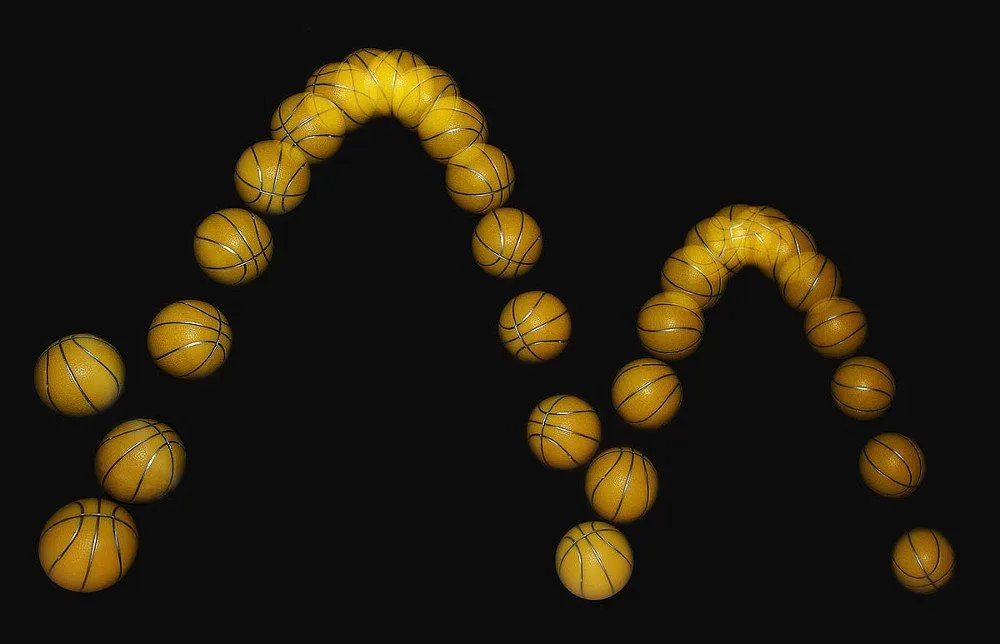
Let’s suppose a rubber ball bounces on a flat, hard surface. Obviously, the rubber ball will rebound off the surface, but with only a fraction of its original energy, because all real collisions are inelastic. (Note: If this collision were elastic, then the ball would have bounced back with the same amount of energy it had before striking the surface.)
You see, when you ‘deform’ something by colliding it with something else (say, when you bounce a basketball on the ground), a fraction of its original energy is lost. That’s why the basketball bounces lower with every collision – as its energy gets converted to heat/vibrations.
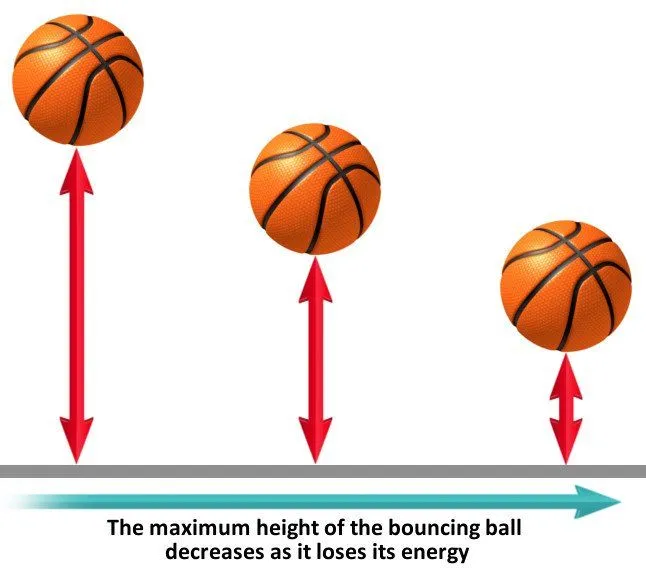
In this case, you can think of the coefficient of restitution as an entity that tells you how efficient the “bouncing” process is. The more efficient it is, the more ‘bouncy’ the basketball shall be.
Values Of The Coefficient Of Restitution
As mentioned earlier, the coefficient of restitution is a measure of how much kinetic energy remains after the collision of two bodies. Its value ranges from 0 to 1. If it’s on the higher side (i.e., close to 1), it suggests that very little kinetic energy is lost during the collision; on the other hand, if the value is low, it indicates that a large amount of kinetic energy is converted into heat or otherwise absorbed through deformation.
In the case of a perfectly elastic collision, which does not happen in real-world settings, the coefficient of restitution would be precisely 1.00. Therefore, if you want a basketball that’s more ‘bouncy’ than others, you need to pick one with a high coefficient of restitution.

Coefficient Of Restitution Formula
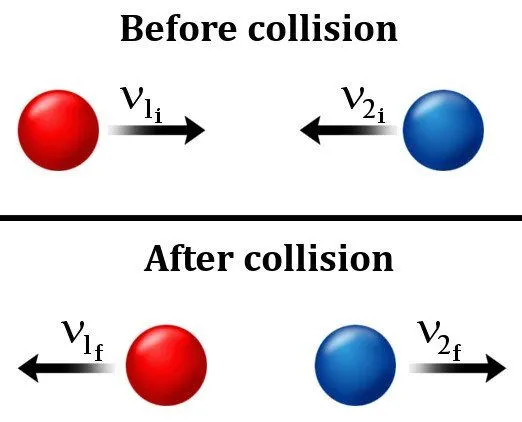
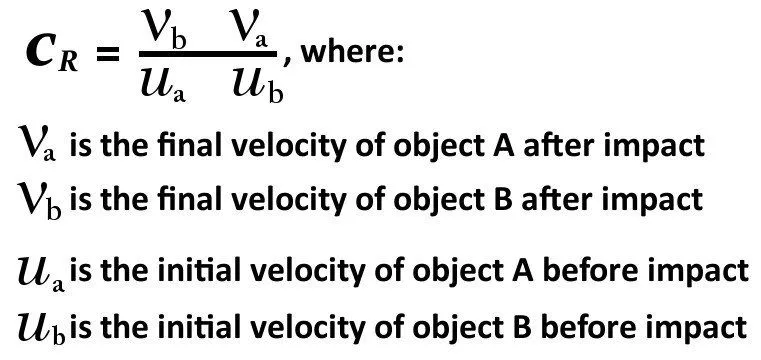
The formula to calculate the coefficient of restitution is rather straightforward. Since it is defined as a ratio of the final to the initial relative velocity between two objects after their collision, it can be mathematically represented as follows:

When considering a one-dimensional collision of two objects, A and B, the coefficient of restitution could be calculated by:
In the case of a ball bouncing off a flat, stationary surface, the coefficient of restitution turns out to be:
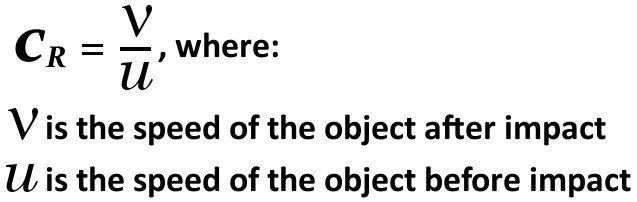
These formulas could be used to calculate the value of the coefficient of restitution with different available variables.
How Do You Measure The Coefficient Of Restitution? (The Drop-Height Method)
Here is the good news: you don't need a high-speed camera to measure the coefficient of restitution. You can do it with a ball, a wall-mounted ruler, and a little physics. The trick is to drop a ball from a known height and measure how high it bounces back.
Why does that work? When you release a ball from a height hdrop, gravity speeds it up so that it hits the floor at a speed of vdown = √(2ghdrop). After the bounce, the ball leaves the floor at some slower speed vup and rises to a lower height hbounce, where vup = √(2ghbounce). Because the coefficient of restitution for a ball bouncing off a stationary surface is just the ratio of those two speeds, the gravitational acceleration g cancels out and you are left with a beautifully simple result:
e = √(hbounce / hdrop)
So if you drop a basketball from 1.8 meters (about 6 feet) and it rebounds to 1.0 meter (about 3.3 feet), the coefficient of restitution is √(1.0 / 1.8), which works out to roughly 0.75. That single square root is why a drop test is the standard way labs and sports bodies check whether a ball is "bouncy enough" without ever measuring a velocity directly.
Can The Coefficient Of Restitution Be Greater Than 1?
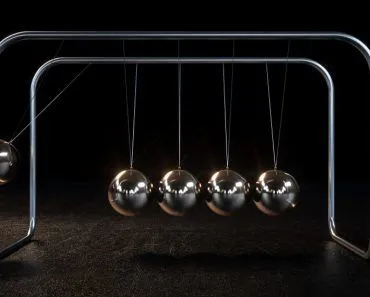
For everyday collisions, no. A value of 1 already represents a perfectly elastic collision (the near-ideal you see in a Newton's cradle) in which the bodies separate exactly as fast as they approached, and since real materials always shed some kinetic energy as heat, sound, and permanent deformation, the coefficient of restitution for an ordinary inelastic collision sits somewhere between 0 and 1. A number above 1 would seem to suggest the collision created energy out of nowhere, which would break the conservation of energy.
But there is a sneaky loophole. The coefficient of restitution can exceed 1 in what physicists call a super-elastic collision, where the objects fly apart faster than they came together because some stored energy is released during the impact. Picture a flexible ruler that you bend and clamp before it strikes a marble: the contact releases the spring energy you loaded into the ruler, so the marble departs faster than the ruler arrived. The extra energy was not conjured up by the collision; it was already sitting there as elastic, chemical, or even pressure energy, waiting to be unleashed. With that energy accounted for, the books still balance.
So the honest answer is that the coefficient of restitution ranges from 0 to 1 for passive collisions, and only nudges past 1 when something inside one of the colliding bodies pitches in extra energy of its own.
The Coefficient Of Restitution In Sports: Golf, Baseball And Basketball
If you have ever wondered why some golf drivers are banned, why aluminum bats were reined in, or why a flat basketball feels dead, the answer in every case is the coefficient of restitution. Sporting bodies care intensely about it, because a more efficient bounce means more distance and more speed, which can tip the balance of a game.

In golf, a thin, springy clubface can flex and snap back during impact (storing and returning elastic energy much like a spring obeying Hooke's law), flinging the ball off faster, an effect nicknamed the "trampoline effect." To keep this in check, the United States Golf Association limits the coefficient of restitution of a conforming driver face to 0.83; a clubface springy enough to push past that value is ruled non-conforming. Baseball faced the same problem with hollow aluminum and composite bats, whose barrel walls flex and spring back like a trampoline to launch the ball harder than solid wood can. The NCAA and high schools answered with the BBCOR (Bat-Ball Coefficient of Restitution) standard, which caps certified bats at 0.50 to rein in batted-ball speeds and protect pitchers.
Basketball goes the other way and uses the coefficient of restitution to guarantee a lively ball. A regulation NBA ball must be inflated to between 7.5 and 8.5 pounds per square inch (psi), the pressure window that makes it rebound the right amount in a standard drop test; a basketball at that pressure has a coefficient of restitution of roughly 0.76. Let too much air out and the coefficient plunges, which is exactly why a half-flat ball thuds instead of bounces.
References (click to expand)
- Restitution - electron6.phys.utk.edu
- https://www.asu.edu/courses/kin335tt/Lectures/Kinetics/Impact%20and%20Coefficients%20of%20restitution.pdf
- 20. Coefficient of Restitution | UCLA Physics & Astronomy - demoweb.physics.ucla.edu:80
- (2013) Complex Velocity Dependence of the Coefficient of Restitution .... University of Erlangen–Nuremberg
- Measurements of the horizontal coefficient of restitution for a superball and a tennis ball - www.physics.umd.edu
- The Coefficient of Restitution. Physics LibreTexts.
- Relative Velocity and the Coefficient of Restitution. Physics LibreTexts.
- Nathan, A. M. The Physics of the Trampoline Effect in Baseball and Softball Bats. University of Illinois.
- USGA and R&A Final Rule on the Spring-Like Effect (0.830 COR limit). United States Golf Association.
- Coefficient of restitution. Wikipedia.