Table of Contents (click to expand)
A projectile’s motion is parabolic because it is affected by gravity. Gravity causes the projectile to fall in a curved path, rather than a straight line. The equation for projectile motion takes into account the force of gravity, which is why the path of a projectile is always a parabola.
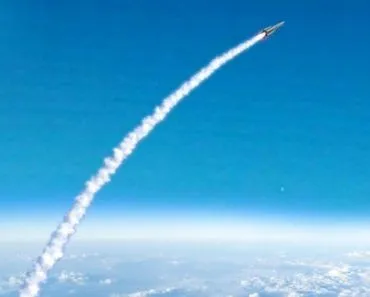
Why does a cannonball shot from a cannon not descend vertically, but rather along a curved path? Why does a tossed javelin draw a sumptuous arc before it stings the ground? Regardless of the nature of the projectile, the arc one draws through the air is precisely a parabola.
The reason is, of course, gravity, the only force that affects its motion (neglecting air resistance) after it is projected. However, what we are essentially asking is, why does gravity force it to trace a parabola? Kepler knew that the planets orbited the Sun in an ellipse, but he didn’t know why they did so. In that same vein, Why doesn’t a projectile trace any other shape but a parabola?
What Is a Parabolic Path?
Before we ask why a projectile traces this particular curve, it helps to be clear about what the curve actually is. A parabolic path (or parabolic trajectory) is the symmetric, arch-shaped curve that an object follows when it is launched into the air and then left to the mercy of gravity alone. A parabola is a specific mathematical shape, the curve described by an equation of the form y = ax + bx², and the flight of a thrown stone, a kicked football or a fired cannonball matches it remarkably well once you ignore air resistance.

You only ever see part of the parabola, the up-and-over arc between launch and landing, but that arc has all the parabola's hallmarks. It is perfectly symmetric about its highest point, so the path on the way up mirrors the path on the way down. The two ends of the arc define the projectile's range (the horizontal distance covered), while the peak defines its maximum height.
The credit for recognising this belongs to Galileo Galilei. By around 1604 he had worked out that a projectile follows a parabolic path, a conclusion that directly contradicted the Aristotelian belief that a cannonball flew in a straight line until its "impetus" ran out and it dropped vertically. Galileo eventually published the result in 1638 in his Two New Sciences, and it became one of the cornerstones of modern mechanics.
Why Does a Projectile Follow a Curved Path?
Here is the heart of it. The reason a projectile curves rather than travels in a straight line is that it is doing two completely separate things at the same time. Galileo's great insight was that the horizontal motion and the vertical motion of a projectile are independent: neither one influences the other.

Think about the two directions separately. Horizontally, once the projectile has left your hand, nothing pushes or pulls it sideways (we are ignoring air resistance). With no horizontal force, there is no horizontal acceleration, so the projectile keeps covering equal horizontal distances in equal slices of time. Its horizontal velocity is simply constant.
Vertically, the story is different. Gravity is the only force acting after launch, and it pulls straight down with a constant acceleration of g ≈ 9.8 m/s² (32 ft/s²). So the vertical velocity is not constant at all. It shrinks as the projectile rises, reaches zero at the very top, then grows again on the way down, exactly as it would for an object in free fall.
Now combine the two. The object marches sideways at a steady pace while gravity bends its vertical motion more and more. Steady horizontal travel plus uniformly accelerated vertical fall is precisely the recipe that, when you write it out mathematically, produces a parabola. Change one ingredient (add air resistance, say) and the curve stops being a clean parabola, which is exactly why we set air resistance aside to see the underlying shape.
The Equation
Of course, this is not true when a projectile is projected perpendicular to the Earth’s surface. To observe a parabolic trajectory, we must project it at some angle with the surface. Even though no horizontal forces affect a projectile following its launch, it is the initial horizontal force that makes the glorious journey possible. How else could a javelin travel a horizontal distance if it were not provided with a horizontal force?
In the 17th century, mankind had yet to build a rocket and the most powerful telescopes couldn’t look further than Saturn. Despite these constraints, how could Newton, sequestered in a tiny room in England, discover that the planets orbit the Sun and not – as the most eminent philosophers of the time believed (or rather hoped) – in a circle, but rather an ellipse? Mathematics, of course.
Newton proved Kepler’s claim by discovering a relationship between the distance between Earth and the sun, and the angle it spans while rotating around it. He discovered that it was exactly the same relationship that describes a point tracing an ellipse. However, his evaluation was based on his newly proposed law of gravity. If his law were untrue, his proof would also fall apart. We now know that what he proposed was true; Newton never explained what gravity is, but he beautifully explained how it works.
Similarly, to determine which curve a projectile traces, we must find an equation that describes its motion and the curve that corresponds to it.
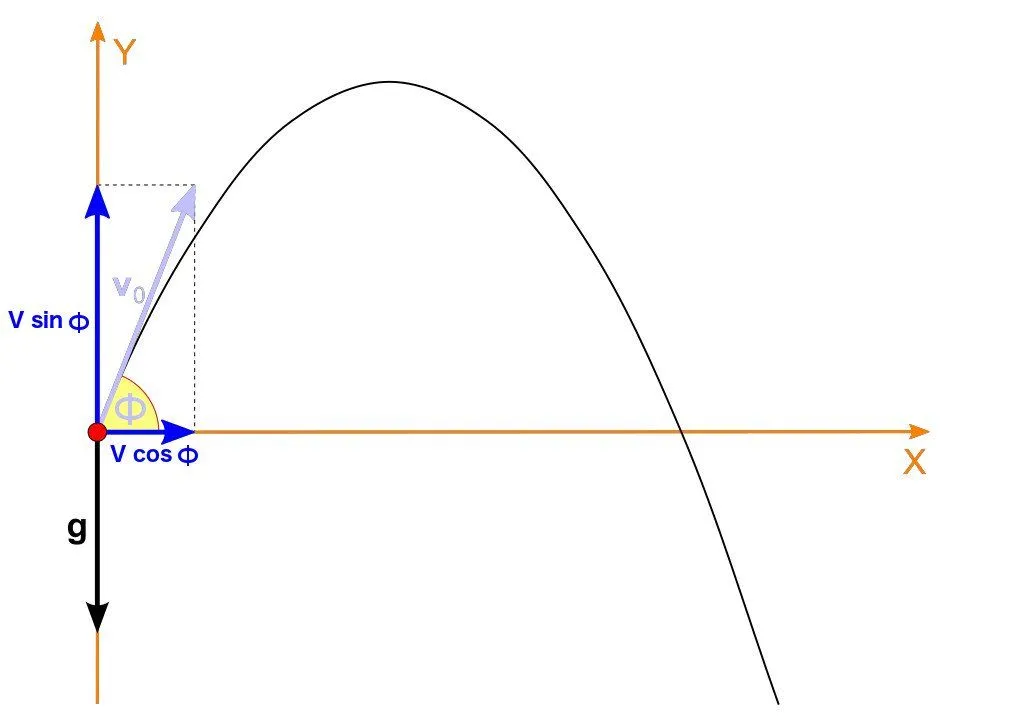
The projectile is projected with an initial velocity ‘v’ at an angle ‘Φ’ with respect to the surface. The distance the projectile travels horizontally (on the X-axis) is given as x = vtcosΦ (v=x/t). However, the distance it travels vertically (on the Y-axis) is given as y = vtsinΦ – (½)gt². This is because vertically, the projectile experiences a force and thus acceleration, namely, the acceleration due to gravity, denoted by ‘g’.
Now, because this acceleration is constant, we can use the kinematic equation s = ut + (½)at² to calculate the distance ‘y’. Here, ‘u’ is the initial velocity, which in this case is vsinΦ and ‘a’ is the constant acceleration, which in this case is ‘-g’, due to our selected convention. Therefore, the vertical distance y = vtsinΦ – (½)gt².
To find ‘y’ in terms of ‘x’, or to obtain an equation that describes the relationship between ‘y’ and ‘x’, we solve for ‘t’ in the first equation and substitute its value in ‘y’.
x = vt cosΦ
or, t = x / (v cosΦ)
Substitute the value of t in: y = vt sinΦ − ½gt²
y = v sinΦ · (x / (v cosΦ)) − ½g(x / (v cosΦ))²
y = x tanΦ − gx² / (2v²cos²Φ)
Here, tanΦ and g/2v²cos²Φ are constants, so the equation uncannily resembles the equation y = ax+bx² – the equation of a parabola!
How High and How Far? A Worked Example
The parabola is not just a pretty shape, it lets us actually predict where a projectile will go. Two quantities matter most: the range R (how far it travels horizontally before landing back at launch height) and the maximum height H. For a projectile launched and landing on level ground, the range works out to:
R = v² sin(2Φ) / g
Because the sine function peaks at 1 when its angle is 90°, the range is greatest when 2Φ = 90°, that is, at a launch angle of Φ = 45°. This is why a long jumper or a shot-putter instinctively aims somewhere near 45 degrees for maximum distance. The formula also hides a neat symmetry: two angles that add up to 90° (for example 30° and 60°) give the same range, just with very different arcs, as the trajectories image above shows.
Let's put real numbers in. Suppose a fireworks shell is fired at v = 70.0 m/s at an angle of Φ = 75.0° to the ground (a steep launch, so it bursts high overhead). The vertical part of its velocity is v sinΦ = 70.0 × sin 75.0° ≈ 67.6 m/s. It keeps climbing until gravity has cancelled that vertical velocity, which takes a time t = (v sinΦ) / g = 67.6 / 9.8 ≈ 6.90 s.
In that time it reaches a maximum height of about 233 m, and it has drifted roughly 125 m downrange by the moment it reaches the apex. Plug a whole range of times into x = v t cosΦ and y = v t sinΦ − ½g t², plot the points, and they fall exactly along the parabola predicted by our equation. The shape on paper and the streak of light in the night sky are one and the same curve.
References (click to expand)
- Deriving Kepler's Laws – Brilliant Math & Science Wiki.
- Newton and Planetary Motion - UNL Astronomy. University of Nebraska–Lincoln
- Projectile Motion (PDF) – The University of Michigan–Dearborn.
- Projectile Motion – University Physics Volume 1. OpenStax.
- Galileo Galilei – MacTutor History of Mathematics Archive, University of St Andrews.