Table of Contents (click to expand)
In 1965, Intel co-founder Gordon Moore observed that the number of transistors on a chip was doubling about every year (he revised this to every two years in 1975). The forecast proved so reliable that Caltech professor Carver Mead dubbed it "Moore's Law," and it became the guiding principle of the semiconductor, computing, and nanotechnology revolution.
Humans have always been fascinated by the largest of scales, like that of the cosmic world, to the very smallest of scales of the recently discovered nano-world.
The unquenchable thirst of curious minds has magnified humankind’s vision to the numerous opportunities that things at the nanoscale have to offer. Nanoscience is one such sub-branch of physics that explores these possibilities. Nanoscience deals with the structures and molecules at the nanoscale. Nano-technology, on the other hand, refers to the practical applications of Nanoscience.
Nanoscience and nanotechnology are often used as synonyms for the other. The scientific activities occurring at less than 100 nanometers of dimension fall under this sub-branch.

There are a few visionary scientists who have been able to make future predictions in this field quite accurately. One of them is Gordon E. Moore, the co-founder of the microprocessor manufacturing giant, Intel.
What Is Gordon Moore’s Statement?
On April 19th, 1965, Gordon Moore published a paper titled "Cramming more components onto integrated circuits" in Electronics Magazine. In it, he noted that the number of transistors packed into an Integrated Circuit (IC) had been doubling roughly every year, and he predicted that this pace would continue for at least a decade. He made this observation while serving as the director of research and development at a company named Fairchild Semiconductor. (A decade later, in 1975, Moore revised the doubling interval to roughly every two years, the figure most people quote today.)
This statement also implied that the power of the computers would double every two years, as more transistors could occupy a designated space of electronic circuitry. The machines that work on computer technologies would become smaller, faster, and cheaper over time. It also meant that new innovative technology would experience tremendous growth. This observation also implied that the growth of microprocessors would be exponential over time.
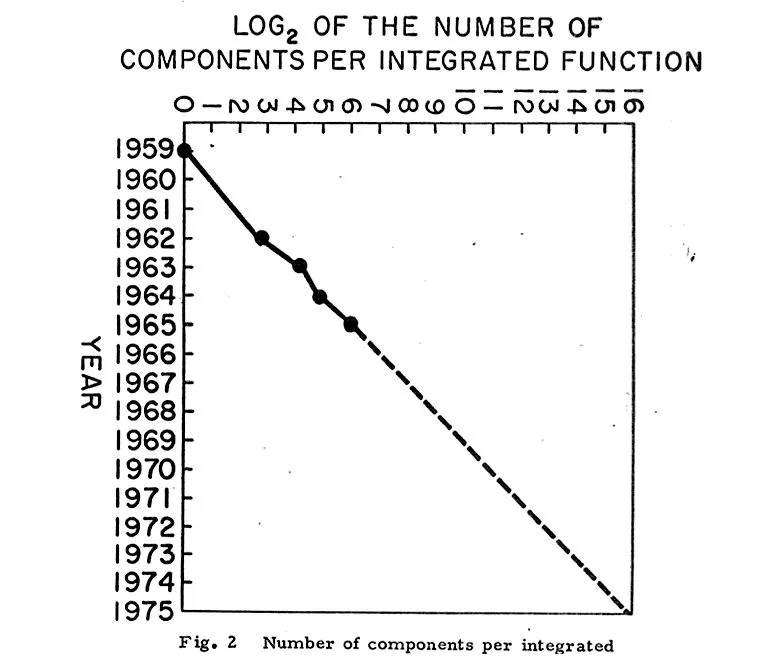
The relevance of Gordon Moore’s statement to the semiconductor, computing, and electronic industries became the driving force behind the technological revolution in Intel and elsewhere.
Accepting His Statement As A Law
It is interesting to note that Moore’s Law isn’t a law in the actual sense, since it has no written proof, but its immense popularity and accuracy led to general acceptance of it as a ‘law’.
The term ‘Moore’s Law’ was coined by Professor Carver Mead of the California Institute of Technology around 1975, and Moore himself always credited Mead with the name. By then Moore had left Fairchild to co-found Intel with Robert Noyce in 1968, and the company became the showcase for his prediction. Moore stayed at the helm of Intel for decades and passed away on March 24, 2023, at the age of 94.

You will often hear Moore’s Law quoted as a doubling “every 18 months,” but Moore himself never used that number. That figure came from Intel executive David House, who folded in the fact that each new generation of transistors was also getting faster. Combining more transistors with quicker ones, House reckoned that overall chip performance would roughly double every 18 months, and the phrase stuck.
Benefits Of Moore’s Law
As mentioned earlier, Moore’s Law was revolutionary in the semiconductor, computing, and electronics industries. It impacted the progress of computing power, making it faster, cheaper, and easier.
Practically everything around us is composed of more and more electronic components. These electronic components are based on the principles of computing and microprocessors. With a higher number of transistors in a given unit of space, integrated circuits can process electrical signals faster, thus increasing their efficiency. We are now able to easily process gigabytes of data in the blink of an eye!
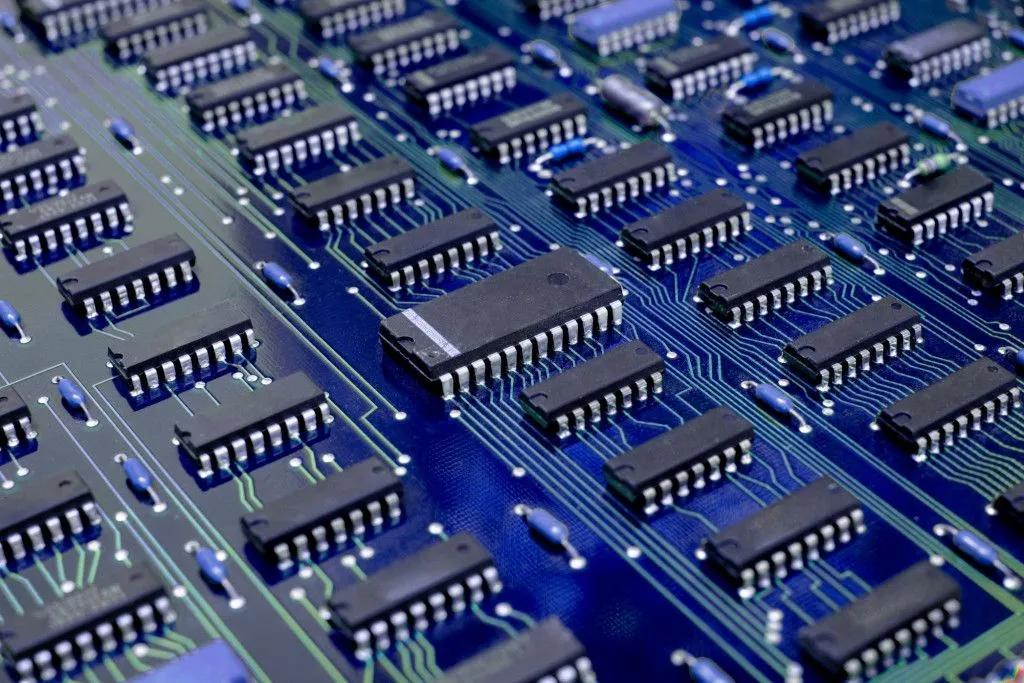
One striking feature of this law is that it implied the cost of electronic components, especially semiconductors, integrated circuits, and computers, would gradually fall. As more transistors are squeezed onto each chip, the price per transistor (and therefore the price of computing) keeps dropping. This has actually happened, putting the technology in everyone’s hands. Consider that ENIAC, the room-sized electronic computer of 1946, cost roughly $487,000 (about $6.5 million in today’s dollars), yet the smartphone in your pocket carries vastly more computing power for a few hundred dollars. Technology sure has come a long way!
Future Predictions
Though Moore’s Law has ruled the semiconductor and electronics industries for a long time, many scientists and researchers agree that we are approaching the point where chips bump up against the physical limits of Moore’s Law. Transistors today are measured in mere nanometers, and you simply cannot keep shrinking features that are already only a handful of atoms wide.
Thermal constraints like the high temperature of transistors fabricated into an IC would eventually make it impossible to create smaller circuits, because it would take more energy to cool down a transistor than the amount of energy already passing through it.
Also, new materials beyond silicon chips acting as microprocessors and IC components may nullify this law.
Quantum computing, which is gaining immense popularity every day, does away with the physical limitations of classical computing, as it is based on Quantum Bits and quantum mechanical effects, such as superposition and quantum entanglement.

But again, this view of Moore’s Law eventually “failing” is highly debated. Some believe that innovations will drive Moore’s Law into the future, like monolithic scaling and system scaling.
Mono-scaling is similar to Moore’s Law scaling, with the effect of reducing the size of transistors and the voltages at which they operate, to increase performance.
System scaling refers to the incorporation of new types of processors that are heterogeneous through various technologies like chip-to-chip interconnection and packaging.
The chip industry is clearly betting on the latter view. By late 2025, both TSMC and Intel had reached their 2nm-class nodes (Intel calls its version 18A, roughly 1.8 nm), shipping a brand-new transistor design called gate-all-around, or GAA (Intel’s RibbonFET, TSMC’s Nanosheet). Engineers now talk about the “angstrom era,” where features are measured in fractions of a nanometer (one angstrom is one-tenth of a nanometer). The headline doubling has clearly slowed, but through clever transistor shapes, 3D stacking, and advanced packaging, the spirit of Moore’s Law marches on.
A Final Note
Moore’s Law is an interconnection between a person’s prediction and their upcoming reality, a “prophecy” that has stood the test of time!
The fast-paced modern world is experiencing rapid changes in technology from the nano-scale to the mega-scale. It will be very interesting to note how many more years Moore’s Law survives and remains relevant. Whatever happens, it will be for the betterment of humankind… hopefully!
References (click to expand)
- 1965: “Moore's Law” Predicts the Future of Integrated Circuits. Computer History Museum
- Press Kit: Moore's Law. Intel Newsroom
- Intel Breakthroughs Propel Moore's Law Beyond 2025. Intel Corporation
- Shalf, J. (2020, January 20). The future of computing beyond Moore’s Law. Philosophical Transactions of the Royal Society A: Mathematical, Physical and Engineering Sciences. The Royal Society.
- The Multiple Lives of Moore's Law - IEEE Spectrum. IEEE Spectrum
- Cumming, D. R. S., Furber, S. B., & Paul, D. J. (2014, March 28). Beyond Moore's law. Philosophical Transactions of the Royal Society A: Mathematical, Physical and Engineering Sciences. The Royal Society.
- (2002) View of The Lives and Death of Moore's Law | First Monday. First Monday