Table of Contents (click to expand)
The laws of quantum physics do apply in biology, and the field of quantum biology studies where. The clearest examples are photosynthesis, the magnetic compass birds use to navigate, enzyme reactions driven by quantum tunneling, and possibly our sense of smell. Even so, biological systems are so warm and complex that most life still runs on ordinary chemistry.
An unorthodox and eccentric collaboration between two seemingly incompatible scientific fields (Quantum Physics and Biology) is producing enthralling new insights into the nature of our living world.
Biological systems are dynamic in nature, constantly exchanging energy and matter with the environment, maintaining the non-equilibrium state synonymous with living. On the other hand, quantum mechanics is the fundamental theory that describes the behavior and properties of atoms, subatomic particles, molecules and molecular assemblies (and possibly far more beyond our present realm of knowledge).
It may confuse you to consider this combination, biology being linked to quantum physics, when the latter deals in nanoscale measurements, while the former goes no smaller than the micro level. Well, your doubts are well deserved. Continue reading to discover how quantum physics shapes many of the crucial biological phenomena of our world.
Photosynthesis
You might have a general idea of what this process entails. Plants and some types of bacteria absorb sunlight and water to synthesize “food”, namely carbohydrates, and release oxygen as a waste product, which is essential for the survival of all other living creatures.
However, what actually goes into this process?
Chromophores are the color-imparting molecules in a plant (chlorophyll is the most familiar one) that gather photons or light particles from incoming sunbeams or other light sources. They then release excitons, which are an outcome of the excess energy being absorbed. This energy can then be transformed into chemical energy, which the plant can metabolize.
The crucial early step here, shuttling that captured energy from the chromophores to the reaction center, happens in well under a billionth of a second (on the scale of femtoseconds to picoseconds) and reaches roughly 95% efficiency, so very little energy is lost along the way. (To be clear, that figure is the efficiency of energy transfer within the light-harvesting machinery; the overall conversion of sunlight into stored sugars is far lower, typically only a few percent.) In this rapidly evolving world, efficiency is all that matters. Clearly, the ingenious mechanism of photosynthesis is truly one of nature’s greatest marvels. So… what’s really happening here?
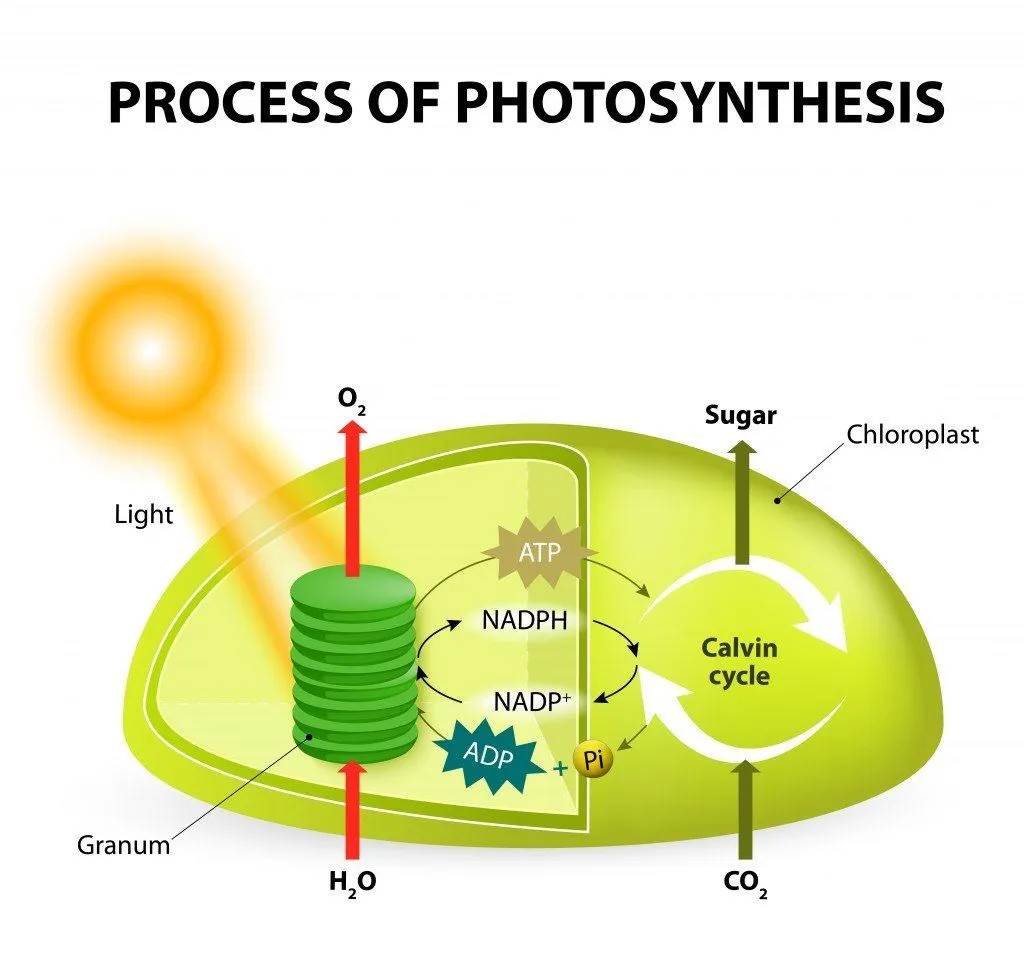
The excitons, instead of traveling down a singular and linear pathway, move in a wave-like motion. When a barrage of excitons travel together, their wave-like motions superimpose to produce quantum coherence. Sounds pretty impressive, right?
According to one popular interpretation, this quantum coherence lets the excitons sample many possible pathways at once and settle on an efficient route to the reaction center. It is a striking idea, though worth flagging that it remains contested: the long-lived coherence reported in early experiments (notably in the bacterial Fenna-Matthews-Olson complex back in 2007) has since been re-examined, and many researchers now attribute the wave-like signals to vibrations within the molecules rather than to a system literally trying every path at the same time.
Now, imagine how big of a breakthrough it would be for energy-producing industries if we could mimic this phenomenon in our own technology. Highly efficient solar panels and long-lasting batteries could pave the way for a green and bright future.
Magnetoreception

It has long been known that some birds and marine animals navigate the globe by using an internal chemical compass that interacts with the Earth’s magnetic field.
However, the truth is that Earth’s magnetic field is too feeble to tingle their senses, so how do birds actually navigate?
Cryptochrome, a special kind of protein, is found in the eyes of European robins and other animal species. When blue light hits the retina of their eyes, the protein undergoes an electron transfer that leaves behind two unpaired electrons on neighboring molecules, known as a photo-induced radical pair.
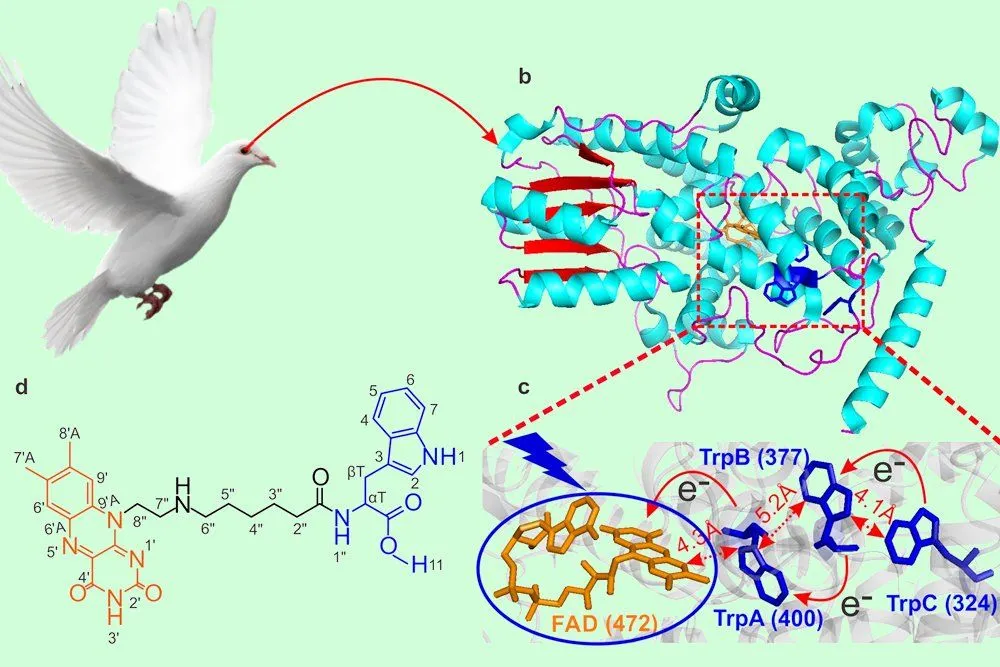
Unpaired electrons are highly susceptible to minute changes. They orient their spin in the direction of Earth’s magnetic field, thus giving them a sense of direction. All of these processes take place on a quantum level, making it yet another quantum biological phenomenon that most people never think about!
Olfaction: The Sense Of Smell
Humans are gifted with the ability to differentiate between thousands of different smells. When aroma molecules make it into our nostrils from the air, they interact with a receptor inside the nose, similar to how photons interact with the optic nerve to grant us the power of sight. The question is, how does the olfactory nerve distinguish one smell from another? The standard answer is that a molecule's shape decides which receptor it fits, but one intriguing (and hotly debated) alternative proposes that quantum physics lends a hand.
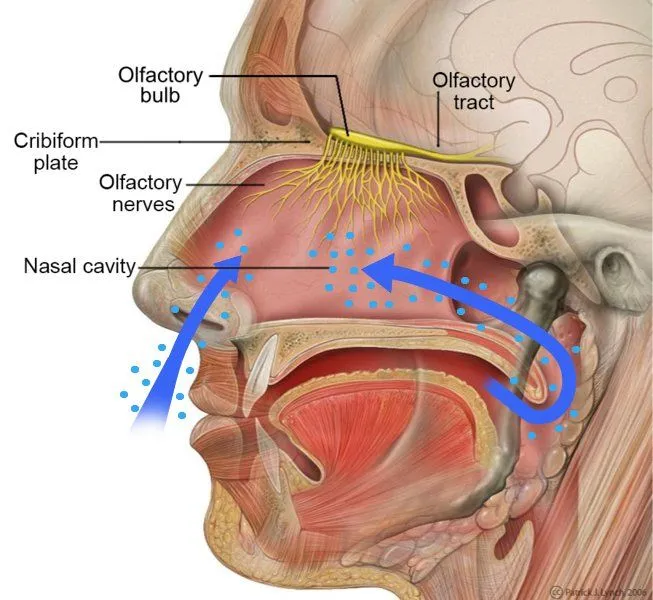
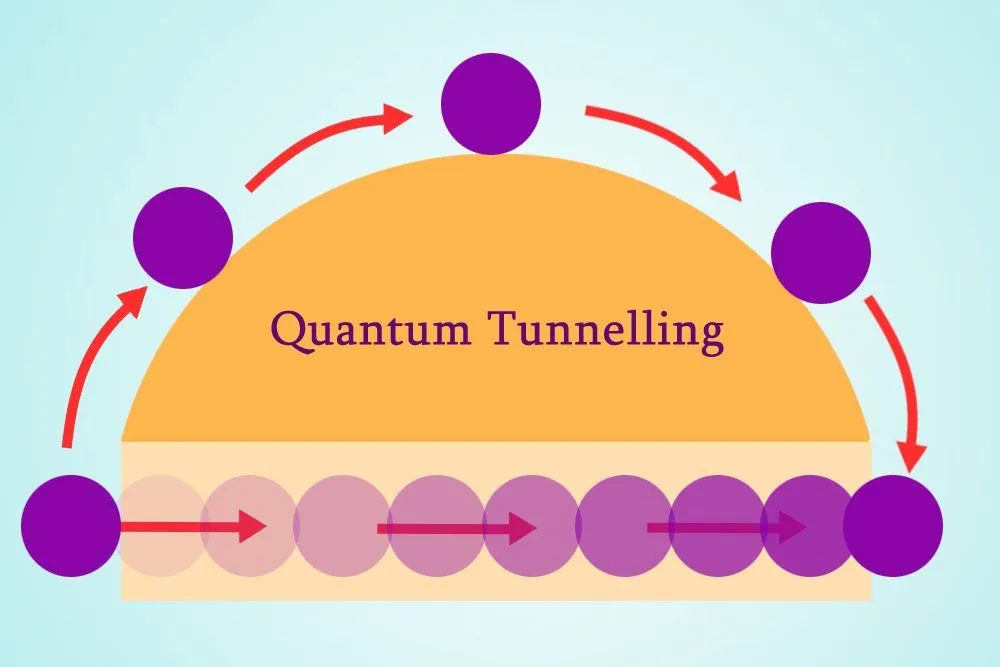
This idea, often called the vibration theory of olfaction and championed by biophysicist Luca Turin, suggests that when an aroma molecule docks in a receptor, an electron passes to the other side of the receptor via quantum tunneling, with the molecule's own vibrations helping decide whether that jump can happen. Quantum tunneling is a phenomenon in which subatomic particles like electrons, protons and neutrons move through a barrier that is otherwise impossible to pass through, according to the theories of classical physics. By doing so, it would convert the information in odorant molecules into electrical signals, which are then directed to the brain, allowing us to detect and rapidly identify the smell. To be fair, the evidence here is mixed: experiments that swapped molecules for heavier isotope versions (which vibrate differently) have produced conflicting results, so most olfaction researchers still favor the shape-based explanation. It is a tantalizing possibility rather than a closed case.
Quantum Cognition
Cognition can be defined as “the mental action or processes involved in acquiring knowledge and understanding, either through thought, experiences or senses.”
Enter “quantum cognition”, a new theory suggesting that the mathematical principles behind quantum mechanics, such as probability theory, could be used to better understand the psychology behind human behavior. After all, thinking is based on the cognitive ability of our brain, and brains function on electrical impulses, which are observed at the quantum level.
Prisoner’s Dilemma
Let’s consider the classic “Prisoner’s Dilemma” thought experiment to understand the cognitive abilities of the human brain better. Two criminals are offered the chance to rat the other’s crimes out. If one rats the other out, but the other doesn’t rat him out, the betrayer goes free, while the other serves a three-year term. If both of them rat each other out, each serves two years. If neither of them rat the other out, they each get one year. If we consider that both criminals always behave in their own self-interest, they will always rat the other out, if they are unaware of the other’s statement.
When classical probability is applied to this thought experiment, it fails to explain it. If the first criminal knew, for sure, that the second would cooperate, it would make the most sense to rat him out and get away with his own crimes; the same thing would also be true for the second criminal. Thus, you can conclude that no matter what the other criminal is doing, it would be best to defect. This all becomes quite confusing when viewed from a classical perspective.
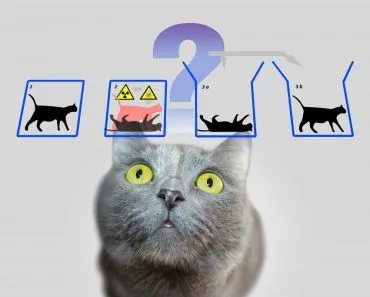
However, a quantum explanation works a bit better. Take Schrödinger’s cat experiment, in which the cat is equally likely to be dead and alive inside the closed box until the box is opened and the state of the cat is observed. Applying this result to our experiment, it can be said that each of these possibilities is like a thought wave. Just as other waves (light, sound, water) can interfere with each other, the waves of choices behind ratting the other prisoner out or keeping your mouth shut can interfere, either to cancel each other out, build a smaller wave, or perhaps a much larger one. This means that if one criminal is going to cooperate, the other might end up cooperating as well!
This example might seem a bit hard to wrap your head around, but in reality, probability theory is a game of chance; by quantizing it, an equal opportunity is given to all sides, ensuring that each decision affects every other.
Conclusion
Natural selection has certainly come up with ways for living systems, regardless of scale and scope, to naturally exploit quantum phenomena.
While not much has been discovered in this interdisciplinary field, and while we are far from fully exploiting our understanding of quantum biology for technological advancements, the era is not far off when bio-inspired quantum devices will outperform the classical, inefficient analogues.
Unlike much of the 20th century, when “warm, wet and noisy” biological systems were thought to be completely incompatible with the delicate quantum states that decoherence destroys in an instant, we’ve reached a new stage of understanding. Now, the question of “Can quantum phenomena affect biology?” has been replaced by “If they do, what effect does it cause and how does it happen?” Given that evolution on Earth has had 3.5 billion years to devise different ways to harness the anomalies of quantum mechanics, there seems to be a lot of fascinating space for quantum biology to explore!
References (click to expand)
- Marais, A., Adams, B., Ringsmuth, A. K., Ferretti, M., Gruber, J. M., Hendrikx, R., … van Grondelle, R. (2018, November). The future of quantum biology. Journal of The Royal Society Interface. The Royal Society.
- The real history of quantum biology - Phys.org. Phys.org
- Marais, A., Adams, B., Ringsmuth, A. K., Ferretti, M., Gruber, J. M., Hendrikx, R., … van Grondelle, R. (2018, November). The future of quantum biology. Journal of The Royal Society Interface. The Royal Society.
- Johnsen, S., & Lohmann, K. J. (2008, March). Magnetoreception in animals. Physics Today. AIP Publishing.
- Nordmann, G. C., Hochstoeger, T., & Keays, D. A. (2017, October 23). Magnetoreception—A sense without a receptor. PLOS Biology. Public Library of Science (PLoS).