Electrons don’t "know" or choose the path of least resistance. When a circuit closes, the electric field pushes on every electron at once, so current flows through all available paths simultaneously. It simply splits in inverse proportion to resistance: lower-resistance routes carry more current, higher-resistance routes carry less, but none is fully avoided.
Consider the scenario where you’re in a crowded McDonald’s, waiting your turn to place an order. Would you wait in line with slower service for your takeaway order, or would you take the line with faster service?

In all probability, you’ll join the line that seems to be moving faster, i.e., the path of least resistance. Something similar happens with electrons flowing through wires, but there’s a catch. Electricity doesn’t actually pick one path and ignore the rest. When several paths are available at once, current flows through all of them, with more of it through the easier (lower-resistance) routes and less through the harder ones. The popular phrase "electricity takes the path of least resistance" is a useful shorthand, but the real mechanism is a bit more interesting than that, so let’s unpack it.
What Is An Electron?
School taught us that atoms are the building blocks of all matter. An atom consists of smaller particles called subatomic particles. An electron is a class of elementary subatomic particles called leptons. Leptons are elementary because they’re not composed of smaller sub-particles.
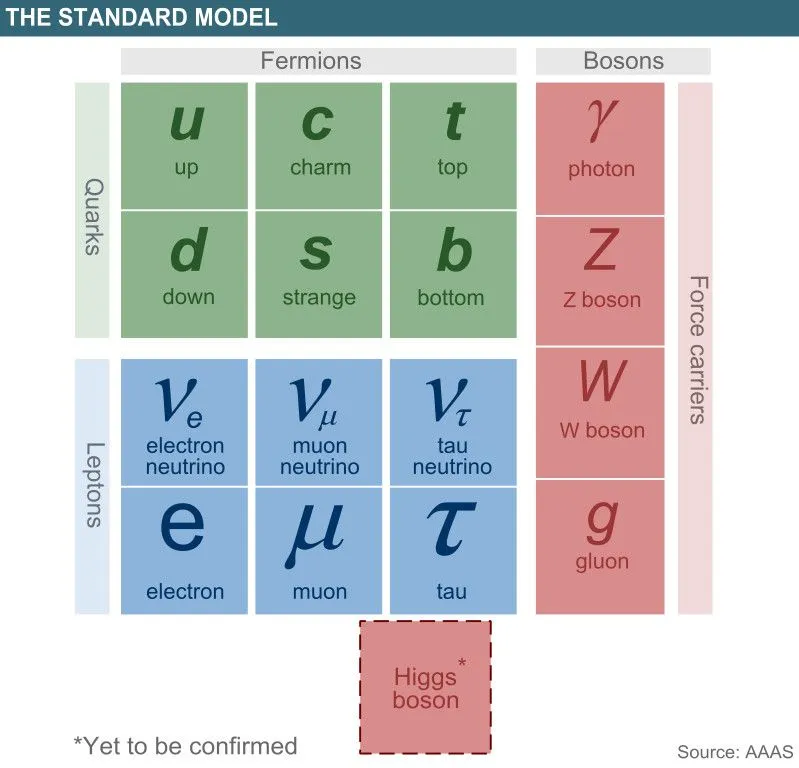
Let’s establish a few fundamental laws about electrons:
- All electrons are identical.
- Electrons carry a negative charge (-1.602×10⁻¹⁹ C).
- Electrons repel each other.
- Inside a metal, electrons jitter around in random directions at very high speeds (on the order of 1,000 km/s, or roughly 600 mi/s), but when a current flows, their net drift along the wire is glacially slow, often less than 1 mm/s. What travels down a wire at nearly the speed of light is the electrical signal (the push of the electric field), not the electrons themselves.
What Is Electric Current?
The flow of charge per unit of time is called electric current.
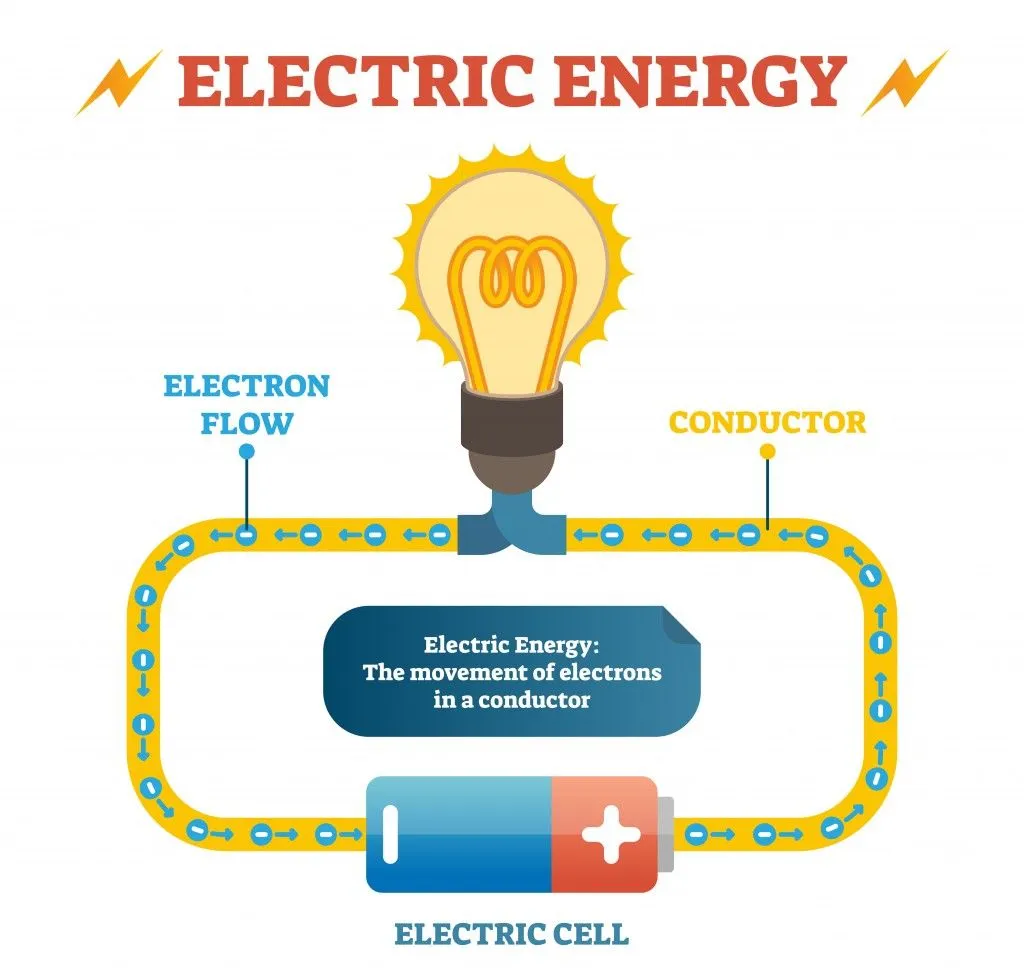
All electrical appliances, like fluorescent lights, air conditioners, and water heaters, have charges flowing through the wires inside them when turned on. In an ideal world, those charges could flow through the path ahead of them without any obstruction, but nature thought otherwise…Let’s assume we have a wire that opposes the flow of charges through it. Such a wire is said to have a resistance R.
What Is The Closed Path That Electrons Travel Through Called?
You may have noticed that the electrons in our story always travel in a loop: out of one terminal of the battery, through the wire, and back into the other terminal. That complete, unbroken loop has a name. It is called a circuit. As OpenStax puts it, for charge to flow there must be "a complete path (or circuit)" from one terminal of the battery to the other. Break the loop anywhere, and the current stops everywhere at once. That is exactly why flipping a light switch feels instant: the switch simply opens or closes a small gap in the loop.
A loop that is joined all the way around and carrying current is a closed circuit; one with a break in it is an open circuit. The material that lets charges move through it easily, such as the copper inside a wire, is a conductor. And the property that pushes back against that flow, the obstruction we met a moment ago, is the wire's resistance. So if you have ever been asked to fill in the blanks: the closed path electrons flow around is called a circuit, and the opposition to their flow is called resistance.
Is It Time To Make Nature Obey Man?
Notice that the direction of current flow is opposite to the direction of electron flow. To make electrons flow, connect the opposite ends of a wire to a battery. A potential difference develops at the opposite ends. Potential Difference explains how far a particle is from an energetically stable state. All particles tend to reach their most energetically stable state, i.e., possess the lowest energy possible within their surroundings (movement from a state of high potential to one of low potential.) Inside a wire unconnected to a battery, some electrons are bound to atoms and cannot move. Still, some free electrons move in random directions. This situation is analogous to a crowded restaurant where some people are seated and don’t move, while those who are standing walk in random directions inside the restaurant.
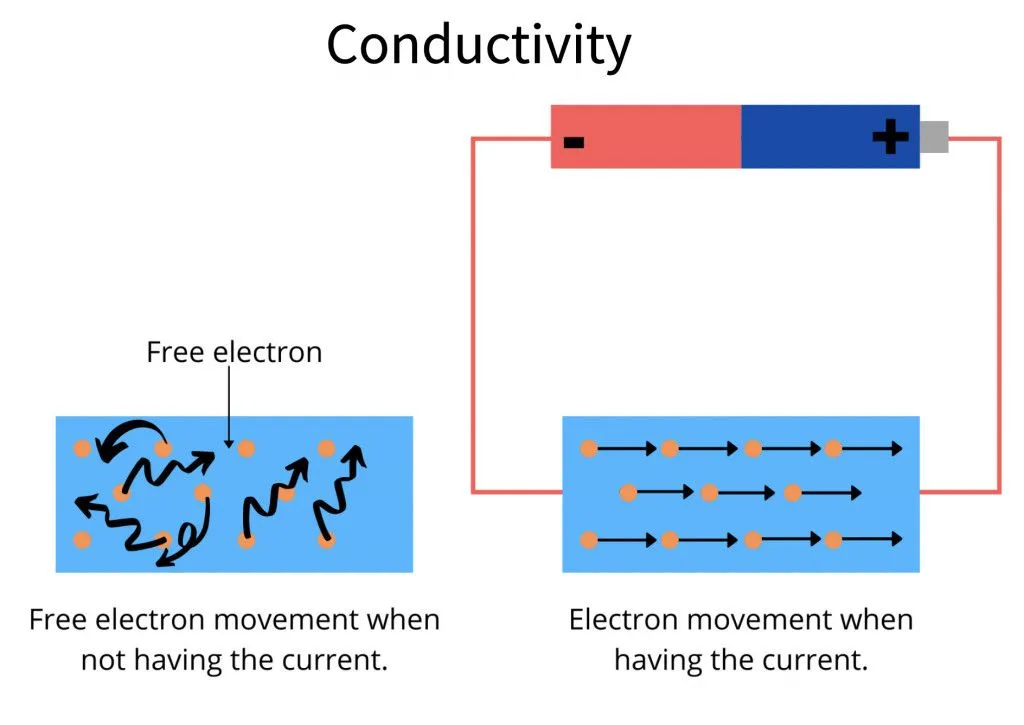
When a battery is connected, a potential difference exists across the opposite ends of the wire (or in our metaphor, the takeaway counter opens and those who are waiting start forming lines), which has the following consequences:
- The electrons at the end connected to the negative terminal of the battery experience a repelling force from the terminal, pushing towards the wire away from the battery.
- The electrons at the end connected to the positive terminal experience an attracting force towards the terminal, pulling away from the wire towards the battery.
- The electrons in the middle are pushed ahead by the electrons behind them and pushed back by the electrons in front.
- The net effect of the above is that an organized, directional flow of electrons begins from the negative end to the positive end.
- The obstruction offered to this flow is the resistance of the wire.
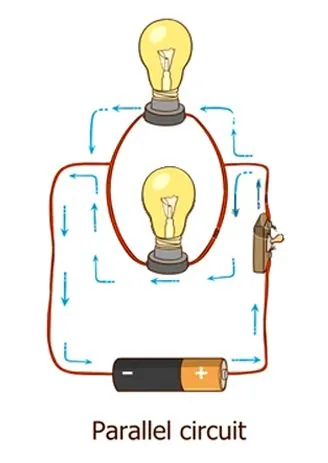
Let two wires, A and B, be connected to the same battery. Also, let Ra be the resistance of A and Rb be the resistance of B and assume that Ra > Rb.Can you guess which wire will carry the larger share of electrons, given that both wires have the same physical dimensions (length and width)? The answer is B. Note that A still carries current too, just less of it. The current splits between the two branches in inverse proportion to their resistance: since Rb is smaller, B takes the bigger share. Let’s walk through the mechanism for greater clarity.
Mechanism
When the switch is turned on, electrons in both the wires connected to the negative terminal flow away from the terminal into the wires, but A offers more opposition to the flow of electrons than B. Thus, electrons in B flow more easily than in A. This is analogous to the McDonalds line with faster service. Gradually, more people will notice that B has faster servicing time than A and will therefore enter line B.Similarly, at the positive terminal, the electrons in B move more easily into the battery and away from the wire than in A.Electrons leaving the negative terminal feed into both A and B at the same time; the wires don’t take turns. Since the opposition to flow is less in B than in A, more electrons flow through B than A in a fixed duration, though A is never starved entirely. Very quickly, the branch currents settle into a steady state (called equilibrium), with the total current splitting between the wires in inverse proportion to each one’s resistance. This equilibrium is maintained for as long as the power supply stays connected. Once the supply is removed, the electrons go back to their aimless wandering (people scrambling away in different directions once the restaurant closes).
Does Lightning Take The Path Of Least Resistance?
The same myth shows up on a far grander scale with lightning. We often say a bolt "finds the path of least resistance" to the ground, but the US National Weather Service is blunt about it: the leader "does not take the path of least resistance from cloud to ground as it moves blindly toward the ground."

A cloud-to-ground flash begins with a faint, almost invisible channel called a stepped leader. It pushes down from the cloud in jumps of roughly 50 meters (about 160 feet) at a time, and at each step it can only sense charges within about 50 meters of its tip. Because the air ahead is never uniform, each jump lunges toward whichever pocket of air happens to be easiest to ionize at that instant. That is why a bolt looks so jagged and branched rather than arrow-straight.
As the leader nears the ground, tall objects respond by pushing up their own faint upward streamers. When a downward leader and an upward streamer meet, they complete a conducting channel, and a brilliant return stroke surges back up it. It is this return stroke, not the dim leader, that we actually see as the flash. So lightning never scouts out one perfect low-resistance route in advance. It gropes its way down step by step, and the bright discharge simply races up whatever ionized trail it happened to carve.
Conclusion
It’s fascinating that electrons are contained in all matter around us, and that their behavior can be pictured with everyday analogies. So the next time someone says electricity "takes the path of least resistance," you’ll know the fuller story: current doesn’t pick a single lane and ignore the rest. It spreads across every available path at once, simply favoring the easier, lower-resistance ones. Funnily enough, that’s a smarter strategy than the one most of us use in a crowded line, where we stubbornly commit to a single queue and just hope for the best!
References (click to expand)
- The Standard Model | CERN. The European Organization for Nuclear Research
- Griffiths D. J. (2013). Introduction to Electrodynamics. Pearson
- Model of Conduction in Metals. University Physics Volume 2 (OpenStax). Physics LibreTexts
- Resistors in Series and Parallel. University Physics Volume 2. OpenStax
- Electrical Current. University Physics Volume 2. OpenStax
- Understanding Lightning: Initiation of a Stepped Leader. National Weather Service (NOAA)
- Severe Weather 101: Lightning FAQ. National Severe Storms Laboratory (NOAA)