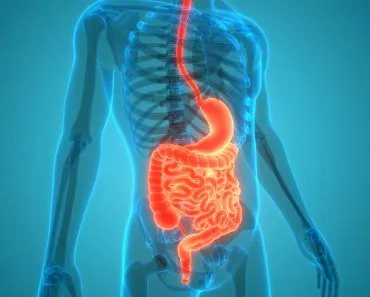
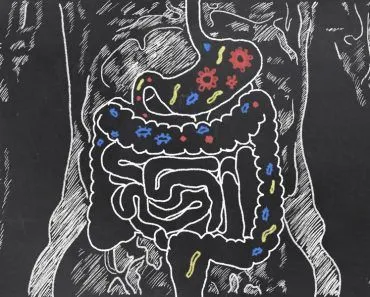
Tapeworms (cestodes) are flat, ribbon-like parasitic worms in the phylum Platyhelminthes. Humans usually get them by eating raw or undercooked beef (Taenia saginata), pork (T. solium), or fish (Diphyllobothrium latum) containing tapeworm larvae. The larvae attach to the small-intestine wall using a head (the "scolex" with suckers and sometimes hooks) and grow by adding new body segments (proglottids) from a neck region — feeding by absorbing nutrients straight through their skin, since they have no mouth or gut. Adults commonly reach 2–7 metres (the fish tapeworm can hit 25 metres) and can live in a single host for 25–30 years.
Tapeworm infections remain a significant global health concern — the WHO classifies taeniasis as a neglected tropical disease, endemic in Africa, Asia, and Latin America, particularly in communities with poor sanitation.
These parasites choose the human body to live out their adult lives, making humans the definitive host of tapeworms. The definitive host of a parasite is the place where the parasite reproduces. When adult tapeworms enter the human body and cause infections, the condition is known as taeniasis.
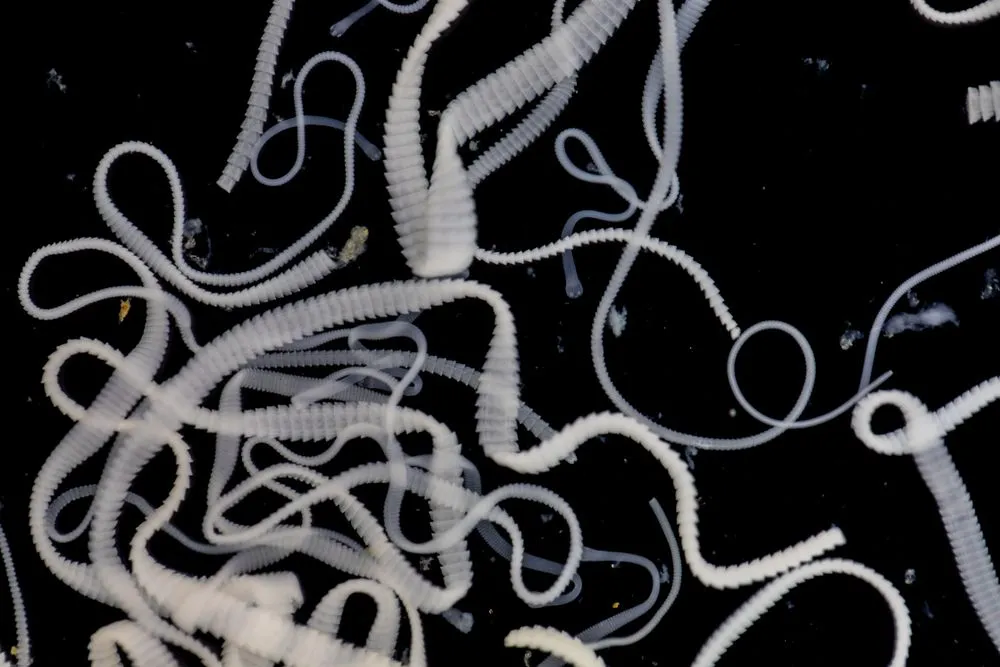
To understand how tapeworms make their way into the human intestine, it is imperative to understand the life cycle of these worms.
So What Exactly Is A Tapeworm?
Before we get to the growing part, it helps to know what we’re actually dealing with. Tapeworms belong to the phylum Platyhelminthes (the flatworms), and more specifically to the class Cestoda. That places them in the same broad group as flukes and freshwater planarians, although tapeworms have taken parasitism to an extreme that few other animals can match.
An adult tapeworm has three distinct regions. At the front is the scolex, a tiny knob-like head fitted with suckers (and in some species, a crown of hooks) that anchors the worm to the lining of its host’s intestine. Just behind it sits the neck, a thin band of dividing cells that does almost all the work of growing the worm. Trailing behind the neck is the strobila, a ribbon-like chain of body segments called proglottids. The whole arrangement looks a bit like a length of fancy tape, which is where the common name comes from.
What makes cestodes truly strange is what they don’t have. Tapeworms have no mouth, no stomach, and no intestine of their own. Everything they need is absorbed directly through their outer skin, called the tegument, which sits bathed in the partly digested food flowing past in the host’s gut. In effect, they let us do the digesting and skim the nutrients off the top.
Several species use humans as their final address. The big three are Taenia saginata (beef tapeworm), Taenia solium (pork tapeworm), and Diphyllobothrium latum (fish tapeworm). But there are others worth knowing about. Hymenolepis nana, the dwarf tapeworm, is a tiny species (just 15 to 40 mm long) that is actually the most common tapeworm of humans worldwide, infecting an estimated 75 million people. And Echinococcus granulosus, a dog tapeworm only a few millimeters long, can cause a serious condition called hydatid disease when its eggs are accidentally swallowed by a human, with slow-growing fluid-filled cysts forming in the liver or lungs.
The Life Cycle Of Tapeworms
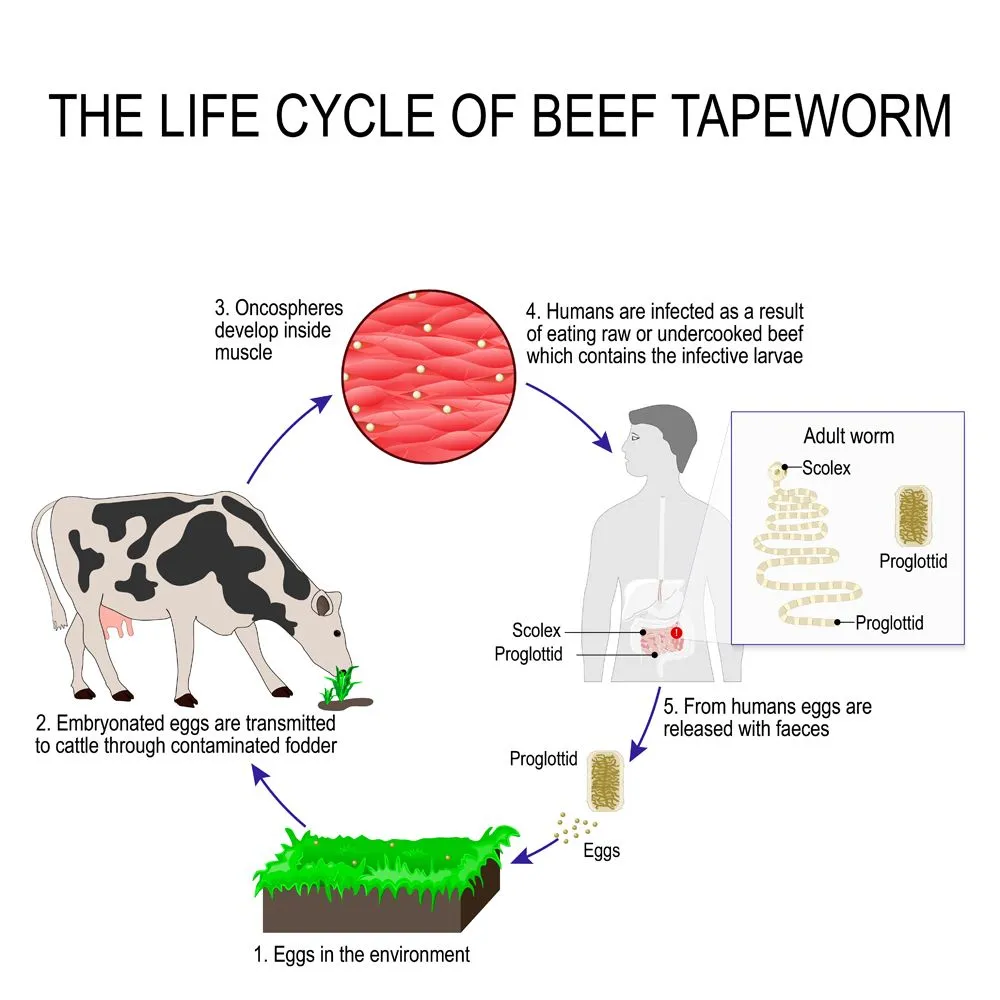
Every parasitic tapeworm bounces between two hosts. Adults reproduce inside a definitive host (often a human, sometimes a dog or fox), shedding eggs into the environment. An intermediate host (a cow, pig, or fish, depending on the species) picks those eggs up and carries the larval form until it can be eaten by the next definitive host. The cycle closes with raw or undercooked meat on someone’s plate.
For the three species that most commonly infect people (Taenia saginata from beef, Taenia solium from pork, and Diphyllobothrium latum from freshwater fish), the route looks like this:
- Adult worm sheds eggs in human feces. A mature tapeworm in the small intestine releases gravid proglottids, each packed with roughly 100,000 fertilized eggs in T. saginata and 50,000 in T. solium. Once the feces reach soil or water, the eggs are free in the environment.
- Intermediate host swallows the eggs. Cattle pick them up while grazing on contaminated pasture (T. saginata); pigs root them up in similar settings (T. solium); freshwater copepods and then small fish accumulate them in lakes and rivers (D. latum).
- Eggs hatch into oncospheres. Inside the intermediate host’s gut, each egg releases a tiny six-hooked larva called an oncosphere. The oncosphere uses those hooks to burrow through the intestinal wall and into the bloodstream.
- Larvae settle as cysticerci. The oncospheres travel through circulation, lodge in muscle tissue (or in fish flesh, for D. latum), and develop into fluid-filled larval cysts called cysticerci. They can sit dormant there for years.
- Human eats raw or undercooked infected meat. Stomach acid dissolves the cyst wall, the larva everts its scolex, and the young worm uses its suckers (and hooks, in the case of T. solium) to anchor to the lining of the small intestine.
- Larva matures into an adult tapeworm. Over roughly two months, the attached larva grows a strobila of new segments and begins producing eggs of its own. From that point the worm can keep growing and shedding eggs for 25 years or more, restarting the cycle the next time its eggs reach an intermediate host.
T. solium has an extra wrinkle. If a person accidentally swallows T. solium eggs (rather than larvae from pork), those eggs hatch inside the human body and the oncospheres treat us as the intermediate host instead, lodging as cysts in muscle, eye, or brain tissue. That second route is called cysticercosis, and when the cysts settle in the brain it becomes neurocysticercosis.
How Tapeworms Actually Grow: The Strobilation Process
Here is the part that surprises most people. A tapeworm does not get longer the way you might expect. It does not extend its tail. It grows from the front, by churning out fresh segments at the neck and pushing the older ones backward, the way a printer feeds paper. The technical name for this process is strobilation.
The neck, which sits just behind the scolex, is a thin band of rapidly dividing cells, the germinative zone of the worm. Day after day, it buds off brand-new proglottids that join the chain. Each new proglottid is added at the front, so the segments closest to the scolex are always the youngest, and the segments at the tail end of the worm are the oldest.
As a segment ages and gets pushed further down the chain, it passes through three stages:
- Immature proglottids, sitting just behind the neck, are mostly placeholders. Their reproductive organs are still forming.
- Mature proglottids, in the middle of the chain, contain a complete set of both male and female reproductive organs. This is where fertilization happens, either between two organs of the same segment (self-fertilization) or between organs of two different segments (cross-fertilization).
- Gravid proglottids, at the tail end of the worm, are essentially walking egg sacs. Each one is packed with tens of thousands of fertilized eggs and very little else.
Once a gravid segment is full, it detaches from the rest of the worm (a process called apolysis) and is passed out in the host’s feces, carrying its eggs along with it. A Taenia saginata sheds roughly six to nine of these gravid segments every day for decades, which is one reason a single contaminated pasture can keep an outbreak going for years.
The fish tapeworm Diphyllobothrium latum takes strobilation to an extreme. According to StatPearls, it can add as much as 22 cm (about 9 inches) to its length every single day, and live for 20 years or more inside one host. At that rate the strobila can pass two meters in under a fortnight.
So when we say a tapeworm has "grown" from a 1 mm larva into a 7 m adult, what we really mean is that its neck has spent the past two or three months hand-rolling thousands of new segments onto the front of the chain. The worm grows not by stretching, but by manufacturing.
Tapeworms Inside The Human Intestine
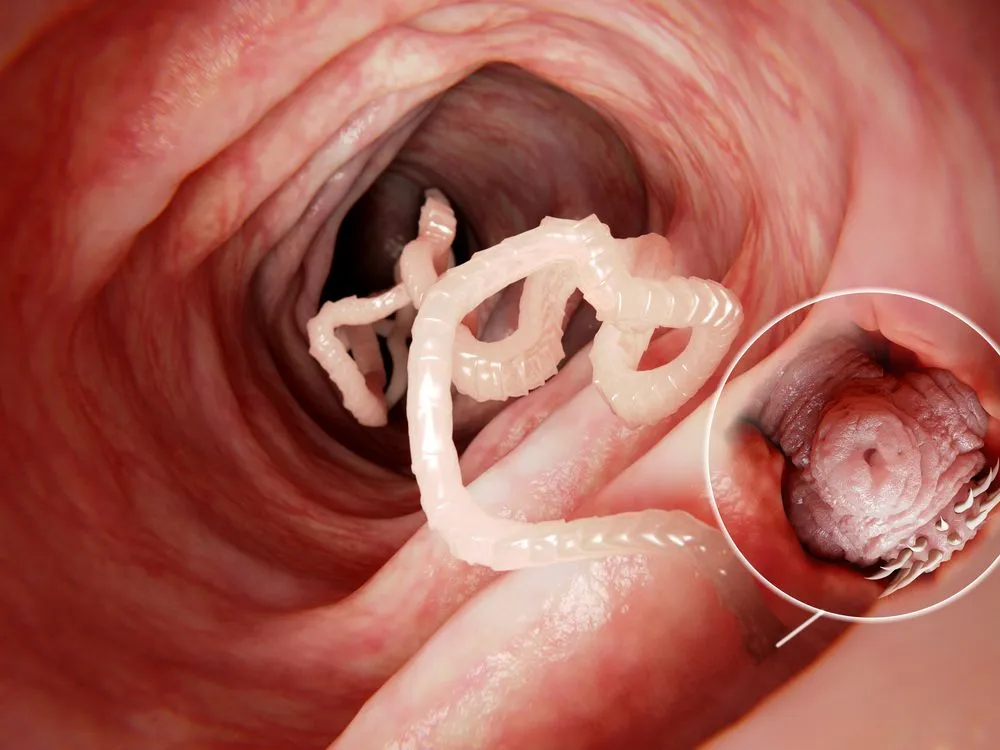
The tapeworm larvae lodge themselves in the human small intestine, wherein they ultimately grow into adults. Tapeworms have a typical worm-type body comprised of a head region known as the scolex, and a body segmented into what are known as proglottids.
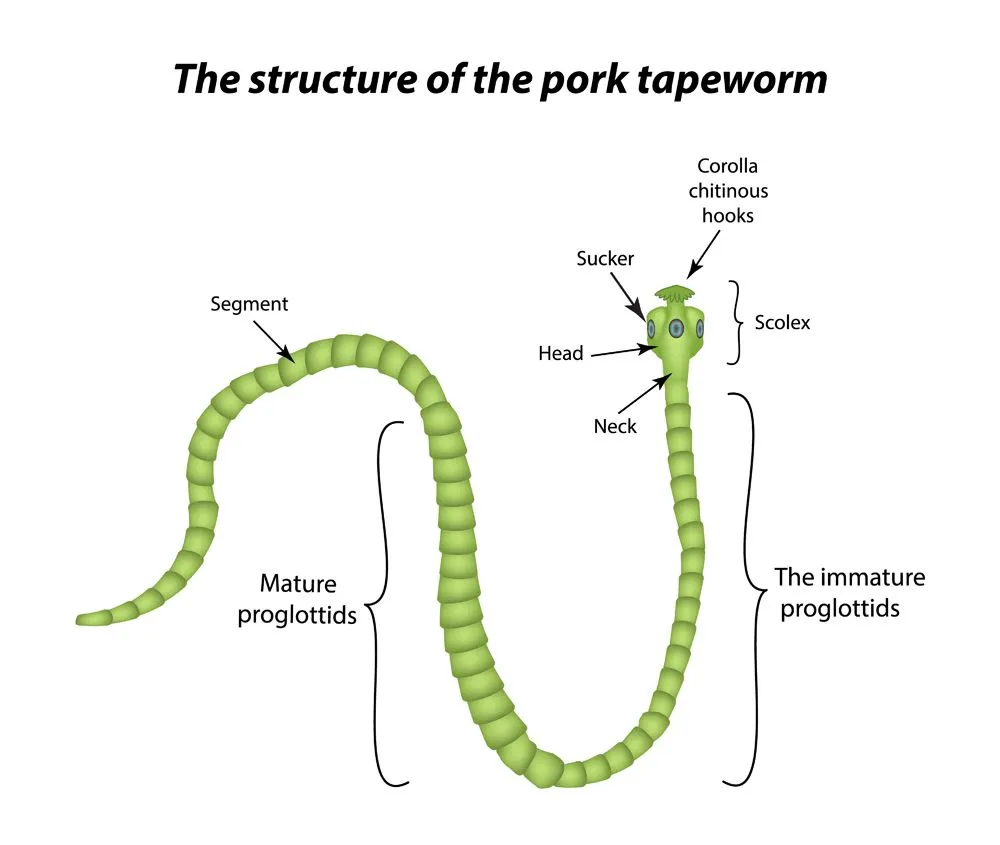
The scolex enables the tapeworm to attach firmly to the intestinal wall. T. solium has both suckers and hooks (earning it the name "armed tapeworm"), while T. saginata has only four suckers and no hooks ("unarmed tapeworm"). It then continues to grow for what can sometimes be 25-30 years—or even the entire lifespan of the infected person.
But how do they continue to grow if their head is hooked to the walls of our intestine? They do so by absorbing the nutrients (that we ingest) through the surface of their body.
Another peculiar feature of most tapeworms is that they are hermaphroditic, which means that they have reproductive characteristics of both sexes. Hence, they can self-fertilize, along with reproducing via cross-fertilization.
Self-fertilization occurs between the male and female gonads of the same tapeworm, which leads to the formation of the eggs (embryos). Cross-fertilization, on the other hand, happens when the male and female gonads of two different tapeworms fertilize to create eggs.
These eggs are present on each of the segments of the tapeworms, the proglottids. As the tapeworms lengthen in size, these egg-containing proglottids detach from the worm’s body and are gradually released, along with the expelled feces of the infected person.
A single segment of a Taenia saginata contains about 100,000 eggs, while that of Taenia solium contains almost 50,000 eggs.
When animals consume these eggs, the life cycle of the tapeworms has come full circle.
Symptoms, Diagnosis, And Treatment Of A Tapeworm Infection
Most adult tapeworm infections are oddly polite. A large share of people carrying Taenia have no idea, because the worm hooks onto the intestinal wall, quietly absorbs a share of the host’s food, and produces no obvious symptoms for years. When symptoms do appear, they tend to be vague: mild abdominal discomfort, nausea, occasional diarrhea, a nagging loss of appetite, or unexplained weight loss. The most common way people do realize something is wrong is by finding pale, flat segments (the gravid proglottids) in their underwear or on the surface of stool.
The fish tapeworm Diphyllobothrium latum has one signature trick the others don’t. It is an aggressive scavenger of vitamin B12, absorbing the vitamin about 100 times faster than the human gut can. As a result, measurable B12 deficiency shows up in roughly 40% of fish-tapeworm infections at diagnosis, and a smaller fraction of patients (under 2%) go on to develop full megaloblastic anemia, with fatigue, pale skin, and sometimes neurological tingling.
Diagnosis is usually straightforward. A clinician orders an ova-and-parasite (O&P) stool exam, in which lab staff look for tapeworm eggs or whole proglottid segments under a microscope. Taenia eggs are easy to spot but hard to species-identify visually, so confirming whether the worm is T. saginata, T. solium, or T. asiatica sometimes requires PCR-based molecular testing.
The treatment is almost embarrassingly simple. A single oral dose of praziquantel (5 to 10 mg per kg of body weight) kills the worm by causing its tegument to fall apart, and the dead worm is then passed in stool. Niclosamide is an effective alternative. The same drugs work for the fish tapeworm and the dwarf tapeworm. The exception is neurocysticercosis, the brain-cyst form of T. solium infection, which is managed quite differently with albendazole, corticosteroids, and anti-seizure medication, sometimes alongside neurosurgery.
Prevention is even simpler, and very much in the home cook’s control. Cook beef and pork to an internal temperature of at least 145 °F (63 °C) for whole cuts, or 160 °F (71 °C) for ground meat, and let it rest for three minutes. Cook fish to 145 °F. Freezing meat or fish at −4 °F (−20 °C) for seven days will also kill cysticerci. Wash hands and produce thoroughly, because for T. solium and Hymenolepis at least, the eggs themselves are infectious and travel happily on hands and food.
Conclusion
Tapeworms are notorious for growing into mind-boggling sizes. The average length of Taenia saginata is more than five meters, while that of Taenia solium is between two and seven meters!
Broadly, parasitic tapeworm infections either occur through their larval form (cysticercosis) or adult form (taeniasis).
Infections brought about by adult worms are mostly asymptomatic, with mild abdominal pain and a loss of appetite being the primary signs. However, when T. solium larvae migrate beyond the intestine and lodge in the brain, the condition is called neurocysticercosis — the most common preventable cause of epilepsy in developing countries, according to the WHO. This occurs when a person accidentally ingests T. solium eggs (rather than larvae), and the larvae form cysts in brain tissue.
The most common way of becoming aware of a tapeworm infection is when the long worms are observed when pieces are passed along with a person’s feces.
References (click to expand)
- CDC - Taeniasis - Biology. The Centers for Disease Control and Prevention
- (2021) Tapeworm - StatPearls - NCBI Bookshelf. The National Center for Biotechnology Information
- (1996) Cestodes - Medical Microbiology - NCBI Bookshelf. National Center for Biotechnology Information
- Cox, F. E. G. (2002, October). History of Human Parasitology. Clinical Microbiology Reviews. American Society for Microbiology.
- Taeniasis/cysticercosis. World Health Organization.
- About Diphyllobothrium (Fish Tapeworm). CDC.
- Taenia saginata - Wikipedia.
- Diphyllobothrium Latum - StatPearls. NCBI Bookshelf.
- About Hymenolepiasis (Dwarf Tapeworm). Centers for Disease Control and Prevention.
- About Echinococcosis. Centers for Disease Control and Prevention.
- About Taeniasis. Centers for Disease Control and Prevention.