Table of Contents (click to expand)
Rock strata form when wind or water deposits sediment in successive horizontal layers, with heavier, coarser grains settling first and finer particles on top. Each layer hardens through compaction and cementation. Per the law of superposition, the deepest layers are the oldest and each overlying layer is younger, which is how geologists read the Earth's history from a cliff face.
The geological layers of the earth carry both the history and present of our planet. From evidence of past climate conditions to information on the evolution of life, these rock layers have gems and secrets preserved deep within them. Over millions of years, many factors worked hand in hand to form these layers.
When rocks are deposited layer by layer, they are said to be stratified. Rock stratum commonly refers to the sequence of sedimentary rocks that cover the majority of the surface. These rocks are produced from fragments of earlier rocks that were eroded by wind or water. The fractured pieces undergo cementation, compaction, and recrystallization to form sedimentary rocks.
Rock strata are visibly distinguished from one another due to their different compositions. The detailed study of rock strata is called stratigraphy.
How Do The Rock Strata Form?
Nicholas Steno, a Danish scientist working in Italy, set out the rules for reading sedimentary strata in the 17th century, publishing his foundational Prodromus in 1669. As per their respective weight or size, solid particles tend to separate from fluids. It is a common observation that the biggest or heaviest things fall to the ground first, while the lightest things settle later. The same is true for rock-forming sediments.
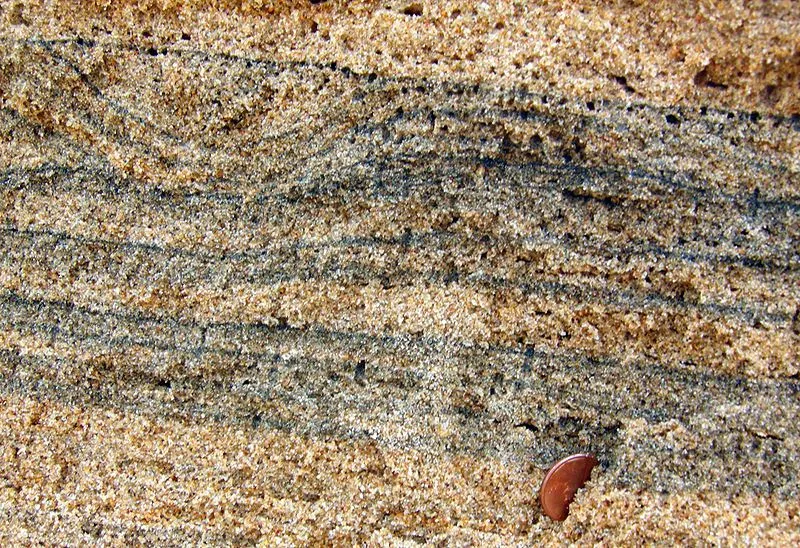
Rock develops layers (also known as beds) as a result of variations in the size of particles or their compositions. Differences in the carrying capacity of a depositing agent, like water or wind, sort the strata according to relative homogeneity in terms of size, weight, and particle form. Stratification might also arise through breaks in sedimentation, which give the older deposits time to alter before new sediments cover them.
Therefore, a series of layers may appear as alternating fine and coarse particles, or as a series of color changes brought on by variations in mineral composition.
How Does Loose Sediment Turn Into Solid Rock?
A pile of sand on a beach is not yet a rock, and neither is the mud on the floor of a lake. Sediment only begins its journey toward becoming rock once the agent carrying it, whether a river, a wave or the wind, loses the energy needed to move it any further. When the current slows enough, the grains drop out and settle wherever they happen to be, which is why sediment gathers in low, quiet places such as river deltas, lake beds and the sea floor.

Then the burying begins. Every new layer that settles on top adds weight to the layers beneath it. This is compaction: the overlying material squeezes the grains closer together, shrinking the pore spaces between them and driving out much of the water trapped inside.
Compaction alone would only give us a tightly packed pile, though. What actually glues the grains together is cementation. Groundwater seeping through the remaining pore spaces carries dissolved minerals, and as it moves, those minerals crystallize in the gaps and bind neighboring grains to one another. The most common natural cements are calcite, silica (usually as quartz) and iron oxides. Oxidized iron is also what gives so many sedimentary rocks their deep red, rusty color.
Geologists call the overall process of turning sediment into rock lithification, and the full set of physical, chemical and biological changes a buried sediment goes through is known as diagenesis. The end product depends on what went in: gravel becomes conglomerate, sand becomes sandstone, and mud becomes mudstone or shale.
So the answer to how the Earth gets more rock on top of other rocks is surprisingly modest. Nothing is manufactured from scratch. Older rock is worn down, its fragments are carried off and dropped somewhere lower, and the pile is then buried, squeezed and cemented until it is rock once again.
What Is The Basic Principle Of Understanding Rock Strata?
Sediments deposit by working their way layer by layer to the bottom. Thus, the lowest layer forms first. More and more sediment keeps being deposited in the succeeding strata. As a result, the deepest beds or layers in a sedimentary sequence are the oldest, as they were deposited the earliest.
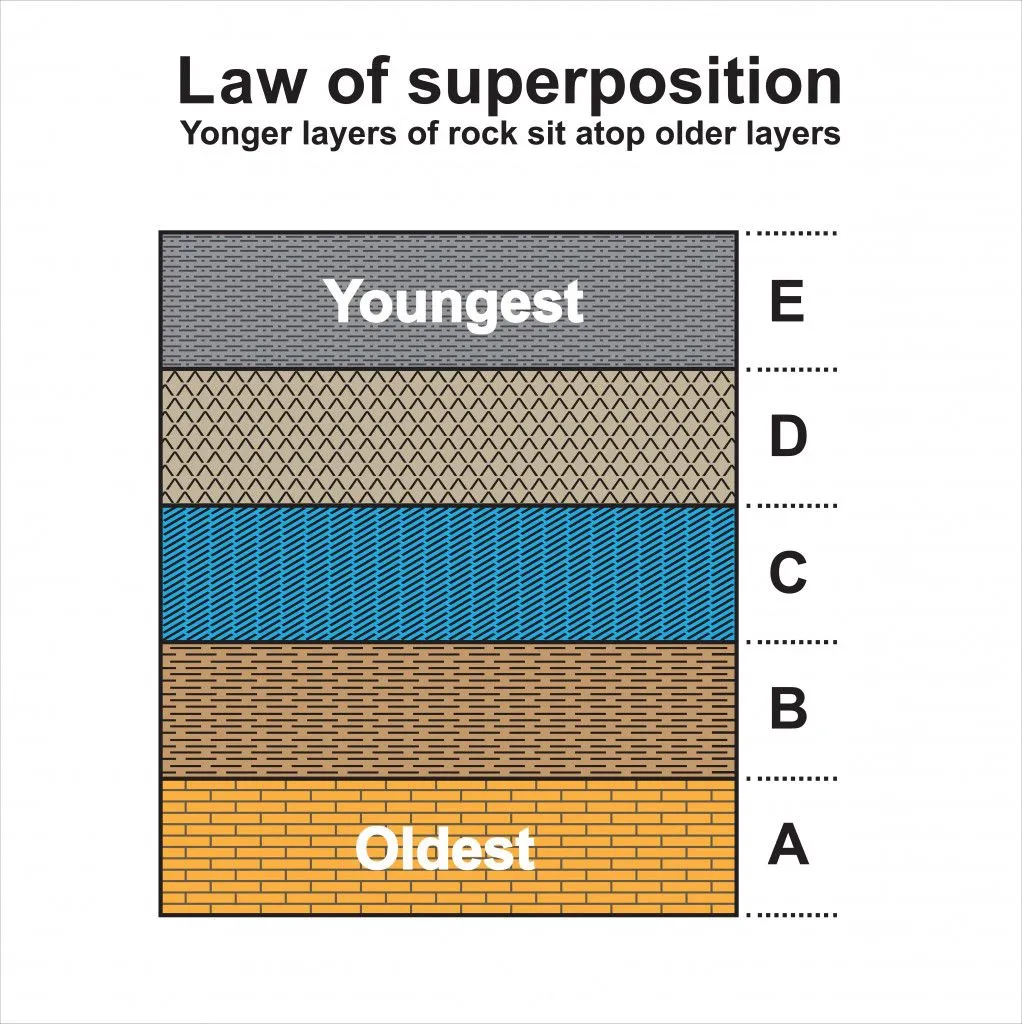
Imagine a pizza. The base is prepared before spreading the sauces. This is followed by putting on your favorite toppings. When looking at a slice, anyone can infer that the base came first and the toppings were added later. Now, think of this in terms of rock layers.
The underlying idea is that as we move from the bottom to the top of a rock sequence, the layers get younger and younger. This fundamental rule of stratigraphy is known as the law of superposition, first set out by Steno in 1669.
What Are Steno’s Other Rules For Reading Rock Layers?
Superposition is the rule everyone remembers, but Steno’s Prodromus set out two companions that geologists lean on just as heavily.
The first is the principle of original horizontality. Sediment settling out of water or air spreads into layers that are horizontal, or very nearly so, and roughly parallel to the surface it lands on. This is why a fresh sedimentary sequence looks like a stack of flat sheets rather than a set of vertical stripes. So whenever you see a rock layer standing on end or folded into an arch, you can be confident that it did not form that way. It was pushed into that position later by crustal disturbances such as faulting or mountain building. Steno’s rule turns a tilted cliff into a two-part story: first the layers were laid down flat, and then something bent them.

Siccar Point on the coast of Scotland shows this beautifully. Near-vertical layers of Silurian greywacke sit beneath gently tilted layers of Old Red Sandstone. The lower layers were deposited flat, tipped almost upright, worn down by erosion, and only then buried under fresh sediment. James Hutton, who visited the site in 1788, read exactly that sequence of events from the rock and realized how much time it must represent.
The second is the principle of lateral continuity. A layer of sediment does not stop abruptly at the edge of a cliff; it originally extended sideways until it thinned out or reached the edge of the basin it was filling. So if the same bed is visible on both sides of a canyon, the layers were once continuous, and the gap between them is simply what a river has carved away since. This is how geologists match up the same strata on opposite rims of the Grand Canyon, even though the canyon itself now separates them.
When Does The Law Of Superposition Break Down?
The law of superposition comes with a quiet condition: it only holds for layers that have not been disturbed since they were deposited. The Earth does not always cooperate.
Folding is the most dramatic exception. The forces that move continents can bend a stack of layers so severely that part of it flips over, locally placing older rocks on top of younger ones. Faulting can also break up and shuffle the order. To work out which way was originally “up”, geologists look for clues that only form one way: animal tracks and raindrop imprints press down into mud, not up, and mud cracks and the gas bubbles trapped in lava have a definite top and bottom. If the tracks are on the ceiling, the bed has been turned over.
The second exception is molten rock. Magma that forces its way through existing layers and hardens underground is called an intrusion. Dikes are a common example: narrow sheets of once-molten rock that slice across the layers, like the dark one in the photo below. Because an intrusion had to cut through the layers to get there, it must be younger than every layer it crosses, no matter where it sits in the stack. This is the principle of cross-cutting relationships: younger rocks or structures cut across older ones. The same logic applies to faults, which are younger than the layers they displace, and to erosion surfaces, which are younger than the rocks they cut into.

An extrusion is the opposite case. When magma reaches the surface it is called lava, and it cools quickly into fine-grained or glassy rock right where it spreads. A lava flow therefore behaves like any other layer: it hardens on top of whatever was already there, so it is younger than the rock beneath it and older than any sediment that later buries it. Superposition handles extrusions perfectly well; it is intrusions that need the cross-cutting rule.
Finally, there is the principle of inclusions. Any fragment of rock found embedded inside another rock must be older than its host, because it had to exist before it could be picked up and enclosed. Pebbles in a conglomerate, or chunks of older rock caught up in a cooling intrusion, are therefore older than the rock around them.
Put together, these rules let geologists untangle sequences that superposition alone cannot explain, and they are the everyday toolkit for working out the order of events recorded in the geological time scale.
How Does Rock Sequence Indicate An Environmental Change?
We can see that time and space are tightly linked in geology. Each sedimentary layer’s textures reveal the state of the local environment at the time the layer originated. The rock stratum with distinctive texture is referred to as a facies by geologists. In the event of an environmental shift, a fresh layer of sediment with a new texture will be added atop the previous layer. Through this procedure, a group of facies provides us with a historical account of environmental changes.
Let’s try to understand this better with the help of an example. The diagram depicts a series of three sedimentary rock types found under different conditions. Limestone is largely formed in warm, shallow seas, either from the precipitation of calcium carbonate or from the accumulated shells and skeletons of marine organisms like corals and foraminifera. Shale is a rock composed of fine clay and silt particles, and it points to a low-energy, calm aquatic environment such as a deep basin or the floor of a quiet lake or sea. Sandstone is usually associated with beaches, river channels, or dunes. Sand grains are too coarse to settle out of still water and too heavy for very slow currents to carry, so they are transported and dropped in moderately energetic settings, like surf zones and flowing streams, where the current is strong enough to move them but eventually drops them as it slackens.
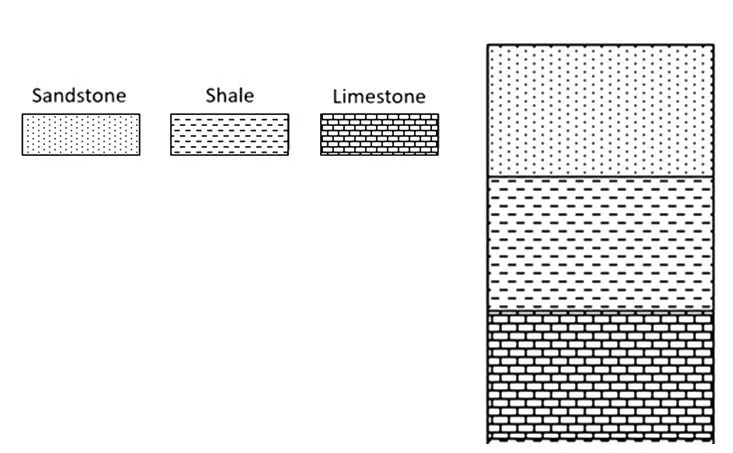
What can we deduce about sea level change from this strata? The texture of the uppermost (youngest) layer indicates deposition in shallow water, whereas the texture of the bottom (oldest) layer shows that it might be the bed of deep water. This rock formation possibly indicates a gradual decline in sea level.
There are places where strata have been distorted. The stratification preserves the history of previous motions of the Earth’s surface. It also allows for the understanding of geologic events and leads to useful outcomes, like the placement of mineral resources, oil reserves, and groundwater reservoirs.
Thus, studying the formation of the sedimentary rock sequence exposes much about the global environmental trends of the past, and can help us better prepare for the future.
References (click to expand)
- LE Edwards. Fossils, Rocks, and Time: Rocks and Layers. The United States Geological Survey
- Linking Time and Space in Geology: The Sedimentary .... Carleton College
- Sedimentary Rocks Lesson #13 - Volcano World. Oregon State University
- PRINCIPLES OF STRATIGRAPHY - eGyanKosh. egyankosh.ac.in
- Geologic Principles: Superposition and Original Horizontality. U.S. National Park Service
- Geologic Principles: Cross-cutting Relationships. U.S. National Park Service
- Geologic Timescale, Geologic Dating Techniques, and Numeric Ages. Grand Canyon National Park, U.S. National Park Service
- Steven Earle. Relative Dating Methods. Physical Geology (Vancouver Island University), Geosciences LibreTexts
- Principle of Superposition and Overturned Rocks. GEOSC 10 Geology of the National Parks, Penn State University
- Stephen A. Nelson. Sedimentary Rocks. EENS 1110 Physical Geology, Tulane University
- Chapter 6: Sedimentary Rocks. Department of Geography, Hunter College CUNY
- Volcanoes: The Nature of Volcanoes. U.S. Geological Survey
- Siccar Point: An Excursion. British Geological Survey Earthwise
- Nicholas Steno (1638-1686). University of California Museum of Paleontology
- Chapter 9: Stratigraphy (Steno's Principles). GEOL 1330, University of Houston