Table of Contents (click to expand)
- How Does An Electric Kettle Boil Water?
- Why Are British Kettles Faster Than American Ones?
- What Is The Difference Between A British And American Kettle?
- Why Won't A US Wall Outlet Just Give A Kettle More Power?
- Can You Boil Water With A Battery Instead?
- How Big A Battery Would A Faster Kettle Actually Need?
- So Why Hasn't Anyone Built A Battery-Boosted Kettle?
- Could A Battery-Boosted Kettle Ever Exist?
- So, Why Doesn't A Battery-Boosted Electric Kettle Exist?
A US kettle on a 120-volt outlet tops out near 1,500 watts and takes about 3.7 minutes to boil a liter of water, while a British kettle on 230 volts runs up to 3,000 watts and does it in under two minutes. You could close that gap with a small battery that stores power between cups and dumps it into the coil during the boil, and that exact trick already ships inside $7,000 battery-buffered stoves. No one sells a battery kettle because the battery would cost more than the kettle, and all it buys you is about 90 seconds.
Picture landing in London, jet-lagged, desperate for tea. You fill the kettle in the flat. You flip the switch. Before you have found the mugs, the thing is roaring, rattling its lid, and clicking itself off. Tea in under two minutes.
Now picture the same craving back home in the United States. You fill an American kettle, flip it, and wait. And wait. It gets there. It just takes its time, like it is thinking the request over.
Every American who has lived abroad notices this. US kettles are slow. There is an obvious fix, too. Strap a battery into the base, let it charge between cups, and have it dump extra power into the coil during the boil. It is a good idea. It is such a good idea that engineers already built it. Just not for kettles. So why not?
How Does An Electric Kettle Boil Water?
Start with the whole appliance, because it is almost nothing. Drop a coil of wire into water. Push electricity through the coil. The wire fights the current, and that fight throws off heat. The coil is called the heating element. Its pushback against the current is called resistance. Heat made this way has a name: Joule heating. That is the entire machine. A wire that does not want to carry electricity, and water sitting on top of it.
Now, how much heat does boiling actually take? A lot, because water is stubborn stuff. The US Geological Survey notes something odd about it. Water soaks up more heat per degree than almost anything you can pour. Warming one gram of it by one degree Celsius costs about 4.2 joules. A joule is a tiny sip of energy. This is the same reason a pot takes forever on the stove and why the sea stays cool into summer. It is also close cousin to latent heat, the extra energy water demands to actually turn to steam.
Put numbers on it. A full mug is roughly a quarter-liter. One liter of water is a kilogram, or a thousand grams. To take that liter from room temperature (about 20 °C) up to boiling (100 °C), you climb 80 degrees. So the energy is 1,000 grams times 4.2 joules times 80 degrees, which lands near 335,000 joules. Call it 335 kilojoules to boil a liter.
Here is the one idea to hold on to. Boiling water is just pouring energy into it. Pour faster, and it boils sooner. The speed you pour energy is measured in watts. Hold on to watts. The rest of the article is watts.

Why Are British Kettles Faster Than American Ones?
Watts are the pour rate, and a British kettle pours faster. A typical American kettle tops out near 1,500 watts. A typical British one runs all the way up to 3,000 watts.
Run those through the 335 kilojoules from the last section. At 1,500 watts, the boil takes 335,000 divided by 1,500, which is about 223 seconds, or 3.7 minutes. At 3,000 watts, it is 335,000 divided by 3,000, about 112 seconds, or 1.9 minutes. Double the watts, halve the wait. That is the whole British advantage on a stopwatch.
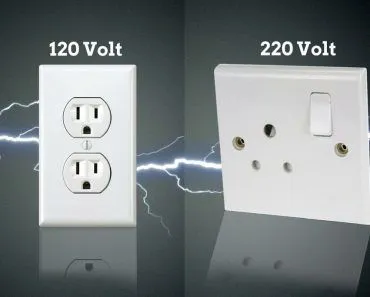
So where do the extra watts come from? The wall. Electrical power is voltage times current. Georgia State's HyperPhysics writes it as P = VI. Here P is power in watts, V is voltage, and I is the current in amps. A US wall socket sits at about 120 volts. A British one sits at about 230 volts. The two countries wired their homes to different standards a century ago. Same current, nearly double the voltage, nearly double the power. That is why the British kettle is a national treasure and the American one is a quiet apology.

What Is The Difference Between A British And American Kettle?
So just drop a British 3,000-watt element into a US kettle and enjoy fast tea? No. And this is the part the buying guides get wrong.
Power does not follow voltage in a straight line. It follows voltage squared. Combine P = VI with Ohm's law, which says voltage is current times resistance, or V = IR. Put them together and the power in a fixed element becomes P = V²/R. That V² just means the voltage multiplied by itself. The element's resistance R is fixed by the wire and does not change. So if you cut the voltage, the power falls off a cliff.
Watch it happen. A British 3,000-watt element on 230 volts has a resistance of about 17.6 ohms. Now plug that same element into a US 120-volt socket. The power becomes 120 times 120, divided by 17.6, which is about 820 watts. Not half of 3,000. Less than a third. Halving the voltage quartered the power, because the voltage got squared.
So a British element on American power is actually weaker than an American kettle. To hit 1,500 watts at 120 volts, US makers wind a different coil with lower resistance, about 9.6 ohms. That is the real difference between the two kettles. Not the plug on the cord, but the wire coiled inside. It is also why a dual-voltage travel kettle has a little switch on the bottom. The switch swaps which coil is doing the work.

Why Won't A US Wall Outlet Just Give A Kettle More Power?
Fine. Wind a beefier coil and pull more watts straight from the 120-volt wall. The wall says no, for two reasons.
The first is the plug. Nearly every US kettle ends in the standard flat wall plug. That plug is rated for 15 amps at 125 volts. Multiply it out and you get a hard ceiling near 1,800 watts. Push past it and the plug and cord start to warm up, which is just what nobody wants under a counter.
The second is a safety margin built into the wiring code. American kitchen counters run on their own 20-amp circuits. The National Electrical Code requires at least two of them. There is also an 80% rule. A plug-in appliance should not pull more than 80% of what its plug is rated for. Draw hard for too long and the wires heat up, a limit EC&M, an electrical trade reference, spells out. Eighty percent of a 15-amp plug lands near 1,440 watts. That is the real reason US kettles bunch up around 1,500 watts and stop climbing. The socket will not hand over British power, and the circuit feeding it was never asked to.

Can You Boil Water With A Battery Instead?
If the wall will not give more, bring your own power. Bring a battery.
Try the simple version first. Yes, you can boil a kettle from a battery. A 12-volt car kettle plugs into the socket by the driver's seat, and it works. It is also feeble. That socket is fused around 10 to 15 amps, so it hands over maybe 120 to 180 watts. That is a tenth of a kitchen kettle. You will wait 30 to 45 minutes for a single cup, which is long enough to regret the whole idea. Low voltage, low power, same physics as before.
Now the clever version. Do not fight the wall at all. Charge a battery slowly between boils, while the kettle is idle. Then comes the boil. For those two minutes, let the battery and the wall push together, so the coil briefly sees European-level power. This is the trickle-charge idea, and it is not science fiction. It already ships. Just inside a stove.
Battery-buffered induction stoves do just this. Impulse Labs sells one that plugs into a normal 120-volt outlet. It keeps a 3-kilowatt-hour battery topped up, then delivers up to 10,000 watts to a single burner. One CalNEXT field study watched a battery-buffered stove at work. It drew just 1,260 watts from the wall. It sent about 6,700 watts to the pot. The battery covered the rest. Why go to the trouble? To skip an electrical panel upgrade that can run past $30,000. And the idea is serious. New York State is funding 10,000 of these battery-backup induction stoves for public housing.

How Big A Battery Would A Faster Kettle Actually Need?
The hard engineering is done, then. So do the kettle version of the math. It is almost embarrassingly small.
You want to lift a 1,500-watt US kettle up to 3,000 watts for the roughly two-minute boil. The wall already supplies its 1,500 watts. The battery only has to add the other 1,500 watts, and only for about 112 seconds. That is 1,500 watts times 112 seconds, which is around 168,000 joules, or about 47 watt-hours. Call it 50 watt-hours, maybe 100 once you allow for losses.
Now compare. The stove's battery holds 3,000 watt-hours. The kettle would need about one-sixtieth of that. A stove hides a battery the size of a small e-bike pack. A kettle would need a battery you could lose in a drawer. Which makes the whole thing stranger. If the battery is tiny and the trick is proven, where is the kettle?

So Why Hasn't Anyone Built A Battery-Boosted Kettle?
Two answers, and both are about the bottom of the kettle, not the physics. Money, and abuse.
Start with money. A $7,000 stove can hide a $300 to $500 battery pack, and nobody blinks. A kettle costs $25. The raw cells for 50 watt-hours cost only a few dollars. BloombergNEF pegged 2025 battery prices at a record-low $108 per kilowatt-hour. But raw cells are not a product. Wrap them in a safe, certified pack with its own charging electronics and you add $10 to $15, easily. Nearly doubling the price of a kettle to save 90 seconds is a hard thing to sell.
Then there is abuse. A stove battery gets cycled a few times per meal. A kettle gets boiled 3 to 6 times a day, every day, so that tiny pack would be drained and refilled far harder and far more often. And think about where it would live: in the base, inches from a rolling boil. Heat is the enemy of lithium cells. Researchers in Scientific Reports describe what heat does to one. It pushes the cell toward runaway. The thin layer keeping its two halves apart can melt. A hot, hard-cycled little battery wears out fast. The one spot in the kitchen where you would need to put it is the worst possible spot for it.

Could A Battery-Boosted Kettle Ever Exist?
Maybe. This corner of engineering moves fast. Battery-buffered cooking went from a bright idea to funded state programs in about three years. Battery prices keep sliding, and small packs keep getting safer. The kettle is the easy case in every way: less power, a smaller battery, a shorter burst.
The thing standing in the way is not the coil or the cells. It is the size of the prize. A stove's battery buys a homeowner out of tearing open a wall and rewiring the panel. That is worth thousands. A kettle's battery buys you a minute and a half while you reach for a mug. That is the entire distance between "worth $7,000" and "not worth $10."
So, Why Doesn't A Battery-Boosted Electric Kettle Exist?
The honest answer is not "impossible." Everything you would need is already on the shelf. Cheap small batteries, the buffering trick, the plain physics of watts and water. Line them up and you could build a US kettle that boils as fast as a British one by the weekend.
It does not exist because the numbers point somewhere else. The same battery that would shave 90 seconds off your tea can instead save a household from a five-figure electrical upgrade, so that is where it went. Engineers did not forget the kettle. They ran the math, and the kettle lost to the stove. This appliance is missing for an unusual reason. It is not gone because it is too hard. It is gone because it is too easy to be worth it, a bit like the heat-pump stove that also refuses to exist.
So the next time you are standing over a slow American kettle, drumming your fingers, take a little comfort. The fix is real, and it is nearly free. It has just been too busy heating dinner to bother with your tea.
References (click to expand)
- Specific Heat Capacity and Water — US Geological Survey
- Electric Power (P = VI, I²R, V²/R) — HyperPhysics, Georgia State University
- Branch Circuits and the NEC (continuous-load 80% rule) — EC&M
- NEC 210.11 Branch Circuits Required (kitchen small-appliance circuits) — UpCodes
- From Gas to Grid: How 120V Induction Stoves Are Cooking Up a New Electrification Tradition — CalNEXT
- $32 Million Commitment to Electrify Cooking Appliances Through the Induction Stove Challenge — NYSERDA
- The Impulse Cooktop (product specifications) — Impulse Labs
- Lithium-ion battery pack prices fall to $108 per kilowatt-hour — BloombergNEF
- Quantitative evaluation of thermal runaway in lithium-ion batteries under critical heating conditions — Scientific Reports (PMC)