Sound waves travel fastest through solids, slower through liquids, and slowest through gases, because tightly packed particles pass the vibration on more quickly. Yet a closed door still muffles noise: every time a sound wave changes medium (air→door→air), the door reflects and absorbs a large fraction of its energy, so very little of the original sound reaches your ear.
You may recall from your high school science classes that of the three states of matter, i.e., solid, liquid and gas, sound waves travel the fastest through solids. The second best is liquid, meaning that sound travels the slowest through gases. What this means is that if you want sound to travel from one place to another, you should try to make it pass through a solid.
However, if that’s the case, why do we close doors to a room when we want to prevent noise from entering it? Since sound travels best through solids (and the worst through air), why do doors, walls and other solid ‘obstructions’ inhibit the detection of sound?

What Is Sound?
A sound is actually a pressure wave created by a vibrating object. In other words, you could say that when something vibrates, it creates sound. Originating from a source, these sound waves travel outwards in all directions at the same rate. As the waves travel, they bounce off and/or are absorbed by objects that lie in their path.
These waves are then picked up by our ears, which send the waves to the brain, where they are processed so we can make some ‘sense’ out of them.
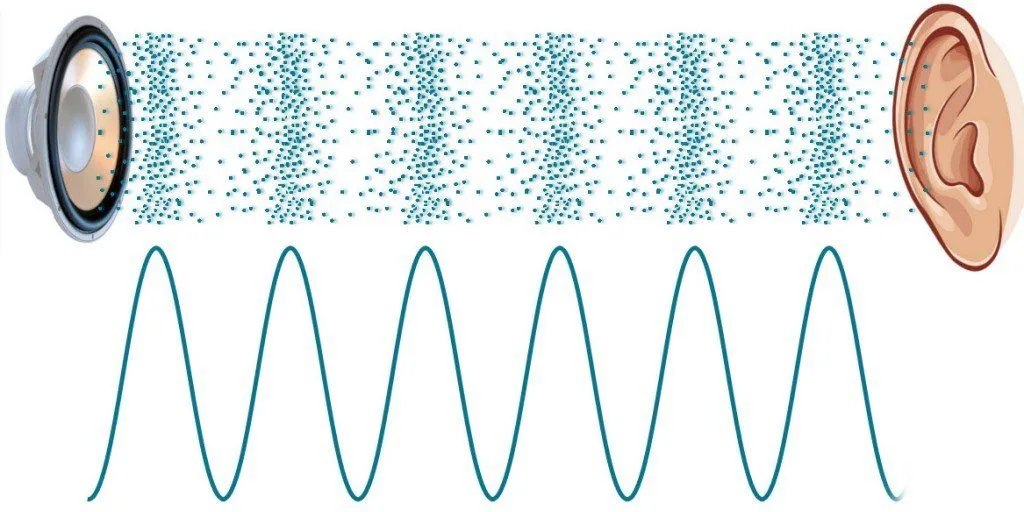
Now, unlike light (which is an electromagnetic wave), sound is a mechanical wave, meaning that it needs a medium in order to travel. It cannot move through a vacuum (whereas light can). That’s the reason why space is silent, because sound cannot travel with an absence of any air.
How Does Sound Travel Through A Medium?
We are constantly surrounded by air, so it’s natural that the sound we hear reaches our ears after traveling through air. For starters, sound travels in dry air at a speed of around 343 m/s (767 mph) at 20°C (68°F), speeding up slightly as the air warms. I should also remind you that sound travels the slowest in air; it travels much faster through solids.
The reason it travels so fast through solids is that sound is actually a local disturbance whose propagation is accomplished through collisions between constituent particles in a medium. In the case of solids, the constituent particles are packed closely together. As a result of this, the vibrations that these particles experience (due to incoming sound waves) are quickly passed on to their neighboring particles, which then pass it on even further.
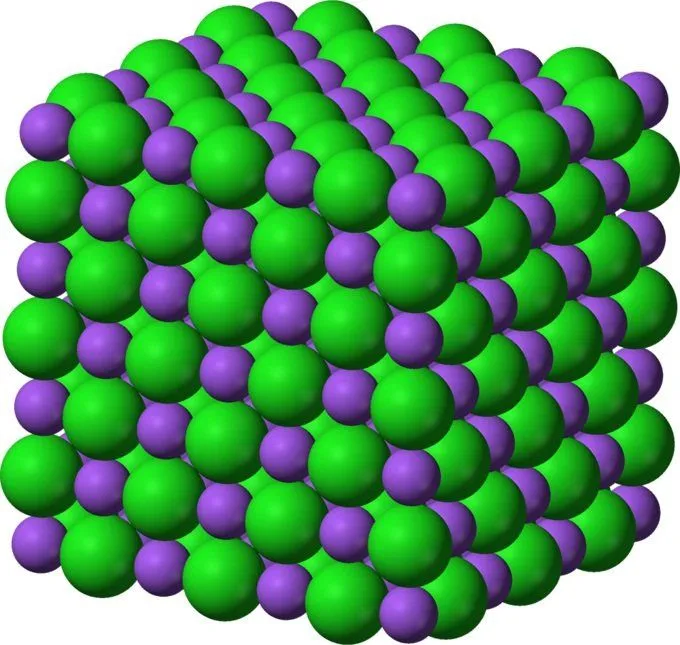
That’s why sound travels so quickly and effectively through solids!
Why Does Sound Travel Faster Through Solids Than Liquids Or Gases?
Here’s the part that trips up most people: solids are denser than liquids, and liquids are denser than gases. If sound were simply a matter of cramming more particles into the same space, you’d expect a denser medium to slow sound down, not speed it up. So why does the ranking come out the other way around, with solids on top?
The answer is that the speed of sound depends on two competing properties of a medium, not one. The first is its stiffness (how strongly it resists being squashed, also called its elastic modulus), and the second is its density (how much mass is packed into it). Physicists tie the two together in a single relationship: the speed of sound roughly equals the square root of the medium’s stiffness divided by its density. In words, sound gets faster as a medium becomes stiffer, and slower as it becomes denser.

So why do solids win despite being the densest of the three? Because their stiffness is enormously higher. The atoms in a solid are locked together by strong bonds, so when one atom is nudged, it springs back almost instantly and shoves its neighbor along. That tug-of-war between stiffness and density isn’t close: a solid’s extra stiffness overwhelms its extra density by a wide margin, so the vibration races ahead. The numbers make it obvious. Sound travels at about 343 m/s (767 mph) through dry air at 20°C, jumps to roughly 1,480 m/s through fresh water, and reaches about 6,000 m/s through steel. That’s steel carrying sound more than 17 times faster than air.
The same stiffness-versus-density tug-of-war explains why warm air carries sound a little faster than cold air. Warming the air makes its molecules jostle more energetically and pass the vibration on sooner, and the speed of sound in air climbs by about 0.6 m/s for every 1°C rise. It’s a small effect next to the gulf between air and steel, but it’s the reason the figure of 343 m/s always comes with a temperature attached.
But if solids are such brilliant carriers of sound, then….
Why Does A Closed Door Block Out Noise?
It’s true that sound travels fastest through solids, but solid objects actually block sound waves from reaching a given space. The reason behind this is very simple: you see, when sound originates from a point, travels through a medium, and then encounters a solid object, it loses some of its energy. In other words, a change in the medium triggers a reduction in the energy being carried by the sound wave. That’s essentially why sounds lose their ‘loudness’ when they run into a different medium.
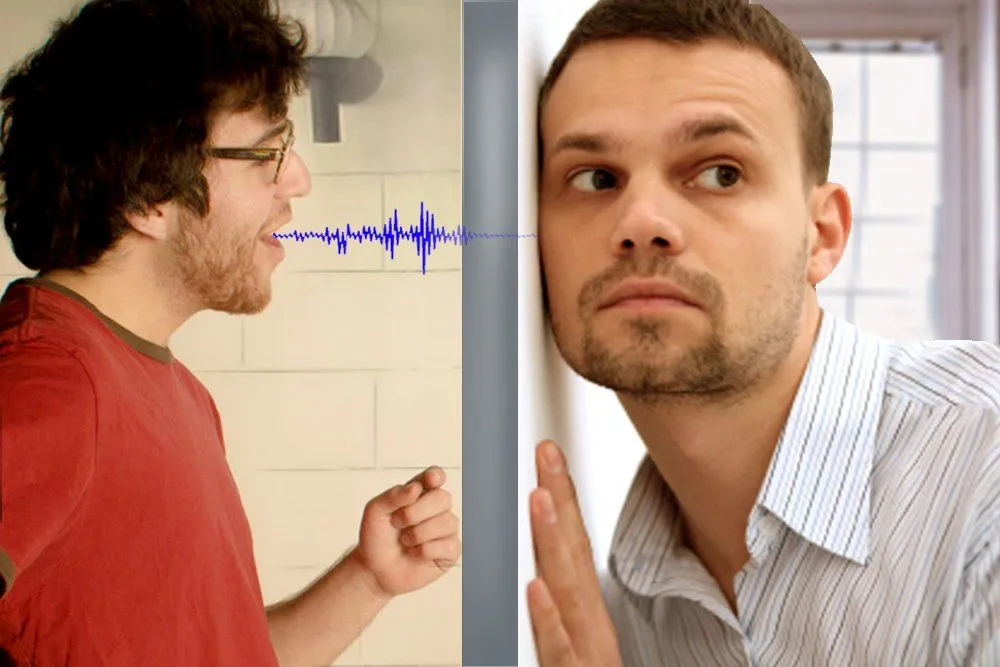
The same thing happens when a closed door or wall reduces outside noise. Noises (sound waves) that originate outside a room (let’s call it the ‘target room’) travel through air before they hit the door. Now, the door absorbs some of the energy of those waves and reflects some of those waves back. Thus, the original sound waves lose a considerable amount of their total energy.
Then, the remaining sound waves travel through the solid door and enter another medium, i.e., the air of the target room, and consequently lose even more energy. The upshot? The noise is either completely blocked out or is too low-intensity to be noticed by anyone within the target room.
That’s why closed doors and walls are so good at blocking outside noise, despite the skill of solid objects to pass sound waves so effectively.