Michael Jordan's hang time of 0.92 seconds let him appear to defy gravity, making his slam dunks legendary.
Michael Jordan is undeniably one of the greatest basketball players of all time, and his name is known even by those who are not interested in basketball.
Although Jordan was outstanding in every aspect of his game, one trait left his competitors in awe: his hang time.
You might be wondering what hang time is, so let me explain.
What Is Jordan’s Hang Time?
Hang time is the length of time that an object or person remains in the air after leaving the ground. In basketball, it refers to a player’s time in the air after jumping to perform a slam dunk, lay-up, or jump shot. The duration of hang time is between the moment your feet leave the ground and when they touch the ground again.
Although Michael Jordan appeared to defy the laws of physics, his impressive hang time was simply because he remained airborne for longer than most people. On average, a person’s hang time is less than 1 second, with an average of approximately 0.53 seconds. A hang time of 1 second requires a vertical leap of about 1.2 meters (4 feet), which only elite athletes can achieve. However, Michael Jordan’s longest recorded hang time is an impressive 0.92 seconds, making him one of the greatest basketball players ever.
The Science Behind Hang Time
Obviously, a person can’t remain airborne for long. Why, you ask?
As with everything in life, Newton’s beloved gravity comes into play. Earth’s gravitational force begins pulling you back down as soon as your feet leave the ground (despite your desire to soar through the air).
Earth pulls you back to the ground with an acceleration of 9.81 m/s2 (the standard value of g, though it varies slightly with altitude and latitude).
To calculate hang time, you need to consider a few values, namely your initial height from the ground (which is 0), the initial velocity of taking the jump, and the value of acceleration coming back down to the ground.
Here is the trick that makes the math simple: a jump is symmetric. The time you spend rising to the top of your jump is exactly equal to the time you spend falling back down. So your total hang time t is just twice the time it takes to fall from your peak height h.
Starting from the free-fall equation h = ½ g (t/2)2 and rearranging to solve for hang time, you get:
t = 2 × √(2h / g)
Let's run the numbers for a 1-second hang time. Setting 1 = 2 × √(2h / 9.81) and solving for h gives a peak height of about 1.23 m (4 ft). That is a serious leap, which is why a full second in the air is the stuff of legend. Working backward from Jordan's recorded 0.92 seconds, his vertical comes out to roughly 1.04 m (41 in), found from h = ½ × 9.81 × 0.462. Notice that hang time grows with the square root of jump height, so doubling your time in the air takes four times the leaping height. That punishing math is exactly why nobody has ever doubled Jordan's number.
How High Could Michael Jordan Jump?
This is the question everyone asks, and the honest answer is messier than the internet suggests. You will constantly see Jordan credited with a 48-inch (1.22 m) vertical leap, but that number was never officially measured. Jordan himself said his jump was never tested, telling Larry King in 1993 that it simply was not important to him. So treat 48 inches as a piece of folklore, not a recorded fact.
What we can do is work backward from something that was timed: his 0.92-second hang time. As we calculated above, a 0.92-second flight corresponds to a peak height of roughly 1.04 m, or about 41 inches. That is the height of his body's center of mass, not the rim he reached, so his fingertips climbed far higher. A 41-inch standing-reach-plus-vertical still comfortably clears a 10-foot (3.05 m) rim with room to slam, which is all a dunk requires.
For context, an elite NBA combine vertical today sits in the 35 to 45 inch (0.89 to 1.14 m) range, and only a handful of players ever crack 45. So a physics-derived 41 inches puts Jordan squarely among the best leapers in league history without needing the inflated 48-inch myth. The takeaway: Jordan's jump was extraordinary, but the legend grew taller than the actual centimeters.
What Was Jordan's Most Famous Dunk?
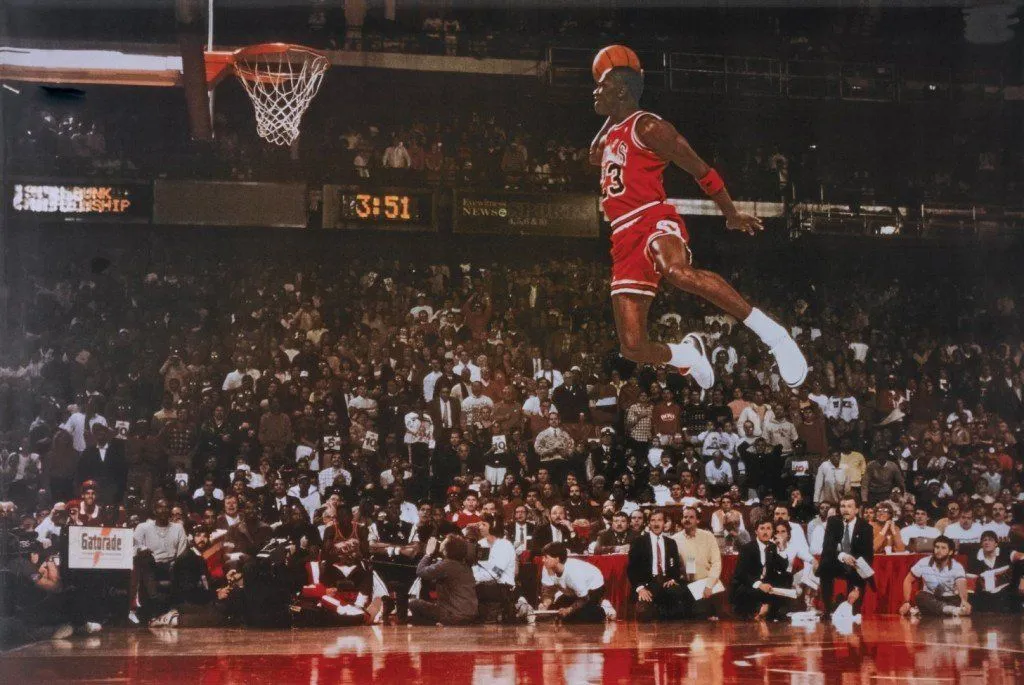
The image above shows it: the free-throw line dunk from the 1988 NBA Slam Dunk Contest, held in front of a home crowd at Chicago Stadium on February 6, 1988. In the final round, Jordan started near the baseline, sprinted the length of the floor, and launched from the free-throw line, which sits 4.57 m (15 ft) from the backboard, gliding the rest of the way to throw it down. The judges handed him a perfect 50, and he edged Dominique Wilkins 147 to 145 to defend his title.
The dunk was not Jordan's invention. Julius "Dr. J" Erving had pulled off the same free-throw-line takeoff to win the very first dunk contest in 1976, and Erving personally encouraged Jordan to try it. What made Jordan's version iconic was the photography: the tongue out, the legs split, the ball cocked back, all frozen at the apex of that flat-parabola peak where, as the physics shows, a jumper lingers longest. That single frame became the template for the Jumpman logo and arguably the most reproduced sports silhouette on Earth.
Worth noting: Jordan actually missed his first attempt at the dunk that night and got a second crack at it, which only adds to the drama. The free-throw line is a punishing launch point because the horizontal distance eats into the height you can reach, so clearing the rim from there takes both elite hang time and pinpoint timing.
Is Hang Time The Same Everywhere?
For practical purposes, yes. Whether you are in New York, London, New Delhi, or Tokyo, your hang time will be essentially the same. Technically, gravity is slightly weaker at higher altitudes (about 9.77 m/s2 atop Mount Everest vs. 9.81 m/s2 at sea level), but the difference is too small to notice in a basketball game. (If you are curious why your weight changes slightly depending on where you are on Earth, that same effect is at play here.)
However, let’s talk about the broader universe, where some truly impressive basketball games could be played.
On different planets, the value of acceleration due to gravity changes, and so does the hang time.
If Jordan tried to dunk a basketball on Venus, he would remain airborne for a little longer than on Earth, as the value of g on Venus (8.87 m/s2) is lower than the g variable on Earth. If he were to do a slam dunk on the moon, he would remain airborne longer than on Earth because the moon’s gravity is almost one-sixth of that on Earth.
If he tried to dunk on Jupiter, what would happen then? Check out the video to find out:
Why Did Jordan Seem To Hang In The Air?
Here is the wonderful secret: a lot of Jordan's "hang time" is an optical illusion, and even Jordan could not slow down gravity. The flight path of your body's center of mass is always a fixed parabola, exactly what the laws of physics demand. You launch, you peak, you fall, and no amount of athleticism changes that arc once your feet leave the floor.
So why does Jordan look like he pauses near the top? Two things. First, projectile motion is lopsided in where the time goes. Because the body slows as it climbs and speeds up as it falls, a jumper spends a disproportionate share of the flight loitering in the upper portion of the arc. More than half of your air time is concentrated near the peak, so the very top of any jump always feels stretched out.
Second is the trick of moving limbs. As biomechanist Duane Knudson of Texas State University explains, the center of mass follows that flat parabola, but the visible parts of the body do not have to. Jordan would tuck his legs up at the top and let them drop on the way down, so his head and torso stayed roughly level while his center of mass quietly rose and fell underneath. Your eye tracks the head, sees it hold steady, and reads it as floating. The apparent extra hang on a running dunk also comes from a high takeoff position and a low, flexed landing, which add visible air time without breaking any physics. In short, Jordan did not beat gravity. He choreographed it.
Last Updated By: Ashish Tiwari
References (click to expand)
- Southworth Planetarium - University of Southern Maine.
- Kaula, W. M. (1975, June). The gravity and shape of the Moon. Eos, Transactions American Geophysical Union. American Geophysical Union (AGU).
- The Moon's Influence on Us.
- Gupta, D. (2015, August 17). Biomechanics of hang-time in volleyball spike jumps and its effect on performance. The University of Texas at Austin.
- Michael Jordan. Encyclopaedia Britannica.
- The physics of a Michael Jordan dunk. Inverse.
- Peterson, A. & Patterson, Z. The math behind Michael Jordan's legendary hang time. TED-Ed.