Usain Bolt is the fastest sprinter in recorded history. The Jamaican is 6’5” (1.95 m) tall, ran the 100 m in 9.58 seconds at the 2009 Berlin World Championships, hit a peak speed of about 12.4 m/s (~44.7 km/h, 27.8 mph), and crossed the line in only 41 strides, four or five fewer than his rivals. Bolt retired from professional athletics in August 2017; his 100 m and 200 m world records still stand.
One of the most decorated athletes of the 21st century, Usain Bolt, needs no introduction. He has completely smashed the world records in the 100m and 200m sprint events. Clocking in at a mere 9.58 seconds in the 100m event at the 2009 World Championship in Berlin, his astonishing speed baffled sports scientists all over the world. He achieved this feat only a year after his famous 9.69-second finish at the 2008 Beijing Olympics.
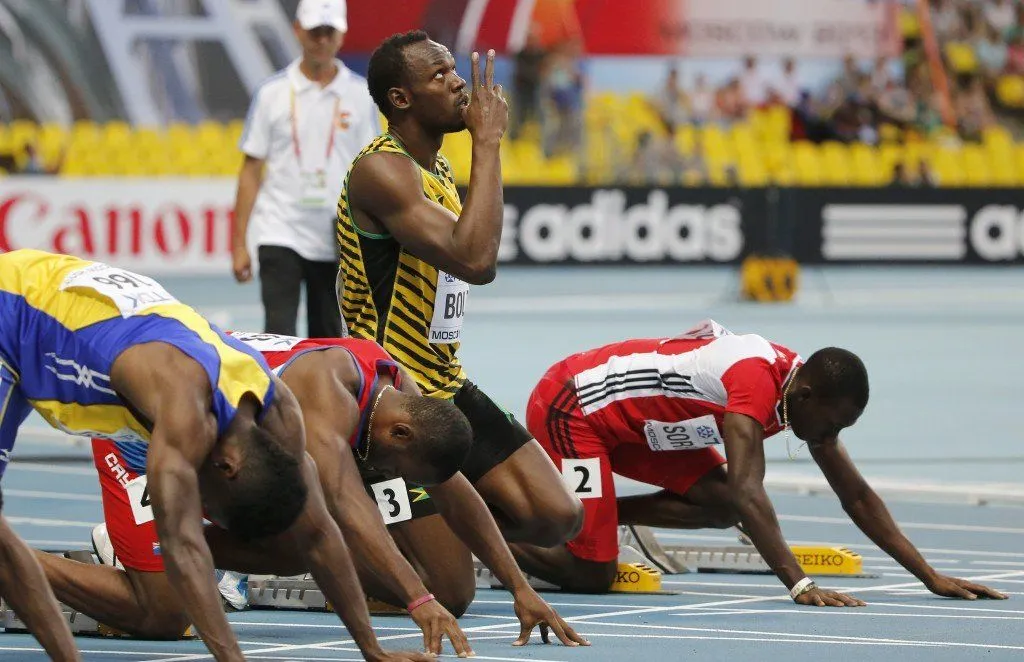
After significant research, scientists were able to analyze the amazing biomechanics that assist Bolt with his incredible speed.
The Science Behind Bolt’s Phenomenal Speed
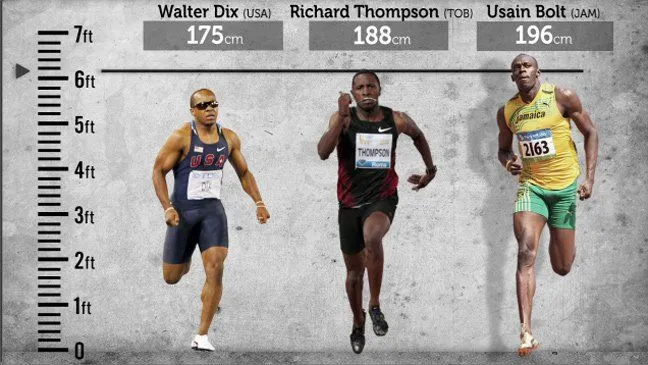
Bolt stands tall at 6 feet 5 inches, which actually makes it harder for him to run so fast, because he has to overcome factors like air density and increased resistance.
During the Berlin Championship, in order to cover the distance in 9.58 seconds, Bolt accelerated to a terminal velocity (the constant speed that a freely falling object eventually reaches when the resistance of the medium through which it is falling prevents further acceleration) of 12.2 metres per second, exerting an average force of 815.8 Newtons. For such an enormous runner, acceleration of that magnitude results in a massive air resistance drag, adding yet another physical hurdle to the already taxing task.
If Aerodynamics Are Working Against Him, How Can He Still Run So Fast?
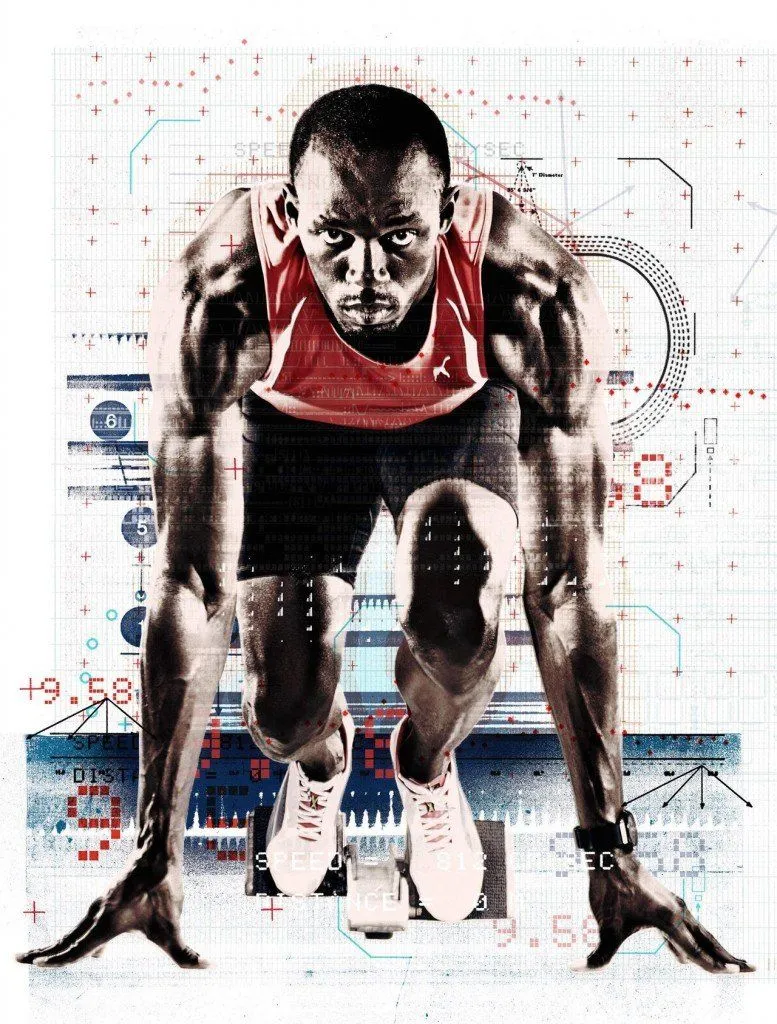
There are multiple reasons for Usain Bolt’s incredible achievements:
1) The fundamental physics behind optimum sprint speed relate to the amount of horizontal force that a sprinter can generate.
A mathematical model used by scientists revealed that Bolt generated 81.58 kilojoules of energy during the sprint, of which only 8% was used to propel his body towards the finish line. The remaining 92% of the generated energy was used to offset the drag of air resistance, i.e. to counter the friction caused by air.
Bolt was able to achieve a maximum output of 2619.5 watts in a single second! To get a fair idea of this, 2619.5 watts is enough to power a dishwasher!
2) Number of steps required to run the distance

It is estimated that an average runner requires about 55 steps to complete 100m, whereas a professional athlete requires only 45 steps.
Owing to the tremendous amount of energy that these athletes generate, it is obvious that their legs spend less time on the ground than the legs of your average runner. An elite sprinter’s foot will typically spend 0.08 seconds in contact with the ground at the beginning of each stride, compared to about 0.12 seconds for an amateur athlete.
Technically, Bolt shouldn’t be able to accelerate to such high speeds, due to the freakishly long legs that he possesses. As soon as he reaches top speed, however, he has an advantage over everyone because of the fewer number of strides he must take! Astonishingly, Bolt can complete a 100m race in about 41 steps, which is three or four fewer than his rivals.
We can safely conclude that Usain Bolt is the closest thing to superhuman that we’ve seen in a long time!
How Fast Was Usain Bolt At His Top Speed?
The 9.58-second figure is an average over the whole 100 m, but Bolt was never running at a single speed. He starts from a standstill, spends the first 40 m or so accelerating, and only then hits his ceiling. So when people ask how fast Usain Bolt actually is, they really mean his peak speed, not his race average.

During the Berlin world-record run, the official 20 m split times released by the IAAF showed that Bolt covered the 60–80 m stretch fastest of all. Over that interval he averaged about 44.7 km/h (27.8 mph), which works out to roughly 12.4 metres per second. A detailed laser-based kinematic analysis of the same race put his single highest instantaneous velocity at about 12.3 m/s, reached a little past the halfway mark of the track.
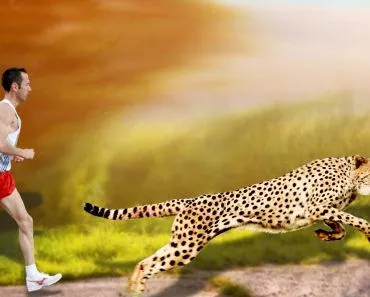
To put that in everyday terms, 44.7 km/h is faster than the speed limit on most residential streets, and Bolt held it on nothing but his own two legs. It is still a long way short of the animal kingdom, though. A cheetah can hit around 98 km/h (61 mph), more than double Bolt at his very best. What makes Bolt remarkable is not that he out-runs nature, but that he sustained his top speed across five consecutive 10 m sections, longer than any rival in that final, which is exactly why he kept pulling away when everyone else was already slowing down.
What Did The 2011 Laser Study Of Bolt Reveal?
A year after Beijing, scientists wanted to watch Bolt at full flight in even finer detail. In September 2011, a research team from the Faculty of Kinesiology and Rehabilitation Science at the Katholieke Universiteit Leuven (K.U. Leuven), a Belgian university, aimed a laser device at Bolt during his 100 m run at the Memorial Van Damme meeting in Brussels on 16 September 2011. It was the first time this kind of laser measurement had been used on a sprinter in actual competition rather than in a lab.

The laser sampled Bolt’s position and speed an astonishing 300 times every second, so the team could plot his velocity almost continuously instead of relying on a handful of timing gates. In that 9.76-second run, they recorded a top speed of 43.99 km/h (about 12.2 m/s), reached after he had already covered 67.13 metres. In other words, Bolt was still accelerating two-thirds of the way down the track, well past the point where most sprinters have already peaked and begun to fade.
The same physics-of-Bolt research also explains where all that effort goes. A model of his 2009 Berlin run by physicists at the National Autonomous University of Mexico found that he generated a peak power output of about 2,619.5 watts, which is roughly 3.5 horsepower, yet only around 8% of the energy he produced actually pushed him forward. The other 92% was spent shoving aside the wall of air in front of him. For a man that tall and that fast, simply beating the air is most of the job.
References (click to expand)
- Krzysztof, M., & Mero, A. (2013, March 1). A Kinematics Analysis Of Three Best 100 M Performances Ever. Journal of Human Kinetics. Termedia Sp. z.o.o.
- Anatomy of a champion: Michael Johnson on Usain Bolt. The modern Olympic Games
- The Biomechanics Of Usain Bolt - Science360 - Video Library - science360.gov
- Laser technology used to analyse Usain Bolt's speed at Van Damme Memorial. ScienceDaily / Katholieke Universiteit Leuven.
- Multicomponent Velocity Measurement for Linear Sprinting: Usain Bolt's 100 m World-Record Analysis. Sensors. NCBI PMC.
- Physics of running fast: Scientists model 'extraordinary' performance of Bolt. ScienceDaily / European Journal of Physics.