The first printed appearance of the plus (+) and minus (−) signs was in Johannes Widmann’s 1489 commercial arithmetic, though they only became operator symbols later. The equals sign (=) was introduced by Welsh mathematician Robert Recorde in 1557. The multiplication sign (×, Saint Andrew’s Cross) was popularised by William Oughtred in Clavis Mathematicae (1631), and the division sign (÷, the obelus) by Johann Rahn in 1659.
Love it or hate it; math is all around us. Everything in the real world requires us to perform some kind of mathematical operation. However, operations aren’t the only daunting thing about math; it’s the symbols too! Math symbols come in all sizes and shapes. Does the ξ symbol not frighten you enough? Here, take a look at ∯.
Mysterious symbols are just the beginning; math uses the Greek and Latin alphabets too. Memorizing which symbol signifies what is a whole different level of headache. Why couldn’t mathematicians just write what the symbol meant and avoided using these weird-looking things?
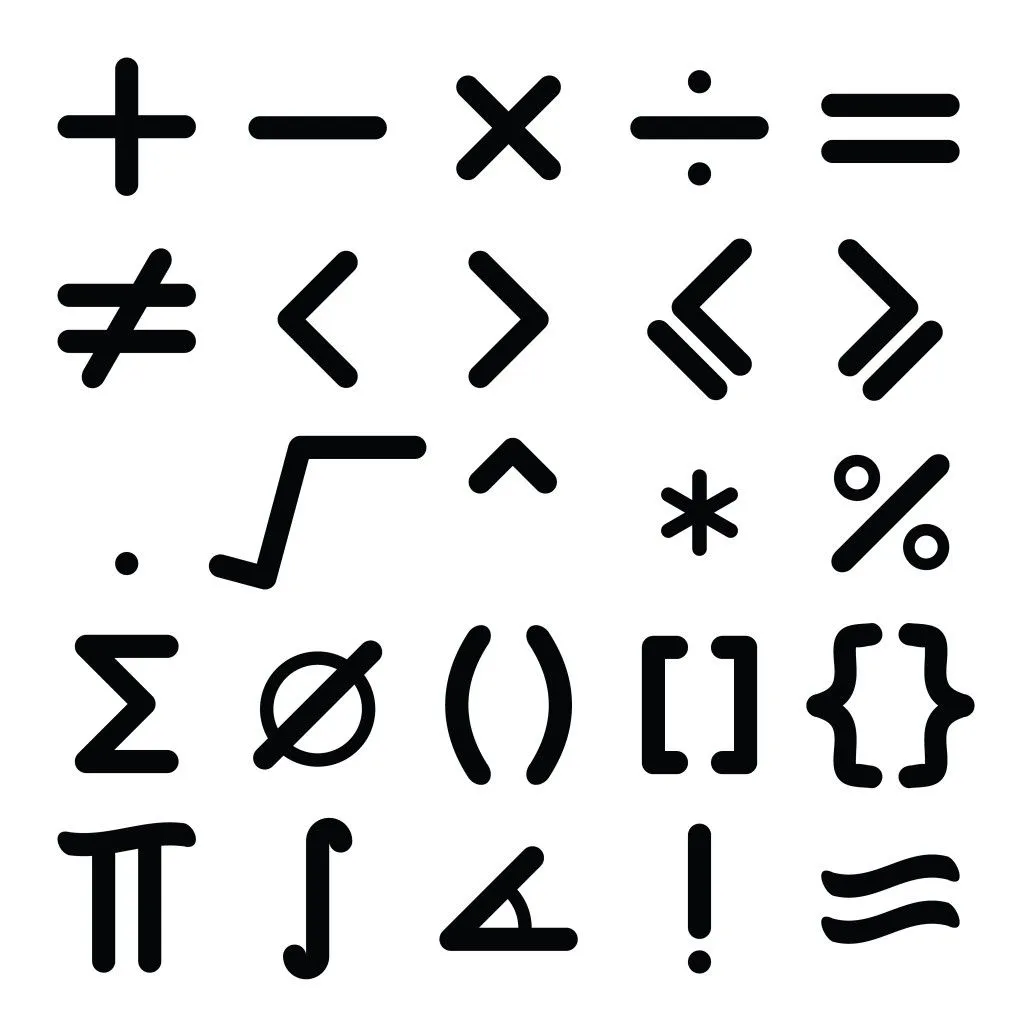
History Of Math Symbols
Mathematicians originally wrote mathematical operations being carried out as proper sentences. So, every time they performed an operation, for example, adding, they would write: Add 2 to number 4. Add 72 to number 120 and so on. If they were to perform a long list of operations, the time they spent writing the operations would take longer than the time spent finding a solution. The symbols were therefore adopted to avoid this kind of redundancy and save time.
Let’s take a look at how symbols for the four basic math operations (addition, subtraction, multiplication and division) came into being, but first, the “equals to” symbol!
Equals To =
Robert Recorde, a Welsh physician and mathematician, invented the “equals to” symbol (=). He introduced the = symbol in his book “The Whetstone of Witte” in 1557.
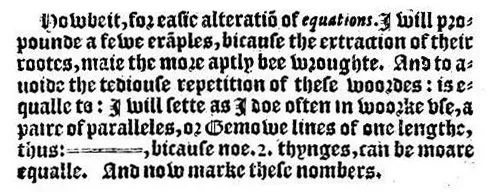
The font and language in the above image might be a bit hard to understand. So here’s a transcription:
“Howbeit, for easie alteration of equations. I will propounde a fewe exanples, bicause the extraction of their rootes, maie the more aptly bee wroughte. And to avoide the tediouse repetition of these woordes : is equalle to : I will sette as I doe often in woorke use, a pair of paralleles, or Gemowe lines of one lengthe, thus: =====, bicause noe .2. thynges, can be moare equalle.”
Recorde was writing the book to teach English students algebra. He soon grew tired of repeating the words “is equal to” over and over again. To avoid the annoyance, he decided to make use of two long parallel horizontal lines of equal length. These lines represented “is equal to”. According to him, no two things could be more equal than the parallel lines. The book is also acknowledged as the first English book to use the plus and minus signs!
Plus And Minus Symbols
The symbols + and – are universally employed for addition and subtraction operations, respectively. The terms plus and minus come from the Latin language, not English. The Latin translation for Plus is “more”, while Minus translates to “less”. But what about the symbols? Where did they come from?
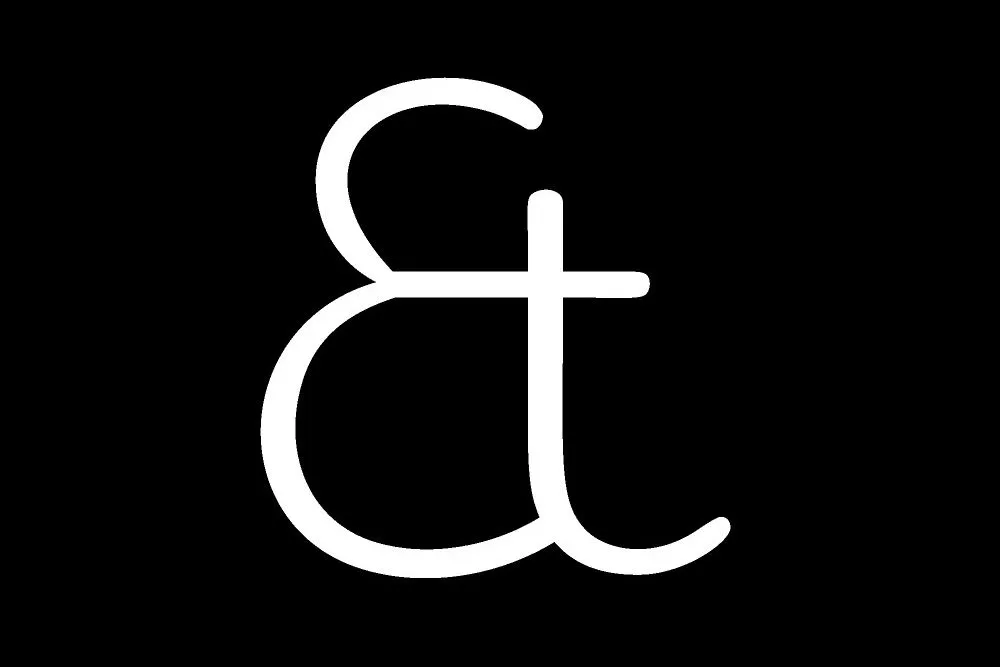
The origins of + and – can be traced back to the 14th and 15th centuries. The + symbol is derived from the Latin word “Et” meaning “And”. A plus-like symbol may appear in a manuscript copy of Nicole Oresme’s Algorismus Proportionum (c. 1356–1361), though historians are not sure whether the French philosopher wrote it himself or a later copyist added it. The earliest secure manuscript appearance of “+” as an abbreviation for et is dated 1417. Either way, the + sign was not the universally accepted notation for addition during the 14th century.
In Europe, Luca Pacioli used the symbols p̄ for plus and m̄ for minus. Egyptians, on the other hand, used a pair of legs walking towards the right to show addition and a pair of legs walking towards the left to indicate subtraction. The origins of the – minus symbol are unclear. Most believe the – symbol may have been derived from the tilde written over m to show subtraction.
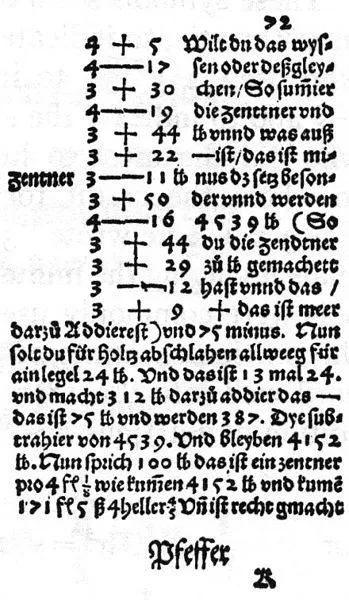
The + and – signs gained popularity after Johannes Widmann used them in print in his 1489 work Behende und hubsche Rechenung auff allen Kauffmanschafft (often translated as Mercantile Arithmetic) — the first known printed appearance of the symbols. Importantly, Widmann used them not as operators, but to mark surplus (+) and deficit (–) in commercial calculations; their reinterpretation as addition and subtraction operators came later. His words read:
“was − ist, das ist minus, und das + ist das mer”.
The term ‘mer’ in Modern German is written as ‘mehr’ and means ‘more’.
Robert Recorde’s book, The Whetstone of Witte, was the first to introduce the plus and minus symbols to the Englishmen. Recorde wrote:
“There be other 2 signes in often use of which the first is made thus + and betokeneth more: the other is thus made – and betokeneth lesse.”
Multiplication
The multiplication symbol (×) is often mistaken as the lowercase of the English letter X… but it isn’t! The symbol is actually called Saint Andrew’s Cross (sometimes referred to as a saltire). The symbol saw its first use in Math in the 16th century. Saint Andrew’s Cross is generally credited to the English mathematician William Oughtred, who used it widely to denote multiplication.
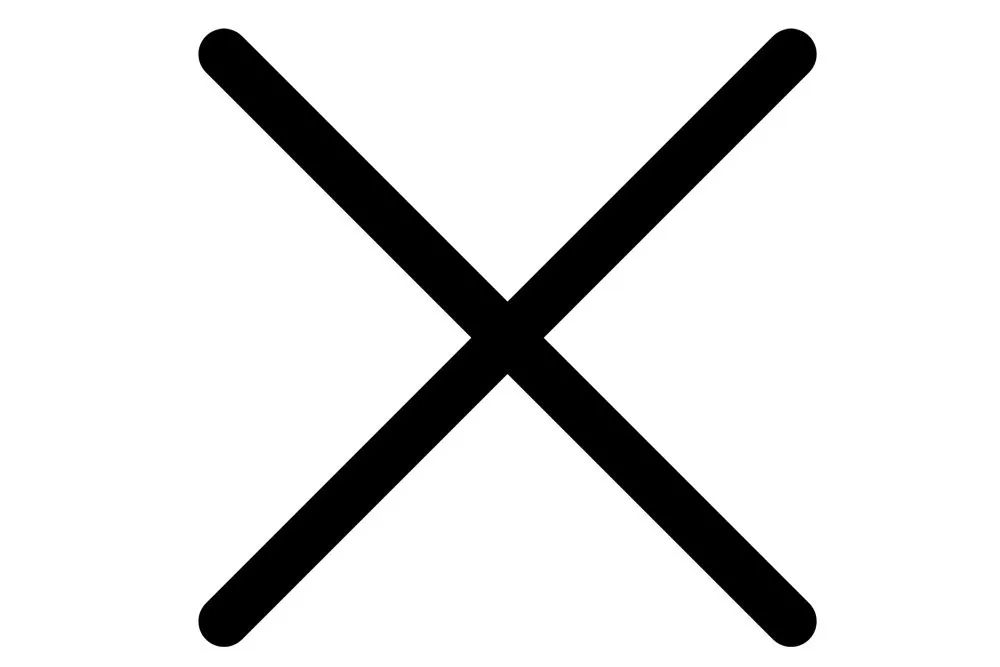
However, an early use of the symbol × for multiplication can be found in the anonymous appendix in Edward Wright’s translation of John Napier’s “A Description of the Admirable Table of Logarithmes” dated 1618. The symbol gained popularity after Oughtred used it in his work titled Clavis Mathematicae in 1631.
However, Gottfried W. Leibniz, the German mathematician, did not like Oughtred’s use of Saint Andrew’s Cross to represent multiplication. In a letter dated 29 July 1698 to Johann Bernoulli (often misattributed to Oughtred, who had died decades earlier), Leibniz wrote:
“I do not like the × symbol as a symbol for multiplication, since it can be mistaken for x; … I often simply relate two quantities with a point and indicate multiplication with RS · PQ.”
This point that Leibniz was referencing to is now popularly known as a dot product and is widely used in certain fields and linguistic cultures.
Division Symbol
Just like the other 3 symbols, the division symbol has had multiple variants over the years, the most popular being the Obelus (÷) and the solidus or fraction bar (/). Yes, they aren’t just called the division signs… they have proper names too!
The word Obelus is an ancient Greek word meaning sharpened stick, and the symbol ÷ supposedly represents a small dagger. The Obelus was first used by Swiss mathematician Johann Rahn in his algebra book titled Teutsche Algebra in 1659. The solidus or the fraction bar (/) for division was popularised by Augustus De Morgan in his 1845 Encyclopaedia Metropolitana article “The Calculus of Functions”.
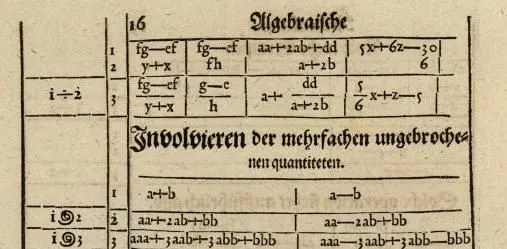
In an attempt to maintain division in the same line, Gottfried Leibniz introduced the colon (:) to represent division and ratios.
Greater-Than And Less-Than Signs
The four operations weren’t the only relationships that needed a shorthand. Mathematicians also wanted a quick way to say that one quantity was bigger or smaller than another. The “greater than” (>) and “less than” (<) signs first appeared in print in Artis Analyticae Praxis, an algebra book credited to the English mathematician Thomas Harriot. Like Recorde’s Whetstone, it was a landmark work, but with a twist: Harriot died in 1621, and the book wasn’t published until 1631, a full ten years after his death. It spelled the symbols out plainly in Latin: “a > b significet a majorem quam b” (a is greater than b) and “a < b significet a minorem quam b” (a is less than b).

Whether Harriot actually drew the signs the way we know them is another matter. The inequality symbols are never found in his surviving handwritten manuscripts, where he used a pair of triangular marks instead. Because the printed Praxis was assembled from his papers by an editor, Walter Warner, after his death, some historians suspect the sleek < and > we use today were the printer’s tidy-up rather than Harriot’s own hand, much as Saint Andrew’s Cross for multiplication was nudged into shape by later mathematicians. Either way, the notation stuck, and today the sign that always opens its wider end toward the bigger number is one of the first symbols schoolchildren meet.
Where Did Other Common Math Symbols Come From?
The plus, minus, times and divide signs get all the attention, but a handful of other everyday symbols have origin stories that are just as odd.
The square root, or radical, sign (√) made its print debut in 1525, in Die Coss, the first German algebra book, written by Christoff Rudolff. It is often said that the symbol is a stylized letter “r”, for the Latin radix (“root”), though the mathematics historian Florian Cajori doubted that neat story. Rudolff’s √ had no bar over the numbers tucked inside it. That horizontal line, called the vinculum, was added by René Descartes in 1637 (in La Géométrie) to give us the shape we still use today.
The infinity symbol (∞), that sideways figure-eight also known as the lemniscate, was introduced by the English mathematician John Wallis in 1655, in De sectionibus conicis. Wallis never explained why he chose it, and one popular guess is that it was a variant of an old Roman numeral for a thousand. If you have ever wondered what sits at the far end of that idea, we have explored the opposite of infinity too.
Then there is π (pi), the ratio of a circle’s circumference to its diameter. The number itself is ancient, but the Greek letter as its shorthand is not. It was first used this way by the Welsh mathematician William Jones in 1706, borrowing the first letter of the Greek word perimetron (“perimeter”). The symbol only truly caught on after the great Leonhard Euler adopted it in the 1730s, which is a big part of why pi is so famous today.

Finally, the percent sign (%). It grew out of the Italian phrase per cento (“for every hundred”). Over roughly three centuries, scribes shrank the written-out per cento into an abbreviation (a “pc” with a little loop), which slowly drifted into the slash-with-two-circles that we scribble across test papers today.
Conclusion
Thus, to avoid repeating themselves and save precious time, mathematicians developed universally recognizable symbols. Most math symbols originally invented during the 14th and 15th centuries are now globally used notations. However, the obelus (÷) is no longer widely recognized as a symbol for division. The ISO now only allows the solidus or fraction bar (/) for division and the colon (:) to indicate ratios. Still, if you are nostalgic for the ÷, hold ‘alt’ on your keyboard and press the numbers 2 4 6 on the number pad. Bet you didn’t know about that life hack, but you do now, along with how the most commonly used math symbols ( + – × ÷ ) came into existence!
References (click to expand)
- Recorde R. (2013). The Whetstone of Witte. CreateSpace Independent Publishing Platform
- Cajori F. (2011). A History of Mathematical Notations (Two Volume in One). Cosimo, Inc.
- ISO 80000-2:2009 - Quantities and units — Part 2. The International Organization for Standardization
- Earliest Uses of Symbols of Relation - MacTutor History of Mathematics, University of St Andrews
- Earliest Uses of Symbols of Operation - MacTutor History of Mathematics, University of St Andrews
- Earliest Uses of Symbols for Constants - MacTutor History of Mathematics, University of St Andrews
- Percent sign - Wikipedia