Table of Contents (click to expand)
A TV dish antenna is concave, specifically a section of a parabola, because that shape has a unique optical property: every wave hitting it parallel to its axis is reflected to the same focal point. The dish is aimed at a geostationary satellite roughly 35,786 km above the equator, and the weak radio waves arriving from that satellite end up concentrated at the dish’s focus, where the small receiving “feed horn” converts them into the strong signal that drives your TV.
You’ve likely read the basics about how concave and convex mirrors work in the field of optics. The idea behind the curved, bowl-like shape of dish antennas is much the same: it facilitates the convergence of incident rays.
However, before we talk about it, let’s do a quick recap of how incident rays converge on a concave surface.
Reflection From A Concave Surface
Take a look at the image below:
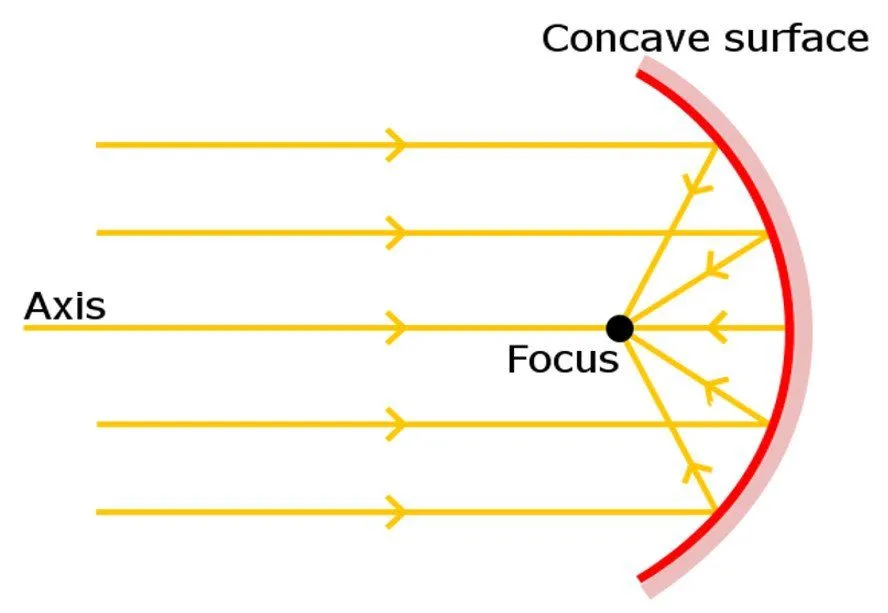
Notice that the incident rays first fall on the surface in a uniform fashion, but due to the curvature of the surface, they are reflected in an unusual way. All of the rays come together to converge at a point that lies on the axis of the surface.
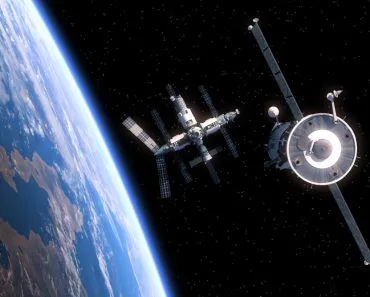
A satellite dish is a particular type of antenna that’s specifically designed to focus the incident rays on a particular broadcast source. It consists of a paraboloid-shaped surface, along with a feedhorn, which is positioned at the focal point of the curvature.
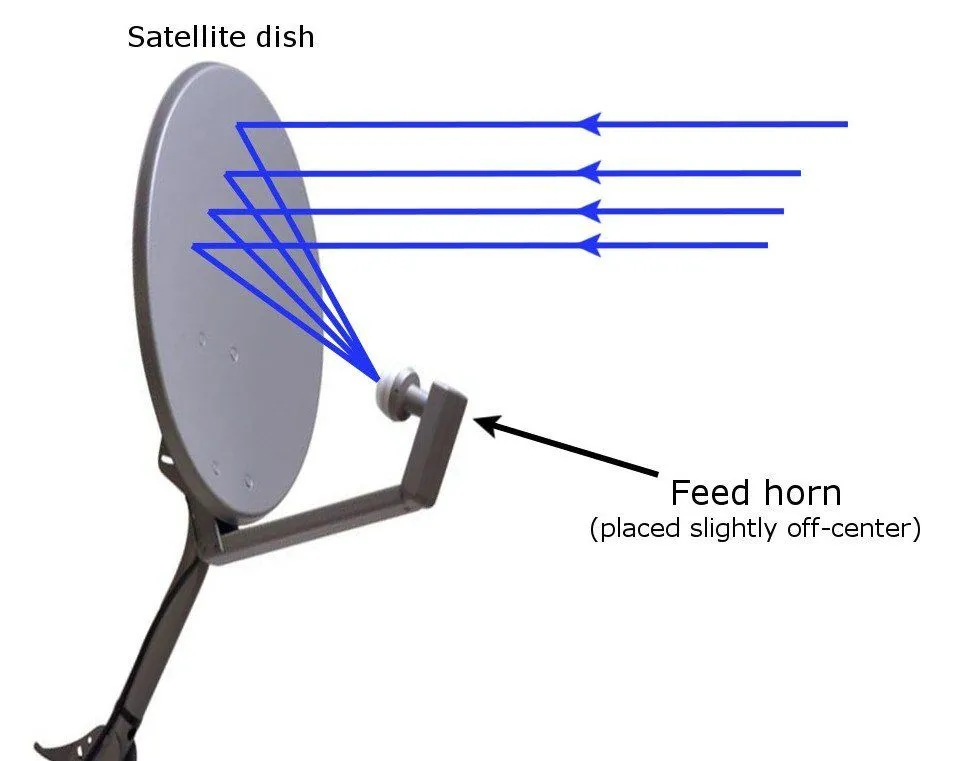
Note that the satellite dishes commonly seen in households are the ‘receivers’, i.e., they are at the receiving end of the signals being transmitted from a satellite, which is quite similar in shape, albeit much larger, and positioned in outer space. The dish placed on the rooftops of households can only receive signals that are transmitted by satellites.
But what about the curvature of the dish?
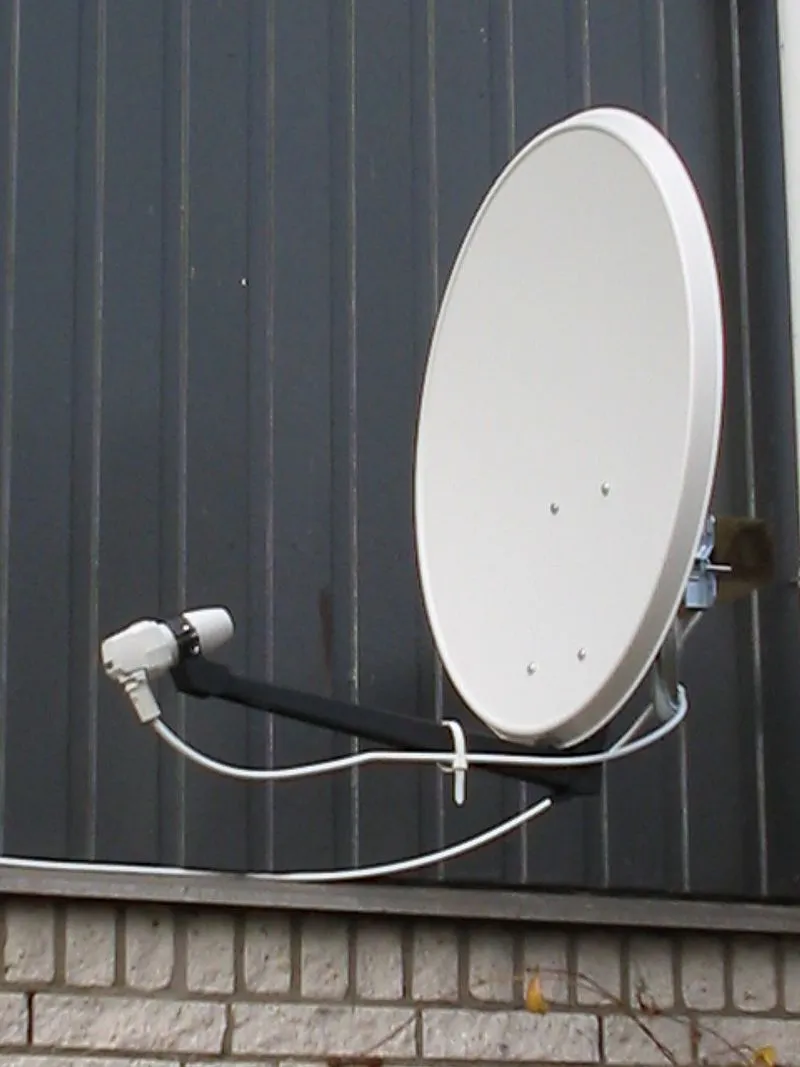
A communication satellite sends a parallel beam (collimated beam) of radio wave signals from outer space down into the atmosphere. Needless to say, these signals have to travel a very long distance to reach the dish antennas installed in your (and everyone else’s) house. When the parallel beam of signals strikes the curved surface, they converge at a single point in front of the dish, i.e., the focal point, and the incoming signal becomes much more consolidated, due to the combined energy of individual radio signals.
It’s interesting to note that the feedhorns of typical TV dish antennas are installed slightly below the middle of the dish, rather than precisely at the focal point of the dish. This is because dish antennas are usually offset antennas, i.e., a parabolic antenna whose feed (feedhorn of the antenna) is not set at the center of the curvature, but slightly off from it, hence the name ‘offset’ antenna.
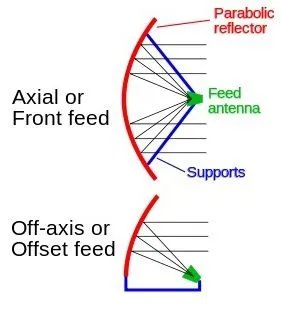
In a regular front-fed dish antenna, the very structure of the feed and its various support equipment hinder the incoming signals that partially obstruct them, decreasing the overall strength of the radio signal. Therefore, to achieve a strong signal on TVs, offset antennas are used.
How Does A TV Dish Antenna Actually Work, Step By Step?
So we know why the dish is curved, but what actually happens between the satellite in the sky and the show on your screen? It’s a tidy little relay race, and the dish is only the first runner.

It begins far above the equator. A broadcaster bundles hundreds of channels together and beams them up to a satellite parked in geostationary orbit, roughly 35,786 km (22,236 mi) above Earth. The satellite’s transponder shifts the signal to a slightly different frequency and sends it back down as a faint, parallel (collimated) beam of microwaves.
By the time that beam reaches your rooftop, it’s incredibly weak, which is exactly why the parabolic dish matters. As we saw above, the curve gathers the parallel waves from a wide area and concentrates them at the focal point. Sitting right there is the feedhorn, a small metal funnel that scoops up the focused waves and channels them into the real workhorse of the system: the LNB, or low-noise block downconverter.
The LNB does two jobs. First, it amplifies the tiny signal while adding as little electrical “noise” of its own as possible. Second, it shifts the whole block of high satellite frequencies down to a much lower band. Home dishes in the US typically receive in the Ku band (around 10.7–12.75 GHz), and the LNB converts that down to an intermediate frequency of roughly 950–2,150 MHz. This step isn’t a luxury, it’s a necessity: microwaves in the 10–12 GHz range bleed away rapidly inside an ordinary coaxial cable, whereas the lower 1 GHz-ish signal travels down that same cheap cable to your living room with far less loss.
From there the coaxial cable feeds a set-top box, the receiver next to your TV. It tunes to the one channel you want out of the hundreds arriving, decrypts and demodulates it, and hands the finished video to the television. So the dish’s job is purely optical, concentrating waves at a point, while every later stage is about amplifying, converting and decoding what that point collects. (For a related ground-based version of this relay, see how satellite internet works.)
What If TV Dish Antennas Are Not Curved?

When your dish antenna is picking up a bunch of radio signals from the sky, you need to make sure that you extract the best ones by making the signals converge at a single point (feed horn) for maximum amplification or ‘signal gain’.
That’s precisely why you can’t have a flat dish antenna, as flat dish antennas are poor when it comes to receiving radio signals and making them converge at a single point. This is not just the case in TV dish antennas; in fact, you’ve probably noticed that all dish antennas, including the large ones that can be seen above radio stations, weather forecast stations etc. are curved for exactly the same reason.
Plain surfaces may be good for reflecting the incoming waves without altering their trajectory, but when you’re looking for convergence, concave surfaces save the day.