Table of Contents (click to expand)
Satellite internet uses satellites in space to bring the internet to users on the ground, even where cables, DSL or fiber cannot reach. A signal travels from the satellite to a small dish, then to a modem and your device. Newer low-orbit networks like Starlink cut the old satellite lag from roughly 600 ms to 20-50 ms.
In the 21st century, the internet is ubiquitous, to the extent that some writers vehemently believe that access to it (the most capacious library of information in human history) must be a birthright. However, optical fibers cannot be slid everywhere; they require additional infrastructure to be drawn from. Rural and remote areas still lack high-quality internet for this very reason. Satellite internet, once dismissed as the slow, expensive last resort, is finally shedding that reputation.
Satellite internet doesn’t require a multistory base station, only a small dish that communicates wirelessly with a satellite overhead. For decades that satellite parked itself high above the equator; today a swarm of satellites zips past, just a few hundred kilometers up. Of course, it’s always easier said than done, so let’s unpack how the signal actually reaches you.
Ka-Band Signals
The days when the internet was merely used to exchange emails are long behind us. Only two decades ago, the ports were scarce and the ships carrying the goods between them were limited. Today, the ports are in the billions and the ships are unlimited. The internet is the busiest network on the planet. To describe the commodities being traded as copious is a massive understatement. As of 2025, the world pushes well over 400 exabytes of data across the internet every single month. For perspective, just 1 exabyte (EB) equals roughly a billion gigabytes (GB).

What opened the floodgates was the introduction of more applications. The internet is no longer just an instant post office; it also houses entire shopping malls, markets, social meets, blind dating venues, and bookstores. However, the most recent additions are the most taxing: high-definition video calls, streaming high-definition movies and live sports matches. Netflix and Amazon Prime are tenaciously competing for our precious and scant attention by providing us with increasingly better shows and services. However, our patience has also severely plummeted; a five-second delay is enough to force us to pick a side. A five-second delay can cost these companies thousands of dollars, if not more.
Bear in mind that the bandwidth is limited, but in the last decade, the number of internet services occupying it have skyrocketed: mobile, broadcasting, space research, telecommunications, Global Positioning Systems (GPS), meteorology, environmental monitoring…. the list is endless. Therefore, to satisfy our ever-increasing demands for speed and availability, we devised another channel, exclusively dedicated to video calls and streaming high-definition videos. This channel of frequencies is known as the Ka-Band and it is on what satellite internet’s trades occur.

Implementation
To implement the technology, we require only three things: a satellite, a transceiver or an antenna installed by the subscriber to communicate with the satellite, and a modem that will connect the subscriber to the internet.
The traditional approach: geostationary satellites
For most of the technology's history, the satellite was geostationary, meaning that it parks over a single patch of Earth. It pulls this off by orbiting in step with the planet's rotation. A geostationary orbit can only be achieved at an altitude very close to 35,786 km (22,236 mi) directly above the equator, and to hold that slot, the satellite must coast at roughly 3.1 km/s (about 6,900 mph). The satellite communicates in the Ka-band of radio frequencies, which spans roughly 18-30 GHz (downlink near 18-20 GHz, uplink near 28-30 GHz). Remember that the satellite is dedicated to broadband applications.
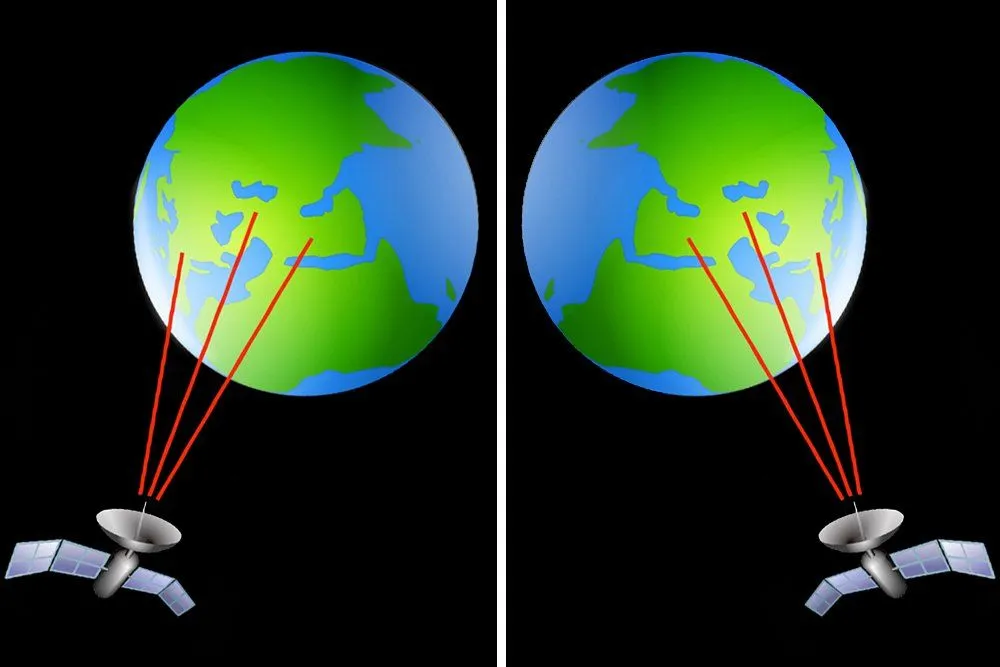
On the ground, the subscribers either install an antenna dish that communicates with the satellite directly or the satellite communicates with what are called gateways. These are small base or ground stations, the Internet Service Providers (ISPs), that receive and relay the radio signals wirelessly to the subscribers in their vicinity, very much like a sprinkler. The subscriber’s antenna feeds the signals to a modem, which demodulates them into Internet Protocol (IP) packets, thereby connecting him or her to the local network, to the internet.
The modern approach: low-orbit constellations
Parking a satellite 35,786 km up has one stubborn drawback: distance. A signal that has to climb to a geostationary satellite and back, then do it again for the reply, racks up a round trip of roughly 600 milliseconds. That is fine for streaming a movie, but painful for a video call or an online game, where every click feels laggy.
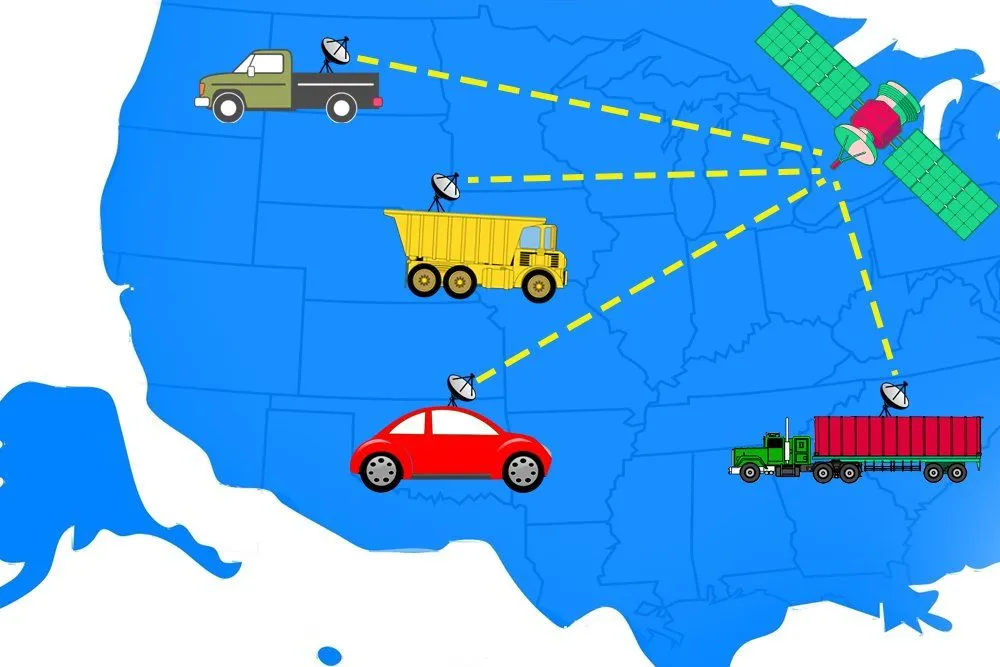
The fix was to fly closer. Instead of one satellite far away, companies now launch thousands of small satellites into low Earth orbit (LEO), just 300-600 km (about 190-370 mi) overhead. Starlink, run by SpaceX, is the giant here: it crossed 10 million subscribers in early 2026 and flies more than 8,000 working satellites, with your dish handing off from one passing satellite to the next as they streak across the sky. Because the trip is so much shorter, latency drops to roughly 20-50 milliseconds, close to what cable or fiber feels like.
It is no longer a one-horse race. Amazon began launching its own constellation (rebranded from Project Kuiper to Amazon Leo in late 2025) and is racing to deploy more than 3,200 satellites, while the OneWeb network already serves businesses and governments. SpaceX has even started beaming a signal straight to ordinary phones: its Direct to Cell service, launched with T-Mobile in 2025, lets a standard handset send texts (and increasingly data) from places with no cell tower for hundreds of kilometers.
The Pros And Cons
Now, because satellite internet is a line-of-sight technology, it does not have to worry about obstructions like mountains and buildings (though it does need a clear view of the sky). With a single geostationary satellite, only a fixed patch of the Earth could be serviced by its narrow beams, and moving away from that patch impaired coverage. Flooding low orbit with thousands of satellites solves exactly this: with the sky blanketed, there is almost always a satellite overhead, and wireless internet becomes available virtually everywhere.
For years, satellite internet was both expensive and slow, which is why it leaned heavily on businesses and governments that could foot the bill. Japan’s WINDS satellite (nicknamed Kizuna), launched on February 23, 2008, beamed broadband to Japan and the Asia-Pacific region and offered connection speeds up to 1.2 Gbit/s, but mainly to organizations that could install antennas with multi-meter apertures; it was retired in 2019. For the same reason, in-flight Wi-Fi, which also rides on satellite links, was once a costly perk on a handful of airlines. The LEO era has flipped that: a Starlink dish on a suburban roof or an RV now costs about the same per month as a mid-tier cable plan.
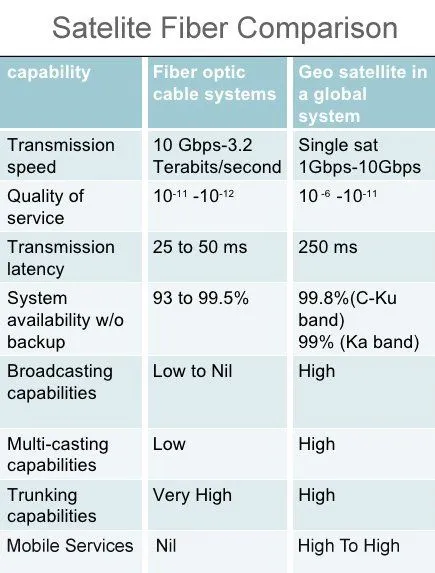
Wires are not done yet, partly because satellite internet can still be impaired by heavy rain and storms, an effect called rain fade. The signal also has to travel a long way: with geostationary satellites it crosses tens of thousands of kilometers… twice, so there is a noticeable delay between your mouse click and the website answering. Dropping to low orbit shrinks that distance dramatically, which is the whole reason LEO latency feels so much snappier than the old satellite experience.
Engineers spent years touting satellite internet as the “wave of the future,” and the low-orbit constellations have finally made good on much of that promise: millions of homes that fiber never reached are now online, often at speeds that rival a DSL or cable connection. Whether these mega-constellations can stay reliable and affordable as they balloon, and how they share the increasingly crowded sky, is the next chapter. Only time will tell!