Table of Contents (click to expand)
A syllogism is a form of deductive reasoning in which a conclusion is drawn from two premises that are assumed to be true. The classic example is: all men are mortal; Socrates is a man; therefore, Socrates is mortal. There are 256 possible forms, of which 24 are considered valid under traditional Aristotelian logic.
We have an innate penchant to argue about things. Anyone reading this knows how amazing it can be to verbally wrestle with your friends about why your favorite football club is the best of all time, or perhaps you get into the classic argument of how Marvel’s cinematic universe kicks DC out of the park every time.
As entertaining as arguing can be, having proper arguments to support your beliefs not only helps you defend them, but also helps you form well-rounded opinions. Having the ability to reason by logic is a method that philosophers have used for centuries to determine the true nature of things, to separate idiosyncratic beliefs from true reality.
Logic and deductive reasoning are the pillars of every verifiable fact that we know about this world, helping us navigate through a sea of false claims and beliefs, especially in today’s world, which is so overloaded with information.
Syllogisms are one way to test existing claims and also arrive at new ones.
Logical Arguments And Deductive Reasoning
It’s important to determine the degree of truth in a statement and see if it holds any value or if the conclusion it comes to is valid. To do this, we form a series of statements that convey our ‘premises’, which are the known facts or assumptions we make in order to reach a conclusion. This series of statements is called an argument and a logical argument is one in which the conclusion holds true, given the premises.
For example:
All men are mortal (1st premise)
Socrates was a man (2nd premise)
Thus, Socrates was mortal (Conclusion)
Here we have used ‘deductive reasoning’, or top-down logic, to reach a valid conclusion by comparing two true premises. This can be done in many ways through various types of logical arguments; syllogisms are one of these arguments, one that uses deductive reasoning to reach a conclusion based on two or more premises that are assumed to be true.
Syllogism And Its Structure
A syllogism is a deductive tool that can be traced all the way back to Aristotle. It has been used by many notable philosophers and was also completely accepted by George Boole, who is famous for introducing Boolean algebra and is also credited for laying the foundation of the information age.
The basic structure of syllogisms is a three-step process to reach a conclusion using two true premises. These three steps are:
Major Premise
Each part of the argument is a categorical proposition, meaning that it agrees or denies that the instance of one category (the subject or the middle) is part of another category (the predicate). A major premise then becomes the first assertion or claim that you put forward on which to base your argument, which is assumed to be true.
For example:
All cats are mammals: Cats – middle (M) and Mammals – predicate (P)
Minor Premise
This is the second assertion that is assumed to be true. It also follows the pattern of a categorical proposition.
For example:
All tabbies are cats; Tabbies – subject (S), and Cats – middle (M)
Conclusion
By assuming the two premises are true and comparing the two, we can come to a logical conclusion. This conclusion holds true because both of our premises hold true; it would become invalid as soon as any one of the premises is proven to be false.
For example:
Major premise – All cats are mammals
Minor premise – All tabbies are cats
Conclusion – All tabbies (S) are mammals (P)
Notice that this works because the middle term (cats) is fully accounted for in at least one premise, which is what links the subject to the predicate. A common pitfall is trying to draw a conclusion from two “some” statements, such as “Some cats are orange” and “Some mammals are cats.” You might be tempted to conclude that “Some mammals are orange,” but the argument is actually invalid: nothing forces the orange cats and the mammal cats to be the same cats. This is known as the fallacy of the undistributed middle.
Various Types Of Syllogisms
As we have seen above, a syllogism takes a form as:
M – Middle, S-Subject, P-Predicate
All M are P – becomes the structure of a Major Premise
All S are M – becomes the structure of a Minor Premise
All S are P – becomes the structure of a Conclusion
By using these variables, there are an infinite number of syllogisms, but there are 256 distinct logical forms (64 moods across 4 figures), of which 24 are considered valid under traditional Aristotelian logic. Under the stricter modern (Boolean) interpretation, which makes no assumption that the categories actually have members, only 15 of those remain unconditionally valid.
Furthermore, the premises and conclusions are of one of the following 4 types:
| Quantifier | Subject(S) | Copula | Predicate(P) | Code | Type | Example |
| All | S | are | P | SaP | universal affirmative | All cats are mammals |
| No | S | are | P | SeP | universal negative | No cats are amphibians |
| Some | S | are | P | SiP | particular affirmative | Some cats are orange |
| Some | S | are not | P | SoP | particular negative | Some cats are not feral |
These 4 types can be used as either the premise or conclusion within a syllogism. Their permutation and combinations can be infinite, but we will look at 5 common examples:
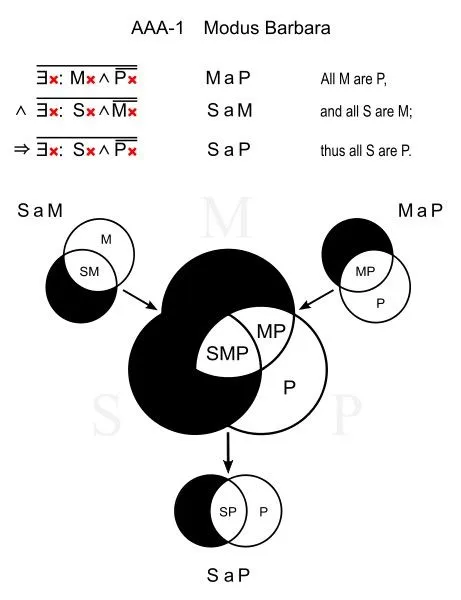
Barbara (AAA-1)
This type uses universal affirmatives in all the premises and the conclusion. For example:
All animals are mortal (MaP)
All dogs are animals (SaM)
All dogs are mortal (SaP)
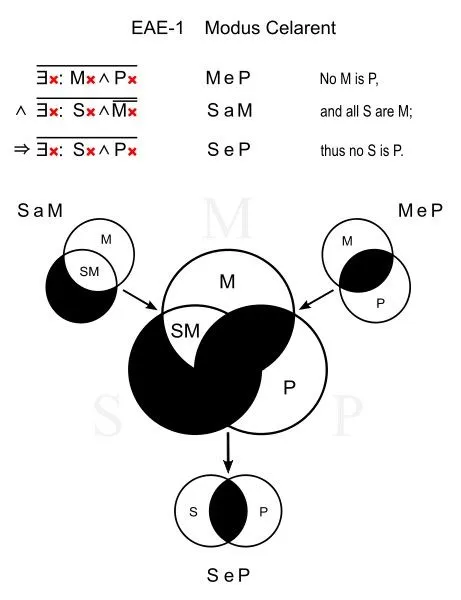
Celarent (EAE – 1)
This type uses a universal negative in the 1st premise, a universal affirmative in the 2nd premise, and a universal negative in the conclusion. For example:
No human has been to Mars (MeP)
All astronauts are human (SaM)
No astronaut has been to Mars (SeP)
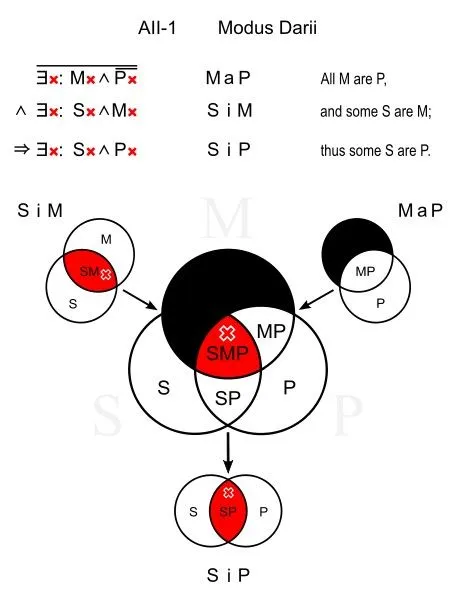
Darii (AII-1)
This type uses the universal affirmative in the 1st premise and the particular affirmative in the 2nd premise and the conclusion. For example:
All dogs have tails. (MaP)
Some pets are dogs. (SiM)
Some pets have tails. (SiP)
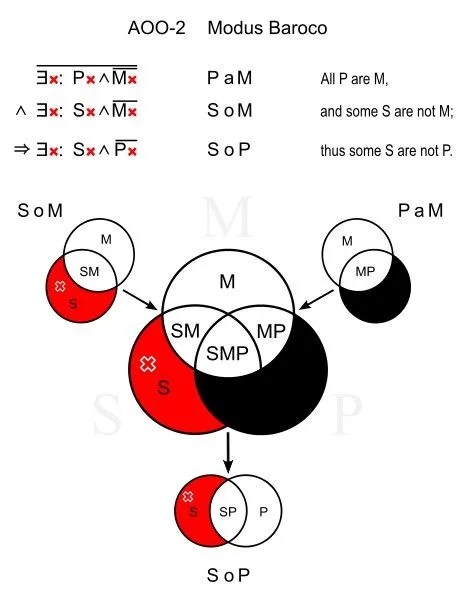
Baroco (AOO-2)
This type uses a universal affirmative in the 1st premise and a particular negative in the 2nd premise and the conclusion. For example:
All pets are domesticated. (PaM)
Some cats are not domesticated. (SoM)
Some cats are not pets. (SoP)
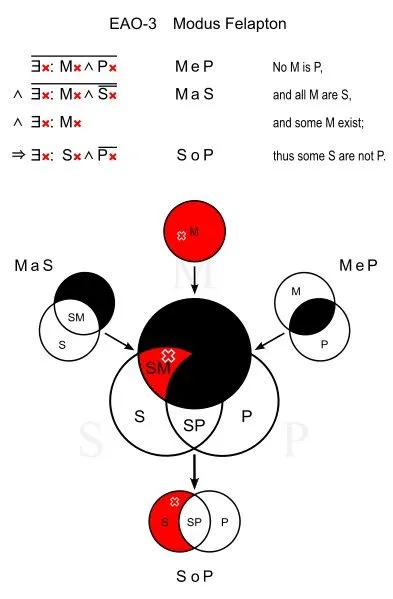
Felapton (EAO-3)
This type uses the universal negative in the 1st premise, universal affirmative in the 2nd premise and particular negative in the conclusion. For example:
No mammals are insects. (MeP)
All whales are mammals. (MaS)
Some whales are not insects. (SoP)
Conclusion
Syllogisms are an important concept to make any argument better or break down an existing claim to see if it holds true. The verification for this is done through checking the validity of the premises, meaning that you check whether they are true or fabricated, whether the sources of the premises are legit and whether the conclusion is drawn from the true premises.
You don’t need to remember all the various combinations of syllogisms; understanding the basic structure will do the trick when it comes to forming your own unique logical argument. Basically, don’t take any information that comes your way at face value. Break down the premises, conclusions and keep yourself logically informed!
References (click to expand)
- Aristotle's Logic - Stanford Encyclopedia of Philosophy.
- Syllogism - Encyclopaedia Britannica.
- http://web.archive.org/web/20181123163931/http://www.cs.utexas.edu:80/~cannata/cs345/New%20Class%20Notes/Syllogisms.pdf
- Teaching Note: Constructing a Logical Argument.
- http://web.archive.org/web/20211127104450/https://web.cn.edu/kwheeler/logic_syllogism.html