Table of Contents (click to expand)
Damascus steel is a patterned blade steel, recognizable by its rippling, watered-silk markings. Historically it was forged from wootz, a high-carbon crucible steel ingot made in southern India and Sri Lanka. The name comes from Damascus, in Syria, where the blades were traded or forged. The swirling pattern is caused by trace impurities, chiefly vanadium, that band iron carbide through the metal.
With a name that sounds like it came straight from Game of Thrones, Damascus Steel does have an air of legend surrounding it. For nearly two millennia, the name has been synonymous with high quality and impeccable integrity, some people even suggesting that a finely crafted Damascus Steel sword could split a human hair!
Before you begin an epic quest to secure some of this Valyrian….err, Damascus steel for yourself, it makes sense to understand where this steel comes from, and what has made it so highly sought after and respected for so many years.
What Is Damascus Steel?
This variety of steel is forged from a specific type of ingot, commonly known as Wootz steel, which comes from South Asia, primarily southern India and Sri Lanka. The name of the steel, however, is a reference to the city of Damascus, the capital of Syria, where the swords were either sold or directly forged at some point in the past.
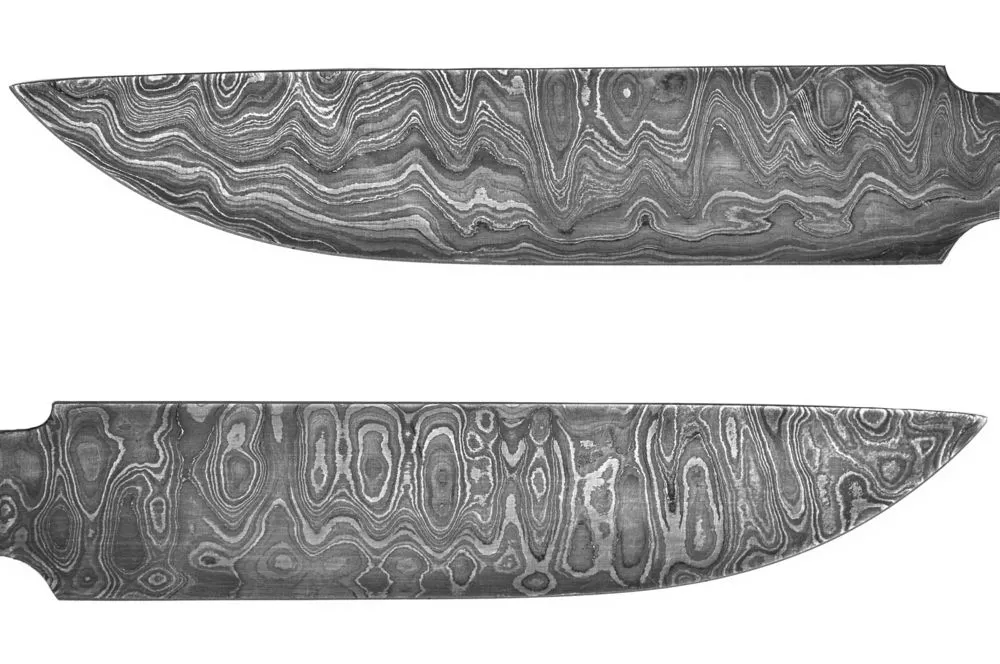
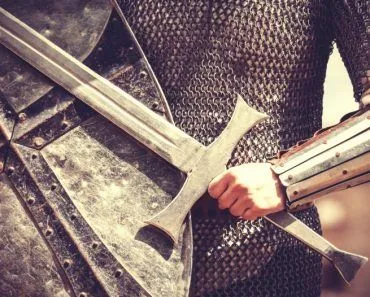
What makes this type of steel stand out, particularly when forged into larger items (e.g., swords) is that the appearance of the metal is entrancingly unique, resembling ripples or waves across water. The patterns found on the steel are swirling and textured, yet the metal is extremely strong and difficult to shatter. Perhaps even more importantly, the forging of such metal was known to be quite simple, as the material was quite plastic and malleable when in a superheated form.
While many relics made of Damascus steel have been found, the original craft of forging these blades died out, and for a long time the technique was considered lost. For roughly 1,500 years, a flow of ingots from South Asia to the Middle East and Europe allowed this remarkable material to spread through the world, but the production of true wootz Damascus blades faded away by around 1750. The metallurgy is no longer a genuine mystery, though. In a series of studies in the 1990s, metallurgists John Verhoeven and Alfred Pendray reverse-engineered the process and reproduced authentic watered-silk patterns in the lab, matching museum specimens in both appearance and microstructure.
Today, there are some manufacturers who claim to forge and sell items made of Damascus steel, but most of it is not the same material the old smiths used. Modern "Damascus" is usually pattern-welded steel: bars of two or more alloys forge-welded together, then folded and twisted to create a visible, layered pattern. That is a different thing from true wootz Damascus, whose pattern grows from within a single cast ingot rather than being stacked up by hand. As for why the original died out, the wootz ingots themselves were variable, since the natural impurities in the ore differed from batch to batch. Crucially, the South Indian ores that produced the best blades carried tiny amounts of carbide-forming elements like vanadium, and once those particular ore sources were exhausted (and the smiths who knew the recipe had passed on), the flow of ingots that could make genuine Damascus steel dried up.
What Makes Damascus Steel So Special?
The unique origins and journey of Damascus steel make it historically relevant, but it also had a number of qualities that made it unusually sought after throughout history. The wootz ingots were a hypereutectoid, ultrahigh-carbon steel, carrying roughly 1 to 2% carbon (about 1.5% in a typical button), far more than the steels most other smiths of the day were working with. That high carbon content was achieved by sealing iron in a clay crucible with carbon-rich material such as wood, leaves and other plant matter, then heating it until the metal absorbed carbon from its surroundings.
So where does the famous watered-silk pattern come from? This is where the science gets genuinely interesting. Work led by metallurgists John Verhoeven and Alfred Pendray showed that the swirling figure is a banding of iron carbide (cementite, Fe3C) particles arranged in sheets through the steel. The bands only form when the ore carries vanishingly small amounts of certain carbide-forming impurities, vanadium above all, at levels as low as around 40 parts per million by weight (roughly 0.004%). During the repeated heat-and-hammer cycles of forging, these trace elements coax the carbide particles to cluster into the alternating light and dark bands you can see with the naked eye. Take the vanadium away and the pattern simply does not appear, which is why reproducing real Damascus steel proved so difficult for so long.
You may also have read that Damascus blades owe their qualities to carbon nanotubes. A 2006 study in Nature reported finding carbon nanotubes and cementite nanowires in a sample of seventeenth-century Damascus sabre, and the claim made headlines. It is worth treating with caution, though: other researchers, including Verhoeven, have questioned whether the structures were genuinely nanotubes rather than misidentified cementite, and even if they are present, there is no firm evidence that they account for the blade’s performance. The carbide banding, on the other hand, is well established.
As opposed to other forms of metal in use at the time, Damascus steel also showed a degree of superplasticity at forging temperatures; this means the material could be worked and shaped without cracking, and a finished blade could flex without snapping. It was reputed that the edge of such blades could also be refined to an unusually sharp and durable point. In an age before sophisticated armor, this combination of a hard, keen edge with a tough, forgiving body made this type of steel extremely valuable.
How Does Damascus Steel Measure Up Today?
While this specialized type of steel was a huge advantage hundreds of years ago, modern advances in steel and other high-strength alloys have largely diminished its practical appeal. To see why, it helps to look at hardness. The Rockwell C scale (HRC) is one common way to measure how hard a metal is and how well its edge resists wear. Measurements of genuine old Damascus blades put many of them in the rough range of Rockwell C 20 to 40, depending on the ingot and how it was heat-treated. That sounds modest today, but it is the right way to read it: in an era when many European blades were hardened to only around 40 HRC, a tough, keen-edged Damascus blade was a real step up. Modern cutlery has since left that behind. Even an ordinary kitchen knife now runs in the mid-50s HRC, and good knife steels routinely reach the high 50s and 60s.
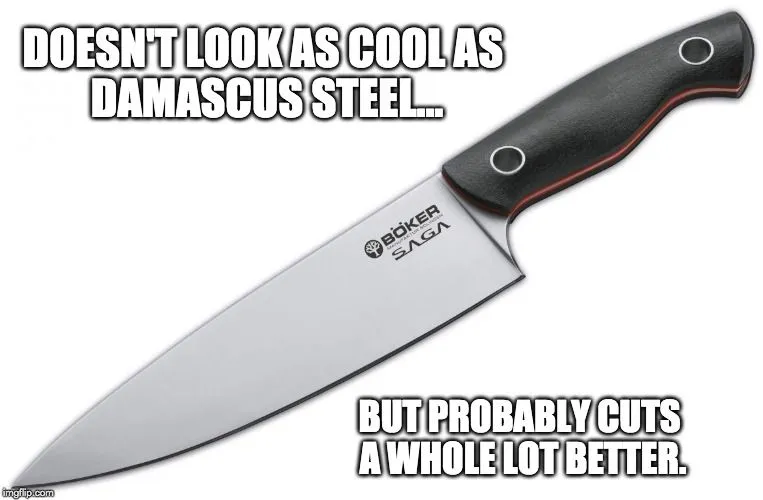
Furthermore, most blades made today are stainless steel, meaning that they are far more resistant to corrosion than the high-carbon wootz of old, which rusts readily if neglected. As for flexibility, modern spring and tool steels can be tuned to bend under load and then snap back to their original shape without taking a permanent set, matching or bettering the resilience that once made Damascus blades stand out.
A Final Word
These days, we are easily enamored by things from the ancient past, particularly those objects that carry some sort of legendary quality. Whether that is a response to the global obsession with Game of Thrones, or some instinctual nostalgia for simpler times, there’s no denying that things like Damascus steel hold a fascination for us. Measured against the alloys we engineer today, the old blades no longer have the performance edge they once did, and most modern "Damascus" knives are really pattern-welded showpieces prized for their looks. Even so, it would be unfair to call the original a mere curiosity. True wootz Damascus was a remarkable feat of early materials science, one that hinged on a trace of vanadium nobody at the time could have known was there, and that quiet bit of chemistry is what kept the secret hidden for so long.
References (click to expand)
- Verhoeven, J. D., Pendray, A. H., & Gibson, E. D. (1996, July). Wootz Damascus steel blades. Materials Characterization. Elsevier BV.
- Kochmann, W., Reibold, M., Goldberg, R., Hauffe, W., Levin, A. A., Meyer, D. C., … Paufler, P. (2004, June). Nanowires in ancient Damascus steel. Journal of Alloys and Compounds. Elsevier BV.
- Reibold, M., Paufler, P., Levin, A. A., Kochmann, W., Pätzke, N., & Meyer, D. C. (2006, November). Materials: Carbon nanotubes in an ancient Damascus sabre. Nature.
- Verhoeven, J. D., Pendray, A. H., & Dauksch, W. E. (1998, September). The key role of impurities in ancient damascus steel blades. Jom. Springer Science and Business Media LLC.
- Sherby, O. D., & Wadsworth, J. (1985, February). Damascus Steels. Scientific American.