Table of Contents (click to expand)
Euler’s number ‘e’ (≈ 2.71828) is an irrational, transcendental mathematical constant that forms the base of the natural logarithm. It first emerged from Jacob Bernoulli’s 1683 work on continuous compound interest, was given its symbol by Leonhard Euler in 1727, and shows up everywhere from exponential growth and decay to calculus, statistics and the famous Euler identity eiπ + 1 = 0.
The mathematical constant ‘e’, popularly known as Euler’s number, is arguably the most important number in modern mathematics. I’m not exaggerating when I say that Euler’s number has touched each and every one of our lives in some way at some point in time. From trigonometry to compound interest calculations, it appears everywhere!
What Is Euler’s Number?
Numerically, e = 2.7182818284…
More specifically, it is a number with infinite digits beyond the decimal point; it follows no discernible pattern and cannot be represented as a definite fraction. Essentially an irrational number, it forms the base natural logarithms, i.e., ‘ln’. The number facilitates the forecasting of numerous growth rates, from the growth of financial indices to the rate of the spread of diseases. Any growth in a financial index or the growth of a disease-spreading virus would eventually follow a pattern governed by ‘e’. Let’s look at a simple example to better understand how this constant comes about.

Imagine that your investment-savvy friend asks for $100 and claims that he can double it in a year. At the end of the year, he’ll give you $200, guaranteeing you a 100% return on investment. If that’s true, if you ask for your investment back in 6 months, theoretically, he should give you a return of 50%, which would total $150. If you take the $150 at the end of 6 months and put it back in his “fund” for the remaining 6 months, at the end of the year, you would receive $225. That’s an extra $25.
Now, what if you took your money out each month and re-invested it? You would be making about $271. And what if you took your money out at the end of each day? You would make approximately $271.82… See where this is going? Instead of doubling your money, you’ve managed to grow it exponentially. In other words, you’ve made your money grow by a factor of ‘e’.

Evidently, e is the result of:
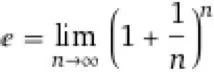
As ‘n’ grows larger, the resultant value approaches Euler’s number.
This is all too familiar for high school students learning about compound interest. If your principal is set to double at the end of the year, but you continue to reinvest the daily interest accrued, thus compounding your interest, your principal will eventually end up growing by a factor roughly equal to ‘e’
This interesting mathematical constant has an equally interesting origin story.
The Origin Of Euler’s Number
Euler’s number first appeared, implicitly, when Scottish mathematician John Napier (1550–1617) was looking for a way to simplify multiplication. He devised a process through which multiplication could be converted to addition (and division to subtraction) by building parallel columns of numbers — the foundation of what became natural logarithm tables, published in his 1614 Mirifici Logarithmorum Canonis Descriptio. Napier never explicitly identified the constant we now call ‘e’, but it was effectively baked into his logarithm tables.

Euler’s number was first identified as a distinct constant by Swiss mathematician Jacob Bernoulli in 1683, while he was studying continuous compound interest — exactly the example we just walked through. Bernoulli showed that the limit of (1 + 1/n)n as n grows without bound exists and is finite, though he didn’t calculate its value precisely or give it a letter. A few years later, Gottfried Leibniz used the letter ‘b’ for the same constant in correspondence with Christian Huygens. It was Leonhard Euler, in an unpublished 1727 paper and then in print in his 1736 Mechanica, who first wrote ‘e’ for the constant and proved many of its astonishing properties. The letter is often assumed to stand for ‘Euler’, but it more plausibly just came next in the alphabet — ‘a’, ‘b’, ‘c’, ‘d’ were already in heavy use as variables.

It’s surprising that a constant with such a significant impact on modern mathematics was identified at such a late stage of human civilization. In contrast, an approximation of π — usually quoted as 22/7, although π is actually irrational and 22/7 is only a convenient handhold — was already known in ancient Babylonian, Egyptian and Indian mathematics, well over two millennia earlier.
So we have a basic idea about what ‘e’ means and where it came from, but what’s the big deal? Why is this constant supposed to revolutionize modern mathematics?
Euler’s Identity: Properties Of Euler’s Number
Euler’s number has several remarkable properties that cross the spectrum of mathematical topics. The derivative of ex is itself, ex, and its integral is ex + C — that self-replicating behaviour is unique to ‘e’ among exponential bases. Closely related: the derivative of the natural logarithm, d/dx (ln x), is 1/x.
In trigonometry, ‘e’ also helps to derive an interesting result:
eix = cos x + i sin x.
This manages to establish a relationship between two trigonometrical functions (sin and cos) and i (√-1), which is quite the feat! Moreover, if you assume that the value of x = π, the formula gives rise to yet another interesting relationship.
eiπ = cos π + i sin π
cos π = -1 and sin π = 0
Consequently, we arrive at an elegant and powerful result combining three of the most interesting variables in mathematics: ‘e’, ‘i’ and ‘π’.
eiπ = -1
This is more commonly written as:
eiπ + 1 = 0
This is popularly known as ‘Euler’s Identity’.
These identities and properties provide a useful tool for those dealing with complex analysis, such as money managers on Wall Street, computer programmers designing the next revolutionary app, or scientists at NASA planning the next mission to Mars. The implications of Euler’s number are clearly far-reaching!
While this article certainly doesn’t represent an exhaustive list of the properties and features of Euler’s number, it is a great starting point to pique your interest. Those hungry for more in-depth information can now pop over to an academic article about Euler’s number and you won’t be entirely clueless about what’s being discussed!
References (click to expand)
- Prag, A. (1970, June). Mathematics - A History of Mathematics. By Carl B. Boyer. New York & London: John Wiley & Sons. 1968. Pp. xv + 717. 97s. The British Journal for the History of Science. Cambridge University Press (CUP).
- Maor E. (2015). E: The Story of a Number. Princeton University Press
- An Appreciation of Euler's Formula.
- The Enigmatic Number e: A History in Verse and Its Uses in ....
- Understanding Mathematics.
- Euler's Number: A Way to Celebrate Our Nerdy Side.