Table of Contents (click to expand)
A Boltzmann brain is a thought experiment: a fully formed, self-aware brain that fluctuates into existence by chance in an otherwise high-entropy universe, carrying false memories of a life that never happened. The paradox is statistical - in a universe that exists long enough, such brief, low-entropy fluctuations would vastly outnumber whole evolved observers like us, so the math says you are more likely to be a Boltzmann brain than a real one. Physicists today treat any cosmological model that predicts this as self-undermining and a sign it is wrong.
Imagine that in this vast universe of ours, some brains have come into existence right this very second. Why brains? Because they’re enough for our consciousness and cognitive abilities, and that’s all one needs for the idea of their existence!
Everything in these brains formed right that second, and is false: the memories of life until that moment, their origin, their ideas, their perspective of the universe… they came with a ready-made set of memories and thoughts that never happened and are therefore artificial! These brains will perceive themselves to be real and everything they know to be real.
So, how would they know that these memories are artificial and their existence is more like a hallucination? How would we know that we aren’t these artificial brains called Boltzmann Brains?

This is the Boltzmann Brain paradox, the result of Ludwig Boltzmann’s long years of debate with other scientists on his interpretation of entropy. The Second Law of Thermodynamics says that the entropy or disorder of a system can either stay the same or increase, but never decrease.
I mean, you’ve surely seen a glass shatter, but have you ever seen that shattered glass return to its previous pristine state?
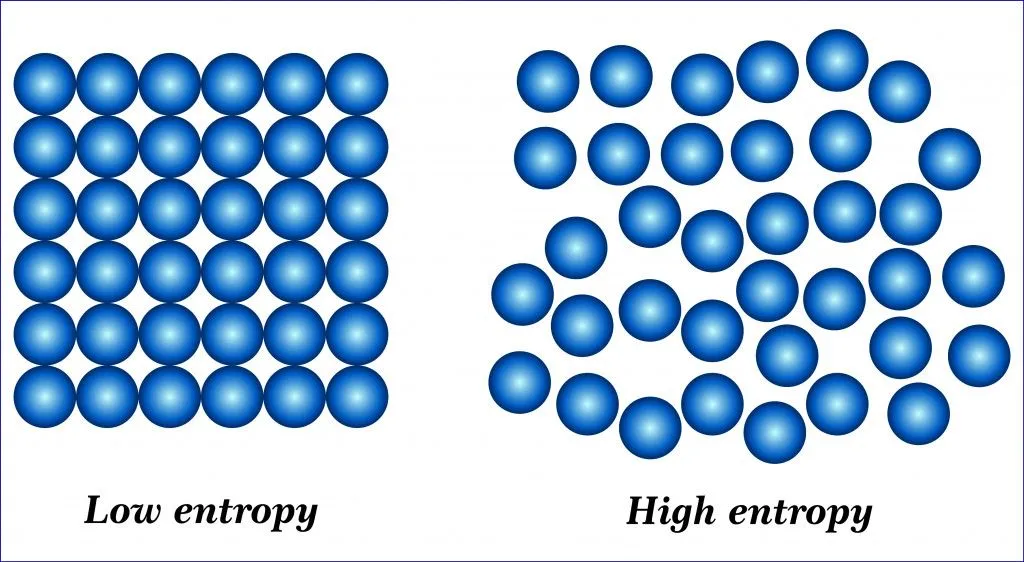
This is what the Second Law revealed, that disorder must either stay the same or increase, but never decrease.
However, when Boltzmann applied his knowledge of statistical mechanics to the concept of entropy, it left scientists in heated debate for decades.
The Catch In The Concept Of Entropy
Boltzmann stated that the probability of the entropy of a system increasing or staying the same is high. However, that doesn’t mean the probability of the entropy decreasing is zero. It is simply so small that for realistic systems, like a box of particles, it can be ignored.
Let’s frame it another way. Imagine you are told that the probability of a ball turning blue from green is one in a trillion for a given box. Now, the box you are given only contains 10 balls, and you can only try 10 times. Technically, the probability of a ball changing from blue to green is negligible, right?
But what happens if you imagine an infinite system?
This question made the scientists at the time pause and take a step back; debate ensued.
The Buildup To The Paradox
Scientists realized that if the system has an infinite number of particles, there will be at least one instance or one possibility of those infinite possibilities that the particles would make something structured, instead of in some random orientation!
An example of this is an infinitely old universe. An infinitely old universe means an infinite number of possibilities where the entropy increases. Increased entropy, as we already know, equals increased randomness. However, as stated before, the seemingly impossible phenomenon of entropy reduction is still possible in an infinite phenomenon! So in an infinite universe, we have only ONE possibility out of an infinite number where the entropy reduces and the particles come together to form a structure, instead of randomly existing.
However, in a finite universe, there is no chance of infinite possibilities, so the idea of a structured universe or an alive universe is moot!
Boltzmann took this example of an infinitely old universe and ran with it. He said that at some point, all of the randomly organized particles in an infinitely old universe must come together to form a structured system. That is what statistics say! Maybe this formation of a structure would mean all these particles converging into one point, leading to the Big Bang!
Another possible idea he proposed was of a local system in an infinitely large system, meaning one universe containing structure and life in the infinite system of a dead multiverse. Why a dead multiverse? Because a dead multiverse has no structure, which is what high entropy in a universe suggests.
So, no structure means more entropy and more entropy is infinitely more likely than reversing entropy. And we know that in an infinite system, there is only one possibility of reducing entropy. So, of course, in the infinite system of a multiverse, all universes except one will be dead!
But why would we even need an entire universe? Boltzmann believed that a local system as small as a galaxy could be structured and undead in an otherwise dead universe!
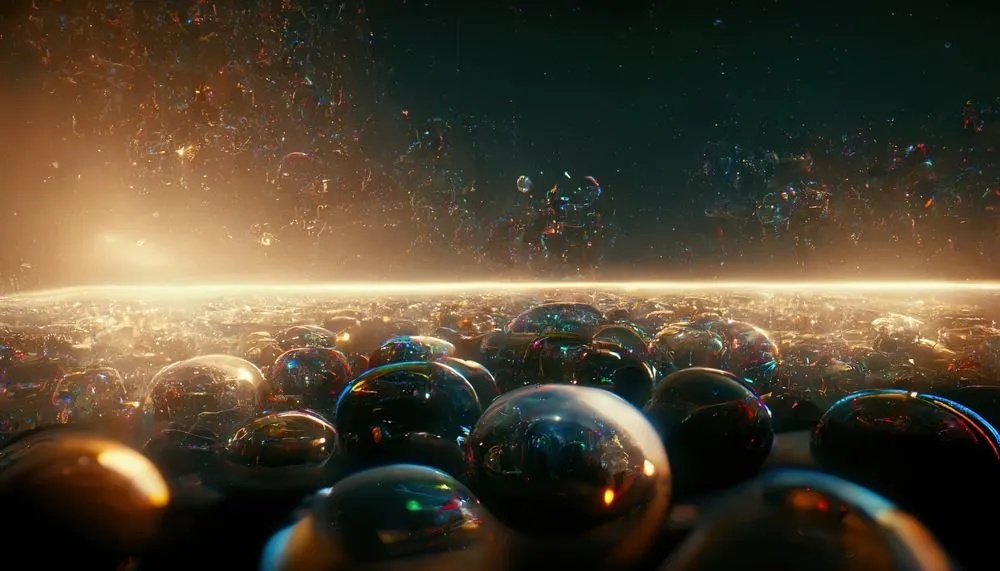
Now this idea, which started with the concept of thermodynamics, had entered the bounds of astronomy. This was when Sir Arthur Eddington, a very famous astronomer, physicist and mathematician of the time, entered the debate.
He took this crazy and exciting train of thought a step further. Or rather, he simplified it a step further. He said that we don’t even need a whole galaxy to validate the existence of structure in a dead universe. We just need one intelligent observer, like you and me!
I mean, let’s be honest! What do you think is more probable – all the particles in an infinite universe converging for a Big Bang, or a local group of particles coming together to form an intelligent observer?
This idea of intelligent observers was brought to the ultimate pinnacle by physicists and cosmologists, Albrecht and Sorbo, who said that we would only need the body part necessary for cognition and consciousness i.e., the brain. A brain randomly existing out of nowhere in a dead universe (high entropy universe) containing memories of an entire life. A life that never actually was and is as artificial as its thoughts. This idea was called the Boltzmann Brain.
Let’s try to understand it in this way. Every memory we have until this point (how we were born, our parents, notions of the solar system, going as far back as our idea of Big Bang itself) would be artificial if we are Boltzmann brains. These are brains that have no reality, but think they do.
Are You A Boltzmann Brain?
Can you believe that all this discussion about the universe and its origin was happening long before Einstein’s theory of general relativity?
Well, I suppose that’s more believable than the fact that you could be a Boltzmann Brain!
When scientists came to understand the legitimacy of this paradox, everyone believed that they could never be a Boltzmann brain. I mean, duh! I know my existence is not artificial. However, a Boltzmann brain would similarly not know that its memories and existence were artificial.
This thought lit a fire and an existential crisis in the community, so people started researching the probability of one being a Boltzmann brain.
They calculated that the possibility of the existence of a Boltzmann brain in an infinite universe is infinitely higher than the probability of a human brain! That means statistically, we are more likely to be surrounded by Boltzmann brains and ARE ourselves Boltzmann brains! whereas, it’s very unlikely that there is even a real brain somewhere!
So, are we even real? Is the author writing this article real? Or are you, the reader of this article, in fact a Boltzmann brain?
How To Break The Boltzmann Paradox?
Now that we’ve fallen into an existential crisis, let’s be real. There is no way of knowing if we are a Boltzmann brain or not, but an infinitely high probability says that we are!
However, here’s the catch! We have been talking about a Boltzmann brain only in the context of a universe that has existed for an infinite amount of time. Maybe the answer is in the fact that the universe hasn’t existed forever!
Scientists studied the cosmological models existing for infinity that support the existence of Boltzmann brains. They came to the conclusion that these models are very unstable and too self-undermining to be considered seriously. Thus, they must be rejected, alongside the existence of these Boltzmann brains.
So the paradox was broken, right? Well, kind of!
We now know that the model of an infinitely long-existing universe is a bust. We instead believe that our universe has existed for a finite period of time starting from the Big Bang.
But the question that has kept the scientists awake at night remains unanswered. What was there before the Big Bang? Nothing? Or a dead universe that led to all the particles coming together and causing a Big Bang, leading to a structured universe? Hmm… sounds a lot like the Boltzmann brain universe to me!
Why The Paradox Came Roaring Back In Modern Cosmology
Here’s the twist that keeps this old debate alive. We just said the classic version leaned on a universe that has existed forever, and that our universe instead has a finite past that began with the Big Bang. Case closed? Not quite. Our universe may have a finite past, but it could still have an infinite future.

In the late 1990s, astronomers discovered that the expansion of the universe is speeding up, pushed along by what we call dark energy. If that dark energy is a cosmological constant (an energy density of empty space that never dilutes), the universe never stops expanding. It coasts into an eternal, near-empty state that physicists call a de Sitter universe, settling down to a fixed, fantastically low temperature set by its own cosmic horizon.
And that is all the paradox needs. Over an endless future, the faint jitter of that near-empty vacuum can, with mind-bendingly small odds, assemble a brain, while ordinary observers like us can only show up during the brief early window when stars and galaxies exist. Given literally forever, the rare flukes pile up and outnumber the real thing. Physicists Lisa Dyson, Matthew Kleban and Leonard Susskind flagged this in 2002 in a paper bluntly titled Disturbing Implications of a Cosmological Constant, and Andreas Albrecht and Lorenzo Sorbo soon recast it as the modern Boltzmann brain problem. So a finite age alone doesn’t bury the paradox. An infinite future digs it right back up.
Just How Unlikely Is A Single Boltzmann Brain?
Let’s put a number on it, because the sheer size of these odds is half the fun. A brain is an exquisitely ordered, low-entropy object, and for one to flicker out of near-empty space the entropy has to take a huge nosedive. Sean Carroll estimates the required drop at roughly 1066 in natural units, which means that, in the language of statistical mechanics, the chance of such a fluctuation scales as e−1066. Read that carefully: it is an exponential of a number that itself already has 67 digits. “Astronomically small” doesn’t begin to cover it.
So no, a Boltzmann brain is not easy to make. In any human-scale stretch of time, it essentially never happens. The whole trick is time. In an eternal de Sitter universe the natural clock is the recurrence time, around e10122 seconds, set by a de Sitter entropy of about 10122. Wait that long and even an e−1066 event happens, again and again. Real observers are crammed into one short early chapter of cosmic history, while the flukes are smeared across infinite time, and infinity wins the long game. This is exactly why it is the never-ending future, not the tiny per-event odds, that does the damage. Whether such fluctuations genuinely “happen” at all in a quiet vacuum, though, turns out to be the loophole physicists pry at next.
How Do Physicists Try To Kill The Paradox For Good?
If the math keeps insisting you are probably a hallucinating brain, most physicists read that as a problem with the math, not with you. Here are the three lines of attack you will hear today.
1. Cognitive instability. Sean Carroll argues that any theory predicting most observers like us are Boltzmann brains is “cognitively unstable”: it cannot be both true and justifiably believed. If you accept it, you must also accept that your memories and your reasoning are random noise, including the very reasoning that led you to the theory. A theory that saws off the branch it is sitting on earns zero credence, so we throw it out.
2. A quiet vacuum doesn’t actually fluctuate. In 2015, Kimberly Boddy, Sean Carroll and Jason Pollack argued that if the late universe truly settles into a de Sitter vacuum, that is a stationary quantum state. Nothing about it is true at one moment and false the next, so nothing really “fluctuates into existence.” The vacuum has a nonzero amplitude for a brain, sure, but having an amplitude is not the same as the event happening. No genuine dynamical fluctuations, no Boltzmann brains.
3. The vacuum decays first. Our vacuum may not be the final word. If it is merely metastable and decays to a lower-energy state long before that absurd recurrence time, the de Sitter phase ends before brains ever get the chance to pile up. Either way, the modern verdict rhymes with the old one: a universe that predicts you are probably a Boltzmann brain is not telling you that you are fake. It is telling you the model is broken.
References (click to expand)
- SG Brush. History of the Kinetic Theory of Gases* by Stephen G. Brush .... The University of Maryland, College Park
- (PDF) The Book of the cosmos: imagining the universe from .... Academia.edu
- Gott, J. R. (2008). Boltzmann Brains--I'd Rather See Than Be One (Version 1). arXiv.
- Dyson, L., Kleban, M., & Susskind, L. (2002). Disturbing Implications of a Cosmological Constant. arXiv / JHEP.
- Carroll, S. M. (2017). Why Boltzmann Brains Are Bad. arXiv.
- Boddy, K. K., Carroll, S. M., & Pollack, J. (2015). Why Boltzmann Brains Don’t Fluctuate Into Existence From the De Sitter Vacuum. arXiv.
- Disentangling the Boltzmann Brain Hypothesis: Memory, Entropy, and Time. Santa Fe Institute.