Robert Hooke was the first scientist to describe and name cells, in his 1665 book Micrographia, after seeing the box-like compartments of cork under his microscope. About a decade later, the Dutch draper Antonie van Leeuwenhoek became the first to describe living single-celled organisms — what we now call bacteria and protists.
We are all composed of cells. They are the building blocks of you, me, an elephant, a shark, a snake, a cockroach, an oak tree, the mold growing on stale pizza, as well as the amoeba and all its single-celled cousins.
However, when you look at an elephant, we don’t see any cells. We see greyish-brown wrinkly skin, large floppy ears, and the beast’s impressive trunk. We don’t see these cells because our eyes simply can’t see things at such a small scale.
The smallest cells are bacterial — the tiniest known free-living bacteria (Mycoplasma species) are about 0.2 micrometers across (200 nanometers), and most other bacteria are 1–5 micrometers. The average cell of an animal is usually between 10 and 100 micrometers. The smallest objects that our naked eyes can see are about 0.1 millimeters.
So, if cells are basically invisible to us, who discovered them—and how?
A Brief History Of The Microscope
The history of the cell, and all mico-organismic life, is closely tied to the invention of the microscope.
Humans have long known that objects can be magnified when seen through certain materials. By the thirteenth century, lenses had been invented and had been put to use in spectacles, magnifying glasses, and the telescope.
Microscopes came into the picture much later, in the early 17th century. Credit for the invention of the first compound microscope goes to a father-son duo, father Hans Janssen and son Zacharias Janssen. Sometime between 1590 and 1600, these spectacle makers in Holland had the idea of putting a lens on either side of a tube. Voila, the compound microscope was born.
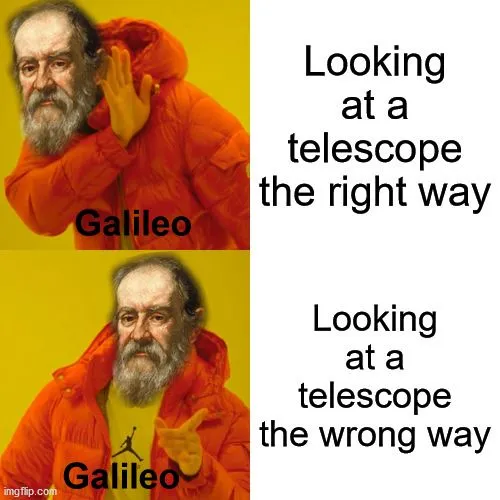
Funnily enough, ten years later, in 1610, Galileo Galilei decided to look through his telescope from the wrong end, thereby creating his own compound microscope, even though he didn’t know about Janssen’s work.
Though scientists now had a microscope, it would take another 60 years or so before actual cells were found. The first reason was that these first microscopes didn’t offer much magnification; they only enlarged objects by 3 to 9 times, not enough to see a cell.
The second reason was that people weren’t looking for cells. The popular opinion before microorganisms were discovered was that all life could be seen by the naked eye. With such a belief, many naturalists focused on describing large objects and their parts.
The Discovery Of The Cell – Robert Hooke And Anton Van Leeuwenhoek
The credit for discovering the cell goes to legendary scientist Robert Hooke.
Robert Hooke, a native of the Isle of Wight in England, was a polymath and prolific scientist. He began his career as a mechanical engineer and inventor. He perfected the air pump, invented the spring balance for watches, and determined a way to accurately determine longitudes at sea (the result of which he curiously didn’t publish). He also helped rebuild London after the Great Fire of London—no small feat!
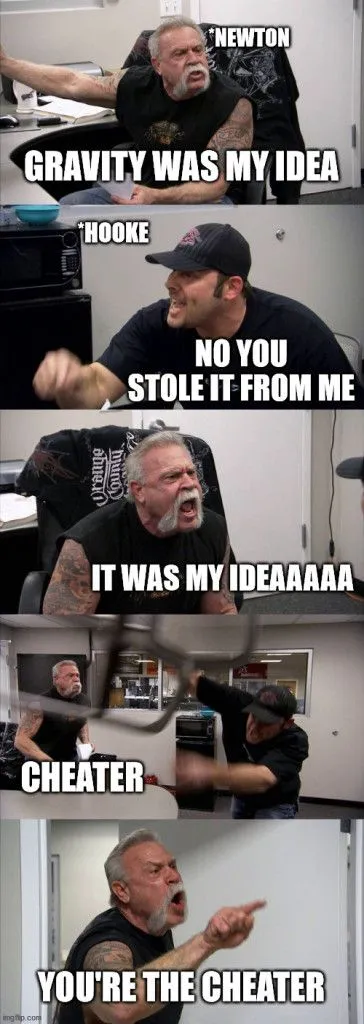
Robert Hooke was also interested in the problems of gravity, an area of Isaac Newton’s expertise. After Newton published Principia, Hooke claimed that Newton had stolen the inverse square law from him. The two soon became arch-nemeses, with many angry letters exchanged and much professional sabotage involved.
Though Robert Hooke couldn’t claim the fame for gravity itself, he would earn historical fame through his discovery of cells!
In 1665, Robert Hooke published Micrographia, a book dedicated to the microscopic. In keeping with his inventive nature, Hooke created a unique compound microscope that allowed him to magnify objects up to about 50 times. With this, he could look at objects smaller than anyone had even before seen.
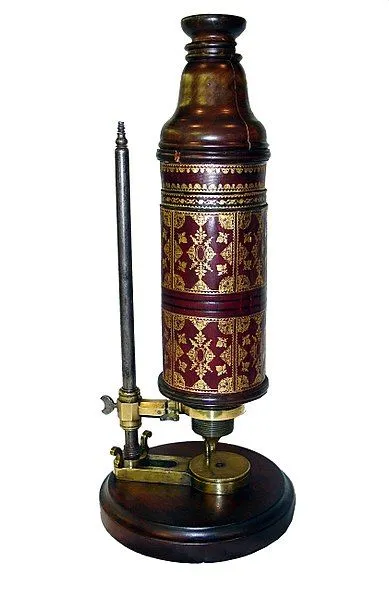
He made almost 60 observations with his microscope of everything from bread mold, linen, and silk to wild oats and cork. It was while Hooke was looking at cork under the microscope that he commented that the pores of the cork reminded him of the cells of monks. Thus, he called them cells.
Micrographia was the first book to describe the most minuscule aspects of life, and it was an instant hit.
Across the English Channel, on the continent, was another brilliant scientist who had likely come across Robert Hooke’s Micrographia. This was Anton Van Leeuwenhoek, one of the other discoverers of cells.
Leeuwenhoek was an unconventional scientist, to say the least. A textile merchant by profession, Leeuwenhoek had a brilliant mind bent towards curiosity, which led him to create his own, peculiar version of a microscope, one that could magnify objects up to 250 times!
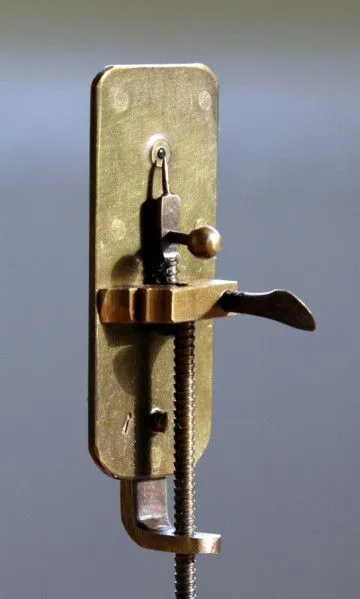
With this microscope, Leeuwenhoek looked at everything he could, sending letters of his observations and results of his experiments to the Royal Society, of which Robert Hooke was a member.
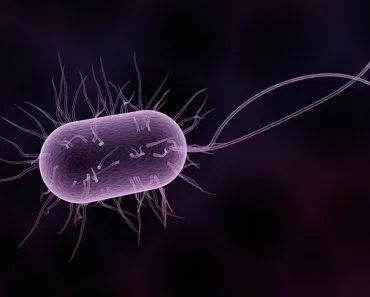
In 1676, he was spurred to examine a three-week-old pepper soup under the microscope. Within the soup, he saw “very wee animals” floating about. This is the first written account of bacteria. Later, he decided to take a closer look at the gunk on his teeth, and those of two other women and two men. There too, he found his little animals, which he lovingly referred to as ‘animalcules’.
In a letter from Leeuwenhoek to the Royal society on the bacteria, he writes, “an unbelievably great company of living animalcules, a-swimming more nimbly than any I had ever seen up to this time. The biggest sort. . . bent their body into curves in going forwards. . . Moreover, the other animalcules were in such enormous numbers, that all the water. . . seemed to be alive.”
Later, Robert Hooke verified these findings.
Urged by his colleagues, Leeuwenhoek even looked at his semen under the microscope, where he found ‘animalcules’, or what we know today as sperm.
So, Who Discovered The Living Cell: Hooke Or Leeuwenhoek?
If you searched for who discovered the cell, you probably ran into two names, and that can be confusing. The short answer is that Hooke and Leeuwenhoek discovered two very different things.

Robert Hooke gets the credit for discovering “the cell” because he was the first to see these tiny compartments and give them a name, back in 1665. But here is the twist: the cork he sliced was dead. What Hooke actually saw were the empty walls left behind by cells that had died long ago. He never looked at a living cell, and he had no inkling that these little boxes were the basic unit of every living thing.
That honor belongs to Antonie van Leeuwenhoek. Peering through his tiny single-lens microscopes from the 1670s onward, he became the first person to describe living cells: the darting “animalcules” (protozoa) he spotted in pond and rainwater around 1674, the bacteria in his three-week-old pepper-water in 1676, and human sperm cells in 1677.
So both answers are, in their own way, correct. Hooke discovered and named the cell as a structure, while Leeuwenhoek discovered the living cell and the entire hidden world of single-celled life. If a quiz asks who was the first to see living cells, the name you want is Leeuwenhoek.
Did Robert Hooke Come Up With Cell Theory?
Because Hooke discovered and named cells, many people assume he also came up with cell theory. He did not.

Hooke described and named cells, and Leeuwenhoek revealed that a living thing could be a single cell, yet neither man grasped that the cell is the fundamental building block of all life. That idea, cell theory, did not take shape until more than 170 years after Micrographia.
Cell theory is usually credited to two German scientists. In 1838, the botanist Matthias Schleiden concluded that all plants are made of cells. A year later, in 1839, the zoologist Theodor Schwann extended the idea to animals, proposing that every living thing is composed of cells. The third principle, that all cells arise from existing cells, followed in the 1850s: Robert Remak published evidence for it in 1852, and the pathologist Rudolf Virchow popularized it with the Latin phrase Omnis cellula e cellula (“every cell comes from another cell”).
So Hooke’s contribution to cell theory was foundational rather than direct. He handed later scientists the cell, its name, and the very first glimpse of one under a microscope, and it took generations of better lenses and far more evidence to work out what cells truly are.
Conclusion
To us, the idea of a cell is nothing special today, but in the 17th century, when most scientists believed that life sprung from thin air, and that a mini-human was present in a sperm, the idea of cells and bacteria was outlandish.
It took another 200 years before the next wave of scientists confirmed the idea of cells and took the next leap forward. The famous aphorism of cell biology, Omnis cellula e cellula, which means “every cell comes from another cell” also came into existence around this time, though who actually uttered it is uncertain—either François-Vincent Raspail or Rudolf Virchow.
Two scientists, Matthias Schleiden and Theodor Schwann, building on the work of many other scientists, proposed the tenets of Cell Theory.
- All living things are made up of cells.
- Cells are the basic structural and functional unit of life.
- All cells come from preexisting cells.
Any scientist today wouldn’t blink at the above phrases, but the idea that the same things that build an elephant also makes up humans, plants, insects and every mushroom in the forest was mind-blowing only a few centuries ago!
References (click to expand)
- Gest, H. (2004). The Discovery of Microorganisms by Robert Hooke and Antoni van Leeuwenhoek, Fellows of the Royal Society. Notes and Records of the Royal Society of London, 58(2), 187–201. http://www.jstor.org/stable/4142050 - JSTOR
- Whitrow, G. J. (1938). Robert Hooke. Philosophy of Science, 5(4), 493–502. http://www.jstor.org/stable/184662 - JSTOR
- journal article - www.jstor.org
- History of the Cell: Discovering the Cell - National Geographic Education
- Foundations of Modern Cell Theory - Microbiology (OpenStax), LibreTexts