Most organic compounds are colorless or white because their carbon-carbon and carbon-hydrogen bonds only absorb high-energy ultraviolet light, not visible light. With no visible wavelengths absorbed, every color of light is reflected, so the compound appears white (or colorless in solution).
One day, you realize that you’ve taken the wrong medicine because every tablet seems to be white. You blame the doctor for not giving you more distinguishable medicine. This is why so many medicines are now colored; to make them visually obvious and distinguishable. Medicines constitute mainly organic compounds, and like most organic compounds, they are colorless/white.
What Are Organic Compounds?
Organic compounds are molecules that primarily contain carbon (C) and hydrogen (H) atoms. Other atoms such as oxygen (O), nitrogen (N), sulfur (S), and silicon (Si) are also present, but in lower amounts compared to those first two.
These atoms help to characterize the organic compounds into various groups based on their unique properties.
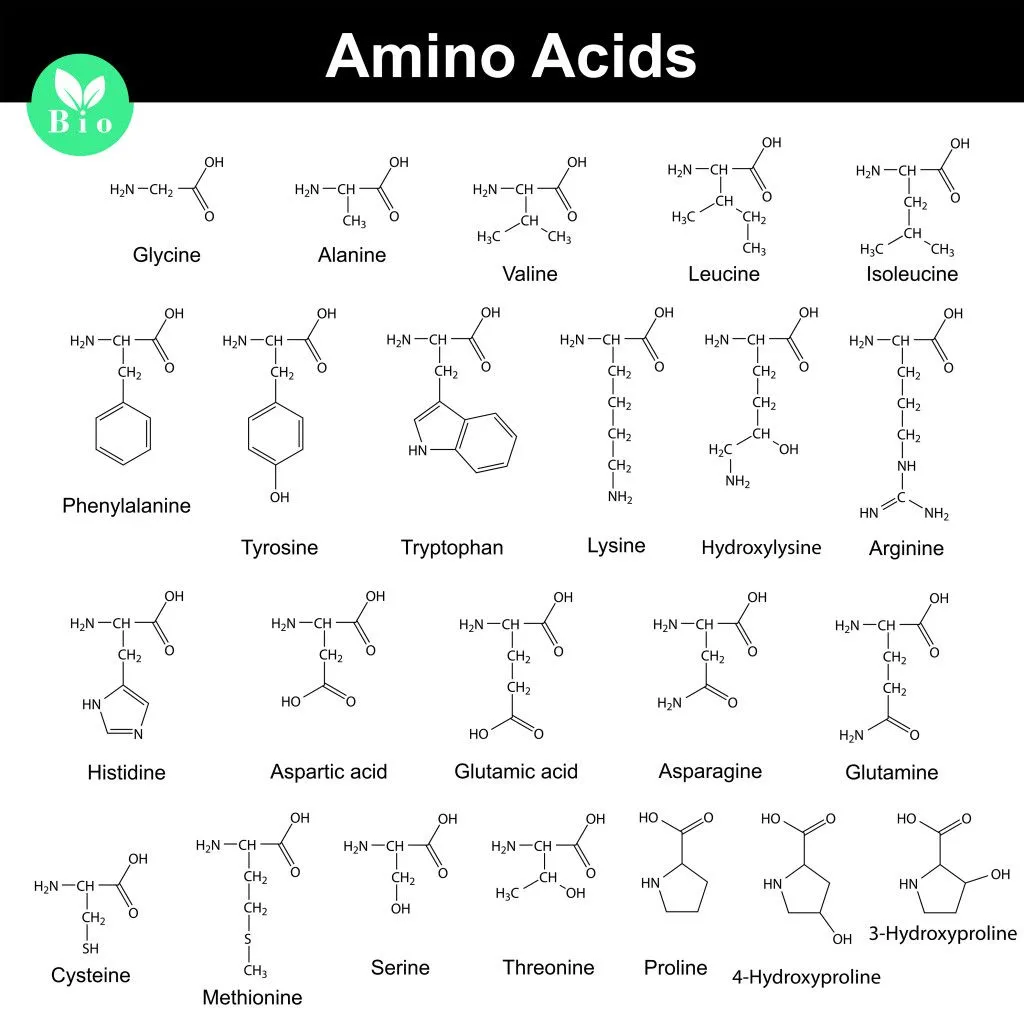
In the past, organic chemistry was thought to be the ‘chemistry of life,’ as living things comprised an abundant number of organic compounds, hence earning the term ‘organic’. The protagonist of the epic study called ‘organic chemistry’ is Carbon, owing to its tetravalency and key property of catenation.
The CAS Registry now catalogs more than 200 million known chemical substances, the vast majority of them organic, with thousands more added every day and countless others still waiting to be discovered or synthesized.
Color Theory
When we talk of color, we simply need to remember “what is seen actually isn’t there.”
Sounds absurd, right?
You can clearly see the blue color of the sky and the red color of your t-shirt. You might think that something is wrong with your eyes, but that’s not the case.
However, it is the opposite, the color you see is actually not the color that the substance contains, but is instead its complementary color. This might sound counterintuitive, but it’s true.
The colors that we see around us are all within the visible part of the electromagnetic spectrum. White light itself is a spectrum of many colors and every color/shade has a corresponding wavelength.
When light falls on any substance, some of it is absorbed and the rest is reflected. The reflected light reaches our eye, which is the color that we see.
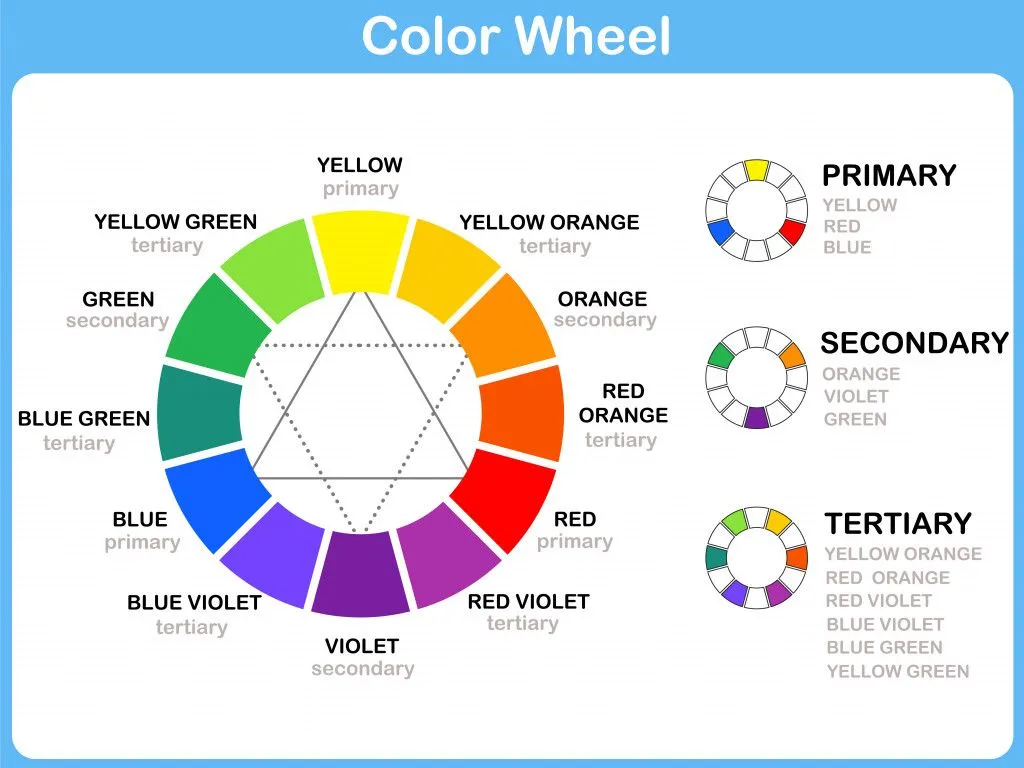
A color wheel that many of us must have seen in art classes can demonstrate this; the color we see, versus its complementary color that is absorbed.
So, when you see a yellow flower, the color that it has actually absorbed is violet.
When we talk of extremes, a substance appearing white indicates that it has reflected all the wavelengths, whereas a substance appearing black means that it has absorbed all the wavelengths and reflected none.
UV-Visible Spectroscopy
Spectroscopy is an important technique for chemists to understand the structure of organic molecules and their properties. In this technique, the desired molecules are irradiated with electromagnetic radiation (the wavelength depends on the type of spectroscopy used), which causes various excitation levels (electronic and atomic) concerning vibration, rotation, energy, etc. The effect of this on the compound is studied and its properties are elucidated.
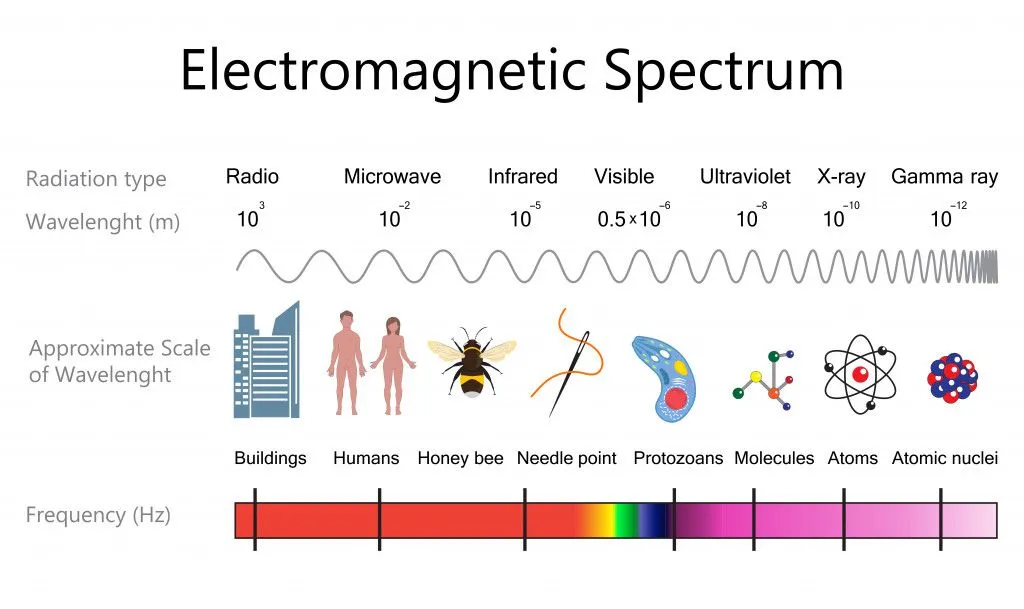
UV- Visible spectroscopy is used to study the color properties of a given compound. The wavelength used is between 200 nm – 800 nm. The region below 200 nm is called the far-ultraviolet region and is often less studied, as it requires vacuum conditions. The compound is subjected to a series of wavelengths and the wavelength at which it shows maximum absorption is taken to be λmax. If λmax lies in the visible region, then its complementary color is the one we see.
Electronic Transitions
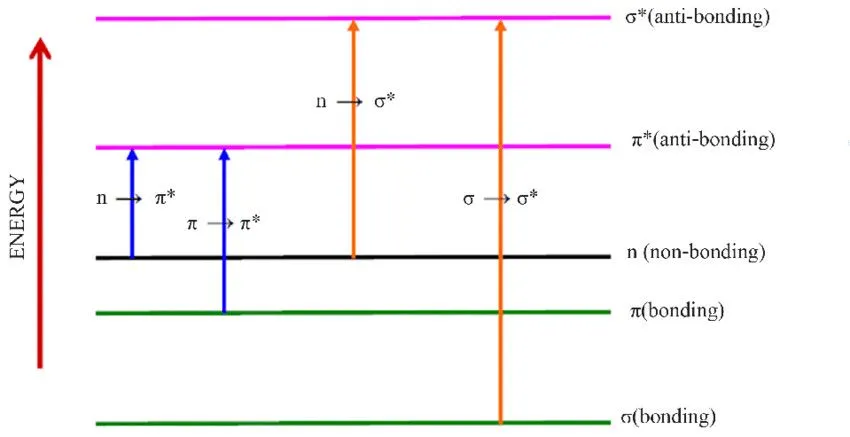
In UV spectroscopy, electronic transitions are of the utmost importance. The bonded electrons get energy from the incident wavelength, and if it’s enough, they get promoted to higher energy levels. As shown in the picture, depending on the type of bonds involved, electrons get excited to several layers.
| Transitions | Meaning |
| σ → σ* | Sigma bonded electron promoted to sigma anti-bonding orbital |
| n → σ* | Non-bonded electron promoted to sigma anti-bonding orbital |
| π → π* | π electrons promoted to an anti-bonding π orbital |
| n → π* | Non-bonded electron promoted to the anti-bonding π orbital |
As can be seen, σ → σ* transitions require the highest energy, followed by the n → σ* transition, and so on. All the organic compounds primarily have sigma C-C and C-H bonds, and transitions to the anti-bonding sigma orbital require wavelengths in the far-ultraviolet region; thus, they don’t show any color and reflect all the visible spectrum wavelengths and appear white.
n → σ* transitions take place in saturated compounds containing one hetero atom with an unshared pair of electrons (n electrons). This transition also lies in the UV region (160 nm – 200 nm), but requires less energy as compared to the previous transition. Hence, compounds like saturated alcohols, ethers, halides, ketones, and aldehydes also appear colorless/white.
What About Colored Organic Compounds?
There exists a plethora of organic compounds that are colorful. After all, the entire dye industry is based on this phenomenon. Dyes are organic compounds too, as organic compounds are the basis of everything colorful seen around you.
Chromophore – A chromophore is simply a functional group or group of atoms that imparts color to organic compounds, as their absorbing wavelength lies in the visible region of the electromagnetic spectrum. This means that their electronic transitions require much less energy.
π → π* and n → π* transitions mainly require wavelengths in the near-UV region and visible region. Examples include, -C≡C-, -C=O-, -N=N-, R-NO2, -COOH, -CONH2.
Auxochrome – Auxochrome by itself doesn’t bring any change in the color of the molecule, but instead enhances the absorption capacity of the molecule towards a longer wavelength (visible region). Examples include -OH, -OR, -NH2, -NR2, and -SH. Benzene (with -C=C- conjugation acting as the chromophore) has a λmax at 255 nm, while aniline (with -NH2 acting as the auxochrome) has a λmax at 280 nm.
Is White the Same as Colorless?
Throughout this article we have used colorless and white almost interchangeably, but they are not quite the same thing, and the difference has nothing to do with chemistry. In both cases the substance absorbs no visible light. What changes is the physical form. A substance looks colorless when light passes straight through it, the way it does through a single clear crystal or a clear solution. It looks white when that same light is scattered back at us from a multitude of tiny surfaces.
Table sugar is the perfect example. Put a single grain under magnification and it is a clear, glassy crystal you can see straight through. Tip those grains into a bowl, however, and the pile looks white. The sucrose has not changed one bit; the powder is simply packed with millions of crystal faces, and at every air-to-crystal boundary a little light bounces off. With all wavelengths scattered roughly equally in every direction, the sum that reaches your eye reads as white.

Snow makes the same point on a grander scale. A solid block of ice is clear, yet snow, which is nothing more than countless tiny ice crystals, is brilliantly white. As the National Snow and Ice Data Center notes, almost all the visible light striking snow is reflected back without any particular preference for a single color, so we see white. The lesson carries straight back to chemistry: when we say most organic compounds are “white,” we are usually describing their powders. The pure crystals or solutions of those very same compounds are colorless. Physical form can transform appearance dramatically; pure carbon itself, for instance, ranges from a clear diamond to black graphite.
How Much Conjugation Does It Take to See Color?
We have seen that chromophores drag a molecule’s absorption into the visible range, but there is a wonderfully simple pattern behind it. The longer the chain of alternating double and single bonds, a feature chemists call conjugation, the smaller the energy gap the electrons must leap, and so the longer the wavelength the molecule absorbs.
The numbers tell the story. A lone C=C double bond in ethene absorbs deep in the ultraviolet, at about 165 nm. Link two double bonds together in 1,3-butadiene and the absorption maximum (λmax) climbs to 217 nm; three double bonds in 1,3,5-hexatriene reach 258 nm. Each added double bond pushes the absorption to a longer wavelength, and if you keep extending the chain you eventually cross out of the ultraviolet and into the visible. β-carotene, the pigment that makes carrots orange, strings together 11 conjugated double bonds and absorbs at around 470 nm, right in the blue. With blue subtracted from white light, what reaches your eye looks orange.

You can even read the color straight off the energy. A photon’s energy (in electronvolts) and its wavelength (in nanometers) are tied together by a handy shortcut: λ ≈ 1240 / E. So a dye that absorbs photons of about 2.34 eV is soaking up light of roughly 1240 / 2.34 ≈ 530 nm, which is green. Take green out of white light and the dye shows its complementary color, a reddish magenta. That single relationship is the whole reason a colorless little molecule can be tuned, one double bond at a time, into a vivid dye.
Are Atoms and Simple Molecules Colorless Too?
It is a fair question. If organic compounds are mostly colorless, what about the atoms and small molecules they are built from? For the most part, the answer is yes. The air around you is overwhelmingly nitrogen (N2) and oxygen (O2), and both are colorless gases. Their bonding electrons are held so tightly that only ultraviolet light packs enough energy to excite them, which is exactly the situation we met with C-C and C-H bonds. Hydrogen, carbon dioxide and water vapor are colorless for the same reason.
Nature does keep a few vivid exceptions, though, and the halogens are the showpiece. Chlorine is a pale yellow-green gas, bromine a reddish-brown liquid that gives off a red-brown vapor, and iodine sublimes into a striking violet vapor. According to Chemistry LibreTexts, these colors arise from an electronic jump between the molecule’s highest occupied (π*) and lowest unoccupied (σ*) orbitals that happens to absorb visible light. The energy gap shrinks as the atoms grow larger down the group, in the order F2 > Cl2 > Br2 > I2, so the absorbed light slides to longer wavelengths and the color deepens, from pale-yellow fluorine through green and brown to violet. In short, atoms and simple molecules obey the very same rule as organic compounds: absorb only in the ultraviolet and you look colorless; reach into the visible and you wear a color.

Conclusion
Organic compounds have an abundant amount of C-C and C-H bonds; electrons in these bonds are sigma bonded and require more energy to get promoted to higher energy levels. This kind of energy is only available with the wavelength in the ultraviolet region of the spectrum, which is not in the visible region. Hence, all the incident wavelengths reflect, so the substances appear white/colorless.
References (click to expand)
- Clayden J., Greeves N.,& Warren S. (2018). Organic Chemistry. Oxford University Press
- Sharma Y. R. (2007). Elementary Organic Spectroscopy. S. Chand Publishing
- Lewis, G. N., & Calvin, M. (1939, October 1). The Color of Organic Substances. Chemical Reviews. American Chemical Society (ACS).
- The Science of Snow. National Snow and Ice Data Center (NSIDC).
- The Effect of Conjugation on λmax. Chemistry LibreTexts.
- Physical Properties of the Halogens. Chemistry LibreTexts.