The hydrogen bonding between sugar and water molecules makes sugar solutions ‘sticky’. The extensive H-bonding increases the cohesion and adhesion of the solution, which, in turn, results in its stickiness.
Sugar syrup, maple syrup, honey, cotton candies… all these sweet delicacies have two things in common: one, they are all products of sugar being dissolved in water, and two, they are all STICKY!
Sugar by itself is just a sweet crystal, and water isn’t sticky either, so why do water and sugar, when combined, produce a sticky gooey mess?
In order to find how these seemingly mundane substances transform completely when mixed together, we have to dive deep into their molecular structure.

A Closer Look At Sugar And Water
The Structure Of Sugar
‘Sugar’ is an umbrella term used to describe a lot of different carbohydrates, but for now, let’s use the term to refer to our very own ‘table sugar’, aka ‘sucrose’.
Sucrose belongs to a class of molecules called carbohydrates, since it is made of carbon, hydrogen, and oxygen atoms. It consists of 12 carbon, 22 hydrogen, and 11 oxygen atoms, hence the chemical formula C12H22O11.
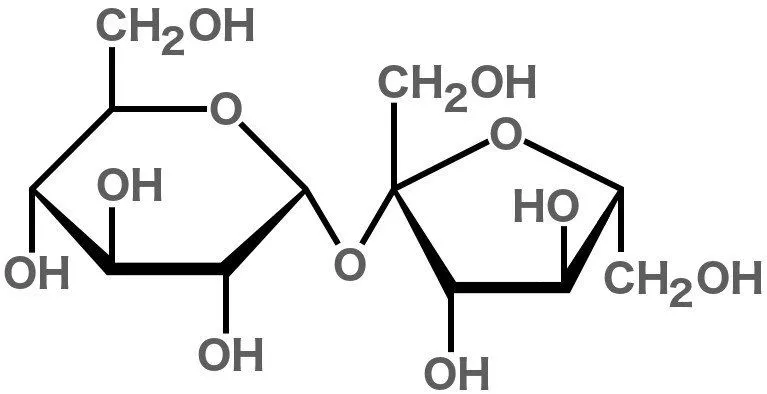
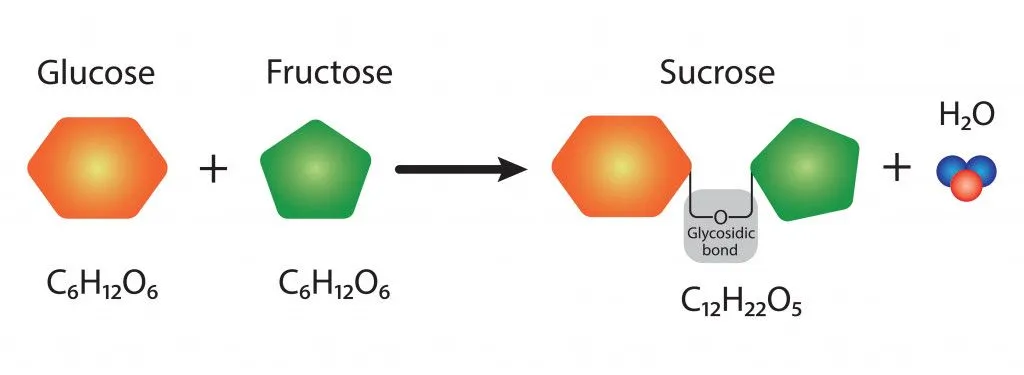
Sucrose is considered a ‘disaccharide’ because it is formed by joining two monosaccharides (simple sugars): glucose and fructose.
The Water Molecule
Water (H2O) is a molecule with which we are all familiar. It consists of two hydrogen atoms covalently bonded to an oxygen atom. Even though water looks like a simple molecule, its physical and chemical properties are extremely complex.
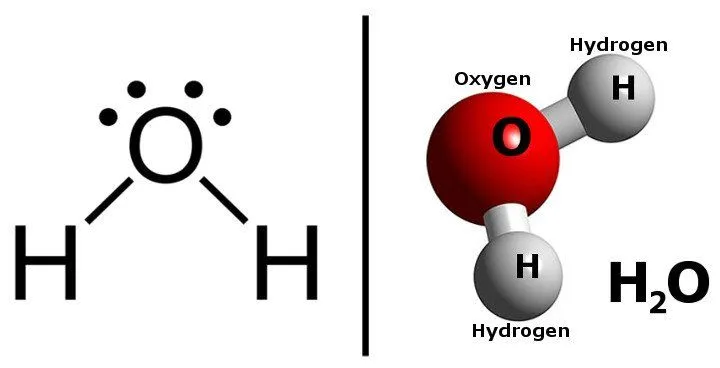
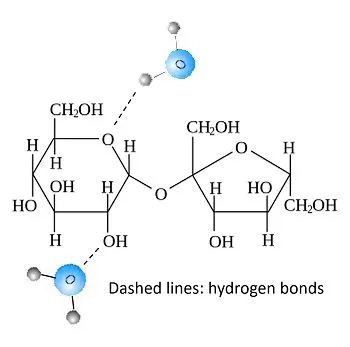
Comparing the two structures, we can see that water and sugar have something in common; both have O-H bonds and both of the molecules are formed by covalent bonding.
These are the main factors resulting in the stickiness of sugar solutions. The covalent O-H bonds participate in something called ‘Hydrogen Bonding’, which provides sugar with all the amazing properties we witness and benefit from.
Covalent Vs Ionic Molecules
Every atom’s ultimate aim is to attain stability, which is obtained by having a completely filled valence shell. To achieve this electron configuration, atoms take different approaches;
- Ionic Bonding: This bond is formed by the transfer of electrons between atoms. It’s like giving your extra pencil to a friend who doesn’t have one. Some atoms donate their extra electrons to other atoms, who accept these to attain stability, thus forming an ionic molecule, e.g., salt; Na+ + Cl− → NaCl
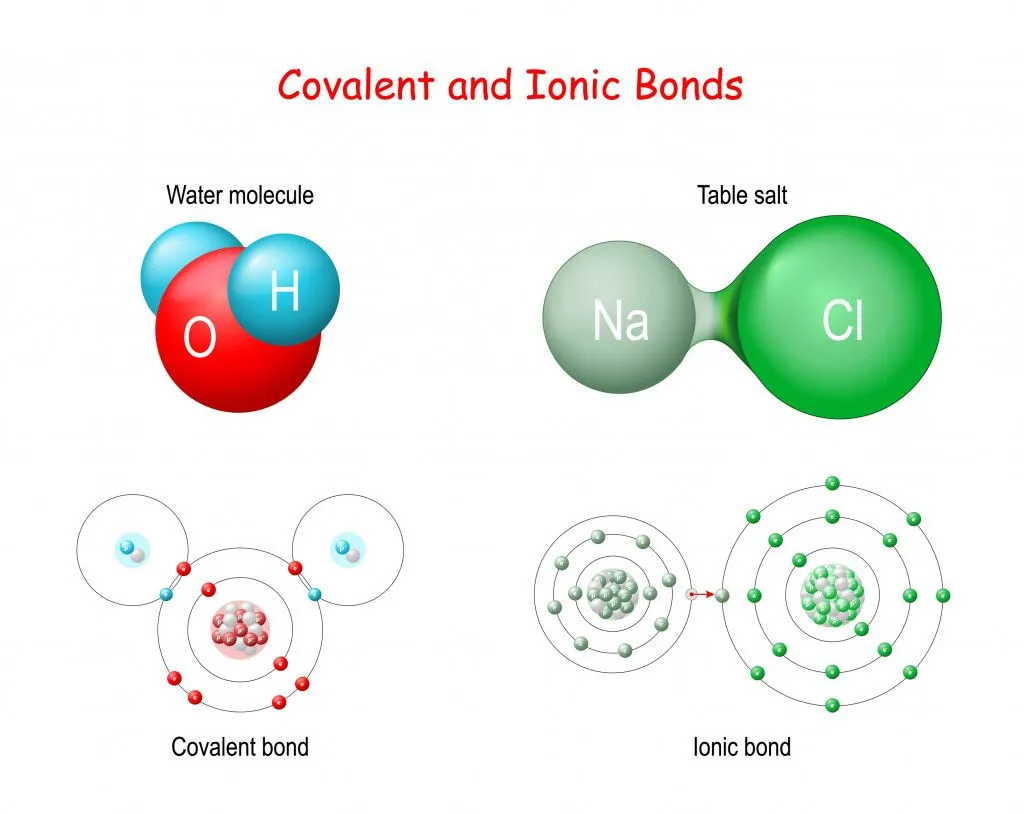
- Covalent Bonding: This bond is formed by the sharing of electrons between atoms. In this case, two bonding atoms share a pair of electrons, and this results in the formation of a covalent molecule, e.g., sugar and water.
Ionic and covalent molecules behave differently in water:
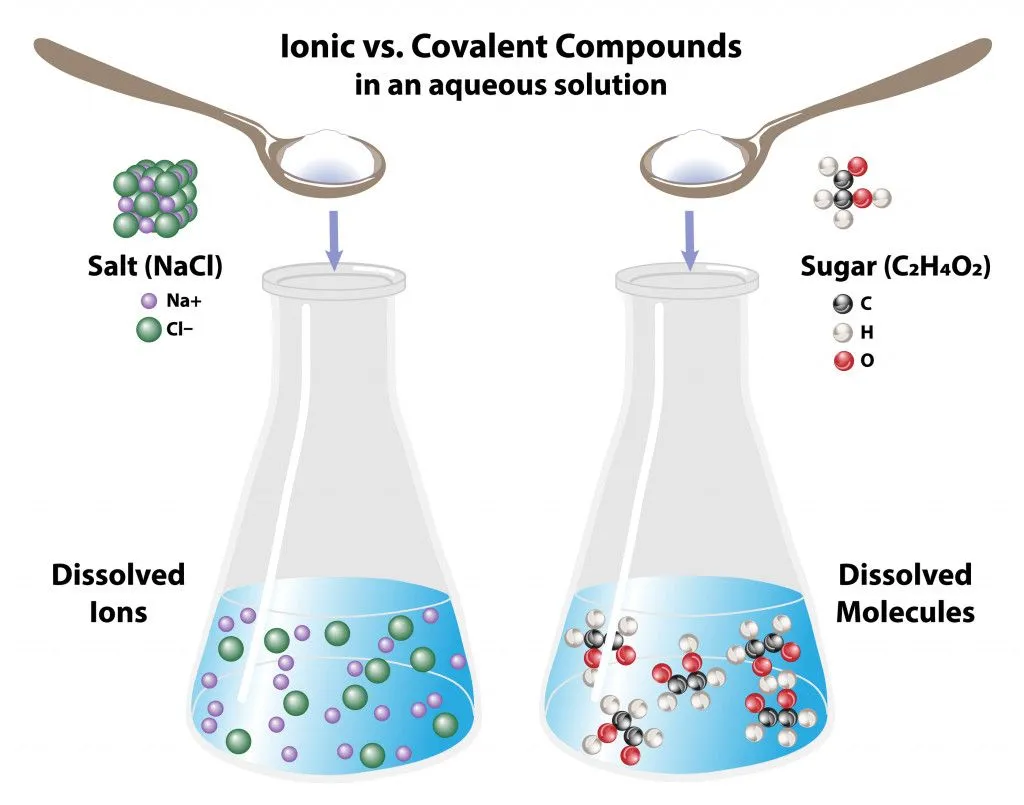
Covalent molecules like sugar remain as molecules when dissolved in water, whereas ionic molecules like salt dissociate into its respective ions.
Is Sugar Ionic Or Covalent?
So, is sugar ionic or covalent? The short answer: sugar is a covalent, or molecular, compound through and through. There isn’t a single ionic bond hiding inside it. Every bond in a sucrose molecule (C12H22O11) is formed by atoms sharing electrons, not handing them over. The carbon backbone is held together by C-C and C-H bonds, the eight hydroxyl groups are C-O and O-H bonds, and the glucose and fructose halves are stitched together by a covalent C-O-C ‘glycosidic’ bridge.
But not all of those covalent bonds share electrons fairly. Oxygen is far greedier for electrons than carbon or hydrogen, so the O-H and C-O bonds end up lopsided, with oxygen carrying a slight negative charge and hydrogen a slight positive one. Chemists call these polar covalent bonds. So when people ask whether sucrose is polar covalent, the answer is yes: the molecule is built from covalent bonds, and many of them are polar. Those partial charges are the whole reason sugar can hydrogen-bond with water and turn sticky.
There’s an easy way to see the difference. Stir table salt into water and the solution conducts electricity, because salt (an ionic compound) splits into free Na+ and Cl− ions that carry charge. Stir sugar into water and almost no current flows, because sucrose dissolves as whole, uncharged molecules. That makes sugar a non-electrolyte, and it is direct proof that its bonds are covalent rather than ionic.
What Is Hydrogen Bonding?
In a covalent bond, the electrons are not shared equally between the atoms. The bonding is similar to a tug of war, where the stronger one wins. Some atoms like oxygen, nitrogen, and fluorine are highly electronegative, which means they have the power to pull the electrons closer to them. As a result, in the bond, one end will be more negative than the other.
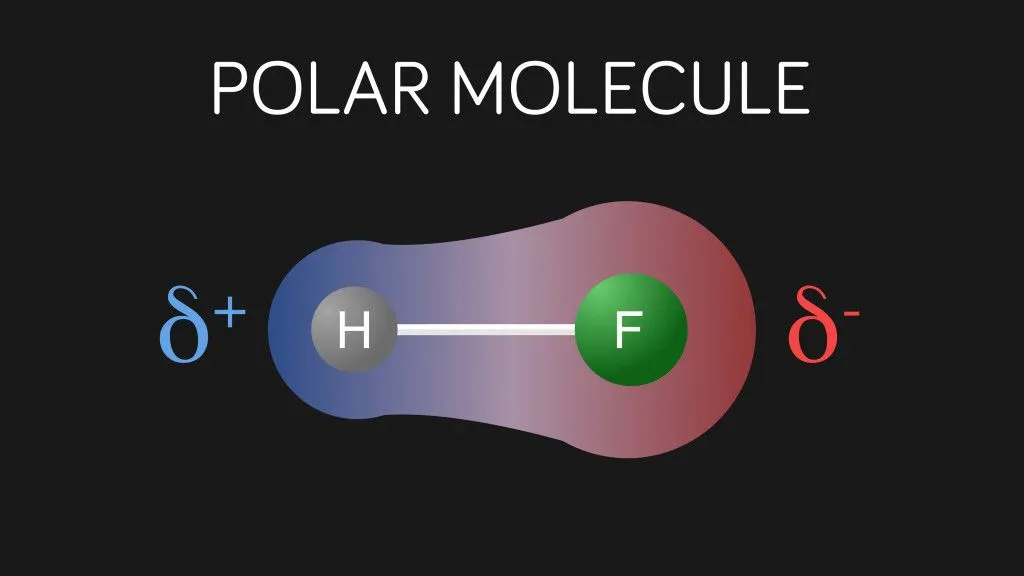
Oxygen has an electronegativity of 3.44, whereas that of hydrogen is 2.20. Hence, oxygen exerts a stronger pull on the electron pair. Thus, in an O-H bond, oxygen has a partial negative charge and hydrogen has a partial positive charge. Partially positive H atoms of one molecule can electrostatically attract the partially negative O atoms of other molecules.
This intermolecular attraction between a hydrogen atom (with a partial positive charge) and another electronegative atom like O, N, or F (bearing a partial negative charge) is called a Hydrogen Bond. As the name suggests, it is not exactly a ‘bond’, but simply a force of attraction between polar molecules. A hydrogen bond is weaker than a covalent bond, but for an intermolecular force, it’s still pretty strong.
But what does this have to do with stickiness?
Stickiness Of Sugary Water
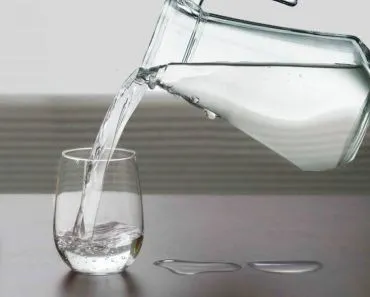
Water and sugar on their own aren’t sticky for two reasons.
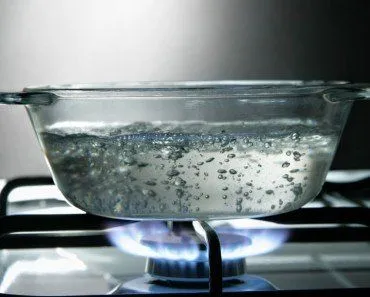
Due to the low number of bonding atoms (2 hydrogen, 1 oxygen) and the small size of water molecules, the hydrogen bonding in liquid water is weak. Although water's overall hydrogen-bond network is unusually strong (which is why water has such a high boiling point), individual hydrogen bonds in liquid water are short-lived, constantly breaking and reforming on the picosecond timescale. As a result, water molecules can slip past each other and the liquid flows easily. This is why water transfers easily to any surface and flows effortlessly.
Compared to water, sucrose is a bulky molecule. It has 8 -OH groups protruding from its carbon chain. This steric hindrance makes it difficult for the sugar molecules to come closer and have a strong hydrogen bond. Moreover, since they’re large, they cannot flow past one another with ease. Thus, they stack up to form a weak crystalline structure. This is why sugar exists as a brittle molecular crystal.
However, when water and sugar are mixed, something interesting happens. In water, the sugar molecules spread out and are free to move. Besides, it’s pretty easy for the tiny H2O molecules to get close to the OH chains of sucrose and link through hydrogen bonding. Thus, sugar and water gradually form an extensive network of hydrogen bonds. The result is a sticky, clumpy mass.
Cohesion And Adhesion
Hydrogen bonding enhances two properties that help in stickiness: cohesion and adhesion.
Cohesion is the tendency of ‘similar’ molecules to stick together. Water-water or sugar-sugar molecules in the solution stick together due to cohesion. Also, if the concentration of sugar is high, the cohesion of sugar molecules escalates due to extensive hydrogen bonding. This linkage may also result in the formation of sucrose chains. This is why sugar syrup is stringy. Cotton candies make use of this ability of sugar to form fine strings.
Adhesion is the tendency of a molecule to stick to a ‘different’ kind of molecule. Bonding between sugar and water represents adhesion. Similarly, sugar can also adhere to other polar molecules. For example, our skin is a polar tissue and sugar is also polar, so they can ‘stick’ together. Adhesion is the reason why sugar solutions stick to our hands and utensils.
The ratio of cohesive and adhesive forces determines the overall ‘stickiness’ of a substance.
Increased cohesion and adhesion imparts some resistance to the flow of a solution. This resistance of a fluid, called viscosity, is responsible for the thick, viscous nature of sugar syrup or honey.
Is Water By Itself Sticky?
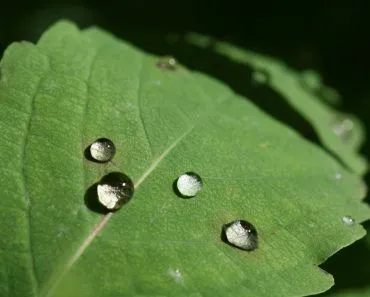
We said earlier that water ‘isn’t sticky’, and next to syrup that’s fair. But water is quietly a little sticky too, just to itself. Every water molecule is constantly hydrogen-bonding to its neighbors, and this self-attraction has a name: cohesion. Cohesion is why water gathers into rounded beads on a freshly waxed car instead of spreading into a flat film, and why raindrops and morning dew pull themselves into little domes.

Cohesion also tugs the surface of water into a taut, elastic ‘skin’, a property we measure as surface tension. Water’s surface tension is about 72 millinewtons per metre (mN/m) at 25 °C (77 °F), among the highest of any everyday liquid; only liquid mercury beats it. That tough surface is strong enough to let a water strider stand on a pond without sinking, and to hold a slightly overfilled glass in a gentle bulge above the rim.
Water is sticky toward other substances as well, an attraction we call adhesion. Adhesion is why water climbs up the inside of a thin glass tube through capillary action, and why your hair clumps together when it is wet. So water really is sticky. It simply clings gently and still flows freely, because each molecule holds only a few hydrogen bonds at a time and those bonds break and reform in trillionths of a second.
Why Is Syrup So Sticky?
Maple syrup, honey, golden syrup and the plain sugar syrup behind soft drinks all share one habit: they cling to everything. The reason is concentration. A syrup is just sugar dissolved in a small amount of water, so it is a far more crowded solution than ordinary sugar water. USDA grading rules, for example, require pure maple syrup to be at least 66% sugar, and honey is more concentrated still, with sugars making up the bulk of its weight.

Pack that many sugar molecules into so little water and their hydroxyl groups end up shoulder to shoulder, knitting into a dense web of hydrogen bonds. That web does two things. First, it makes the liquid thick and slow to pour, a resistance to flow we call viscosity; the tangled bonds will not let the molecules slide past one another quickly. Second, it leaves a huge number of bonding sites free to grab onto whatever the syrup touches, be it a spoon, a countertop or your fingers. High cohesion plus high adhesion is the exact recipe for stickiness.
It also explains a familiar kitchen observation. Warming syrup makes it noticeably runnier, because the extra heat jostles the molecules hard enough to snap some of those hydrogen bonds, loosening the network and lowering the viscosity. Let it cool and the bonds re-knit, and the syrup turns slow and sticky once more.
Conclusion
Now we know why sugar solutions make such a sticky sweet mess. The extensive hydrogen bonding between sugar and water molecules improves the cohesive and adhesive properties of the system, thereby increasing its stickiness. Now you understand the not-so-simple chemistry behind sticky sugary solutions!
References (click to expand)
- Burke, J., & Hartel, R. W. (2021, February). Stickiness of sugar syrups with and without particles. Journal of Food Engineering. Elsevier BV.
- Imberti, S., McLain, S. E., Rhys, N. H., Bruni, F., & Ricci, M. A. (2019, December 18). Role of Water in Sucrose, Lactose, and Sucralose Taste: The Sweeter, The Wetter?. ACS Omega. American Chemical Society (ACS).
- Chemical Bonds. Georgia State University
- Electronegativity – Periodic Table of Elements – PubChem
- 7.3: Hydrogen-Bonding and Water - Chemistry LibreTexts. LibreTexts
- Crystallography. The structure of crystals. The Spanish National Research Council
- 15.7: Electrolytes and Nonelectrolytes. Chemistry LibreTexts
- Hydrogen Bonds Make Water Sticky. Exploring Our Fluid Earth, University of Hawaii
- Adhesion and Cohesion of Water. Water Science School, U.S. Geological Survey
- Maple Syrup Grades and Standards. Agricultural Marketing Service, U.S. Department of Agriculture