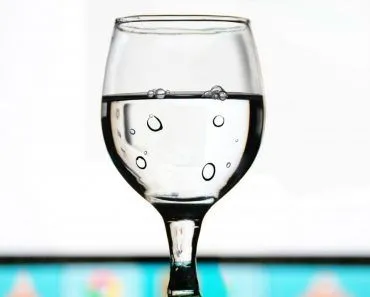
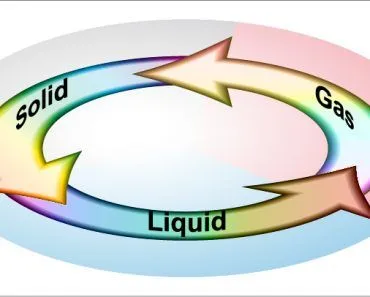
When water is actually boiling at 100°C, the big bubbles rising through it are gaseous water, or steam, formed as water molecules gain enough energy to break free of the hydrogen bonds holding them in the liquid. The smaller bubbles that appear before boiling, on the other hand, are dissolved air (mostly oxygen, nitrogen and a little carbon dioxide) coming out of solution as the water warms, because gases are less soluble in hot water than in cold.
If you’ve ever boiled water, you will have noticed that as water heats up, very tiny bubbles are formed that rise from the bottom to the top. Initially, the bubbles are few and far between, but as the water becomes hotter, more bubbles of larger sizes start to form. Increasing the heat further results in even larger bubbles that form quite frequently and rise immediately to the top. This escalation reaches a peak when water starts to boil.
But why does boiling water make bubbles?
The answer to that has to do with the chemistry of water itself. More specifically, it has to do with all the dissolved substances in water, as well as the nature of bonding between water molecules.
Chemical Properties Of Water Molecules
Each molecule of water is composed of two hydrogen (H) atoms and one oxygen (O) atom. Both the H atoms are covalently bonded to the sole O atom. Every element in nature strives to reach a state of the lowest possible energy. This state is achieved by losing or gaining electrons to reach the nearest noble gas configuration.
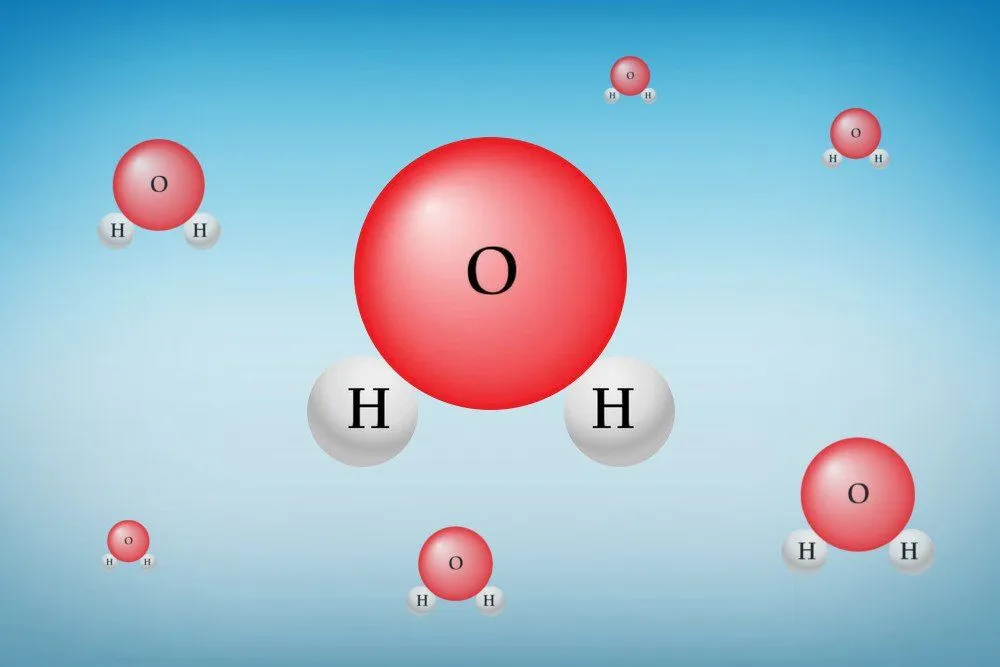
An oxygen atom has six electrons in its valence (outermost) shell. The nearest noble gas, Neon, has eight electrons in its valence shell. Thus, O has a strong tendency to gain two electrons and attain a stable electronic configuration (enter the lowest energy state). A hydrogen has one electron in its valence shell, while the nearest noble gas, Helium, has two electrons on its valence shell. Thus, H tends to gain a share of one electron to attain a stable electronic configuration.
Both the H atoms share an electron each with O, while O shares two electrons, one for each H. This is a covalent bond. Oxygen has a strong tendency to attract shared electrons towards itself, due to a property called electronegativity. Thus, electrons spend more time near the O atom than the H atom, resulting in a partial negative charge on O and a partial positive charge on H.
The geometry of a water molecule is such that the charges don’t cancel out, and there is a separation of charge centers (polarization). When two water molecules with slight polarization approach each other, the partially negative O of one molecule attracts the partially positive H of the other molecule to form a weak intermolecular bond. This is called a Hydrogen Bond, and is the force responsible for holding water molecules together.
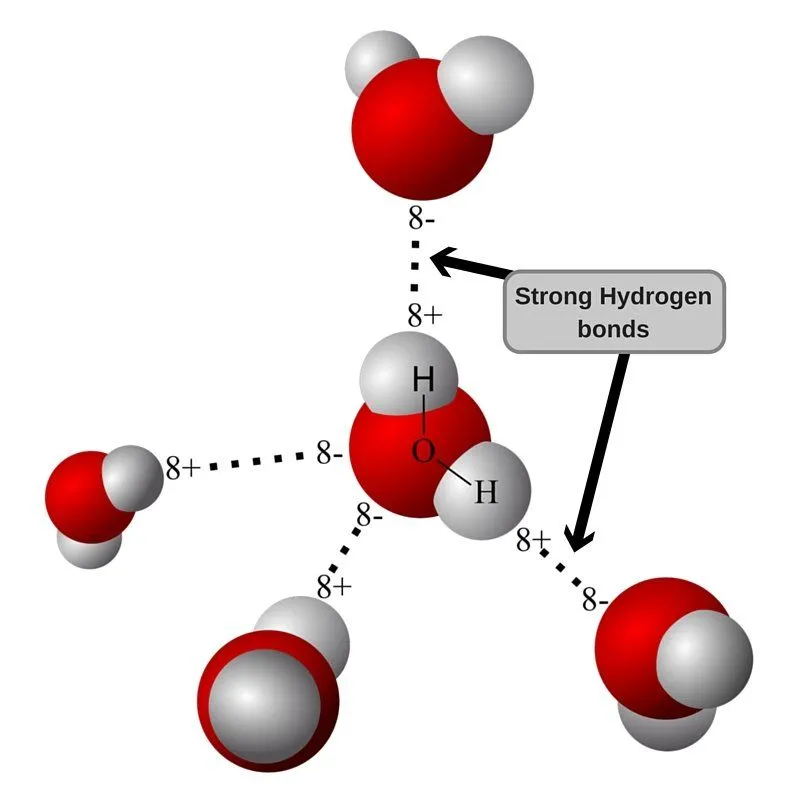
As the hydrogen bond is weak, water remains liquid at room temperature and as the temperature rises, the molecules gain more energy to overcome intermolecular hydrogen bonding. At 100oC, the energy is sufficient for the molecules to break free.
Dissolved Substances In Water
The dissolution of one substance in another is possible only when there is an interaction between the molecules of the two substances. Likewise, some gases, e.g., O2, CO2, N2, NH3, and SO2, get dissolved in water because there exists some attractive interaction between the water molecules and the gas molecules.
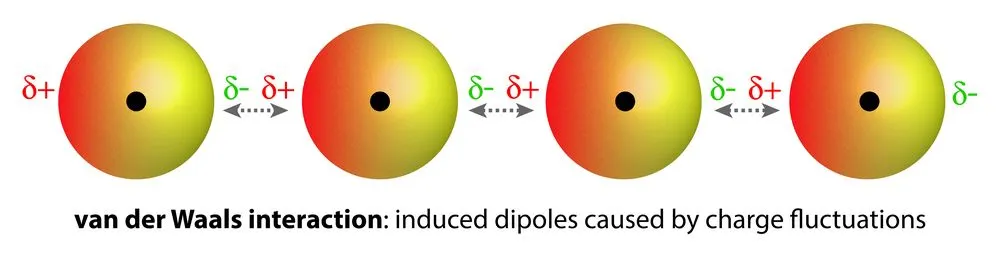
There are two ways that gases can dissolve in water: van der Waals bonding and Hydrogen Bonding.
Heteronuclear molecules (i.e., having atoms from different elements), like NH3 or CO2, have an electronegativity difference between the atoms. N and O are more electronegative than H and C, respectively. Thus, N and O remain partially negative and H and C become partially positive. This leads to the partial polarization of NH3 and CO2 molecules.
The negative ends (N and O) are attracted to the partially positive H of water; meanwhile, the positive ends (H and C) are attracted to the partially negative O of water. This is hydrogen bonding. The greater the polarization of the gaseous molecule, the better it dissolves in water.
Homonuclear molecules (i.e., having atoms of the same element), like O2 and N2, are non-polar and are sparingly soluble (very low solubility) in water. Weak van der Waals forces of attraction hold these gases with water molecules. These are much weaker than dipole-dipole interactions.
The solubility of gases in water decreases as the temperature increases.
The Sequence Of Events When Water Boils
Let’s take liquid water at room temperature (25oC). At this temperature, the solubility of O2 is 8.27 mg/L and that of CO2 is 1.5 g/L. As the temperature increases, molecules of gas and water gain more kinetic energy. This energy makes it easier for all the molecules to overcome the intermolecular attraction. At 50oC, the solubility of O2 decreases to 2.75 mg/L and that of CO2 to 0.75 g/L. This decrease in solubility means that the gaseous molecules can overcome the weak intermolecular attractions. Since gas molecules have densities lower than that of water, they rise to the top as bubbles. Homonuclear molecules like N2 and O2 bubble out at lower temperatures because of the weak van der Waals forces. Increasing the temperature further results in the bubbling out of polar molecules like CO2 and NH3, which are held by dipole-dipole interactions.
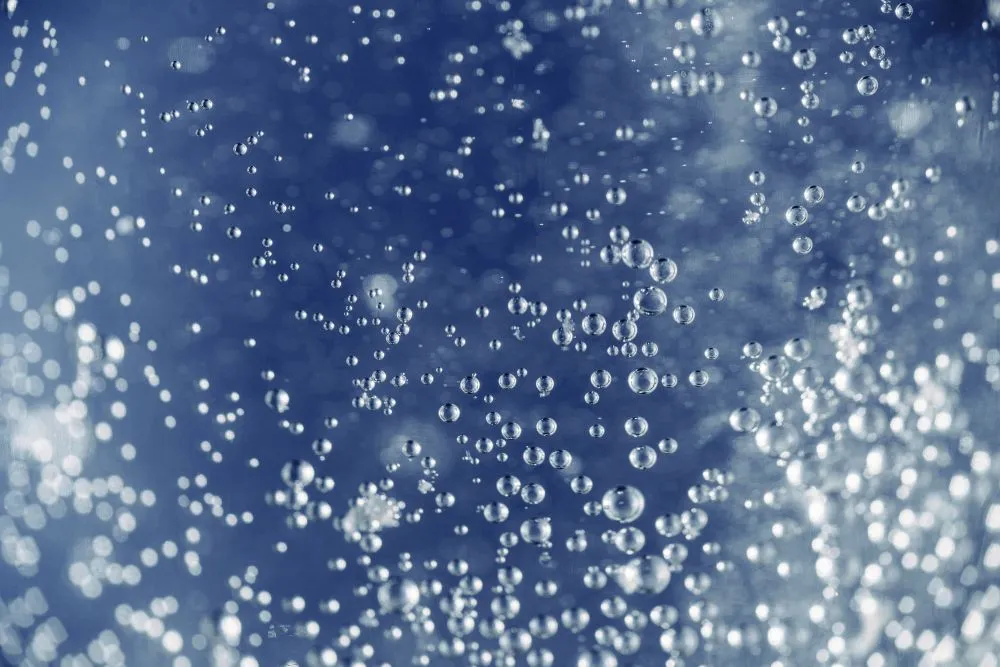
This bubbling continues until the boiling point of water is reached. The heating of water is not completely uniform, meaning that there are regions of higher and lower temperatures. At temperatures above 90oC, some water molecules near the bottom gain enough energy to transition to the vapor phase. Regions of gaseous water are formed, which are indicated by huge bubbles rising up from the bottom. Also, due to the vigorous motion of molecules, convective heating raises the temperature further. At 100oC, almost all the water molecules have sufficient kinetic energy to transition to the vapor phase and bubbles of water vapor will begin to rise up rapidly!
Do The Bubbles Rise Or Sink, And Why Do They Get Bigger?
The bubbles always rise. Whether they are pockets of dissolved air or true water vapor, the gas inside them is far less dense than the surrounding liquid, so buoyancy lifts them straight to the surface rather than letting them sink.

What surprises most people is that the bubbles also swell as they climb. There are two reasons for this. First, a rising bubble has less and less water above it, so the pressure squeezing it drops, and a gas at lower pressure simply takes up more room. Second, and more importantly as the water nears its boiling point, the bubble keeps gaining material on the way up: dissolved gas continues to leave the warming water and join it, and once the liquid is hot enough, water molecules vaporize straight into the bubble. A pocket that started as a pinhead at the bottom can arrive at the top several times larger.
This also explains the racket a kettle makes. Before a full boil, the bottom of the pot is much hotter than the top. Vapor bubbles born at the scorching base rise into cooler water higher up, where the steam inside them condenses back to liquid and the bubble collapses on itself with a sharp snap. Millions of these tiny implosions create the rumble and hiss of a heating kettle. Once the whole pot reaches roughly 100oC and the temperature is even from top to bottom, the bubbles no longer collapse; they survive all the way up and pop gently at the surface, which is why a kettle goes quiet just before it reaches a rolling boil.
Are The Bubbles Oxygen Or Hydrogen? Does Boiling Split Water?
A common belief is that boiling tears water apart into hydrogen and oxygen gas. It does not. Boiling is a physical change: the H2O molecules stay completely intact and merely switch from the liquid state to the gas state. The big bubbles at a rolling boil are gaseous water (steam), and every particle inside them is still a whole water molecule. Cool that steam back down and you get ordinary water again, with nothing lost.
So where does the "oxygen" idea come from? The faint bubbles that appear before boiling really do contain some oxygen, but that oxygen was dissolved air (along with nitrogen and a little carbon dioxide) escaping the warming water, not water being ripped into its elements.

Splitting water into hydrogen and oxygen takes a genuine chemical change and far more energy than a stovetop can supply. Electrolysis does it by forcing an electric current through the water, with a theoretical minimum of about 1.23 volts, and the two gases bubble off separately at different electrodes. The only other route is thermolysis, which needs temperatures well above 2,000oC before even a small fraction of water molecules break apart. A pot at 100oC is nowhere close.
This is also how boiling bubbles differ from the fizz of a chemical reaction. Drop baking soda into vinegar and the bubbles are brand-new carbon dioxide, a different substance created by the reaction. Boiling makes no new substance at all; it only changes water's physical state.
References (click to expand)
- Limnology: 4.1. Dissolved gases – Oxygen, Carbon dioxide .... ecoursesonline.iasri.res.in
- Solubility. Florida State University
- Oxygen Solubility. Colby College
- Electronegativity - UW-Madison Chemistry. The University of Wisconsin–Madison
- Maximum Dissolved Oxygen Concentration Saturation Table. lakestewardsofmaine.org
- Solubility of Gases in Water vs. Temperature. engineeringtoolbox.com
- Boiling. Chemistry LibreTexts
- Why does the kettle get louder then quieter as it reaches boiling point? The Naked Scientists
- Electrolysis of water. Wikipedia
- Water splitting. Wikipedia